National Security and Defense
The ADF needs the ability to collaborate with our neighbors, creating a unified front in modern warfare to safeguard our region from any foreign or domestic threats. Investing in industries and programs should be a priority for protecting our national interests.
This investment will drive growth for all Australians and our neighbors in the Indo-Pacific region.
Understanding the Australian Defence Organisation (ADO)
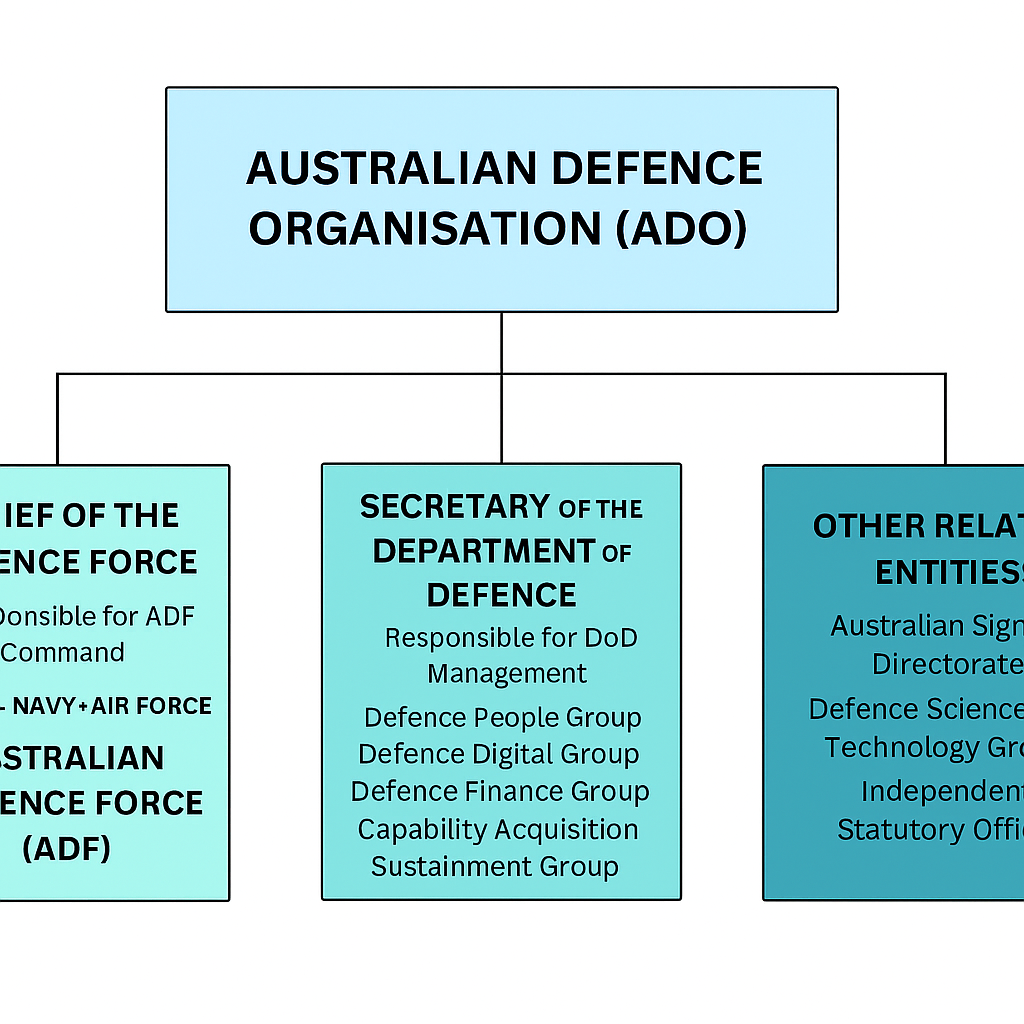
The Australian Defence Organisation (ADO) is a unified, complex structure responsible for defending Australia and its national interests, thereby advancing the nation's security and prosperity. It is built on a strategic "One Defence" framework designed to balance and align strategy, capability, workforce, and resources, enabling rapid adaptation and response to a changing geopolitical landscape.
The ADO integrates civilian oversight with military command through a unique Diarchy Model, ensuring both democratic accountability and operational effectiveness. This structure allows Australia to pivot efficiently between peacetime activities—such as regional cooperation and disaster relief—and wartime contingencies.
The Diarchy Model: Governance and Command
The ADO operates under a dual leadership structure to ensure comprehensive management and accountability:
Leadership RoleFunctionKey Focus AreasSecretary of DefenceCivilian HeadPolicy, funding, governance, resource management, and parliamentary accountability.Chief of the Defence Force (CDF)Military CommanderOperational command of the Australian Defence Force (ADF) and execution of military missions.
This shared leadership ensures strategic policy is integrated with operational command, aligning all efforts under the "One Defence" system.

Department of Defence (DoD)
-
Handles overall management, policy, funding, and governance.
-
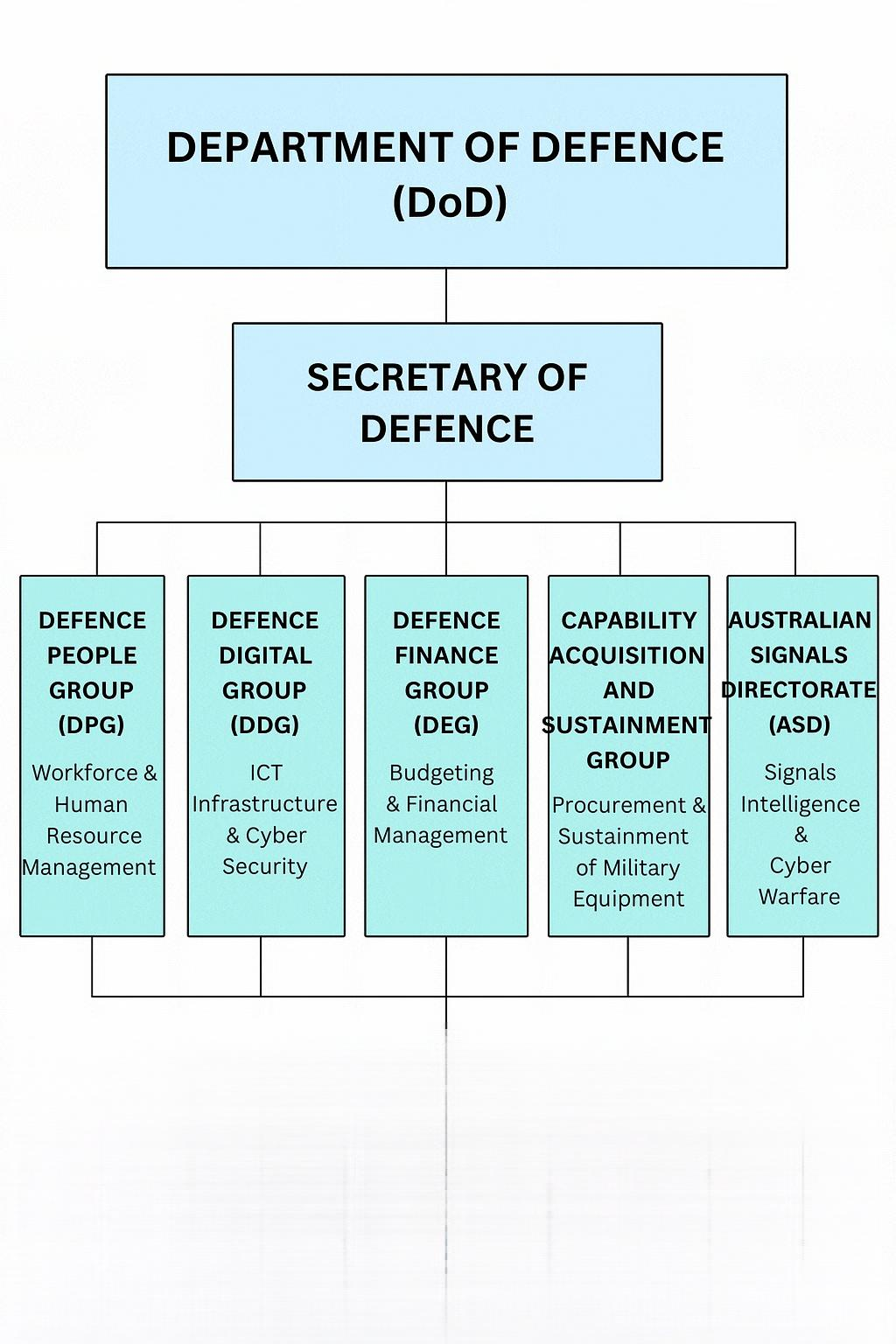
Led by the Secretary of Defence, who oversees civilian groups like Defence People Group, Defence Digital Group, and Defence Finance Group.
-
Ensures accountability to the Commonwealth Parliament and alignment with government policy.
Led by: Secretary of Defence Function: Civilian oversight, policy, governance, and resource management.
Key Groups under DoD:
-
Defence People Group (DPG)
-
Manages recruitment, workforce planning, training, and HR policies.
-
-
Defence Digital Group (DDG)
-
Oversees ICT systems, cybersecurity, and digital transformation across Defence.
-
-
Defence Finance Group (DFG)
-
Controls budgeting, financial reporting, and resource allocation.
-
-
Capability Acquisition and Sustainment Group (CASG)
-
Procures and maintains military platforms and systems (ships, aircraft, vehicles).
-
-
Defence Science and Technology Group (DSTG)
-
Conducts research and innovation to support capability development and strategic advantage.
-
-
Australian Signals Directorate (ASD)
-
Provides signals intelligence, cyber warfare capabilities, and information security
-
The Australian Defence Force (ADF)
The ADF is the operational component of the ADO, commanded by the Chief of the Defence Force (CDF). It comprises the three services plus integrated joint commands, executing missions ranging from combat operations to peacekeeping and humanitarian assistance.
ADF Components
ComponentPrimary RoleRoyal Australian Navy (RAN)Maritime defence, sea control, and naval power projection.Australian ArmyLand warfare, combat operations, and domestic support.Royal Australian Air Force (RAAF)Air superiority, surveillance, transport, and strike capabilities.Joint Operations Command (JOC)Coordinates multi-service operations and deployments.Joint Capabilities Group (JCG)Integrates logistics, health, intelligence, and training across the services.
Independent Statutory Offices
To ensure robust accountability and transparency, several independent bodies operate within or alongside the ADO, reporting directly to Parliament:
- Inspector-General of the ADF: Investigates conduct, discipline, and systemic issues within the military.
- Defence Honours and Awards Appeals Tribunal: Reviews appeals related to military honours and recognition.
- Share
Australian Defense Forces
Analysis: Australian Defence Force
-
-
- Strengths (✅)
- - Unified command structure under the CDF
- - Strong joint operations and interoperability
- - Global reputation for peacekeeping missions
- - Growing sovereign defence industry partnerships
-
- Weaknesses (⚠️)
- - Delays in major capability programs (submarines, frigates)
- - Recruitment and retention challenges in critical roles
- - Aging platforms across Army and Navy
- - Limited offensive cyber capabilities
Opportunities (🌏)
- Deepening regional partnerships (Japan, India, ASEAN)
- Integration of AI, autonomous systems, and space ISR
- Expansion of sovereign manufacturing capabilities
- Climate-driven demand for humanitarian operations
- Establishing a dedicated Cyber Command
Threats (🚨)
- Rising strategic tensions in the Indo-Pacific region
- Vulnerable supply chains for critical components
- Hybrid warfare and grey-zone tactics

International issues
-
- The Australian Signals Directorate (ASD) is dedicated to cybersecurity and intelligence operations.
-
- The Defence Science and Technology Group (DSTG) focuses on advancing research and fostering innovation.
-
- The Capability Acquisition and Sustainment Group (CASG) manages the procurement and upkeep of military equipment.
-
- Independent statutory offices include the Inspector-General of the ADF and the Defence Honours and Awards Appeals Tribunal.
- Creating a Cyber security over all of the indo pacific regions to ensure a safer region
- managing both civilian and government cyber sercurity to ensure a safer region
- Create a dome defence system within Australia and south indo pacific region
- Continue peace keeping exercises with nato and world issues once our capabilities can allow this
Breakdown of Each Group:
Group - Primary Function
Secretary of Defence: Leads the DoD, responsible for civilian oversight, governance, and strategic alignment.
Defence People Group (DPG): Manages workforce strategy, recruitment, training, and HR policies.
Defence Digital Group (DDG): Oversees ICT infrastructure, cybersecurity, and digital transformation.
Defence Finance Group (DFG): Handles budgeting, financial planning, and resource allocation.
Capability Acquisition and Sustainment Group (CASG): Procures and maintains military platforms and systems.
Defence Science and Technology Group (DSTG): Conducts research and innovation to support defence capability.
Australian Signals Directorate (ASD): Provides signals intelligence, cyber warfare capabilities, and information security.
This structure ensures that the civilian backbone of Defence is robust, agile, and aligned with operational needs.
If desired, a detailed chart can illustrate how these groups interact with the Australian Defence Force (ADF) and external stakeholders like industry and Parliament—useful for understanding policy flow and procurement pathways.
Include this on the chart:
The expanded chart includes all key Department of Defence (DoD) groups with their primary functions and shows connections to the Australian Defence Force (ADF), Parliament, and Industry.
What’s New in This Chart:
Functional Roles:
- DPG: Workforce and HR.
- DDG: ICT and cybersecurity.
- DFG: Budgeting and finance.
- CASG: Procurement and sustainment.
- DSTG: Research and innovation.
- ASD: Signals intelligence and cyber warfare.
External Connections:
- To ADF: Support functions like logistics, capability delivery, and digital infrastructure.
- To Parliament: Accountability through reporting, budget approvals, and strategic reviews.
- To Industry: Procurement contracts, R&D collaboration, and sovereign capability development.
This chart provides clarity on the structure and relationships within the Department of Defence.
⚖️ Independent Statutory Offices
These report directly to Parliament or operate independently to ensure accountability:
-
Inspector-General of the ADF
-
Investigates conduct, discipline, and systemic issues within the ADF.
-
-
Defence Honours and Awards Appeals Tribunal
-
Reviews appeals related to military honours and awards.
-
This structure ensures that strategic planning, operational readiness, and accountability are all aligned under the One Defence framework — enabling Defence to anticipate, adapt, and respond effectively.
🔍 What This Flowchart Reveals
-
Top-down strategy: Government sets direction → DoD translates into policy and resource allocation → ADF executes operationally.
-
Horizontal integration: Civilian and military branches coordinate through shared systems like One Defence.
-
Accountability nodes: Independent offices ensure transparency and uphold standards across b
-
both civilian and military domains.
Governance alignment and decision rights
Integrated governance model
-
- **Lead authority:** Department of Home Affairs for domestic resilience; Defence for strategic contingencies.
-
- **Joint board:** Civil–Military Resilience Board (CMRB) chaired by Deputy Secretary (Home Affairs) and VCDF representative.
-
- **Decision rights:**
-
- **Policy:** Joint ownership by DoD/Home Affairs.
-
- **Ops tasking:** CDF (ADF) and NEM/EMA (civilian agencies).
-
- **Budget:** Split pools with joint prioritisation.
-
- **Assurance:** IGADF for conduct/systemic issues, ANAO for value-for-money, Tribunal for honours/recognition.
**Operating constructs:**
- **Mission assignment:** Pre-approved task libraries under DACC-style arrangements (engineering, logistics, ISR support, cyber hardening, medical).
- **Service-level agreements (SLAs):** Time-bound, capability-specific SLAs with surge clauses and readiness protections.
- **Legal frameworks:** Clear thresholds for domestic deployment requiring Governor-General/Cabinet approval with transparency reports.
**Capability pathways and workforce model:**
- **Dual-use capability roadmaps:**
- **Engineering:** Deployable bridging, route clearance, water purification; prepositioned at joint-use nodes (ports/airfields).
- **Logistics:** Strategic lift (air/sea), cold-chain, fuel distribution; interoperable with state emergency services and NGOs.
- **C4ISR:** Shared situational awareness platforms, common geospatial layers, spectrum deconfliction.
- **Cyber:** Joint defensive hunt teams for critical infrastructure exercises, incident surge support with strict scope boundaries.
- **Medical:** Modular Role 1/2 facilities, evacuation support, joint credentialing with state health.
- **Workforce mix:**
- **ADF core:** High-readiness units with capped domestic tasking to protect warfighting cycles.
- **Reserves:** Primary domestic surge force with targeted skills (engineers, medics, cyber).
- **Civilian augmentation:** APS/contractor pools and state volunteers embedded via liaison (CIMIC).

Suggestions for Growth and Upgrades
- **Capability Development**
- Accelerate delivery of Hunter-class frigates and AUKUS submarines
- Invest in long-range strike systems (e.g., HIMARS, Tomahawk)
- Expand space surveillance and satellite resilience
en joint-service leadership development
- **Digital & Cyber Upgrades**
- Create a Cyber Defence Command with offensive capabilities
- Deploy AI in logistics, ISR, and decision-making
- Harden networks against electronic warfare and ransomware
- **Strategic Posture**
- Develop forward operating bases in Northern Australia and the Pacific
- Increase joint exercises with Quad and ASEAN partners
- Enhance maritime domain awareness via drones and satellites
- **Industry & Sovereignty**
- Expand local manufacturing of guided weapons and drones
- Build strategic reserves for fuel, ammunition, and rare earths
- Incentivise dual-use innovation and technologies

Key milestones aligned with budget increases:
2026–2028: Establishment of Cyber Command; launch of satellite tranche-1; acceleration of LAND 400 program.
2028–2030: Integration of Tomahawk missiles and HIMARS; procurement of air-to-air refuelers; advancements in base hardening.
2030–2033: Delivery of frigates; significant expenditures on the submarine program; surge in guided weapons production.
2033–2035: Integration of missile defense systems; maturation of sovereign MRO capabilities; sustainment activities take precedence.
Civilian military projects plan
The Australian Defense Force (ADF) can assist civilian–military projects in Australia by providing specialized capabilities, infrastructure, and organizational expertise that strengthen national resilience, disaster response, and strategic planning.
The Australian Defense Force (ADF) need to make use of shared collaborations between education and home affairs to strengthen is national defense and security.
🔑 Key Areas of ADF Assistance
-
Disaster Relief & Emergency Response Through Defence Assistance to the Civil Community (DACC), the ADF supports civilian agencies during bushfires, floods, cyclones, and pandemics. This includes logistics, engineering, medical support, and manpower.
-
Example: Over 5,000 ADF personnel assisted with flood relief in Queensland and NSW in 2022.
-
-
Civil-Military Cooperation (CIMIC) The ADF has developed CIMIC units to coordinate with civilian organizations in complex emergencies. These units bridge military planning with community needs, ensuring that operations are integrated rather than siloed.
-
The Asia-Pacific Civil-Military Centre of Excellence enhances training and doctrine for such cooperation.
-
-
Infrastructure & Capability Development Defense projects often involve dual-use infrastructure (airfields, ports, communications systems) that can benefit civilian sectors. The ADF’s engineering corps and logistics units can contribute to building resilient national infrastructure.
-
Civil Resilience & National Security The ADF plays a role in enhancing civil resilience by supporting critical supply chains, cyber defense, and communications interoperability. This strengthens Australia’s sovereign capacity to withstand shocks.
-
Specialized Skills & Training Military personnel bring expertise in planning, scenario modelling, and rapid mobilization. These skills can be applied to civilian projects such as pandemic preparedness, energy security, or infrastructure upgrades.
-
Strategic Considerations
-
Balance of Roles: While the ADF’s primary mission is warfighting, its increasing domestic use raises questions about readiness trade-offs.
-
Governance: Civilian–military projects must be carefully structured to avoid over-reliance on Defence at the expense of civilian capacity.
-
Future Planning: Embedding ADF support into national resilience frameworks ensures sustainable cooperation without undermining Defence’s core mission.
-
-
- Rapid Mobilization & Logistics: The ADF efficiently deploys personnel, vehicles, and aircraft to support disaster relief and infrastructure initiatives.
-
- Specialized Skills: Expertise in engineering, medical, cyber, and communications enables high-value assistance to civilian agencies.
-
- National Reach: A network of bases across Australia facilitates support to remote and regional communities.
-
- Trusted Institution: High public confidence in Defense reinforces legitimacy in aiding civil authorities.
Opportunities
-
Dual-Use Infrastructure: Defense investments in ports, airfields, and communications can be designed for shared civilian use.
- developmental plans between the ADF, Police, home affairs and education to embed pathways to protect our borders and country from foreseeable threats.
-
National Resilience Frameworks: Embedding Defense into whole-of-nation resilience planning (e.g., supply chains, cyber security).
-
Training & Knowledge Transfer: Civilian agencies can benefit from Defense’s scenario modelling, planning, and leadership training.
-
Regional Engagement: Civil–military cooperation strengthens Australia’s role in humanitarian assistance across the Indo-Pacific.
Budgets
Budget Allocation by Domain (Example Figures)
Resource allocation reflects a strategic pivot toward joint and advanced capabilities:
- Joint / Strategic Capabilities: AUD 10.9 billion (Command infrastructure, logistics, multi-domain training)
- Army: AUD 8.6 billion (LAND 400, long-range fires, infantry upgrades)
- Sovereign Capability: AUD 8.2 billion (Local manufacturing, guided weapons, export strategy)
- Navy: AUD 7.3 billion (Hunter-class frigates, Collins-class sustainment)
- Air Force: AUD 5.6 billion (F-35A acquisition, MQ-28 Ghost Bat, hypersonics)
- Cyber & Space: AUD 2.9 billion (Satellite constellations, AI integration)
-
Budget Allocation by Domain
-
Joint / Strategic Capabilities
-
AUD 10.9 billion
-
Covers command infrastructure, logistics, fuel reserves, multi-domain training
-
-
Army
-
AUD 8.6 billion
-
Funds LAND 400, long-range fires, infantry upgrades, reserve expansion
-
-
Sovereign Capability
-
AUD 8.2 billion
-
Supports local manufacturing, guided weapons, export strategy
-
-
Navy
-
AUD 7.3 billion
-
Invests in Hunter-class frigates, Collins-class sustainment, forward basing
-
-
Air Force
-
AUD 5.6 billion
-
Covers F-35A acquisition, MQ-28 Ghost Bat, refueling, hypersonic defence
-
-
Cyber & Space
-
AUD 2.9 billion
-
Funds satellite constellations, Cyber Defence Command, AI integration
-
-

10-year defence budget plan (2025–2035) with GDP percentage
Assumptions: GDP grows at 2–2.5% real; inflation 2.5%; baseline Defence spend ~AUD 55B in 2025. Percent-of-GDP targets step from 2.0% to 2.5% by 2035. Figures are indicative and for planning.
Annual totals and GDP share
-
2025: AUD 55B — 2.0% of GDP
-
2026: AUD 58B — 2.05% of GDP
-
2027: AUD 61B — 2.10% of GDP
-
2028: AUD 65B — 2.15% of GDP
-
2029: AUD 69B — 2.20% of GDP
-
2030: AUD 74B — 2.25% of GDP
-
2031: AUD 79B — 2.30% of GDP
-
2032: AUD 84B — 2.35% of GDP
-
2033: AUD 90B — 2.40% of GDP
-
2034: AUD 96B — 2.45% of GDP
-
2035: AUD 103B — 2.50% of GDP
Domain allocations per year
-
Land (22%)
-
AUD 12.1B in 2025 → AUD 22.7B in 2035
-
-
Maritime (26%)
-
AUD 14.3B in 2025 → AUD 26.8B in 2035
-
-
Air (18%)
-
AUD 9.9B in 2025 → AUD 18.5B in 2035
-
-
Space & cyber (9%)
-
AUD 5.0B in 2025 → AUD 9.3B in 2035
-
-
Joint & strategic (15%)
-
AUD 8.3B in 2025 → AUD 15.5B in 2035
-
-
Industry & sovereign capability (10%)
-
AUD 5.5B in 2025 → AUD 10.3B in 2035
-
Rationale: Maritime share rises to absorb submarine and frigate programs; Land and Air remain stable; Space & cyber scales with satellite, cyber command, and AI; Industry allocation supports domestic production and supply chain resilience.
Phasing by spend category
-
R&D (10–12%): Front-loaded 2025–2029 for hypersonics, autonomy, space ISR.
-
Acquisition (45–50%): Peaks 2028–2033 with ships, subs, long-range fires, aircraft.
-
Sustainment (30–32%): Grows steadily with fleet expansion; buffers OPEX risk.
-
Infrastructure (8–10%): Northern base upgrades, fuel reserves, dry docks, cyber facilities.
Key milestones tied to budget lifts
-
2026–2028: Cyber Command stood up; satellite tranche-1 launched; LAND 400 ramp.
-
2028–2030: Tomahawk/HIMARS integration; air-to-air refuelers; base hardening.
-
2030–2033: Frigate deliveries; submarine program heavy spend; guided weapons production surge.
-
2033–2035: Missile shield integration; sovereign MRO matured; sustainment dominates.
ADF Share department parntership to strength its national interests
Policy reforms to enable the roadmap across ABF, Home Affairs, Defense, and partners
Australia has the governance scaffolding to start—Home Affairs’ corporate plan and ABF’s Strategy & Border Modernization provide the program streams and outcome focus. To fully deliver autonomous surveillance, integrated border platforms, quantum‑safe infrastructure, resilience, and education pipelines, the policies below need reform, change, or implementation.
Border, immigration, and customs
-
Legal authority for autonomous surveillance and ISR data sharing:
-
Update border surveillance and privacy statutes to explicitly permit unmanned vessels/UAS, persistent sensing, and interagency data fusion with Defense and ACSC under audited safeguards.
-
Embed proportionality, audit trails, and ethics requirements in regulations to maintain public trust.
-
-
Integrated border platforms and data fabric policy:
-
Establish a whole‑of‑government border data standard linking customs, immigration, cargo, and intelligence; mandate real‑time risk scoring and API interoperability across agencies.
-
Align with the Border Controls Whole‑of‑Government Policy Framework to operationalize integrated controls and joint outcomes.
-
-
Trusted trade and travelled modernization refresh:
-
Expand Smart Gate, Trusted Trader analytics, and cargo pre‑clearance authorities; codify risk‑based processing thresholds to lift throughput and deter unlawful activity.
-
Use ABF’s modernization streams (traveler and trade frameworks) as the delivery vehicle.
-
-
Migration system performance settings:
-
Legislate service levels, digital triage rules, and integrity safeguards for visa decisioning; publish outcome metrics in PBS for transparency.
-
Enable targeted, multi‑year appropriations to sustain backlog reduction and integrity uplift, building on recent Home Affairs/ABF investment commitments.
-
Cyber, data, and quantum security
-
Quantum‑safe migration mandate for critical systems:
-
Set timelines and standards for post‑quantum cryptography across border, immigration, and port systems; require independent validation and incident reporting.
-
-
Sovereign cloud and data residency policy:
-
Mandate sovereign hosting for core border/cargo/identity services; define cross‑agency data sharing rules with zero‑trust architectures and audit logging.
-
-
National cyber education pipeline accreditation:
-
Create accredited pathways (certificate to postgraduate) with placement quotas for government and critical infrastructure operators, tie grants to completion and employment outcomes. Collaboration through governmental departments.
-
Transport, infrastructure, and climate resilience
-
All‑hazards resilience code for ports and logistics:
-
Update transport security legislation to require redundancy in fuel, power, and data; mandate biometric cargo screening and tamper‑evident supply chains.
-
-
Resilience financing instruments:
-
Authorize resilience bonds and sovereign infrastructure financing for climate‑proofing of ports, flood mitigation, and emergency shelters; require public reporting on resilience ROI.
-
-
Predictive emergency operations policy:
-
Standardize hazard modelling and interagency activation protocols (NEMA, ABF, Defense) with data sharing requirements and rehearsal cycles.
-
Governance, coordination, and funding
-
National Resilience Implementation Office (statutory basis):
-
Establish within PM&C with powers to set milestones, enforce interagency gates, and publish open dashboards on outcomes and spend.
-
-
Strategic Investment Board (cross‑portfolio):
-
Formalize a board spanning Defense, Home Affairs/ABF, ACSC, NEMA, Finance, Education, Infrastructure to approve tranche funding and risk‑weighted portfolio shifts.
-
-
Outcome‑linked appropriations and transparency:
-
Tie multi‑year capital envelopes to measurable PBS outcomes (throughput, deterrence, resilience, integrity); publish benefit realisation plans and post‑project reviews.
-
Leverage Home Affairs’ corporate plan transformation and ABF program streams to align delivery with outcomes.
-
Education, cohesion, and ethics
-
Cybersecurity Academy legislation and funding model:
-
Create a national program with Commonwealth‑university‑industry co‑funding; set annual graduate targets and government placement ratios.
-
-
Emergency leadership accreditation standard:
-
Define national competencies for cross‑jurisdiction incident leadership; link accreditation to NEMA and Defense support operations.
-
-
Multicultural resilience curriculum framework:
-
Develop nationally consistent civic identity and cohesion modules, fund community partnerships and measure impact on inclusion and resilience.
-
-
Mandatory AI governance and ethics CPD:
-
Require continuing professional development for public servants in AI risk, procurement integrity, and data protection; embed into APS career frameworks.
-
Direct actions to operationalize reforms
-
Pass enabling legislation and standards: Autonomous surveillance authority; border data standards; quantum‑safe deadlines; all‑hazards port security; resilience financing instruments.
-
Stand up cross‑agency governance: PM&C implementation office; Strategic Investment Board; public scorecards.
-
Lock multi‑year funding: Tranche capital for fleet/ISR, integrated platforms, quantum‑safe migration, resilience infrastructure, and education pipelines; protect delivery capacity through PBS outcomes and performance gates.
-
Execute via existing streams: Use ABF Strategy & Border Modernization and Home Affairs transformation actions as the delivery spine for platform integration, trade/traveler modernization, and integrity uplift.
These reforms build on existing plans and frameworks within Home Affairs and ABF, which already emphasize whole‑of‑government border integration, outcome‑based delivery, and modernization—your policy work should focus on the enabling authorities, standards, and financing to scale them nationally
Current Collaboration Highlights
🛡️ Defence + Home Affairs
-
Cyber Security Strategy 2023–2030: Led by Home Affairs, with Defense and ASD contributing to national cyber posture, threat response, and resilience uplift.
-
Sovereign Cyber Plan: A proposed initiative to transition ADF members and families into the cybersecurity workforce — directly linking Defense and Home Affairs with education and employment pathways.
-
Joint deterrence and ISR coordination: Defense and ABF collaborate on maritime domain awareness and border operations under Operation Sovereign Borders and broader strategic planning.
🧠 Education + Home Affairs
-
Cyber education pipeline (in development): Home Affairs is consulting on national cyber education frameworks, with input from universities and training providers.
-
Emergency management and resilience training: Education departments and NEMA are involved in scenario-based leadership development, though not yet formalized as a national curriculum.
🧩 Whole-of-Government Cyber Partnerships
-
Australian Signals Directorate’s Cyber Security Partnership Program: Includes Defense, Home Affairs, and Education stakeholders to lift national cyber capability through shared training, threat intelligence, and outreach.
🚧 Gaps in Current Collaboration
While foundational partnerships exist, the following areas still need structured joint implementation:
-
Autonomous surveillance and fleet renewal: No formal Defense–ABF–Education program yet for unmanned systems, ISR integration, or ethics training.
-
Quantum-safe infrastructure and sovereign cloud: Collaboration is underway in policy, but not yet in delivery or education pipelines.
-
Multicultural resilience curriculum: Education and Home Affairs have not yet launched a national framework or embedded civic cohesion modules.
-
AI governance and ethics training: No mandatory cross-agency CPD program exists yet for public servants or Defense personnel.
🛠 What’s Needed to Scale Collaboration
-
Formalize the Sovereign Cyber Plan: Transition ADF personnel into cyber roles via accredited education pathways and Home Affairs placements.
-
Create a Strategic Investment Board: Include Defense, Home Affairs, Education, Finance, and PM&C to align funding, milestones, and workforce pipelines.
-
Launch national education programs: Cyber Academy, Emergency Leadership, Multicultural Curriculum, and AI Ethics — co-funded and co-delivered.
-
Embed joint scenario planning: Defense, NEMA, Police, and Education should co-design resilience exercises and leadership labs.
The ADF needs the ability to collaborate with our neighbors, creating a unified front in modern warfare to safeguard our region from any foreign or domestic threats. Investing in industries and programs should be a priority for protecting our national interests.
This investment will drive growth for all Australians and our neighbors in the Indo-Pacific region.
Oliver Hartman