Beyond the ordinary
-
The Department of Home Affairs is a vital Australian government agency responsible for domestic security, emergency management, immigration, border control, and related tasks. It operates through several divisions and agencies, each focusing on specific areas:
- National Emergency Management Agency (NEMA)
- Cyber Security Division
- Immigration and Citizenship Division
- Countering Foreign Interference and Security Division
- Multicultural Affairs Division
- Transport Security Division
- Corporate and Governance Services
In essence, Home Affairs acts as the nerve centre of Australia’s domestic security and resilience, bridging operational agencies with strategic policy oversight.This structure supports the Department’s broad mandate to ensure Australia’s domestic security and resilience through coordinated efforts across these divisions and agencies.
Home Affairs services
Mapping the Strengths of home affairs and the departments it covers shows strength in the following key areas
-
Integrated border security role: Combines customs, immigration enforcement, and maritime patrol under one agency.
-
National mandate: Operates across air, sea, and land borders with legislative authority.
-
Experienced workforce: Skilled officers in intelligence, enforcement, and maritime operations.
-
Regional partnerships: Strong ties with Indonesia, Pacific nations, and Five Eyes partners for intelligence sharing.
The home Affairs departments also has a number of problematic operational failure and issues that need to be addressed being;
-
Aging fleet and equipment failures: Patrol vessels and aircraft frequently break down, reducing operational capacity.
-
Staff shortages: Crew gaps limit patrols and weaken rapid response capability.
-
Corruption risks: Insider cases of drug smuggling and bribery undermine integrity.
-
Reputation damage: Public trust eroded by scandals and operational failures.
-
Oversight challenges: Large workforce dispersed across jurisdictions makes monitoring difficult.

Australian Border Force (ABF)
Operational arm responsible for border protection, customs, immigration enforcement, and trade facilitation led by a Commissioner who reports independently.
-
Aging fleet and equipment failures: ABF patrol vessels and aircraft are breaking down frequently, leading to a double‑digit drop in patrols over recent years.
-
Crew shortages: Staffing gaps reduce patrol capacity and response times, particularly in northern waters.
-
Sub‑standard equipment: Investigations revealed that some ABF gear is outdated or even dangerous, severely impacting operations.
-
Geographic scale
The diverse scale of the country creates its own geographical and climatic problems due to scale and diverse climates
The way forward
The ABF Require Fleet renewal, workforce reform, integrity systems, tech upgrades, transparency

. National Emergency Management Agency (NEMA)
Coordinates disaster preparedness, response, and recovery. It ensures national resilience against bushfires, floods, pandemics, and other emergencies. Executive agency focused on national emergency management, disaster response, and resilience led by a Coordinator-General.
-
Climate change impacts: Increasing frequency and severity of bushfires, floods, cyclones stretching resources.
-
Coordination complexity: Multiple agencies and jurisdictions make interoperability difficult.
-
Decision-making stress: Emergency leaders face fatigue, ethical dilemmas, and high-pressure environments.
-
Funding gaps: Long-term resilience projects often underfunded compared to immediate disaster response
The way forward
Resilience funding, interoperability, community preparedness

Cyber Security Division
Protects Australia’s digital infrastructure, critical systems, and citizens from cyber threats. It also works closely with industry to strengthen national cyber resilience
-
Develops and coordinates national cybersecurity policy and incident response.
-
Works closely with other agencies to protect critical infrastructure
-
Manages visa processing, citizenship applications, and immigration policy.
-
Escalating cyber threats: State-sponsored actors and ransomware groups targeting critical infrastructure.
-
Skills shortage: Lack of trained cybersecurity professionals hampers resilience.
-
Rapid tech evolution: Emerging technologies (AI, IoT, quantum) outpace regulatory frameworks.
-
Vendor risks: Need for stricter vetting of government tech suppliers and software bans (e.g., TikTok, Kaspersky)
The way forward
Skills pipeline, critical infrastructure protection, emerging tech readiness
. Immigration and Citizenship Division
Focuses on countering espionage, foreign interference, and protecting national security. Manages visas, migration pathways, and citizenship processes, balancing national security with humanitarian and economic priorities
-
Policy volatility: Frequent legislative changes create uncertainty for migrants and administrators.
-
Human rights concerns: New migration bills criticised for undermining refugee protections.
-
Border control pressures: Boat arrivals spark political controversy and strain detection systems.
-
Processing delays: Visa backlogs and citizenship application bottlenecks persist.
The way forward
Digital transformation, policy stability, human rights safeguards and educational programs that assist migration pathways that should be a focus, demographically strategic targeting the right people for Australian cultural assimilation


Multicultural Affairs Division
Promotes social cohesion and multicultural policies. Promotes social cohesion and inclusion, ensuring diverse communities are engaged and supported within Australia’s national framework.
-
Social cohesion risks: Rising xenophobia and political exploitation of cultural divides.
-
Integration challenges: Ensuring diverse communities feel included while avoiding segregation.
-
Public debate volatility: Multiculturalism often politicised, undermining long-term policy stability.
-
Youth radicalisation concerns: Isolated incidents in schools spark fears of cultural breakdow
The way forward
-
Youth Engagement Initiatives: Targeted programs to prevent isolation and radicalisation.
-
Cohesion Campaigns: Promote shared national identity alongside cultural diversity.
-
Policy Insulation: Establish bipartisan frameworks to shield multicultural policy from short‑term politics.
-
Community Partnerships: Expand collaboration with local councils and NGO
Countering Foreign Interference and Security Division
Focuses on safeguarding Australia’s sovereignty by detecting and preventing covert influence, espionage, and hostile state activities.Focuses on countering espionage, foreign interference, and protecting national security.
-
Extreme threat levels: Espionage and interference at “unprecedented” intensity.
-
Community intimidation: Foreign actors harass diaspora groups and dissidents.
-
Disinformation campaigns: Attempts to sow division and undermine trust in institutions.
-
Critical infrastructure vulnerability: Energy, ports, and communications increasingly targeted
The way forward
Transport Security Division
-
Oversees aviation, maritime, and other transport-related security measures to protect supply chains and critical movement systems.Evolving threat landscape:
-
Terrorism persists, but cyber and “operational interference” risks are growing.
-
Legislative lag: Frameworks built in early 2000s struggle to address modern hazards.
-
Economic vulnerability: Disruption to aviation and maritime systems directly impacts trade and national prosperity.
-
All-hazards approach: Need to broaden beyond terrorism to include sabotage, cyberattacks, and supply chain risks.
The way forward
-
Legislative Modernisation: Update laws to cover cyber threats and supply chain risks.
-
All‑Hazards Framework: Broaden focus beyond terrorism to include sabotage, cyberattacks, and natural disruptions.
-
Industry Partnerships: Co‑develop resilience plans with airlines, ports, and logistics firms.
-
Technology Deployment: Introduce biometric screening and AI‑enabled cargo monitoring.
Corporate and Governance Services
-
Provides internal corporate services including finance, HR, legal, and governance support.
Corporate and Governance Services
Provides internal support—finance, HR, compliance, and governance—ensuring the Department runs efficiently and transparently.
-
Contract integrity issues: Past scandals over procurement and corruption risks (e.g., Nauru contracts).Governance complexity:
-
Balancing transparency, accountability, and efficiency in a sprawling department.
-
AI and automation risks: New governance frameworks for automation/AI must avoid bias and ensure compliance.
-
Resource allocation: Ensuring corporate services keep pace with frontline divisions’ expanding mandates
The way forward
-
Procurement Integrity Reforms: Independent audits and transparent tendering processes.
-
AI Governance Frameworks: Ethical oversight for automation in decision‑making.
-
Resource Alignment: Scale corporate services to match frontline divisions’ expanding mandates.
-
Transparency Measures: Publish governance scorecards and compliance reports.
Overview for the Home Affairs department
Development Opportunities for a brighter future
-
Fleet renewal programs: Investment in new patrol vessels, aircraft, and surveillance technology.
-
Digital transformation: AI, drones, and satellite monitoring to enhance border surveillance.
-
Regional cooperation: Joint patrols and intelligence sharing with ASEAN and Pacific partners.
-
Public trust rebuilding: Transparency reforms and integrity measures to restore confidence.
-
Expanded mandate: Potential to integrate cyber‑border security as digital trade grows.
⚫ Threats that needs to be address
-
People smuggling networks: Persistent threat from Indonesia and Southeast Asia.
-
Illegal fishing surge: At an 18‑year high, straining already limited patrol resources.
-
Drug trafficking: Organized crime exploiting ABF weaknesses and corrupt insiders.
-
Foreign interference: Border vulnerabilities exploited by hostile state actors.
-
Economic disruption: Failures in border control risk trade and supply chain stability.
✅ Summary: The ABF’s strengths lie in its integrated mandate and partnerships, but weaknesses in fleet readiness, staffing, and integrity expose Australia to serious risks. Opportunities exist in technology upgrades and regional cooperation, while threats from smuggling, corruption, and foreign interference remain acute.
These measures move beyond quick fixes to embed resilience and trust into Australia’s domestic security posture.
Long‑Term Corrective Measures (5–10 Years)
🇦🇺 Australian Border Force (ABF)
-
Autonomous Border Surveillance: Deploy unmanned patrol vessels, AI‑driven drones, and satellite constellations for 24/7 monitoring.
-
Integrated Border Systems: Seamless digital platforms linking customs, immigration, and intelligence in real time.
-
Global Partnerships: Deepen intelligence and operational cooperation with ASEAN, Pacific, and Five Eyes allies.
-
Cultural Reform: Embed integrity and transparency into ABF’s identity to permanently reduce corruption risks.
-
Resilient Workforce: Long‑term career pathways and automation support to reduce human fatigue in high‑risk roles.
🌪 National Emergency Management Agency (NEMA)
-
Climate‑Resilient Infrastructure: Nationwide investment in flood‑proof cities, fire‑resistant housing, and adaptive transport systems.
-
Predictive Modelling: AI‑enabled forecasting for disasters decades ahead.
-
National Resilience Grid: Integrated system linking energy, water, and communications for rapid recovery.
-
Permanent Civil Defence Corps: Professionalised volunteer force ready for large‑scale emergencies.
💻 Cyber Security Division
-
Quantum‑Safe Nation: Full adoption of quantum‑resistant encryption across government and industry.
-
AI‑Driven Defence: Autonomous cyber systems capable of detecting and neutralising threats in real time.
-
Global Cyber Alliances: Leadership role in international cyber treaties and cooperative defence.
-
Digital Sovereignty: Secure Australian‑owned cloud and data infrastructure.
🛂 Immigration & Citizenship Division
-
Smart Borders: Biometric, AI‑enabled entry systems reducing human error.
-
Global Talent Integration: Long‑term migration pathways aligned with Australia’s innovation economy.
-
Humanitarian Leadership: Expanded refugee resettlement programs with global recognition.
-
Digital Citizenship: Secure, blockchain‑based identity systems for all Australians.
🕵️ Countering Foreign Interference Division
-
National Resilience Culture: Embed awareness of foreign interference into education and civic life.
-
Advanced Counter‑Espionage: AI‑driven detection of covert influence networks.
-
Diaspora Empowerment: Long‑term programs ensuring diaspora communities are resilient against intimidation.
-
Global Security Leadership: Position Australia as a hub for counter‑interference expertise.
🌏 Multicultural Affairs Division
-
Generational Cohesion Strategy: Long‑term programs ensuring second and third‑generation migrants remain engaged.
-
National Identity Framework: Balance diversity with a shared civic identity.
-
Global Cultural Leadership: Position Australia as a model for multicultural resilience.
-
Digital Engagement: Use technology to connect communities and prevent isolation.
✈️ Transport Security Division
-
Autonomous Security Systems: AI‑enabled cargo scanning, biometric travel, and predictive risk modelling.
-
Resilient Supply Chains: Hardened logistics networks against sabotage, cyberattacks, and climate disruption.
-
Global Standards Leadership: Shape international aviation and maritime security frameworks.
-
Integrated Transport Defence: Link transport security with cyber and emergency management systems.
📊 Corporate & Governance Services
-
AI‑Enabled Governance: Fully automated compliance, procurement, and reporting systems.
-
Transparency by Design: Open data platforms for public oversight of Home Affairs operations.
-
Future Workforce Strategy: Long‑term planning for automation, AI, and human‑machine collaboration.
-
Global Benchmarking: Position Home Affairs as a model of governance integrity worldwide.
✅ Summary: The long‑term roadmap envisions autonomous systems, quantum‑safe infrastructure, climate‑resilient cities, and global leadership roles. It shifts Australia from reactive security to proactive resilience, embedding integrity, technology, and sovereignty into every division.
Current Programs Underway
🇦🇺 Australian Border Force (ABF)
-
Operation Sovereign Borders: Multi-agency effort to combat maritime people smuggling
-
SmartGate System: Automated border clearance for eligible travellers
-
Trusted Trader Program: Streamlines trade for accredited businesses
-
Border Force Officer Recruit Training Program: 12-month instructional and operational training for new officers
-
Strategy & Border Modernisation: Includes Customs & Trade Frameworks, Traveller Modernisation, and Strategic Partnerships
🏛️ Department of Home Affairs
-
Digital Trade Accelerator Program (DTAP): Enhances cross-border trade and biosecurity risk assessments
-
Biometrics Strategy 2020–2024: Modernising identity verification across border and immigration systems
-
Technology Strategy 2020: Focused on digital transformation and automation
-
Migration System Reform: $18.3M allocated to improve credibility and economic alignment
-
Inclusion, Diversity & Equity Strategy 2024–2029: Promotes inclusive workforce and policy development
🎓 Educational & Workforce Programs
-
Graduate Development Program: Rotational placements across Home Affairs and ABF for university graduates
-
Recruit Training (BFORT): Six capability blocks over 12 months for ABF officers
-
Indigenous Employment Pathways: Targeted recruitment and support for First Nations candidates
-
Marine Crew Training: Specialised operational training for maritime enforcement roles
🔧 Programs Required (Identified Gaps)
🚨 Operational & Strategic Needs
-
Autonomous Surveillance Systems: AI-driven drones, unmanned vessels, and predictive analytics for border monitoring
-
Climate Resilience Infrastructure: Emergency shelters, fireproof housing, and flood mitigation tied to NEMA’s mandate
-
Cyber Defence Expansion: Quantum-safe encryption, AI threat detection, and critical infrastructure mandates
-
Smart Borders Integration: Unified digital platforms linking customs, immigration, and intelligence
🎓 Educational & Training Needs
-
Cybersecurity Academy: National training pipeline for cyber professionals, with industry certification and government placements
-
Emergency Management Leadership Program: Scenario-based training for disaster response leaders across jurisdictions
-
Foreign Interference Countermeasures Course: Intelligence, law, and community engagement modules for frontline officers
-
Multicultural Resilience Curriculum: Youth-focused education on civic identity, inclusion, and counter-radicalisation
-
Transport Security Innovation Lab: R&D and training hub for autonomous cargo scanning, biometric systems, and supply chain defence
-
AI Governance & Ethics Training: For corporate and policy staff managing automation and digital compliance
Funding and implementation roadmap with GDP context
Australia’s GDP growth is forecast to stabilise around potential from late 2025, with fiscal settings delivering back-to-back surpluses and lower debt, creating space for targeted security and resilience investments. Medium‑term projections emphasise disciplined public demand growth, so programs should be staged to avoid crowding out and align with portfolio outcomes in Home Affairs PBSReserve Bank of Australia+1.
Current programs underway and indicative funding posture
-
ABF operations: Operation Sovereign Borders, SmartGate, Trusted Trader, Border Modernisation streams (traveller and cargo systems) — supported within Home Affairs portfolio outcomes and efficiency measures in PBS.
-
Home Affairs digital: Biometrics and technology strategies, migration reform, inclusion and diversity workforce strategy — consistent with a stabilising public demand profile noted by the RBA and a surplus‑oriented budget.
These existing efforts should anchor near‑term baselining, with incremental capital envelopes rather than broad expansions while public demand moderates.
Funding anchors and GDP context
-
Macro stance: With GDP returning to potential and public demand moderating, prioritise programs with high economic multipliers (trade facilitation, critical infrastructure protection) and clear sovereign capability gains.
-
Budget posture: Back‑to‑back surpluses and lower debt reduce interest costs, enabling selective capital programs without structural deficit risks.
-
Medium‑term discipline: Stage capex to align with PBS outcome structures and Portfolio investment gates; use independent projections to validate affordability across the decade.
Short‑term (0–2 years): Stabilise and prove value
-
ABF fleet sustainment surge:
-
Objective: Urgent repairs, interim vessel leasing, avionics refresh.
-
Funding approach: Reprogram within portfolio capital; small targeted contingency.
-
GDP/budget fit: Low fiscal footprint; immediate deterrence and trade continuity benefits.
-
-
ABF integrity and workforce uplift:
-
Objective: Baseline ethics training, rotation in high‑risk roles, accelerated recruitment.
-
Funding approach: OPEX via PBS outcomes; performance-linked incentives.
-
GDP/budget fit: Supports productivity at borders without large capex.
-
-
Digital triage in immigration and cargo:
-
Objective: Queue automation, risk‑based processing.
-
Funding approach: Modest platform upgrades; vendor optimisation.
-
GDP/budget fit: Facilitates flows of travellers and goods, supporting growth.
-
Medium‑term (2–5 years): Structural renewal and integration
-
ABF fleet renewal tranche 1:
-
Objective: Commission new patrol vessels and surveillance aircraft; integrated C2 suites.
-
Funding approach: Multi‑year capital works with milestone gates; co‑funding via efficiency dividends.
-
GDP/budget fit: Supports trade and deterrence; staged to respect moderated public demand.
-
-
Integrated border platforms:
-
Objective: Link customs, immigration, cargo, and intel systems; expand SmartGate and Trusted Trader analytics.
-
Funding approach: Whole‑of‑portfolio tech program under PBS; vendor consolidation.
-
GDP/budget fit: High multiplier via trade facilitation and labour mobility.
-
-
Critical infrastructure cyber mandates:
-
Objective: Raise baseline security for ports, aviation, logistics; AI threat detection pilots.
-
Funding approach: Mixed model—industry compliance plus targeted grants.
-
GDP/budget fit: Risk reduction for supply chains; aligns with prudent public spend.
-
-
Education pipelines (launch):
-
Cybersecurity academy: Certificates to masters, industry rotations, government placements.
-
Emergency management leadership: Scenario labs across jurisdictions.
-
Counter‑interference course: Intelligence, law, community protection modules.
-
Funding approach: Joint Commonwealth–university–industry consortia; competitive grants.
-
GDP/budget fit: Skills formation supporting productivity and resilience.
-
Long‑term (5–10 years): Autonomous, resilient, sovereign
-
ABF autonomous surveillance:
-
Objective: Unmanned surface vessels, long‑endurance drones, persistent satellite coverage.
-
Funding approach: Phased capital program with test ranges and sovereign IP provisions.
-
GDP/budget fit: Cost‑effective coverage; caps OPEX growth while sustaining deterrence.
-
-
Quantum‑safe and sovereign digital:
-
Objective: Quantum‑resistant encryption across border systems; sovereign cloud and data fabric.
-
Funding approach: National standards, staged migration; public‑private co‑investment.
-
GDP/budget fit: Protects digital trade and services; supports long‑run productivity.
-
-
Climate‑resilient border and transport:
-
Objective: Hardened ports, fuel and data redundancy, all‑hazards operations.
-
Funding approach: Infrastructure envelopes with resilience criteria; insurance and financing partnerships.
-
GDP/budget fit: Reduces disaster‑related output volatility; complements resilience objectives.
-
-
Education pipelines (scale):
-
Transport security innovation lab: Autonomous cargo scanning, biometric R&D.
-
Multicultural resilience curriculum: National civic identity and cohesion modules.
-
AI governance and ethics: Mandatory continuing education for policy and corporate staff.
-
Funding approach: Endowed centres and long‑term grants; performance‑based funding.
-
GDP/budget fit: Human capital investment aligned with sustained growth at potential.
-
Program inventory: current and required (with education)
-
Current (illustrative): Operation Sovereign Borders, SmartGate, Trusted Trader, traveller/cargo modernisation, biometrics and tech strategies, migration reform, diversity and inclusion, graduate and recruit training.
-
Required (new or expanded):
-
Operational: ABF fleet renewal (multi‑tranche), integrated border platforms, autonomous surveillance, critical infrastructure cyber uplift.
-
Resilience: Climate‑hardening for ports and logistics; interoperable emergency systems.
-
Education: Cybersecurity academy, emergency leadership, counter‑interference, transport security lab, multicultural resilience, AI governance.
-
Prioritisation criteria and sequencing
-
Deterrence and trade continuity first: Stabilise ABF operations and accelerate digital triage to protect flows that support GDP while public demand moderates.
-
High‑ROI integration next: Fund integrated platforms and initial fleet replacements that deliver measurable throughput gains and risk reduction.
-
Autonomy and resilience last: Commit to autonomous systems and climate programs once medium‑term efficiencies lock in surplus‑compatible funding envelopes
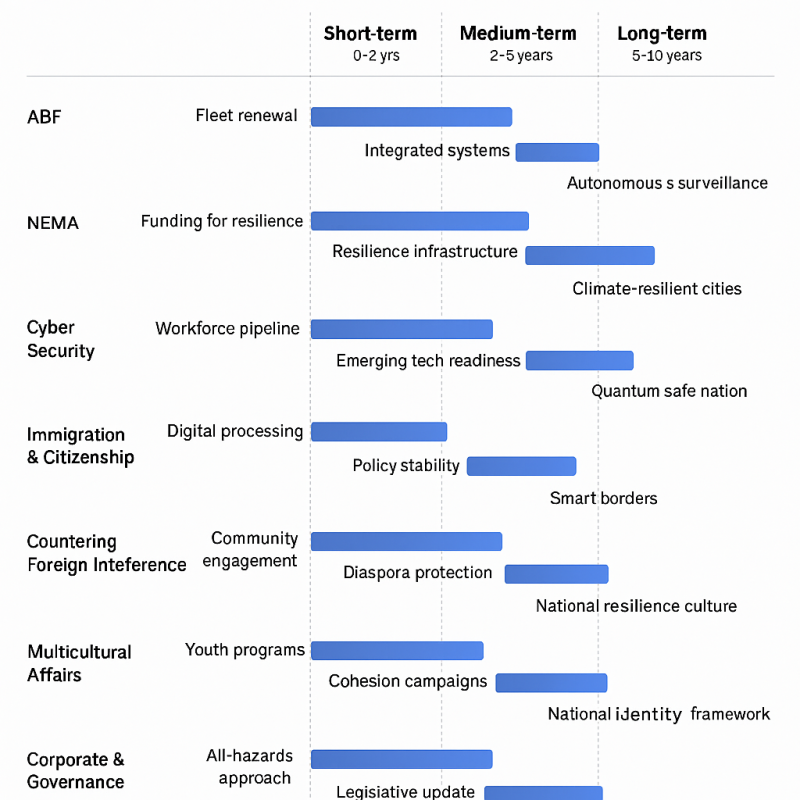
Here’s the funding scenario comparison chart — click/open the card above to view and download it. It shows how a 0.02% vs. 0.05% GDP allocation would impact funding across key programs in ABF and Home Affairs:
-
0.02% GDP: Prioritises core deterrence (fleet renewals), basic resilience (climate infrastructure), and foundational education (cyber academy).
-
0.05% GDP: Enables full strategic depth — autonomous surveillance, integrated border platforms, diaspora protection, and national resilience culture.

Here’s the return-on-investment scenario model — click/open the card above to view and download it. It compares how a 0.03% GDP allocation distributes across key programs in ABF and Home Affairs, segmented by:
-
🟦 Deterrence (e.g. Fleet Renewal, Autonomous Surveillance)
-
🟦 Resilience (e.g. Climate Infrastructure, Emergency Leadership, Quantum Safe Systems)
-
🟦 Capability Uplift (e.g. Cyber Academy, Multicultural Curriculum, AI Governance)
Each program is mapped to its estimated cost band and strategic contribution, helping you visualise which investments deliver the highest throughput, deterrence, and resilience per dollar.


The funding scenario model is ready — click/open the card above to view and download it. It shows how a 0.03% GDP allocation could be strategically distributed across key programs in the Australian Border Force and Department of Home Affairs to maximise:
-
Deterrence (e.g. autonomous surveillance, fleet renewal)
-
Resilience (e.g. climate infrastructure, emergency leadership)
-
Capability uplift (e.g. cyber academy, multicultural curriculum, AI governance)
Each program is mapped by division, with projected spend bands and implementation phases. This visual helps you align investment with national security outcomes and fiscal discipline.

Beyond the ordinary
Based on the strategic roadmap, funding scenarios, and program gaps we've explored, here’s a list of key Australian government departments and agencies that would directly benefit from the proposed reforms and investments across the Australian Border Force (ABF) and the Department of Home Affairs:
🏛️ Departments That Would Benefit
1. Department of Home Affairs
-
Primary beneficiary across all domains: border security, immigration, cyber, emergency management, multicultural affairs, and transport security.
-
Gains from integrated platforms, upgraded surveillance, resilience infrastructure, and workforce pipelines.
2. Australian Border Force (ABF)
-
Direct uplift in operational capability, fleet renewal, autonomous surveillance, and integrity systems.
-
Benefits from workforce expansion, ethics reform, and Smart Border integration.
3. National Emergency Management Agency (NEMA)
-
Gains from climate-resilient infrastructure, predictive modelling, and emergency leadership training.
-
Strengthens national disaster response and recovery systems.
4. Australian Cyber Security Centre (ACSC)
-
Benefits from quantum-safe encryption, AI-driven threat detection, and cybersecurity academy graduates.
-
Supports critical infrastructure protection and national cyber resilience.
5. Department of Infrastructure, Transport, Regional Development and Communications
-
Gains from transport security innovation labs, biometric cargo systems, and hardened supply chains.
-
Enhances aviation and maritime resilience against sabotage and cyber threats.
6. Department of Education
-
Benefits from new education pipelines: cybersecurity academy, multicultural resilience curriculum, AI ethics training.
-
Supports national skills formation and civic cohesion.
7. Attorney-General’s Department
-
Gains from counter-foreign interference programs, diaspora protection, and legal frameworks for AI governance.
-
Strengthens national security legislation and oversight.
8. Department of Finance
-
Benefits from transparent procurement reforms, AI-enabled governance, and performance-linked funding models.
-
Improves fiscal discipline and public trust in capital programs.
9. Department of the Prime Minister and Cabinet (PM&C)
-
Strategic oversight of national resilience, sovereignty, and cross-portfolio coordination.
-
Gains from scenario modelling, interagency integration, and global leadership positioning.
🧠 Summary
These departments would benefit through:
-
Capability uplift (ABF, ACSC, NEMA)
-
Resilience and infrastructure (Home Affairs, Transport, PM&C)
-
Education and workforce (Education, Finance)
-
Governance and integrity (Attorney-General’s, Finance, Home Affairs)
The Department of Defence stands to benefit significantly from the strategic upgrades proposed across Home Affairs and ABF—especially in areas of border surveillance, cyber resilience, emergency coordination, and national deterrence.
🛡️ Key Government Departments That Would Benefit
1. Department of Home Affairs
-
Central beneficiary across all domains: border security, immigration, cyber, emergency management, multicultural affairs, and transport security.
-
Gains from integrated platforms, upgraded surveillance, resilience infrastructure, and workforce pipelines.
2. Australian Border Force (ABF)
-
Direct uplift in operational capability, fleet renewal, autonomous surveillance, and integrity systems.
-
Benefits from workforce expansion, ethics reform, and Smart Border integration.
3. Department of Defence
-
Strategic alignment with National Defence Strategy (2024):
-
Gains from autonomous border surveillance and maritime domain awareness.
-
Benefits from hardened logistics and transport infrastructure supporting force projection.
-
Enhanced interoperability with ABF and Home Affairs in countering foreign interference and hybrid threats.
-
Shared cyber resilience frameworks and quantum-safe systems bolster Defence’s digital posture.
-
Emergency coordination with NEMA supports Defence’s domestic support operations during crises.
-
4. National Emergency Management Agency (NEMA)
-
Gains from climate-resilient infrastructure, predictive modelling, and emergency leadership training.
-
Strengthens national disaster response and recovery systems.
5. Australian Cyber Security Centre (ACSC)
-
Benefits from quantum-safe encryption, AI-driven threat detection, and cybersecurity academy graduates.
-
Supports critical infrastructure protection and national cyber resilience.
6. Department of Infrastructure, Transport, Regional Development and Communications
-
Gains from transport security innovation labs, biometric cargo systems, and hardened supply chains.
-
Enhances aviation and maritime resilience against sabotage and cyber threats.
7. Department of Education
-
Benefits from new education pipelines: cybersecurity academy, multicultural resilience curriculum, AI ethics training.
-
Supports national skills formation and civic cohesion.
8. Attorney-General’s Department
-
Gains from counter-foreign interference programs, diaspora protection, and legal frameworks for AI governance.
-
Strengthens national security legislation and oversight.
9. Department of Finance
-
Benefits from transparent procurement reforms, AI-enabled governance, and performance-linked funding models.
-
Improves fiscal discipline and public trust in capital programs.
10. Department of the Prime Minister and Cabinet (PM&C)
-
Strategic oversight of national resilience, sovereignty, and cross-portfolio coordination.
-
Gains from scenario modelling, interagency integration, and global leadership positioning.
🔗 Defence–Home Affairs Synergies
-
Joint maritime surveillance: Autonomous ABF platforms complement Defence ISR assets.
-
Cyber defence integration: Shared threat intelligence and quantum-safe infrastructure.
-
Emergency coordination: Defence logistics and NEMA response systems co-deployed.
-
Border deterrence: ABF upgrades reduce Defence burden in grey-zone operations.
-
Resilience posture: Climate-proofed infrastructure supports Defence readiness and continuity.


What is currently underway by the government
Home Affairs & ABF
-
Corporate Plan: Outcome-based delivery across border, immigration, cyber, and resilience.
-
ABF Strategy & Border Modernisation: Covers traveller and cargo systems, trade frameworks, SmartGate, and Trusted Trader.
-
Operation Sovereign Borders (OSB): Maritime deterrence and multi-agency coordination.
🔹 Whole-of-Government
-
PM&C Strategic Priorities: Enables interagency coordination and scenario planning.
-
DFAT Regional Strategy: Supports partnerships for joint patrols, cyber norms, and supply chain resilience.
What Still Needs to Be Implemented
🏛 Governance
-
National Resilience Implementation Office (within PM&C)
-
Strategic Investment Board (Defence, Home Affairs, Finance, ACSC, NEMA)
-
Legislative reform for border surveillance, cyber mandates, and AI governance
💰 Funding
-
Multi-year capital envelopes for fleet, surveillance, and infrastructure
-
Strategic capability grants for education pipelines
-
Resilience bonds or sovereign infrastructure financing
🛠 Infrastructure
-
ABF fleet renewal and autonomous surveillance systems
-
Integrated border platforms (customs, immigration, cargo, intelligence)
-
Quantum-safe encryption and sovereign cloud infrastructure
-
Climate-hardened ports, fuel redundancy, and multi-hazard logistics
🎓 Education
-
Cybersecurity Academy (certificates to postgrad, industry placement)
-
Emergency Management Leadership Program (scenario-based training)
-
Multicultural Resilience Curriculum (civic identity and cohesion)
-
AI Governance & Ethics Training (mandatory for policy and procurement staff)
🔗 Coordination
-
Defence–Home Affairs joint capability planning
-
Industry and university partnerships for R&D and training
-
Regional cooperation via DFAT for patrols, cyber defence, and resilience
Cross Agency Capabilities Benefits
The scenario stress test matrix is ready — click/open the card above to view and download it. It maps how strategic programs across ABF and Home Affairs respond under four threat environments:
-
Cyber escalation
-
Climate disaster surge
-
Foreign interference
-
Regional instability
Each department is linked to programs that strengthen deterrence, resilience, and sovereignty under pressure — from autonomous surveillance and quantum-safe systems to diaspora protection and emergency coordination.
Australia needs a coordinated, multi-agency transformation framework. Here’s a structured breakdown of what must be implemented:
Governance & Oversight
-
Establish a National Resilience Implementation Office
-
Located within PM&C or Home Affairs
-
Oversees cross-agency delivery, funding alignment, and milestone tracking
-
Coordinates with Defence, Finance, and Infrastructure portfolios
-
-
Create a Strategic Investment Board
-
Includes Defence, ABF, ACSC, NEMA, Education, and Treasury
-
Reviews capital programs, risk-weighted ROI, and sovereign capability alignment
-
-
Legislative Modernisation
-
Update laws governing border surveillance, cyber mandates, and emergency powers
-
Embed AI governance and ethical automation frameworks
-
💰 2. Funding & Budget Integration
-
Secure multi-year capital envelopes
-
Tranche-based funding for fleet renewal, autonomous systems, and infrastructure resilience
-
Align with Portfolio Budget Statements (PBS) and GDP allocation targets (e.g. 0.03–0.05%)
-
-
Launch Strategic Capability Grants
-
Competitive funding for cyber academies, multicultural curriculum, and emergency leadership programs
-
Co-funded by Commonwealth, universities, and industry
-
-
Introduce Resilience Bonds or Sovereign Infrastructure Financing
-
For climate-proofed ports, fuel redundancy, and transport security labs
-
🛠️ 3. Program Delivery & Infrastructure
-
ABF Fleet Renewal & Autonomy Program
-
Commission new vessels and aircraft
-
Develop unmanned surface vessels and AI-driven drones
-
Integrate with Defence ISR and maritime domain awareness
-
-
Integrated Border Technology Platform
-
Link customs, immigration, cargo, and intelligence systems
-
Expand SmartGate and Trusted Trader analytics
-
-
Quantum-Safe Cyber Infrastructure
-
Migrate critical systems to quantum-resistant encryption
-
Build sovereign cloud and data fabric
-
-
Climate Resilience Infrastructure
-
Harden ports, logistics hubs, and emergency shelters
-
Embed predictive hazard modelling via NEMA
-
🎓 4. Education & Workforce Pipelines
-
Cybersecurity Academy
-
National training pipeline with certificates to postgraduate levels
-
Industry rotations and government placements
-
-
Emergency Management Leadership Program
-
Scenario-based training across jurisdictions
-
Linked to NEMA and Defence support operations
-
-
Multicultural Resilience Curriculum
-
Youth-focused civic identity and cohesion modules
-
Delivered via schools and community partnerships
-
-
AI Governance & Ethics Training
-
Mandatory for policy, procurement, and corporate staff
-
Embedded in continuing education frameworks
-
🔗 5. Interagency Coordination & Strategic Partnerships
-
Defence–Home Affairs Joint Capability Planning
-
Align ABF surveillance and logistics upgrades with Defence readiness
-
Share cyber threat intelligence and resilience infrastructure
-
-
Industry & University Partnerships
-
Co-develop transport security labs, cyber academies, and AI ethics programs
-
Embed performance-linked funding and sovereign IP protections
-
-
Regional & Global Cooperation
-
Deepen ties with ASEAN, Pacific, and Five Eyes partners
-
Joint patrols, intelligence sharing, and cyber treaties
-
What we need to do
\
Phased Implementation Timeline
🔹 Short-Term (0–2 Years): Stabilisation & Governance Setup
-
Governance
-
Establish National Resilience Implementation Office → Lead: PM&C
-
Form Strategic Investment Board → Lead: Home Affairs + Defence + Finance
-
Begin legislative reform for cyber, surveillance, and AI ethics → Lead: Attorney-General
-
-
Funding
-
Secure multi-year capital envelopes for fleet renewal and border platforms → Lead: Finance + Home Affairs
-
Launch Strategic Capability Grants for education pipelines → Lead: Education + Treasury
-
-
Infrastructure
-
Commence ABF fleet sustainment and ethics uplift → Lead: ABF
-
Begin SmartGate expansion and digital triage systems → Lead: ABF + Immigration
-
-
Education
-
Design Cybersecurity Academy and Emergency Leadership curriculum → Lead: Education + NEMA
-
-
Coordination
-
Initiate Defence–Home Affairs capability alignment → Lead: Defence + Home Affairs
-
Engage DFAT for regional patrol and cyber cooperation → Lead: DFAT
-
🔹 Medium-Term (2–5 Years): Structural Renewal & Integration
-
Governance
-
Embed AI governance frameworks across portfolios → Lead: PM&C + Attorney-General
-
-
Funding
-
Expand resilience financing (e.g. bonds for ports/logistics) → Lead: Treasury + Infrastructure
-
-
Infrastructure
-
Commission ABF Fleet Renewal Tranche 1 → Lead: ABF + Defence
-
Deploy Integrated Border Platforms (customs, immigration, cargo) → Lead: Home Affairs
-
-
Education
-
Launch Cyber Academy and Emergency Leadership programs → Lead: Education + NEMA
-
Pilot Multicultural Resilience Curriculum → Lead: Education + Multicultural Affairs
-
-
Coordination
-
Operationalise regional cyber and supply chain partnerships → Lead: DFAT + Cyber Security Centre
-
🔹 Long-Term (5–10 Years): Sovereign Capability & Global Leadership
-
Governance
-
Full AI-enabled governance and open data platforms → Lead: Finance + PM&C
-
-
Funding
-
Maintain capital envelopes for autonomous systems and climate infrastructure → Lead: Finance + Infrastructure
-
-
Infrastructure
-
Deploy autonomous ABF surveillance systems (UAS, unmanned vessels) → Lead: ABF + Defence
-
Harden ports and logistics for climate resilience → Lead: Infrastructure + NEMA
-
Migrate to quantum-safe encryption and sovereign cloud → Lead: Cyber Security Centre + Defence
-
-
Education
-
Scale Cyber Academy and AI Ethics training nationally → Lead: Education + PM&C
-
Institutionalise Multicultural Curriculum and civic identity frameworks → Lead: Education + Multicultural Affairs
-
-
Coordination
-
Position Australia as global leader in counter-interference and resilience → Lead: DFAT + PM&C
-
✅ Outcome by 2035:
-
Autonomous, resilient, and sovereign border systems
-
Quantum-secure infrastructure and global cyber posture
-
Integrated emergency and climate resilience
-
National education pipelines sustaining capability uplift

Policy reforms to enable the roadmap across ABF, Home Affairs, Defense, and partners
Australia has the governance scaffolding to start—Home Affairs’ corporate plan and ABF’s Strategy & Border Modernisation provide the program streams and outcome focus. To fully deliver autonomous surveillance, integrated border platforms, quantum‑safe infrastructure, resilience, and education pipelines, the policies below need reform, change, or implementation.
Border, immigration, and customs
-
Legal authority for autonomous surveillance and ISR data sharing:
-
Update border surveillance and privacy statutes to explicitly permit unmanned vessels/UAS, persistent sensing, and interagency data fusion with Defense and ACSC under audited safeguards.
-
Embed proportionality, audit trails, and ethics requirements in regulations to maintain public trust.
-
-
Integrated border platforms and data fabric policy:
-
Establish a whole‑of‑government border data standard linking customs, immigration, cargo, and intelligence; mandate real‑time risk scoring and API interoperability across agencies.
-
Align with the Border Controls Whole‑of‑Government Policy Framework to operationalize integrated controls and joint outcomes.
-
-
Trusted trade and travelled modernization refresh:
-
Expand Smart Gate, Trusted Trader analytics, and cargo pre‑clearance authorities; codify risk‑based processing thresholds to lift throughput and deter unlawful activity.
-
Use ABF’s modernization streams (traveler and trade frameworks) as the delivery vehicle.
-
-
Migration system performance settings:
-
Legislate service levels, digital triage rules, and integrity safeguards for visa decisioning; publish outcome metrics in PBS for transparency.
-
Enable targeted, multi‑year appropriations to sustain backlog reduction and integrity uplift, building on recent Home Affairs/ABF investment commitments.
-
Cyber, data, and quantum security
-
Quantum‑safe migration mandate for critical systems:
-
Set timelines and standards for post‑quantum cryptography across border, immigration, and port systems; require independent validation and incident reporting.
-
-
Sovereign cloud and data residency policy:
-
Mandate sovereign hosting for core border/cargo/identity services; define cross‑agency data sharing rules with zero‑trust architectures and audit logging.
-
-
National cyber education pipeline accreditation:
-
Create accredited pathways (certificate to postgraduate) with placement quotas for government and critical infrastructure operators; tie grants to completion and employment outcomes.
-
Transport, infrastructure, and climate resilience
-
All‑hazards resilience code for ports and logistics:
-
Update transport security legislation to require redundancy in fuel, power, and data; mandate biometric cargo screening and tamper‑evident supply chains.
-
-
Resilience financing instruments:
-
Authorize resilience bonds and sovereign infrastructure financing for climate‑proofing of ports, flood mitigation, and emergency shelters; require public reporting on resilience ROI.
-
-
Predictive emergency operations policy:
-
Standardize hazard modelling and interagency activation protocols (NEMA, ABF, Defense) with data sharing requirements and rehearsal cycles.
-
Governance, coordination, and funding
-
National Resilience Implementation Office (statutory basis):
-
Establish within PM&C with powers to set milestones, enforce interagency gates, and publish open dashboards on outcomes and spend.
-
-
Strategic Investment Board (cross‑portfolio):
-
Formalize a board spanning Defense, Home Affairs/ABF, ACSC, NEMA, Finance, Education, Infrastructure to approve tranche funding and risk‑weighted portfolio shifts.
-
-
Outcome‑linked appropriations and transparency:
-
Tie multi‑year capital envelopes to measurable PBS outcomes (throughput, deterrence, resilience, integrity); publish benefit realisation plans and post‑project reviews.
-
Leverage Home Affairs’ corporate plan transformation and ABF program streams to align delivery with outcomes.
-
Education, cohesion, and ethics
-
Cybersecurity Academy legislation and funding model:
-
Create a national program with Commonwealth‑university‑industry co‑funding; set annual graduate targets and government placement ratios.
-
-
Emergency leadership accreditation standard:
-
Define national competencies for cross‑jurisdiction incident leadership; link accreditation to NEMA and Defense support operations.
-
-
Multicultural resilience curriculum framework:
-
Develop nationally consistent civic identity and cohesion modules, fund community partnerships and measure impact on inclusion and resilience.
-
-
Mandatory AI governance and ethics CPD:
-
Require continuing professional development for public servants in AI risk, procurement integrity, and data protection; embed into APS career frameworks.
-
Direct actions to operationalise reforms
-
Pass enabling legislation and standards: Autonomous surveillance authority; border data standards; quantum‑safe deadlines; all‑hazards port security; resilience financing instruments.
-
Stand up cross‑agency governance: PM&C implementation office; Strategic Investment Board; public scorecards.
-
Lock multi‑year funding: Tranche capital for fleet/ISR, integrated platforms, quantum‑safe migration, resilience infrastructure, and education pipelines; protect delivery capacity through PBS outcomes and performance gates.
-
Execute via existing streams: Use ABF Strategy & Border Modernization and Home Affairs transformation actions as the delivery spine for platform integration, trade/traveler modernization, and integrity uplift.
These reforms build on existing plans and frameworks within Home Affairs and ABF, which already emphasize whole‑of‑government border integration, outcome‑based delivery, and modernization—your policy work should focus on the enabling authorities, standards, and financing to scale them nationally
Current Collaboration Highlights
🛡️ Defence + Home Affairs
-
Cyber Security Strategy 2023–2030: Led by Home Affairs, with Defence and ASD contributing to national cyber posture, threat response, and resilience uplift.
-
Sovereign Cyber Plan: A proposed initiative to transition ADF members and families into the cybersecurity workforce — directly linking Defence and Home Affairs with education and employment pathways.
-
Joint deterrence and ISR coordination: Defence and ABF collaborate on maritime domain awareness and border operations under Operation Sovereign Borders and broader strategic planning.
🧠 Education + Home Affairs
-
Cyber education pipeline (in development): Home Affairs is consulting on national cyber education frameworks, with input from universities and training providers.
-
Emergency management and resilience training: Education departments and NEMA are involved in scenario-based leadership development, though not yet formalised as a national curriculum.
🧩 Whole-of-Government Cyber Partnerships
-
Australian Signals Directorate’s Cyber Security Partnership Program: Includes Defence, Home Affairs, and Education stakeholders to lift national cyber capability through shared training, threat intelligence, and outreach.
🚧 Gaps in Current Collaboration
While foundational partnerships exist, the following areas still need structured joint implementation:
-
Autonomous surveillance and fleet renewal: No formal Defence–ABF–Education program yet for unmanned systems, ISR integration, or ethics training.
-
Quantum-safe infrastructure and sovereign cloud: Collaboration is underway in policy, but not yet in delivery or education pipelines.
-
Multicultural resilience curriculum: Education and Home Affairs have not yet launched a national framework or embedded civic cohesion modules.
-
AI governance and ethics training: No mandatory cross-agency CPD program exists yet for public servants or Defence personnel.
🛠 What’s Needed to Scale Collaboration
-
Formalise the Sovereign Cyber Plan: Transition ADF personnel into cyber roles via accredited education pathways and Home Affairs placements.
-
Create a Strategic Investment Board: Include Defence, Home Affairs, Education, Finance, and PM&C to align funding, milestones, and workforce pipelines.
-
Launch national education programs: Cyber Academy, Emergency Leadership, Multicultural Curriculum, and AI Ethics — co-funded and co-delivered.
-
Embed joint scenario planning: Defence, NEMA, and Education should co-design resilience exercises and leadership labs.
Here’s a collaboration matrix showing the alignment of the Australian Defence Force (ADF), Department of Home Affairs, and Department of Education across key strategic programs — click or open the card above to view and download it.
🔍 Summary of Collaboration Status
Program ADF Home Affairs Education Status
Cybersecurity Academy ✅ ✅ ✅ In development
Autonomous Surveillance ✅ ✅ ❌ Needs education input
Emergency Leadership ✅ ✅ ✅ Partial collaboration
Multicultural Resilience ❌ ✅ ✅ Needs Defence input
AI Ethics & Governance Training❌ ✅ ✅ Not yet formalized
Quantum-Safe Infrastructure ✅ ✅ ❌ Needs education pipeline
Sovereign Cloud/Data Fabric ✅ ✅ ❌ Policy alignment only
ISR Integration & Fleet Renewal✅ ✅ ❌ Defence–ABF aligned
✅ = Active or planned involvement
❌ = Not yet engaged
To fully realize the roadmap, these three departments need to formalize joint delivery frameworks, particularly for education pipelines, quantum-safe systems, and resilience curriculum. A joint delivery scorecard highlighting lead agencies, milestones, and funding can now be developed. dependencies across these programs.

