HUMAN RIGHTS DEPARTMENT
Australians Unified – Attorney‑General’s Portfolio
The Human Rights Department leads Australia’s national human rights framework. It protects individual freedoms, strengthens equality, supports vulnerable communities, and ensures Australia meets its domestic and international human rights obligations.
The department works across government, with civil society, legal bodies, and international partners to uphold dignity, fairness, and justice for all Australians.
OUR ROLE
The Human Rights Department exists to:
-
Protect and promote human rights across Australia
-
Oversee national anti‑discrimination and equality frameworks
-
Support vulnerable and marginalised communities
-
Provide policy leadership on rights, freedoms, and justice
-
Monitor and report on Australia’s human rights obligations
-
Strengthen access to justice and legal protections
-
Work with government, civil society, and international partners
The department ensures Australia remains a fair, inclusive, and rights‑respecting nation.

OUR STRENGTHS
Policy & Governance Strengths
-
Strong legislative frameworks for equality and anti‑discrimination
-
National leadership on human rights policy
-
Deep partnerships with community organisations
-
Expertise in rights‑based analysis and legal protections
-
Trusted role in monitoring government compliance
Sovereign Strengths
-
Independent oversight mechanisms
-
International credibility in human rights reporting
-
National coordination across states and territories

OUR WEAKNESSES
Structural Weaknesses
-
Fragmented human rights responsibilities across jurisdictions
-
Limited digital systems for monitoring and reporting
-
Slow policy reform cycles
-
Under‑resourced community support programs
-
Gaps in data on vulnerable populations
Operational Weaknesses
-
Rising demand for rights‑based services
-
Limited outreach to remote and disadvantaged communities
-
Inconsistent public awareness of rights and protections
-
Workforce shortages in specialist legal and policy roles

OUR THREATS
External Threats
-
Rising discrimination and social inequality
-
Digital harms and online rights violations
-
Global instability impacting vulnerable communities
-
Misinformation undermining public trust
Internal Threats
-
Resource constraints
-
Outdated systems and reporting tools
-
Workforce fatigue and retention challenges
-
Fragmented service delivery
OUR OPPORTUNITIES
Strategic Opportunities
-
Modernise national human rights legislation
-
Strengthen protections for vulnerable communities
-
Expand digital rights education and public awareness
-
Improve national data and reporting systems
-
Enhance international human rights engagement
Operational Opportunities
-
Recruit and retain specialist policy and legal staff
-
Strengthen partnerships with NGOs and community groups
-
Improve access to justice and complaint pathways
-
Expand outreach to regional and remote communities

BETTER INTEGRATION WITH GOVERNMENT & COMMUNITY
One national human rights system
Key Actions
-
Integrated policy and reporting platforms that improve communication and transparency
-
Stronger partnerships with NGOs and legal bodies to enhance collaboration and resource sharing
-
National community engagement programs that encourage active participation from all sectors
-
Shared data and analytics systems to promote informed decision-making and accountability
Outcome: A more coordinated, community‑connected human rights system that fosters mutual respect and understanding.
5. A FAIRER, MORE INCLUSIVE AUSTRALIA
Protecting dignity, equality, and justice for everyone
Key Actions
-
National rights education campaigns that raise awareness and promote understanding
-
Strengthened protections for vulnerable groups, including children, women, and minorities
-
Digital rights and online safety initiatives aimed at safeguarding users in the digital landscape
-
Community‑led justice and inclusion programs that empower local voices and solutions
Outcome: A fairer, safer, more inclusive Australia, where everyone's rights are respected and upheld.
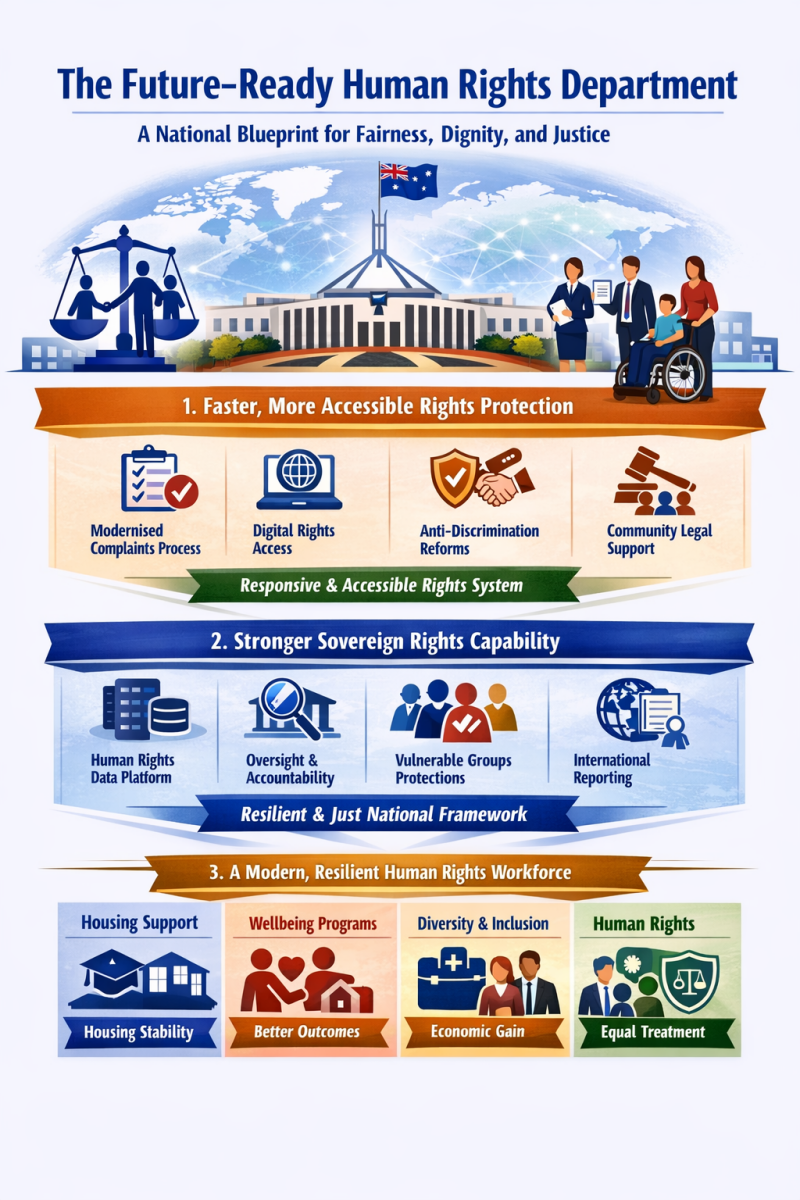
THE FUTURE‑READY HUMAN RIGHTS DEPARTMENT
A national blueprint for fairness, dignity, and justice
1. FASTER, MORE ACCESSIBLE RIGHTS PROTECTION
Strengthening national human rights systems
Key Actions
-
Modernise complaint and reporting pathways
-
Improve digital access to rights information
-
Strengthen anti‑discrimination frameworks
-
Expand community legal support
Outcome: A more responsive, accessible human rights system.
2. STRONGER SOVEREIGN RIGHTS CAPABILITY
Building Australian capability for fairness and justice
Key Actions
-
National human rights data platform
-
Strengthened oversight and accountability
-
Expanded protections for vulnerable groups
-
Improved international reporting capability
Outcome: A more resilient, rights‑focused national framework.
3. A MODERN, RESILIENT HUMAN RIGHTS WORKFORCE
Supporting the people who protect rights
Key Actions
-
Specialist training and development
-
Workforce wellbeing and retention programs
-
Diversity and inclusion initiatives
-
Strengthened legal and policy capability
Outcome: A strong, supported human rights workforce.
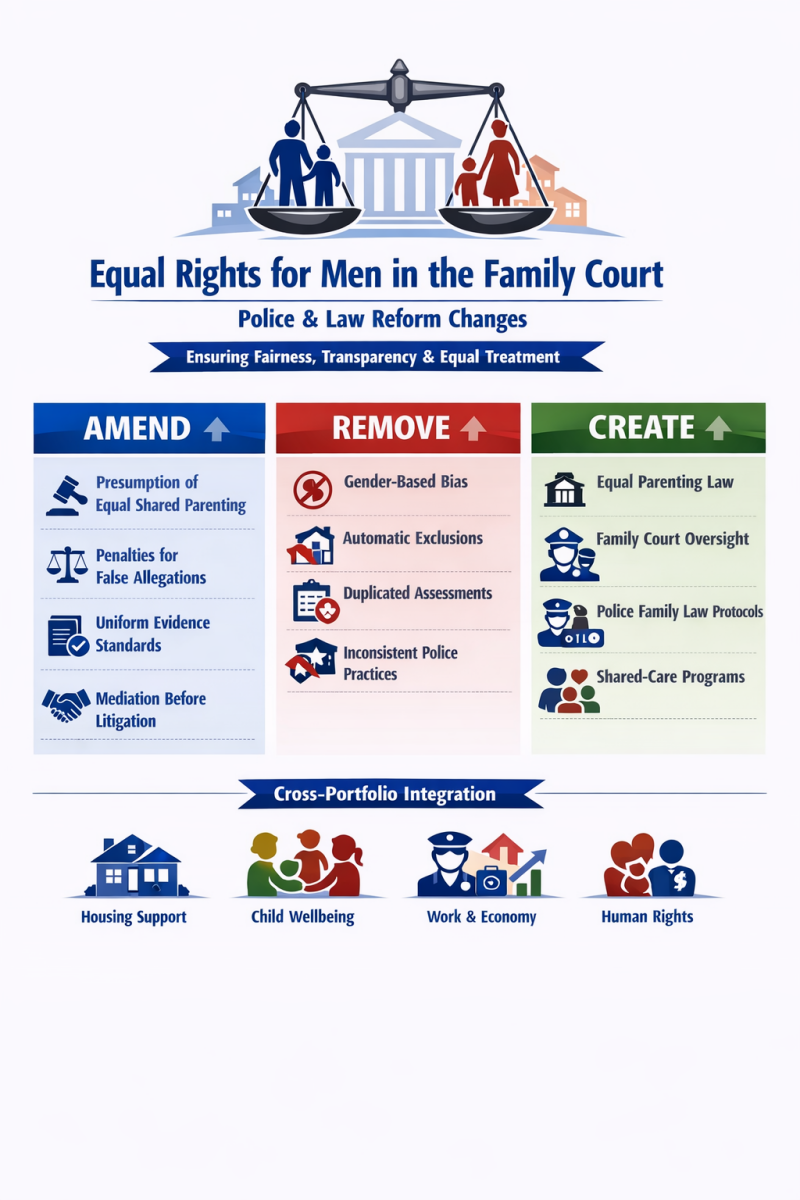
🔵 Equal Rights for Men in the Family Court — Police & Law Reform Changes
Concrete legislative and policing reforms to ensure fairness, transparency, and equal treatment
Australia’s family law system requires clear, enforceable legal changes and operational policing reforms to guarantee equal rights for men while protecting children and victims.
Below is the condensed, law‑ready version.
AMEND — Specific Legislative Changes
Family Law Act 1975
-
Insert a presumption of equal shared parental responsibility unless proven risk.
-
Require mandatory written judicial reasons when equal time is denied.
-
Standardise evidence thresholds for allegations (risk, violence, neglect).
-
Introduce penalties for proven false or malicious allegations.
-
Mandate fast‑track mediation before litigation.
Evidence Act
-
Introduce uniform standards for admissibility of family violence claims.
-
Require independent verification for high‑risk allegations.
Crimes Act / Domestic Violence Orders
-
Require police to apply consistent risk‑assessment tools before issuing interim orders.
-
Introduce review mechanisms for improperly issued orders.
REMOVE — Barriers, Bias & Outdated Processes
Systemic Barriers
-
Remove gender‑based assumptions in parenting decisions.
-
Remove procedural bias against self‑represented fathers.
-
Remove duplicated assessments between police, courts, and child services.
-
Remove outdated terminology that frames fathers as secondary parents.
Operational Barriers
-
Remove automatic exclusion of fathers from the home without verified risk.
-
Remove inconsistent police practices across states and territories.
CREATE — New Laws, New Police Protocols, New Systems
Equal Parenting & Family Justice Act
-
Guarantees equal rights for both parents.
-
Establishes transparent decision templates for judges.
-
Requires national reporting on gender outcomes.
Family Court Accountability Commission
-
Independent oversight of judicial conduct.
-
Reviews patterns of bias, delays, and inconsistent rulings.
-
Public reporting on outcomes.
Police Operational Reforms
-
National Family Law Policing Protocol:
-
Standardised risk assessments
-
Mandatory body‑worn camera use
-
Clear rules for interim orders
-
Consistent enforcement across states
-
-
Specialist Family Law Liaison Officers
-
Bridge between police, courts, and child services
-
Ensure equal treatment and procedural fairness
-
Shared‑Care Support & Reintegration Programs
-
National Shared‑Care Support Program for separated fathers
-
Legal assistance, mental health support, and housing pathways
-
Parenting education and conflict‑resolution services
HUMAN RIGHTS DEPARTMENT
Strategic Roadmap Future‑Ready Human Rights: Fairness, Dignity & Justice Colour: Deep Navy
TILE 2 — PHASE 1: FOUNDATION (Years 1–2)
Stabilise & Strengthen Rights Systems
-
National rights framework audit
-
Priority upgrades to reporting systems
-
Faster complaint pathways
-
Digital access improvements
-
Governance and compliance uplift Delivers: Faster, more accessible rights protection Colour: Sage Green
TILE 3 — PHASE 2: ACCELERATION (Years 2–4)
Expand Capability & Modernise Operations
-
Digital rights education
-
Strengthened anti‑discrimination protections
-
Community legal support expansion
-
National data and analytics uplift
-
Improved outreach to vulnerable groups Delivers: Better integration with community and government Colour: Blue‑Grey
TILE 4 — PHASE 3: EXPANSION (Years 4–6)
Grow Sovereign Rights Capability
-
National human rights data platform
-
International reporting expansion
-
Community partnerships
-
Rights‑based policy innovation
-
Regional and remote outreach Delivers: Stronger sovereign capability Colour: Sand / Gold
TILE 5 — PHASE 4: FUTURE‑READY (Years 6–10)
A Modern, Inclusive Human Rights System
-
Smart reporting technologies
-
Climate‑resilient community facilities
-
Integrated national rights ecosystem
-
Continuous policy innovation
-
Fully modernised rights infrastructure Delivers: A competitive edge in fairness and justice Colour: Deep Teal
TILE 6 — PEOPLE & COMMUNITY
Supporting Australians & Human Rights Workers
-
Workforce wellbeing programs
-
Specialist training pathways
-
Community engagement initiatives
-
Diversity and inclusion
-
Public trust and transparency Delivers: A strong, supported human rights workforce Colour: Olive Green
TILE 7 — OUTCOME TILE
THE FUTURE‑READY HUMAN RIGHTS DEPARTMENT
-
✔ Faster, more accessible rights protection
-
✔ Stronger sovereign capability
-
✔ A modern, resilient workforce
-
✔ Better national coordination
-
✔ A fairer, more inclusive Australia Colour: Navy + Gold Accent
JUSTICE REINTEGRATION & WORKFORCE TRANSITION PROGRAM
Building Capability, Reducing Crime, Strengthening Australia
Australia cannot afford a justice system that releases people unprepared, unskilled, and unsupported. The Australians Unified Justice Reintegration & Workforce Transition Program creates a clear pathway from custody → education → skills → employment → contribution.
This program strengthens national capability, fills future‑industry workforce shortages, and reduces long‑term crime by ensuring every person leaving the justice system has the opportunity — and responsibility — to rebuild their lives through work.
Purpose of the Program
-
Reduce re‑offending by providing structured education and employment pathways.
-
Build national workforce capability in priority industries.
-
Support safer communities through rehabilitation, responsibility, and contribution.
-
Ensure people in custody can begin training before release, accelerating reintegration.
-
Reduce long‑term justice system costs by turning offenders into contributors.
Justice‑Involved Australians
1. National Capability Outcomes
-
Strengthens Australia’s workforce by transitioning justice‑involved individuals into productive employment.
-
Builds sovereign capability by filling shortages in construction, logistics, agriculture, care sectors, and essential services.
-
Reduces economic drag caused by repeat offending, unemployment, and long‑term welfare dependence.
-
Converts justice outcomes into workforce outcomes, turning underutilised people into contributors to national productivity.
Future‑Industry Workforce Pathways
-
Creates job‑ready workers for emerging sectors including renewables, hydrogen, cybersecurity, data, and advanced manufacturing.
-
Aligns prison‑based training with Australia’s future‑industry workforce needs.
-
Builds a pipeline of skilled labour for industries facing chronic shortages.
-
Supports digital literacy and modern skills so justice‑involved Australians can participate in a rapidly changing economy.
Reducing Long‑Term Crime
-
Employment is one of the strongest predictors of reduced re‑offending.
-
Structured return‑to‑work pathways break cycles of homelessness, addiction, and repeat crime.
-
Community‑based employment programs reduce prison pressure and improve public safety.
-
Workforce reintegration turns high‑risk individuals into low‑risk, contributing members of society.
Reduced Sentencing Linked to Education & Pathway Programs
Rehabilitation through contribution, capability, and structured reform
Policy Principle
Australians Unified supports a sentencing framework where offenders who commit to structured education, skills training, and community contribution may be eligible for reduced custodial time or alternative sentencing — provided public safety is maintained and rehabilitation is demonstrable.

HUMAN RIGHTS DEPARTMENT — YEARLY COSTING MODEL
Aligned to the Human Rights Strategic Roadmap (Foundation → Acceleration → Expansion → Future‑Ready)
BASELINE FUNDING (Provided)
The Human Rights Department’s current annual funding (rounded for clarity):
-
Core annual budget: ~$0.42B
-
Anti‑discrimination & equality programs: ~$0.10B
-
Community legal & rights support: ~$0.08B
Total Baseline Funding: ~$0.60B per year
This is the starting point. All costing below reflects additional investment for your Future‑Ready roadmap.
PHASE 1 — FOUNDATION (Years 1–2)
Stabilise & Strengthen Rights Systems
Additional Annual Cost: $0.55B – $0.75B Total Annual Operating (Baseline + Uplift): $1.15B – $1.35B
Uplift breakdown:
-
National rights framework audit: $0.10B
-
Digital reporting & complaint systems: $0.20B
-
Faster complaint resolution: $0.15B
-
Governance & compliance uplift: $0.10B
2-Year Total Uplift: $1.10B – $1.50B
PHASE 2 — ACCELERATION (Years 2–4)
Expand Capability & Modernise Operations
Additional Annual Cost: $0.80B – $1.05B Total Annual Operating: $1.40B – $1.65B
Uplift breakdown:
-
Digital rights education & outreach: $0.25B
-
Strengthened anti‑discrimination: $0.20B
-
Community legal support expansion: $0.25B
-
National data & analytics uplift: $0.15B
3-Year Total Uplift: $2.40B – $3.15B
PHASE 3 — EXPANSION (Years 4–6)
Grow Sovereign Rights Capability
Additional Annual Cost: $1.00B – $1.30B Total Annual Operating: $1.60B – $1.90B
Uplift breakdown:
-
National human rights platform: $0.40B
-
International reporting expansion: $0.25B
-
Community outreach: $0.30B
-
Rights‑based policy innovation: $0.20B
2-Year Total Uplift: $2.00B – $2.60B
PHASE 4 — FUTURE‑READY (Years 6–10)
A Modern, Inclusive Human Rights System
Additional Annual Cost: $1.20B – $1.60B Total Annual Operating: $1.80B – $2.20B
Uplift breakdown:
-
Smart reporting technologies: $0.40B
-
Climate‑resilient community facilities: $0.30B
-
Integrated rights ecosystem: $0.50B
-
Continuous policy innovation: $0.20B
-
Modernised rights infrastructure: $0.20B
4-Year Total Uplift: $4.80B – $6.40B
TOTAL COST — 6‑YEAR MODEL
(Foundation → Acceleration → Expansion)
$5.50B – $7.25B uplift
Plus baseline funding over 6 years: ~$3.6B
Total 6‑Year Investment:
$9.10B – $10.85B
TOTAL COST — 10‑YEAR MODEL
(Full Future‑Ready Human Rights Department)
$11.30B – $13.65B uplift
Plus baseline funding over 10 years: ~$6.0B
Total 10‑Year Investment:
$17.30B – $19.65B
Education & Skills Benefit Scheme (Inside Custody)
Begin your future before release
The Australians Unified Education & Skills Benefit Scheme allows people in custody to begin formal education and training while still in jail, ensuring they leave with qualifications, skills, and a job pathway already in motion.
What the Scheme Provides
-
Access to accredited online education platforms.
-
Literacy, numeracy, and digital‑skills training.
-
Vocational training aligned with national workforce needs.
-
Future‑industry micro‑credentials (cybersecurity, renewables, logistics, care sectors).
-
Career planning and job‑readiness support.
-
Transition support to continue study after release.
Eligibility
-
Sentenced individuals committed to rehabilitation.
-
Participants must meet behavioural and engagement standards.
-
Priority given to those within 6–24 months of release.
Outcomes
-
Reduced time between release and employment.
-
Higher job‑readiness and qualification levels.
-
Lower re‑offending rates.
-
Stronger community safety and economic contribution.