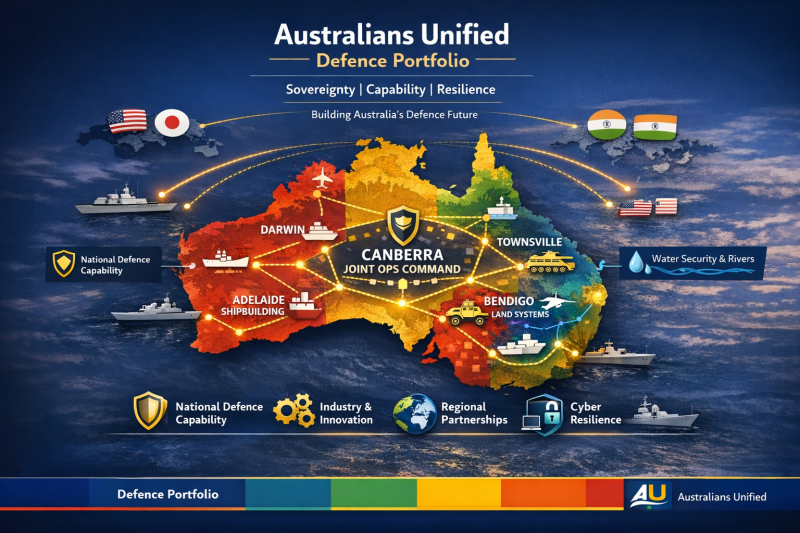
Department of Defence
Defence
Reform Stream: ADF‑Aligned Employment
-
Civilian and Reserve pathways
-
Disaster response and logistics roles
-
Cybersecurity and engineering trades Infographic Tile: ADF Reintegration Pathways
Protecting Australia’s Sovereignty, Security & Strategic Interests
The Department of Defence safeguards Australia’s people, borders, and national interests through a modern, capable, and resilient defence force. Its work ensures that Australia remains secure in an increasingly complex global environment, while supporting regional stability and strengthening alliances that underpin peace and prosperity.
National Defence Capability
What They Do
-
Maintain and modernise the Australian Defence Force (ADF)
-
Strengthen maritime, air, land, space & cyber capabilities
-
Deliver strategic planning & defence readiness
-
Support defence industry development & sovereign manufacturing
Why It Matters
-
Protects Australia’s borders and national sovereignty
-
Ensures readiness in a rapidly changing global environment
-
Strengthens deterrence and regional stability
-
Reduces reliance on foreign supply chains
Key Outputs
-
Defence capability plans
-
Force posture & readiness reports
-
Defence industry programs
-
Strategic threat assessments


Australian Defence Force (ADF)
AUSTRALIAN DEFENCE FORCE
Protecting Australia at Home & Abroad
What They Do
-
Land, air, maritime & joint operations
-
Rapid response & national defence readiness
-
Humanitarian & disaster relief
-
International peacekeeping missions
Why It Matters
-
Safeguards national sovereignty
-
Responds to crises and emergencies
-
Strengthens regional stability
-
Supports global security partnerships
Key Outputs
-
Operational deployments
-
Readiness reporting
-
Humanitarian missions
-
Defence capability delivery

Australian Signals Directorate (ASD)
AUSTRALIAN SIGNALS DIRECTORATE
Cyber Defence, Intelligence & Digital Security
What They Do
-
Cyber threat detection & defence
-
Signals intelligence (SIGINT)
-
Offensive cyber operations
-
Critical infrastructure protection
Why It Matters
-
Shields Australia from cyber attacks
-
Protects government & industry networks
-
Strengthens national digital resilience
-
Supports defence & intelligence operations
Key Outputs
-
Cyber threat intelligence
-
National cyber defence operations
-
SIGINT reporting
-
Infrastructure security programs

Capability Acquisition & Sustainment Group (CASG)
CAPABILITY ACQUISITION & SUSTAINMENT GROUP
Delivering & Maintaining Australia’s Defence Assets
What They Do
-
Procure ships, aircraft, vehicles & systems
-
Sustain defence platforms
-
Manage industry partnerships
-
Oversee lifecycle planning
Why It Matters
-
Ensures ADF capability is modern & reliable
-
Strengthens sovereign manufacturing
-
Reduces foreign dependency
-
Supports long‑term defence readiness
Key Outputs
-
Procurement programs
-
Sustainment schedules
-
Industry contracts
-
Capability lifecycle plans

Capability Acquisition & Sustainment Group (CASG)
CAPABILITY ACQUISITION & SUSTAINMENT GROUP
Delivering & Maintaining Australia’s Defence Assets
What They Do
-
Procure ships, aircraft, vehicles & systems
-
Sustain defence platforms
-
Manage industry partnerships
-
Oversee lifecycle planning
Why It Matters
-
Ensures ADF capability is modern & reliable
-
Strengthens sovereign manufacturing
-
Reduces foreign dependency
-
Supports long‑term defence readiness
Key Outputs
-
Procurement programs
-
Sustainment schedules
-
Industry contracts
-
Capability lifecycle plans
Joint Operations Command (JOC)
JOINT OPERATIONS COMMAND
Coordinating Australia’s Military Operations
What They Do
-
Command & control of ADF operations
-
Strategic logistics & deployment
-
International defence cooperation
-
Multi‑domain operational planning
Why It Matters
-
Ensures coordinated national defence
-
Strengthens global partnerships
-
Enables rapid response
-
Supports regional stability
Key Outputs
-
Operational plans
-
Deployment coordination
-
Joint training programs
-
Strategic logistics frameworks

WEAKNESSES BY CATEGORY — AUSTRALIAN DEFENCE FORCE

Australian Defence Force Headquarters (ADFHQ)
Weaknesses
-
Complex decision‑making layers slow down responsiveness during fast‑moving crises.
-
Heavy administrative burden reduces agility and operational focus.
-
Coordination challenges between strategic leadership and service‑level execution.
-
Resource competition across services can create internal bottlenecks.
-
Dependence on legacy systems limits real‑time data integration and situational awareness.

Joint Capabilities Group (JCG)
Weaknesses
-
High demand for specialised skills (cyber, intelligence, space) outpaces recruitment and training capacity.
-
Fragmented capability development across domains can lead to duplication or gaps.
-
Reliance on external contractors for critical technical functions reduces sovereign control.
-
Rapidly evolving technology makes it difficult to maintain up‑to‑date systems.
-
Interoperability issues between services and partner nations require constant alignment.

Joint Operations Command (JOC)
Weaknesses
-
Operational tempo pressures strain personnel and resources during prolonged missions.
-
Logistics vulnerabilities in supply chains, especially for remote or maritime operations.
-
Limited surge capacity for simultaneous domestic and international operations.
-
Dependence on ageing infrastructure at key operational hubs.
-
Complex multinational coordination can slow decision cycles during coalition operations.
PROPOSAL: Integrating ADF Engineering Capability Into National Infrastructure Planning
A lawful, strategic, and community‑focused model for Defence–Civil cooperation
Australia faces increasing infrastructure pressures — climate impacts, remote‑area access, supply‑chain fragility, and rising demand for resilient national assets. The Australian Defence Force (ADF), particularly its engineering and logistics elements, holds unique capabilities that can support national infrastructure outcomes without replacing civilian industry.
This proposal outlines a framework that respects legal boundaries while strengthening national resilience.
1. PURPOSE OF THE FRAMEWORK
To enable the ADF to:
-
Support national infrastructure resilience
-
Assist in remote, emergency, or strategic projects
-
Strengthen sovereign capability
-
Enhance whole‑of‑nation preparedness
- assist in nation energy & water grid
- create a work force through return to work education
…while ensuring the ADF does not compete with civilian construction sectors or assume state/territory responsibilities.
2. LEGAL & POLICY PRINCIPLES
This model operates under:
-
Defence Assistance to the Civil Community (DACC)
-
Defence Assistance to the Civil Authority (DACA)
-
Commonwealth emergency powers
-
National security infrastructure provisions
The ADF may support, but not replace, civilian infrastructure providers.
3. THE MODEL — “ADF INFRASTRUCTURE SUPPORT PARTNERSHIP” (AISP)
AISP is a structured, scalable partnership between:
-
Australians Unified
-
Department of Defence
-
State and Territory Governments
-
Local Councils
-
Civil engineering and construction industries
It has three operational streams:
STREAM 1 — Strategic National Infrastructure Support
(Long‑term, planned, non‑competitive)
ADF engineers contribute to planning and resilience for infrastructure that directly supports national security, such as:
-
Northern bases and dual‑use airfields
-
Strategic fuel and logistics hubs
-
Remote communications and radar sites
-
Disaster‑resilient transport corridors
ADF role: technical advice, planning input, environmental assessment, and limited construction support. Civilian role: primary construction and delivery.
STREAM 2 — Emergency & Disaster Infrastructure Response
(Rapid, lawful, high‑impact)
ADF engineers deploy when civilian capacity is overwhelmed:
-
Rebuilding washed‑out bridges
-
Restoring access roads
-
Constructing temporary shelters or field hospitals
-
Re‑establishing communications and power
-
Airfield repair after cyclones or fires
This is fully compliant with DACC provisions.
STREAM 3 — Remote & Indigenous Community Support
(Partnership‑based, culturally respectful)
ADF engineers assist in remote areas where civilian industry is limited or absent:
-
Water infrastructure
-
Access roads
-
Health and community facilities
-
Emergency airstrips
-
Environmental remediation
This supports Closing the Gap objectives and strengthens Defence’s regional relationships.
4. SAFEGUARDS TO PROTECT CIVILIAN INDUSTRY
To ensure no legal or economic conflict:
✔️ ADF cannot tender for civilian projects
No competition with private companies.
✔️ ADF involvement must be requested by government
Not self‑initiated.
✔️ ADF work must be non‑commercial
No profit, no market displacement.
✔️ Civilian industry remains the primary builder
ADF fills gaps, not roles.
✔️ All projects undergo civilian consultation
Industry, unions, and local government included.
5. BENEFITS TO AUSTRALIA
National Resilience
Stronger infrastructure in remote and disaster‑prone regions.
Sovereign Capability
Reduced reliance on foreign contractors for critical infrastructure.
ADF Readiness
Engineers gain real‑world experience that improves operational capability.
Community Trust
Visible, practical Defence support strengthens public confidence.
Economic Stability
Civilian industry remains the primary workforce.
6. IMPLEMENTATION ROADMAP
Phase 1 — Policy & Governance
-
Establish AISP governance board
-
Define legal boundaries and approval pathways
-
Create national infrastructure priority list
Phase 2 — Capability Mapping
-
Identify ADF engineering units suitable for civil support
-
Map civilian industry gaps
-
Develop joint training programs
Phase 3 — Pilot Projects
-
One northern region
-
One remote Indigenous community
-
One disaster‑prone region
Phase 4 — National Rollout
-
Annual infrastructure support plan
-
Integrated Defence–Civil exercises
-
Ongoing evaluation and reporting
7. THE AISP PROMISE
A stronger, safer, more resilient Australia — built through partnership, not competition. A Defence Force that supports communities while staying focused on its core mission. A nation where infrastructure, security, and community wellbeing are aligned.