Prime Minister and Cabinet
Prime Minister & Cabinet
Reform Stream: National Coordination
-
Cross‑portfolio integration
-
Capability planning and reform oversight
-
Public importance framing Infographic Tile: Campaign Architecture Map
To provide support to the Prime Minister, the Cabinet, portfolio ministers, and Assistant Ministers to improve the lives of all Australians, including through coordination of government activities, effective policy advice and development, and program delivery.
Additionally, fostering community engagement and public participation is essential in shaping policies that reflect the diverse needs of the Australian population. By promoting transparent communication channels and facilitating consultations, the government can ensure that citizens have a voice in decision-making processes. This collaborative approach not only enhances trust between the government and the community but also leads to more inclusive and effective policy outcomes that resonate with the public's expectations and aspirations.


WHY CHANGE IS NEEDED
Key challenges:
-
Increasing complexity of national and global risks
-
Fragmented policy coordination across portfolios
-
Slow, manual Cabinet and intergovernmental processes
-
Rising cyber, security and misinformation threats
-
Limited real‑time visibility of national performance
-
Overlap between central agencies and portfolio departments
If unchanged:
-
Slower national decision‑making
-
Reduced resilience to crises and emerging threats
-
Inefficient policy delivery and duplication
-
Lower public trust in government transparency
-
Weaker national coordination across states and territories

STRENGTHS
-
Central authority for national coordination and governance
-
Deep expertise across security, economic and social policy
-
Strong relationships with states, territories and agencies
-
Large datasets across national performance and risk
-
High public visibility and institutional trust

WEAKNESSES
-
Manual, slow Cabinet and policy processes
-
Fragmented systems across central agencies
-
Limited real‑time visibility of national risks
-
High administrative burden on departments
-
Overlap with Treasury, Home Affairs and Finance

THREATS
-
Cybersecurity risks to national governance systems
-
Rapid geopolitical and economic volatility
-
Misinformation and digital interference
-
Climate‑related national disruptions
-
Political or commercial influence undermining independence
OPPORTUNITIES
-
AI‑enabled policy modelling and national forecasting
-
National governance intelligence network
-
Digital tools for ministers, departments and states
-
Predictive modelling for security, economic and social risks
-
Stronger transparency and public trust
-
Whole‑of‑government efficiency uplift
- department of Business operations required
FUTURE PM&C MODEL (AI‑ENABLED, INDEPENDENT, NATIONAL COORDINATION)
Design principles:
-
One national coordination and strategic governance engine
-
AI‑supported policy modelling, forecasting and risk detection
-
Transparent, evidence‑based Cabinet and policy processes
-
Strong independence from political and commercial influence
-
Real‑time national performance visibility
Future functions:
-
National governance and policy intelligence network
-
Predictive modelling for economic, security and social trends
-
Digital self‑service tools for departments and ministers
-
Automated Cabinet, reporting and intergovernmental dashboards
-
Integrated national crisis, resilience and security platform
Business OPERATIONS — HOW PM&C FUNCTIONS DAY‑TO‑DAY
Core operational activities:
-
Cabinet Secretariat manages agendas, submissions, minutes and decision tracking
-
Policy divisions coordinate cross‑government reforms and national priorities
-
Crisis Coordination Centre monitors national risks and leads emergency response
-
Governance and Integrity teams oversee APS performance, standards and accountability
-
Intergovernmental Relations manages COAG‑style processes and national agreements
-
First Nations Affairs coordinates policy, funding and community partnerships
-
Corporate Services supports HR, finance, ICT, security and ministerial services
Operational characteristics:
-
High‑security, high‑confidentiality environment
-
Rapid response capability for national issues
-
Heavy reliance on interdepartmental coordination
-
Large volume of Cabinet, policy and intelligence workflows
-
Significant legislative, regulatory and governance responsibilities

COSTING MODEL (PHASED REFORM)
BASELINE FUNDING (REDUCED)
$1.10B per year (Reduced from $1.57B — 30% efficiency gain)
-
Reduced duplication across central agencies
-
Lower administrative overhead
-
Reduced consultant reliance
-
AI replaces repetitive Cabinet, reporting and analysis tasks
-
Streamlined national governance architecture
PHASE 1 — YEARS 1–2
$0.82B – $1.10B Foundation: Unify & Stabilise
-
AI pilots for policy modelling and national forecasting
-
Workflow automation across Cabinet, reporting and coordination
-
Consolidation of legacy central agency systems
-
Independent national governance board
-
Unified national governance data architecture
PHASE 2 — YEARS 2–4
$1.80B – $2.40B Acceleration: Modernise & Automate
-
AI‑enabled national performance and risk monitoring
-
Automated Cabinet, compliance and reporting workflows
-
Digital self‑service tools for ministers and departments
-
Automated national dashboards and modelling tools
-
Cyber‑resilience upgrades for central governance systems
PHASE 3 — YEARS 4–6
$1.40B – $1.90B Expansion: Strengthen Capability
-
National governance intelligence network
-
Real‑time economic, security and social dashboards
-
Workforce augmentation tools for central agencies
-
Transparency and audit upgrades
-
Expanded national resilience and digital governance systems
PHASE 4 — YEARS 6–10
$3.60B – $4.80B Future‑Ready: Transform & Protect
-
Fully automated Cabinet and reporting cycles
-
Predictive national risk, economic and security forecasting
-
AI‑enabled misinformation and threat detection
-
Integrated national governance ecosystem
-
Continuous optimisation of policy platforms
TOTAL INVESTMENT
6‑Year Total: $4.02B – $5.40B 10‑Year Total: $7.92B – $10.20B
Outcome: A lean, AI‑enabled, politically‑independent PM&C delivering faster, safer, more transparent and more coordinated national governance for all Australians.
TRATEGIC ROADMAP (HOW CHANGE HAPPENS)
PHASE 1 — FOUNDATION (Years 1–2)
-
Merge overlapping central agency and governance functions
-
Reduce duplicated staffing and systems
-
Deploy workflow automation
-
Begin AI pilots for national forecasting and risk modelling
-
Build unified national governance data architecture
-
Establish independent governance oversight board
Outcome: Lower cost, unified direction, reduced political influence.
PHASE 2 — ACCERATION (Years 2–4)
-
AI‑enabled national monitoring and forecasting
-
Automated Cabinet and compliance workflows
-
Digital self‑service tools for ministers and departments
-
Automated reporting and governance dashboards
-
Strengthened cyber‑resilience
Outcome: Higher capacity with fewer resources.
PHASE 3 — EXPANSION (Years 4–6)
-
Whole‑of‑government adoption of AI tools
-
National governance intelligence network
-
Real‑time economic, security and social dashboards
-
Workforce augmentation tools
-
Enhanced transparency and public reporting
Outcome: Stronger sovereign governance capability.
PHASE 4 — FUTURE‑READY (Years 6–10)
-
Fully automated Cabinet and reporting cycles
-
Predictive national risk and economic modelling
-
AI‑enabled misinformation and threat forecasting
-
Integrated national governance ecosystem
-
Continuous system improvement
Outcome: A modern, resilient, future‑ready national governance system.
What we do
OSTING MODEL (PHASED REFORM)
BASELINE FUNDING (REDUCED)
$1.10B per year (Reduced from $1.57B — 30% efficiency gain)
-
Reduced duplication across central agencies
-
Lower administrative overhead
-
Reduced consultant reliance
-
AI replaces repetitive Cabinet, reporting and analysis tasks
-
Streamlined national governance architecture
PHASE 1 — YEARS 1–2
$0.82B – $1.10B Foundation: Unify & Stabilise
-
AI pilots for policy modelling and national forecasting
-
Workflow automation across Cabinet, reporting and coordination
-
Consolidation of legacy central agency systems
-
Independent national governance board
-
Unified national governance data architecture
PHASE 2 — YEARS 2–4
$1.80B – $2.40B Acceleration: Modernise & Automate
-
AI‑enabled national performance and risk monitoring
-
Automated Cabinet, compliance and reporting workflows
-
Digital self‑service tools for ministers and departments
-
Automated national dashboards and modelling tools
-
Cyber‑resilience upgrades for central governance systems
PHASE 3 — YEARS 4–6
$1.40B – $1.90B Expansion: Strengthen Capability
-
National governance intelligence network
-
Real‑time economic, security and social dashboards
-
Workforce augmentation tools for central agencies
-
Transparency and audit upgrades
-
Expanded national resilience and digital governance systems
PHASE 4 — YEARS 6–10
$3.60B – $4.80B Future‑Ready: Transform & Protect
-
Fully automated Cabinet and reporting cycles
-
Predictive national risk, economic and security forecasting
-
AI‑enabled misinformation and threat detection
-
Integrated national governance ecosystem
-
Continuous optimisation of policy platforms
TOTAL INVESTMENT
6‑Year Total: $4.02B – $5.40B 10‑Year Total: $7.92B – $10.20B
Outcome: A lean, AI‑enabled, politically‑independent PM&C delivering faster, safer, more transparent and more coordinated national governance for all Australians.

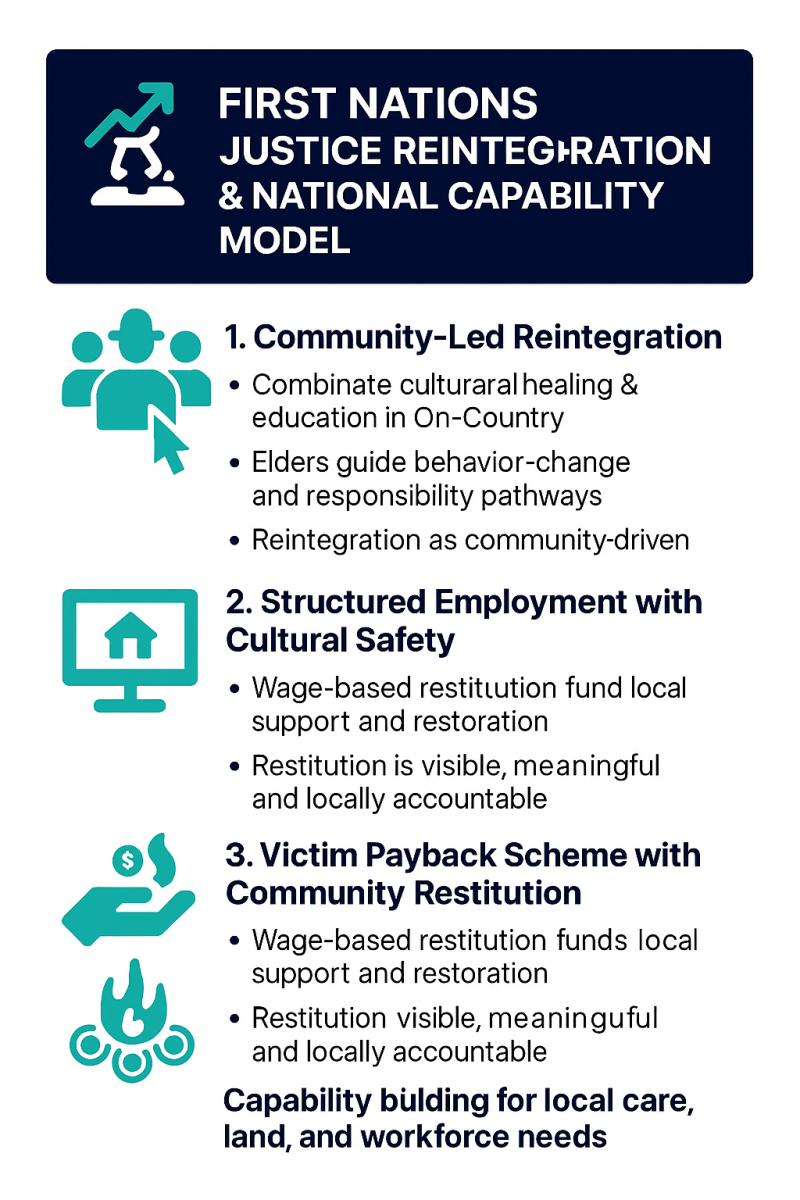
How First Nations communities benefit
1. Community‑Led Reintegration
-
Justice‑involved First Nations individuals can return to on‑Country programs that combine cultural healing with structured education and employment.
-
Elders and local leaders guide behaviour‑change, restorative justice, and responsibility pathways.
-
Reintegration becomes community‑driven, not system‑imposed.
2. Structured Employment with Cultural Safety
-
Remote work and ADF‑aligned roles can be tailored to local industries, regional logistics, disaster response, and community infrastructure.
-
Training and employment pathways are delivered with cultural safety, language support, and local mentoring.
3. Victim Payback Scheme with Community Restitution
-
Wage‑based restitution can be directed to local victim support services, healing programs, or community restoration projects.
-
Restitution becomes visible, meaningful, and locally accountable.
4. Capability Building for Local Economies
-
Training streams in construction, cyber, logistics, care, and agriculture directly strengthen First Nations workforce capacity.
-
Apprenticeships and micro‑credentials can be delivered on‑Country, reducing barriers to participation.
5. Reduced Re‑offending through Cultural Integration
-
Education inside custody includes First Nations history, identity, and healing modules.
-
Community‑based orders allow offenders to contribute to local projects, land care, and cultural programs.
How to embed First Nations leadership
-
Co‑design every program stream with First Nations communities.
-
Fund local justice reintegration hubs led by Elders and community organisations.
-
Ensure data sovereignty and local control over outcomes and evaluation.
-
Create First Nations advisory panels across Defence, Justice, Employment, and Social Services portfolios.