Delivering transparent government through responsibility, systemic reform and clear outcomes. Within the Australians Unified Governance Framework, the accountability portfolio ensures public institutions remain answerable to all Australian citizens across federal, state and local responsibilities.

The accountability portfolio links key reform areas directly to the Five Governance Pillars. By establishing transparent lines of responsibility from parliamentary chambers to local community operations, we ensure public functions serve real community priorities with measurable integrity.

True reform requires robust checks, balances and independent scrutiny. We articulate how departmental obligations, statutory authorities and public agencies maintain institutional transparency, eliminating bureaucracy and strengthening direct public oversight.

Accountability is defined by real-world delivery. By mapping department actions to tangible benchmarks across the Commonwealth, our portfolio framework empowers everyday Australians to understand, evaluate and shape national progress.
While portfolio overviews establish an educational foundation for understanding government functions, portfolio breakdown reports provide rigorous assessments of governance arrangements. They examine the practical operation of accountability mechanisms—including parliamentary scrutiny and integrity agencies—and evaluate performance against national priorities and the long-term maintenance of public trust.
A further central focus is interagency coordination. The effective delivery of government outcomes frequently depends on multiple portfolios working collaboratively across shared priorities, including disaster resilience, housing, health, infrastructure and economic development. Portfolio breakdown reports can identify overlapping responsibilities, limitations in information sharing and funding arrangements that create service gaps. These insights support decision-makers to strengthen collaboration and deliver more coordinated, coherent and effective public services.
Each report provides a rigorous assessment of operational environments, principal institutional risks, regulatory obligations, and emerging digital governance considerations. Through measured evaluation across the Five Governance Pillars, our analysis identifies practical, evidence-based pathways for maintaining transparent, accountable decision-making aligned with the public interest.
We also assess stakeholder engagement and organisational capability, evaluating how effectively institutions communicate with communities, respond to feedback, and prepare their teams to manage change. This broader perspective enables leaders to strengthen public trust, enhance service delivery, and establish governance frameworks that remain resilient as expectations, technologies, and public needs continue to evolve.
Understanding how taxpayer funds support transparency, governance, oversight and public accountability across the Australian Government. The Accountability Portfolio ensures responsible decision-making, financial stewardship and enduring public trust.
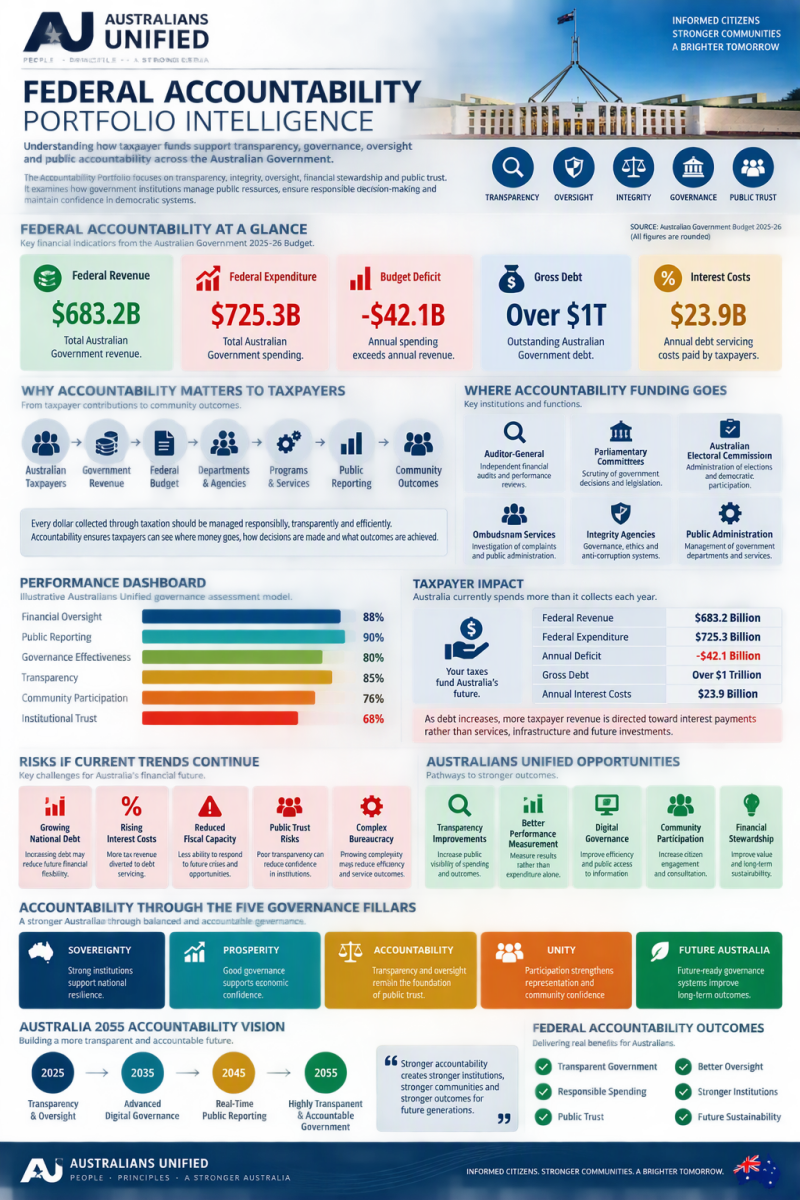
With annual federal expenditure reaching $725.3 billion against $683.2 billion in revenue, rigorous oversight through the Auditor-General and parliamentary committees ensures every taxpayer dollar is independently reviewed, eliminating waste and restoring democratic accountability.
With gross national debt surpassing $1 trillion and annual interest costs exceeding $23.9 billion, unchecked spending diverts essential resources away from frontline services. Strong fiscal accountability safeguards economic sovereignty and long-term capability.
Australians Unified champions modern governance systems that transition public administration toward real-time public reporting, open data access, and streamlined regulatory frameworks that empower direct citizen participation and institutional trust.
Accountability is the vital linchpin connecting Sovereignty, Prosperity, Unity and Future Australia. By linking institutional scrutiny directly to measurable outcomes, we ensure Australian public administration delivers enduring value for everyday taxpayers.
🟢 Australians Unified Opportunities
- Improve Transparency & Reporting
- Measure Performance & Outcomes
- Modernise Digital Governance
- Increase Community Participation
- Strengthen Financial Stewardship
🇦🇺 AU Governance Matrix
🛡️ Sovereignty → Strong Institutions
📈 Prosperity → Economic Confidence
⚖️ Accountability → Transparency & Oversight
🤝 Unity → Participation & Representation
🚀 Future Australia → Future-Ready Governance
AU Summary
Australia currently spends more than it collects, carries more than $1 trillion in gross debt, and spends approximately $23.9 billion annually servicing debt. The Accountability Portfolio exists to ensure taxpayer funds are managed transparently, responsibly, and in a way that delivers measurable outcomes for current and future generations.
The Five Governance Pillars
Every government portfolio can be linked to one or more of the Australians Unified Governance Pillars.

🛡 Sovereignty
Protect Australia
Portfolios focused on national security, defence, border protection, foreign affairs, and national resilience.
Primary Portfolios
- Defence
- Home Affairs
- Foreign Affairs & Trade
- Veterans' Affairs
- Prime Minister & Cabinet
Key Reform Areas
- Defence
- Border Security
- Veterans
- Emergency Management
- National Security
Explore Sovereignty Portfolios →

💰 Prosperity
Build Australia
Portfolios focused on economic growth, infrastructure, industry, agriculture, employment, and long-term prosperity.
Primary Portfolios
- Treasury
- Finance
- Infrastructure
- Agriculture
- Employment
- Industry, Science & Resources
Key Reform Areas
- Infrastructure
- Energy
- Industry
- Employment
- Cost of Living
- Small Business
Explore Prosperity Portfolios →

⚖ Accountability
Govern Australia
Portfolios focused on justice, transparency, public trust, integrity and responsible government.
Primary Portfolios
- Attorney-General
- Australian Federal Police
- Electoral Commission
- Integrity Agencies
- Ombudsman
Key Reform Areas
- Crime
- Justice
- Courts
- Police
- Electoral Integrity
- Government Transparency
Explore Accountability Portfolios →

🤝 Unity
Support Australians
Portfolios focused on health, education, housing, disability services, and community wellbeing.
Primary Portfolios
- Health & Aged Care
- Education
- Social Services
- Housing
- NDIS
- Families & Communities
Key Reform Areas
- Health
- Mental Health
- Housing
- Education
- Disability
- Child Safety
🚀 Future Australia
Prepare Australia
Portfolios focused on science, technology, innovation, cyber security, and future capability.
Primary Portfolios
Key Reform Areas
Explore Future Australia Portfolios →
Australians Unified Perspective
Portfolios are where governance becomes action. They connect reform priorities with the departments, agencies and public services responsible for delivering outcomes for Australians.
By linking portfolios to the Governance Matrix, Australians Unified provides a clear pathway from understanding government responsibilities to exploring reform opportunities, policy development and community outcomes.
Understand Government → Explore Reform → Understand Responsibility → Build Better Outcomes. 🇦🇺
This page becomes the front door to all portfolio pages, just as the Reform Overview page became the front door to all reform areas.
State and territory governments play a critical role in maintaining institutional integrity across public services, operational agencies, and parliamentary decision-making. Through independent oversight bodies, state auditing offices, and dedicated ombudsman services, our federal system ensures spending is examined, administrative disputes are resolved fairly, and public sector governance remains transparent and lawful.
Operating alongside anti-corruption bodies and parliamentary oversight committees, these state accountability mechanisms systematically protect public trust and prevent misconduct. Together, they establish clear standards of conduct, ensure the responsible use of community resources, and strengthen democratic confidence for Australians in every state and territory.
State Government Responsibilities
State & Territory Role
State and Territory Governments play a critical role in maintaining accountability across public services, government operations and parliamentary decision-making. They help ensure government actions remain transparent, lawful and responsive to the communities they serve.
State accountability systems support public trust by providing independent oversight, reviewing government performance, and investigating concerns about public administration.
State Auditing Bodies
State auditing bodies independently review government finances, programs and operations.
Their role includes:
- Examining government spending
- Assessing value for money
- Monitoring financial accountability
- Reporting findings to Parliament
- Identifying opportunities for improvement
These reviews help ensure public resources are managed responsibly and transparently.

State Ombudsman Services
Ombudsman offices provide independent investigation and dispute resolution services.
Their role includes:
- Investigating complaints about government agencies
- Reviewing administrative decisions
- Supporting fair treatment of citizens
- Identifying systemic issues within public services
- Recommending improvements
Ombudsman services help strengthen fairness, transparency and public confidence.

Integrity Commissions
Integrity commissions monitor standards of conduct within government and public administration.
Their role includes:
- Promoting ethical behaviour
- Monitoring integrity systems
- Preventing misconduct
- Supporting public sector accountability
- Improving governance standards
These agencies help maintain confidence in public institutions.

Anti-Corruption Bodies
Anti-corruption agencies investigate serious misconduct and corruption risks within public institutions.
Their responsibilities may include:
- Investigating corruption allegations
- Reviewing public sector conduct
- Identifying governance weaknesses
- Providing corruption prevention advice
- Supporting integrity improvements
Strong anti-corruption systems help protect public trust and government integrity.

Parliamentary Oversight Committees
Parliamentary committees examine government activities and public administration in detail.
Their role includes:
- Reviewing legislation
- Investigating public issues
- Examining government decisions
- Gathering evidence from stakeholders
- Producing reports and recommendations
Committees help ensure governments remain accountable to Parliament and the public.

Auditor-General Offices
Independent bodies that assess how effectively public resources are managed and how government programs perform.

Ombudsman Offices
Investigate complaints and concerns about government departments, agencies, and public services.

Independent Integrity Agencies
Support ethical governance, monitor conduct, and investigate serious integrity issues.

Public Accountability Frameworks
The laws, standards, reporting systems, and governance processes that help ensure transparency, responsibility, and public oversight across government.
Community Outcome
Together, these accountability mechanisms help:
- Protect public trust
- Strengthen transparency
- Improve governance
- Support ethical decision-making
- Ensure responsible use of public resources
- Maintain confidence in democratic institutions
Understanding transparency, governance, oversight and stewardship across Victoria's public institutions. Examining how taxpayer funds are managed, decisions are monitored and institutions remain accountable to Victorian communities.
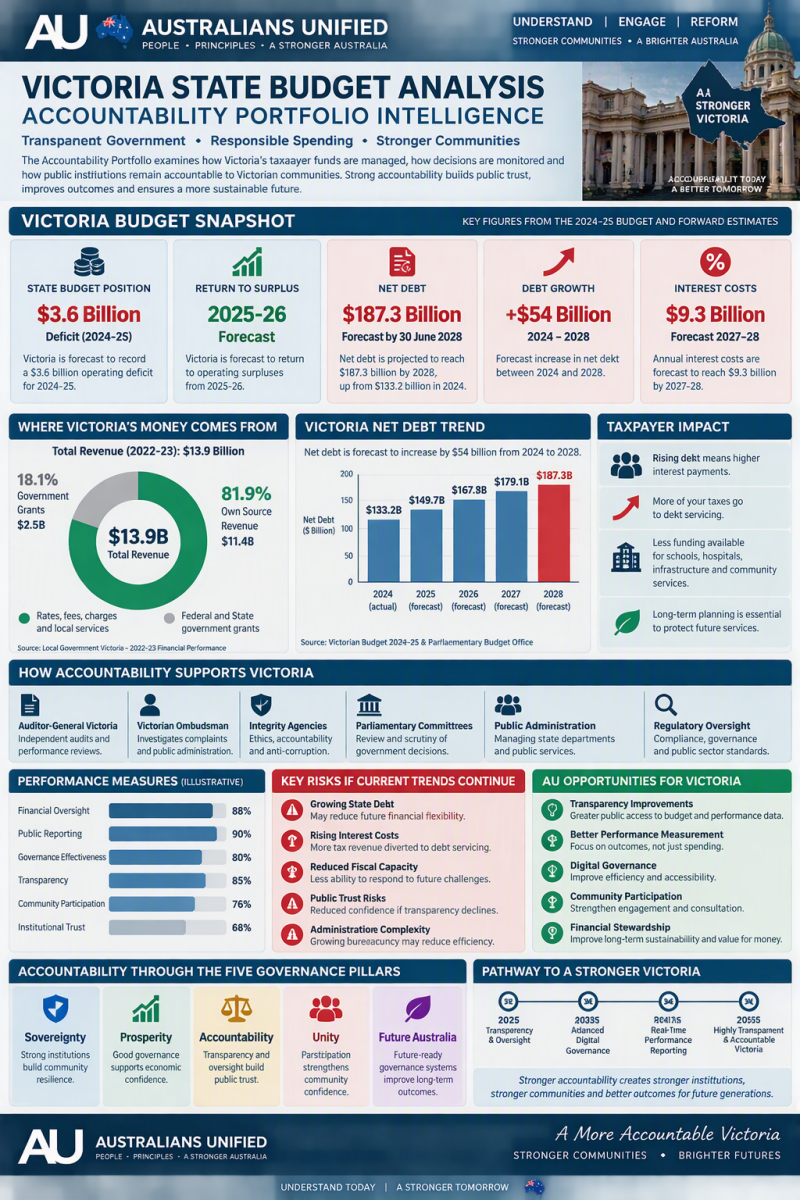
Victoria forecast a $3.6 billion operating deficit in 2024-25 as state spending continues to outpace revenue. Responsible fiscal oversight and transparent financial controls are essential to stabilize public finances before returning to sustainable operating balances.
Forecast net debt is projected to surge by +$54 billion to reach $187.3 billion by June 2028. Annual interest expenses climbing toward $9.3 billion divert critical taxpayer funding away from frontline healthcare, education and regional infrastructure.
Modernising Victorian governance through open digital reporting, independent audit enforcement and outcome-based performance metrics. Restoring institutional transparency ensures taxpayers directly monitor where funds are allocated and how services perform.
Anchored in Sovereignty, Prosperity, Unity and Future Australia, our 2055 Accountability Vision transitions Victoria toward real-time public reporting and participatory oversight, creating resilient public institutions for future generations.
State Accountability Intelligence - Key Takeaways
- 💰 Victoria recorded a forecast $3.6 billion operating deficit in 2024-25 while continuing to fund essential public services and infrastructure.
- 📈 Victoria's net debt is forecast to increase from $133.2 billion to $187.3 billion by 2027-28, an increase of approximately $54 billion.
- 💸 Annual interest costs are forecast to reach $9.3 billion, meaning more taxpayer contributions will be directed towards servicing debt rather than frontline services and future investment.
- ⚖️ State accountability systems, including the Auditor-General, Ombudsman, Integrity Agencies and Parliamentary Committees, help ensure public resources are managed transparently and responsibly.
- 🔴 Key risks include growing debt, rising interest costs, reduced future budget flexibility and increasing pressure on health, education, housing and infrastructure services.
- 🟢 Key opportunities include stronger governance, improved transparency, better performance reporting, digital accountability systems and more effective stewardship of public resources.
Local governments support accountability by ensuring decisions affecting neighbourhoods and municipalities remain transparent, accessible, and responsive to community priorities. While local councils do not typically manage standalone integrity commissions like federal or state tiers, they maintain vital governance obligations that promote direct community participation, ethical representation, and public trust.
Through structured public consultation, open council meetings, published budgets, and strategic municipal planning, councils operate under defined legislative standards. Independent audit and risk committees alongside transparent registers ensure community assets are stewarded responsibly, strengthening democratic accountability across Australian communities.
Local Government Responsibilities
Community Role
Local Governments support accountability by ensuring decisions affecting local communities are transparent, accessible and responsive to residents.
While Local Governments generally do not operate large independent integrity systems like Federal or State Governments, they have important governance obligations designed to promote responsible decision-making, community participation and public trust.

Public Consultation
Local Governments provide opportunities for residents to participate in community decision-making.
This may include:
- Community consultation
- Public submissions
- Strategic planning feedback
- Community engagement programs
- Public exhibitions of proposed plans
These processes help ensure local decisions consider community views and priorities.

Council Meetings
Councils conduct formal meetings where elected representatives debate and vote on local matters.
Council meetings support accountability through:
- Open decision-making
- Public agendas
- Published minutes
- Community observation opportunities
- Recorded decisions
This helps residents understand how decisions are made.
Council Meetings
Provide visibility of local decision-making and governance activities.

Financial Reporting
Local Governments are responsible for reporting on how public funds are collected, managed, and spent.
This generally includes:
- Annual budgets
- Financial statements
- Annual reports
- Performance reporting
- Public disclosure requirements
Financial reporting promotes responsible stewardship of community resources.
Annual Reports
Explain council performance, activities, and financial outcomes.

Strategic Planning
Councils develop plans that help guide the future of their municipalities.
These plans may include:
- Council Plans
- Municipal Strategies
- Community Vision Statements
- Infrastructure Plans
- Asset Management Plans
Strategic planning helps align community aspirations with future development priorities.
Community Consultation Programs
Allow residents to contribute to local planning and decision-making.

Governance & Compliance
Councils operate under legislative and governance frameworks established by State Governments.
Responsibilities may include:
- Ethical conduct standards
- Conflict of interest management
- Procurement governance
- Record keeping
- Policy compliance
- Risk management
These obligations help maintain public confidence and organisational integrity.
Public Registers & Disclosures
Provide access to important council information, policies and declarations.
Audit & Risk Committees
Many councils maintain independent committees that assist with financial oversight, governance and risk management.

Community Representation
Councillors are elected to represent local communities and advocate for local needs.
Their responsibilities include:
- Representing residents
- Participating in council decisions
- Supporting community priorities
- Providing local leadership
- Promoting community wellbeing
Strong representation strengthens local democracy and community participation.
Community Outcomes
Effective local accountability helps support:
- Transparent Decision-Making
- Community Trust
- Public Participation
- Responsible Financial Management
- Better Local Services
- Stronger Community Representation
- Improved Governance
Local accountability ensures councils remain connected, responsive, and answerable to the communities they serve.
Understanding how councils maintain transparency, governance, oversight and public trust. The Accountability Portfolio focuses on ensuring councils remain transparent, accountable and answerable to the communities they serve through rigorous financial reporting, independent audit committees, public consultation and measurable stewardship.
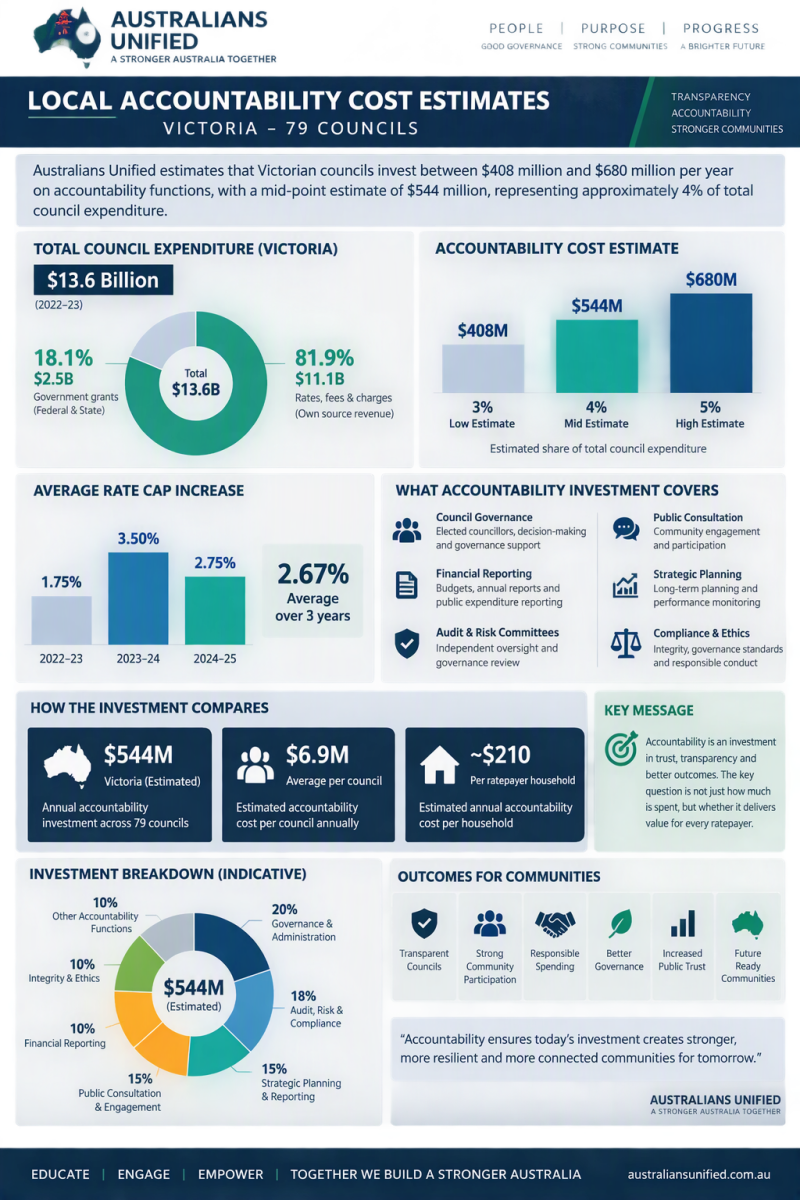
Across Victoria's 79 municipal councils, estimated accountability investment sits at approximately $544 million annually (representing 4% of total local government expenditure, within an estimated range of $408M to $680M). With 81.9% of funding sourced directly from ratepayers via rates, fees and charges, and an average annual rate cap of 2.67%, strong oversight ensures every dollar is accounted for.
Accountability investment is targeted across core governance functions: elected councillor oversight and decision-making, audited financial reporting, independent audit and risk committees, structured public consultation, compliance and ethics integrity systems, and strategic municipal planning aligned with community needs.
Without rigorous transparency, councils face serious systemic challenges: declining community trust from opaque decisions, governance complexity stifling delivery, limited public participation weakening democratic representation, poor performance reporting obscuring results, and weak asset oversight generating long-term financial liabilities.
Our reform roadmap introduces real-time transparency dashboards, modern digital governance frameworks, and outcome-based performance metrics. By elevating community engagement and stewardship standards, we ensure Victorian ratepayer funds deliver visible, measurable outcomes for current and future generations.
Local Accountability Intelligence - Key Takeaways
- ⚖️ Australians Unified estimates Victorian councils invest between $408 million and $680 million annually in accountability functions, with a working midpoint estimate of $544 million, representing approximately 4% of total council expenditure.
- 💰 81.9% of council revenue comes directly from rates and fees, meaning accountability systems are largely funded by local ratepayers.
- 📈 Average council rate cap increases over the last three years were 2.67% per annum (1.75%, 3.50%, and 2.75%).
- 🏛️ Accountability investment supports council governance, financial reporting, audit and risk committees, public consultation, strategic planning, compliance, and ethical governance.
- 🔍 Estimated accountability investment equates to approximately $6.9 million per council annually across Victoria's 79 councils.
- 🔴 Key risks include declining public trust, poor performance reporting, increasing governance complexity, limited community participation and inadequate oversight of long-term assets.
- 🟢 Key opportunities include transparency dashboards, digital governance, stronger community engagement, outcome-based reporting and improved stewardship of ratepayer funds.
- ✅ The goal of the Accountability Pillar is simple: ensure every ratepayer dollar is managed transparently, responsibly, and delivers measurable outcomes for the community.