
AUSTRALIANS UNIFIED OVERVIEW
BUSINESS SYSTEM REFORM BLUEPRINT
Fixing the fragmented machinery of Australia’s economy
Australia's business environment is shaped by seven separate federal entities, each controlling a pillar of the economy. This leads to slow approvals, conflicting rules, high costs, and lack of accountability.
Australians Unified will rebuild this system from the ground up.
AUSTRALIANS UNIFIED — BUILDING A NATION THAT WORKS
Australia has every advantage — talent, resources, stability, and a proud history. However, our economic systems are fragmented and burdened by bureaucracy. Seven federal entities control the rules that shape our economy, yet none collaborate.
Australians Unified is dedicated to rebuilding national productivity.
Below is our blueprint for an effective business system.
1. A STRONG, FAIR ECONOMIC SYSTEM
Treasury — Economic Rules & Market Conditions
Australia's economy is hindered by complex taxes and weak competition.
Australians Unified will:
-
Simplify business taxes and reduce compliance burdens
-
Strengthen competition laws
-
Apply foreign investment rules
-
Develop long-term economic modeling
A fair economy that rewards work and innovation.
2. A NATION THAT BUILDS AND MAKES THINGS
Industry, Science & Resources — National Capability & Growth
Australia exports raw materials but imports finished goods, leaving our manufacturing base hollow.
Australians Unified will:
-
Build local processing and manufacturing capacity
-
Develop a national industrial strategy
-
Stabilise innovation funding
-
Keep critical minerals onshore for value-added production
A self-reliant Australia.
3. A MODERN, SKILLED WORKFORCE
Employment & Workplace Relations — Workforce & Skills
Businesses face complex laws and skills shortages.
Australians Unified will:
-
Simplify workplace laws while protecting workers
-
Create a national skills pipeline
-
Modernise TAFE and apprenticeships
-
Fast-track skilled visas for critical sectors
A workforce prepared for today's and tomorrow's industries.
4. INFRASTRUCTURE THAT KEEPS AUSTRALIA MOVING
Infrastructure, Transport & Regional Development — National Backbone
Our roads, rail, ports, and digital networks are struggling to keep up.
Australians Unified will:
-
Implement independent project selection
-
Construct modern freight corridors
-
Upgrade regional roads and rail
-
Ensure universal high-speed connectivity
Infrastructure that supports growth.
5. STRONG REGIONAL INDUSTRIES & FOOD SECURITY
Agriculture, Fisheries & Forestry — Regional Economy & Exports
Farmers face rising costs and unfair market power.
Australians Unified will:
-
Enhance biosecurity with modern surveillance
-
Reform water management for food security
-
Ensure fair markets for farmers
-
Upgrade rural infrastructure
A resilient regional Australia.
6. SECURE TRADE, SKILLED MIGRATION & CYBER PROTECTION
Home Affairs — Workforce Access & Trade Security
Australia’s supply chains and migration systems are slow and vulnerable.
Australians Unified will:
-
Implement fast-skilled migration
-
Enhance national cybersecurity
-
Streamline trade compliance
-
Build supply chain resilience
A secure economic system.
7. A SIMPLE, FAIR TAX SYSTEM FOR BUSINESS
Australian Taxation Office — Financial Reality of Business
SMEs are overwhelmed by paperwork.
Australians Unified will:
-
Simplify GST and reporting
-
Speed up dispute resolution
-
Streamline superannuation compliance
-
Upgrade digital tax systems
Less paperwork. More productivity.
THE AUSTRALIANS UNIFIED PROMISE
Australia's business systems are fragmented and slow. We commit to a National Business & Industry Framework that aligns all federal entities under one strategy — ensuring clear approvals, strong planning, modern infrastructure, regional investment, and sovereign capability.
One system. One strategy. One accountable government. A nation that builds. A nation that grows. A nation that works.
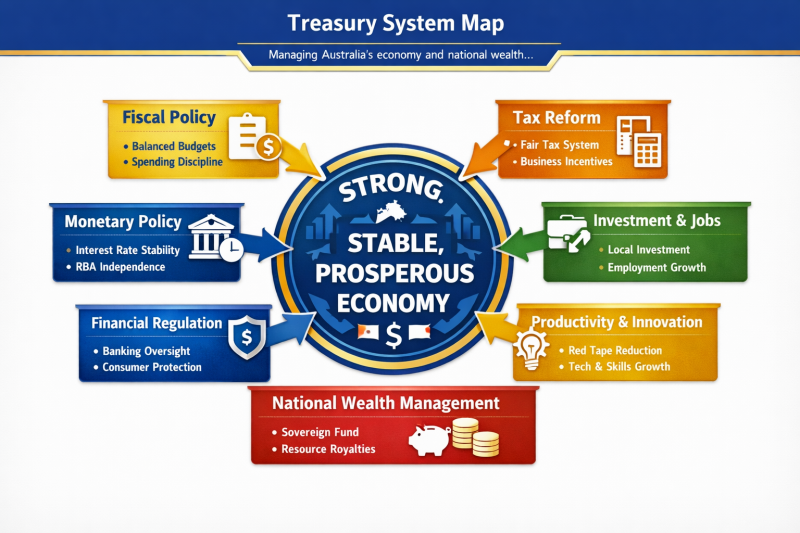

TREASURY — Economic Rules & Market Conditions
The Problem
-
Tax settings are complex and uncompetitive.
-
Competition policy is weak; major sectors are dominated by a few players.
-
Foreign investment rules lack strategic clarity.
-
Economic forecasting is reactive, not strategic.
Australians Unified Reform
-
Simplify business tax and reduce compliance burden.
-
Strengthen competition laws to break up market concentration.
-
Strategic foreign investment rules protecting national interests.
-
Long‑term economic modelling tied to sovereign capability and productivity.

-
INDUSTRY, SCIENCE & RESOURCES — National Capability & Growth
The Problem
-
Australia exports raw materials instead of value‑added products.
-
Manufacturing base hollowed out.
-
Innovation funding unstable and bureaucratic.
-
Critical minerals strategy underdeveloped.
Australians Unified Reform
-
Build sovereign processing and manufacturing capacity.
-
National industrial strategy focused on energy, defence, agriculture, and tech.
-
Stable innovation funding with commercialisation pathways.
-
Critical minerals kept onshore for value‑added production.
-

EMPLOYMENT & WORKPLACE RELATIONS — Workforce & Skills
The Problem
-
Fair Work system too complex for small business.
-
Skills shortages across construction, agriculture, mining, and tech.
-
Training system fragmented and outdated.
-
Skilled visa system slow and unpredictable.
Australians Unified Reform
-
Simplify workplace laws while protecting workers.
-
National skills pipeline aligned with industry needs.
-
Modernise TAFE and apprenticeships for emerging industries.
-
Fast, targeted skilled visa pathways for critical sectors.

INFRASTRUCTURE, TRANSPORT & REGIONAL DEVELOPMENT — National Backbone
The Problem
-
Major projects plagued by cost blowouts and delays.
-
Freight networks outdated and inefficient.
-
Regional infrastructure decades behind demand.
-
Digital connectivity gaps hurting rural business.
Australians Unified Reform
-
Independent, transparent project selection.
-
National freight corridors linking ports, rail, and regions.
-
Rebuild regional roads, bridges, and rail.
-
Universal high‑speed digital connectivity.
THE CORE SYSTEM FAILURE
Australia’s business environment is fragmented across seven departments
causing:
-
Slow approvals
-
Conflicting regulations
-
High compliance costs
-
Weak accountability
-
Poor coordination
-
Lost investment
-
Reduced competitiveness
This fragmentation is a national economic risk.
THE AUSTRALIANS UNIFIED SOLUTION
A National Business & Industry Framework that:
-
Aligns all seven departments under shared goals
-
Sets national standards for approvals, regulation, and coordination
-
Reduces duplication and red tape
-
Strengthens sovereign capability
-
Supports regional development
-
Drives productivity and competitiveness
One system. One strategy. One accountable government.

AGRICULTURE, FISHERIES & FORESTRY — Food Security & Regional Economy
The Problem
-
Biosecurity threats increasing.
-
Water insecurity and over‑extraction.
-
Farmers squeezed by supermarket and processor dominance.
-
Labour shortages and high input costs.
Australians Unified Reform
-
Modern biosecurity with real‑time surveillance.
-
Water reform protecting long‑term food production.
-
Fairer markets through competition reform.
-
Agricultural workforce strategy + regional infrastructure upgrades.

HOME AFFAIRS — Workforce Access, Trade & Security
The Problem
-
Skilled visa system slow and unpredictable.
-
Cybersecurity threats rising faster than capability.
-
Border and trade compliance inconsistent.
-
Supply chain vulnerabilities exposed by global shocks.
Australians Unified Reform
-
Fast, targeted skilled migration for critical industries.
-
National cybersecurity uplift for business and government.
-
Streamlined trade compliance to reduce delays and costs.
-
National supply chain resilience strategy.

AUSTRALIAN TAXATION OFFICE — Financial Reality of Business
The Problem
-
High compliance burden for small and medium businesses.
-
Complex GST and reporting requirements.
-
Slow dispute resolution.
-
Superannuation compliance burdensome for employers.
- Opposes profit shifting via fees, royalties, and charges that escape taxation.
Australians Unified Reform
-
Simplify GST and reporting for SMEs.
-
Faster, fairer dispute resolution.
-
Streamlined superannuation compliance.
-
Digital‑first business tax systems.
- Multinationals must pay their fair share of tax while operating in Australia
-
Close loopholes that allow multinationals to report low taxable income.
-
Align with sovereign capability and national revenue protection.
National capabilities cost and return on investment Ev cars and super grid systems
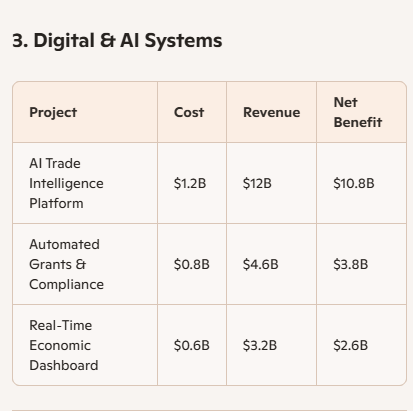
Business Services Budget & Revenue
Australians Unified • Foreign Affairs & Trade Portfolio
Sovereign Capability • AI‑Enabled Trade • National Economic Engine
Purpose
The Business Services Department is the economic accelerator of Australians Unified — unifying trade, approvals, grants, compliance, and export intelligence into one AI‑enabled, politically‑independent system that drives national growth.
10‑Year Financial Outlook
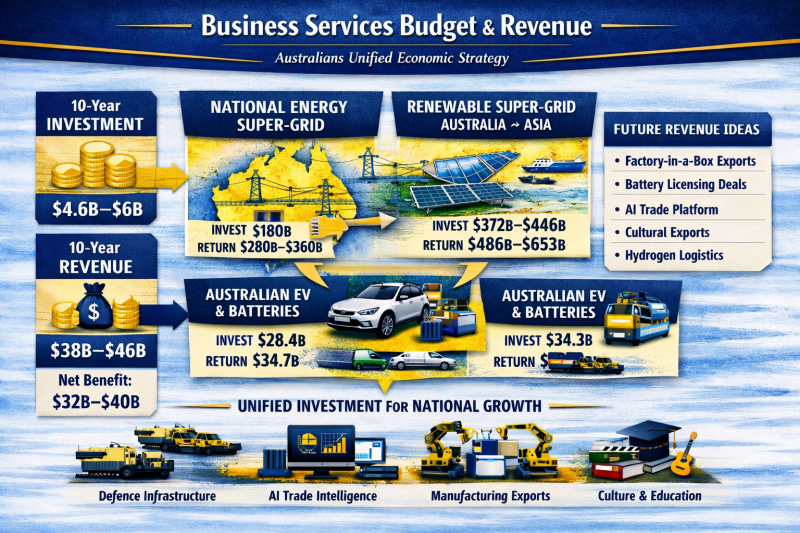
Budget Investment (10 Years)
$4.58B–$5.96B
Revenue Potential (10 Years)
$38B–$46B
Net Benefit
$32B–$40B
Integrated National Infrastructure Revenue Streams
⚡ National Energy Super‑Grid
-
Investment: $180B
-
Revenue: $280B–$360B
-
Net Benefit: $100B–$180B
☀️ Renewable Super‑Grid (Australia → Asia)
-
Investment: $372B–$446B
-
Revenue: $486B–$653B
-
Net Benefit: $114B–$207B
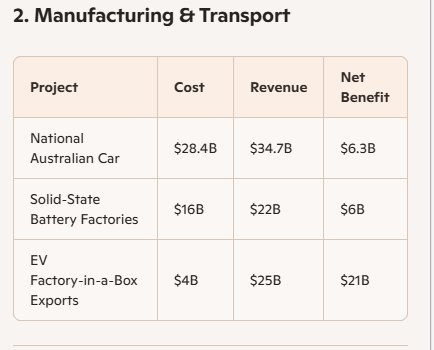
🚗 National Australian Car + Solid‑State Batteries
-
Investment: $28.4B
-
Revenue: $34.7B
-
Net Benefit: $6.3B
Core Functions
-
Unified trade approvals
-
AI‑enabled export intelligence
-
Automated grants & compliance
-
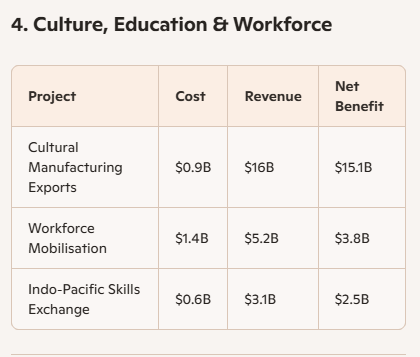
National workforce mobilisation
-
Cross‑portfolio economic modelling
-
Indo‑Pacific trade corridor integration
Strategic Outcomes
-
Faster approvals
-
Lower cost of government
-
Higher export volume
-
Stronger sovereign capability
-
Transparent, real‑time economic performance

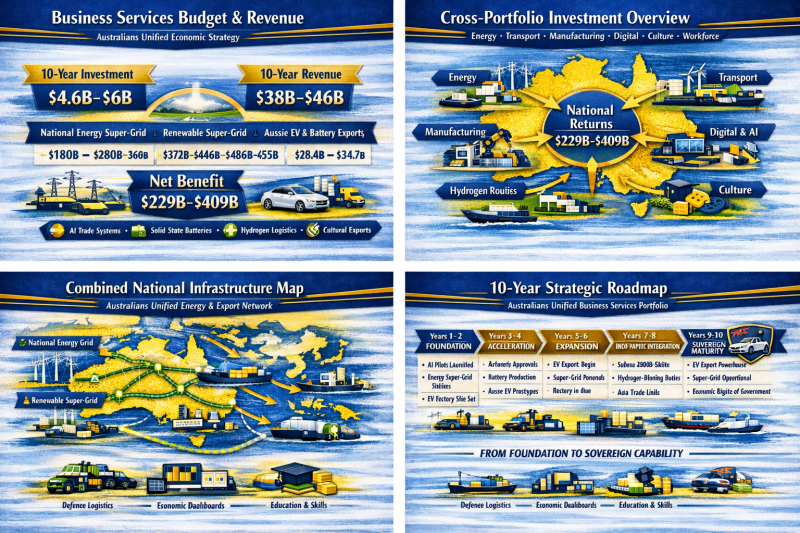

10‑YEAR STRATEGIC MAP (TEXT VERSION)
A decade of sovereign capability building
Years 1–2 — Foundation
-
Merge Business Services functions
-
Deploy AI pilots for trade & compliance
-
Begin National Energy Super‑Grid planning
-
Establish EV factory sites (Geelong, Newcastle, Townsville, Whyalla)
Years 3–4 — Acceleration
-
Launch automated grants & export approvals
-
Begin solid‑state battery production
-
Start National Australian Car prototype builds
-
Begin hydrogen corridor construction
-
Deploy real‑time economic dashboards
Years 5–6 — Expansion
-
Full EV assembly lines operational
-
Export EVs to ASEAN, India, Pacific
-
Super‑Grid Stage 1 online
-
Launch Factory‑in‑a‑Box exports
-
Cultural manufacturing export program begins
Years 7–8 — Indo‑Pacific Integration
-
Subsea cable links to Singapore & Japan
-
Hydrogen shipping lanes operational
-
AI trade intelligence platform fully deployed
-
Workforce mobilisation pipeline at scale
Years 9–10 — Sovereign Maturity
-
Australia becomes Indo‑Pacific EV & battery hub
-
Super‑Grid fully operational
-
National Australian Car in mass export
-
Business Services becomes the economic engine of government
-
Total net national benefit exceeds $229B–$409B

Our history
From modest beginnings, we've grown through unwavering dedication and a commitment to continuous improvement. Each step has reinforced our core belief in the power of collaboration and the importance of integrity. We're passionate about what we do, and we're excited to share our story with you.

Policy implemetation and development
Introduce an Infrastructure Bank
Government Infrastructure Bonds will be used to fund the Construction of Sovereign Assets through an Infrastructure Bank.
Introduce an Infrastructure Bank to be managed by the RBA in conjunction with Treasury. The Bank will issue bonds to either the federal or state government for seven infrastructure assets. These are dams, baseload power stations and transmission lines, road, rail, ports, airports, and telecommunications.
Monetary policy is not being used effectively in Australia. As a result, there is a chronic underinvestment in infrastructure. Infrastructure can drive productivity and provides essential services. Australia’s monetary policy solely relies on qualitative easing which is insufficient to deal with underlying economic structural issues. The RBA should also use quantitative easing in the form of infrastructure bonds to finance infrastructure that is vital to Australia’s economic and sovereign security. Unlike qualitative easing which predominantly impacts demand, the use of infrastructure bonds increases the supply of goods and services without having to use foreign debt.
Restore a Public Retail Bank & Insurance Office
People First are calling on the reinstatement of a public bank, similar to the old Commonwealth Bank. A public bank will ensure that bank branches stay open, so people can access essential banking services.
The last three decades have seen rapid decline in the number of bank branches, particularly in the regions. This has had a detrimental impact on many small towns as businesses and residents must travel large distances to access banking services.
While the internet has enabled some services to be conducted online, not all services can be performed online. Furthermore, some regions cannot access the internet. Many of my constituents, especially retirees, are uncomfortable using online banking due to scam concerns. The People First Party believes banking is an essential service and that a public bank be run by the government to ensure universal banking for all.
Banking services could be provided in existing post offices using the payment systems of the RBA.
The Australian Government sold the Commonwealth Bank for $8 billion in the 1990’s, and now it makes $10 billion a year. Banks are closing thousands of branches, leaving people unable to access proper banking services.
We are now seeing banks charge fees for those who want to withdraw and deposit cash.
State Governments sold their Insurance Offices in the 1990’s. This has resulted in less competition and rapidly escalating Insurance costs leaving people without affordable Insurance.
People First will advocate to reintroduce a Public Bank and Government Insurance Office so that Australians can access affordable financial services which like health and education are essential services.
Repatriate Australia’s Gold from the Bank of England
Australia’s gold needs to be secured in Australia.
The RBA has never been able to explain why it is necessary to store Australia’s gold with the Bank of England. There are serious concerns about the security of Australia’s gold given audit reports into Australia’s gold holdings are not fully disclosed. These concerns have been further exacerbated by the RBA releasing documents stating that the Bank of England has detected the presence of fake gold bars and duplicate serial numbers amongst their gold holdings. There are also genuine concerns about the leasing of Australia’s gold holdings, which acts against the interests of Australia’s gold producers who contribute tens of billions in exports and employ thousands of people.
What are the major taxation problems in Australia today?
Answer: Australia’s tax system is widely seen as complex, inefficient, and unfairly weighted, creating pressure on households and businesses. Key issues include:
-
Bracket creep pushing workers into higher tax bands
-
High effective tax rates on low and middle‑income earners
-
Multinational tax avoidance reducing national revenue
-
Over‑reliance on income tax instead of diversified revenue
-
Inefficient state taxes (stamp duty, payroll tax)
-
ATO enforcement gaps enabling fraud and non‑compliance
-
Complicated rules that burden small businesses and families
These problems contribute directly to cost‑of‑living pressure, which is addressed in the
Answer: Australians Unified supports a simpler, fairer, sovereign tax system that reduces pressure on working families and strengthens national capability. Reform directions include:
-
Simplifying the tax system to reduce compliance costs
-
Reducing bracket creep through indexation
-
Strengthening ATO enforcement to close loopholes
-
Cracking down on multinational tax avoidance
-
Shifting away from inefficient state taxes
-
Increasing the tax‑free threshold
-
Aligning tax settings with national‑interest industries
These reforms are detailed in the 👉 Treasury Reform & Modernisation page
What Treasury‑style reforms does Australians Unified support?
Answer: Australians Unified supports a Treasury‑aligned reform package including:
-
Tax system simplification
-
Fairer personal taxation
-
Stronger ATO enforcement
-
National‑interest tax settings
-
State tax modernisation
These reforms are outlined in the 👉 Treasury Reform & Modernisation page:
How does taxation reform link to other Australians Unified reforms?
Answer: Tax reform directly supports:
-
Cost of Living Reform
-
Housing Reform
-
Energy & Manufacturing Sovereignty
-
Immigration & Workforce Planning
-
GDP, Debt & Fiscal Integrity
-
ATO Modernisation
-
Treasury Reform & Modernisation
TREASURY
Jobs Saved → Education Pathways
Freed‑up APS roles transition into:
-
Economics
-
Digital payments
-
Taxation
-
Financial modelling
-
Sovereign finance operations
Updated Skilled Jobs Needed: 4,700
(Down from 5,400)
Staffing Cost Estimate: $412M annually
Workforce Sources:
-
Unemployment: Finance graduates, data analysts
-
Immigration: Economists, fintech specialists
-
APS Redeployment: Modelling, compliance, digital payments
Economic Effects During the Buy‑Back Australia Process
Transitioning from foreign control to sovereign prosperity
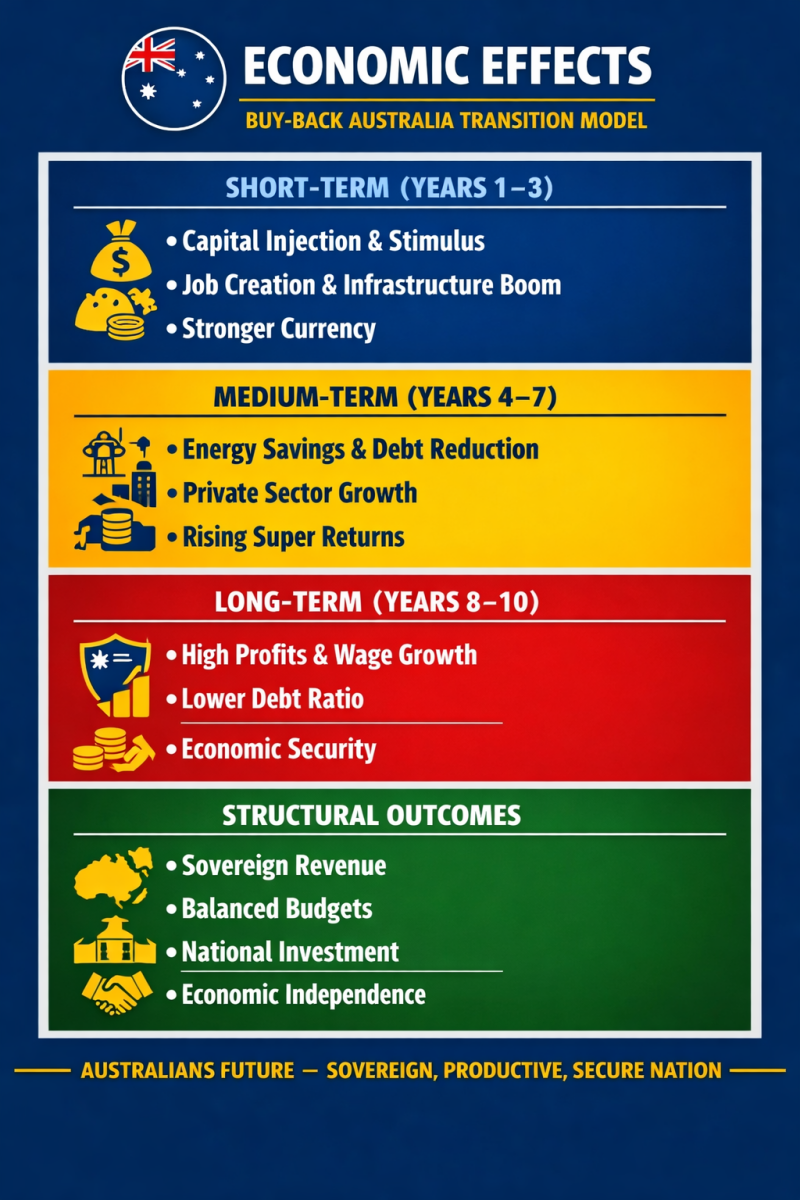

1️⃣ Short‑Term (Years 1–3) — Investment & Stabilisation
-
Capital injection: $392.5 B buy‑back financed through sovereign bonds and superannuation investment.
-
Immediate stimulus: Infrastructure, energy, and logistics sectors expand; GDP growth lifts by ~1.2 %.
-
Employment surge: Construction, engineering, and manufacturing absorb displaced admin labour.
-
Currency stability: Sovereign ownership reduces foreign profit outflows, strengthening the AUD.

2️⃣ Medium‑Term (Years 4–7) — Productivity & Paydown
-
Energy Super‑Grid cuts national power costs 20–30 %, lowering inflation.
-
Debt paydown: 60 % of profits redirected to reduce national debt ($411 B by Year 10).
-
Private‑sector expansion: Domestic firms reinvest in sovereign supply chains.
-
Superannuation returns: Members gain higher yields from productive, onshore assets.

3️⃣ Long‑Term (Years 8–10) — Sovereign Growth
-
Annual profit: $68.5 B from national enterprises; $26 B from the Super‑Grid alone.
-
Debt‑to‑GDP ratio: Falls from 38 % to 28 %.
-
Wages: Rise 22–28 % as productivity and domestic manufacturing strengthen.
-
National resilience: Australia becomes energy‑secure, export‑competitive, and fiscally independent.

4️⃣ Structural Outcomes
-
Foreign profit extraction replaced by sovereign dividends.
-
Public finance stabilised through predictable infrastructure returns.
-
Private investment aligned with national priorities.
-
Economic sovereignty restored — Australia owns its future.