HEALTH, DISABILITY & AGEING PORTFOLIO — OVERVIEW
Strengthening Australia’s health system, protecting vulnerable communities, and ensuring dignity across every stage of life.
Australia’s health, disability and ageing systems are essential to national wellbeing — but they face rising pressures. From workforce shortages to ageing demographics, chronic disease, disability system strain, and escalating costs, the portfolio requires strong leadership, modern systems, and long‑term planning.
The Health, Disability & Ageing Portfolio is committed to delivering a fair, modern, accessible, and sustainable system for all Australians.
OUR MISSION IN HEALTH, DISABILITY & AGEING
Australia doesn’t need more fragmentation — it needs clarity, coordination, and capability.
A strong health system. A fair disability system. A safe, dignified ageing system. A workforce supported to care. A nation protected from health threats.
We are a country with world‑class potential — but demographic, economic, and global pressures demand proactive reform.
Today, we assert: Our commitment to the health and wellbeing of Australians is unwavering. It’s time to strengthen the foundations of our national care systems.
PURPOSE & ROLE
The Health, Disability & Ageing Portfolio leads Australia’s national approach to:
-
Health system performance & hospital funding
-
Primary care, mental health & preventive health
-
Disability support, NDIS stewardship & inclusion
-
Aged care safety, quality & workforce capability
-
Public health, disease prevention & emergency response
It supports individuals, families, carers, providers, and communities while safeguarding Australia’s long‑term wellbeing.
CHALLENGES — KEY OVERVIEW
1. Ageing Population & System Demand
-
Rising demand for aged care & chronic disease management
-
Workforce shortages across health & care sectors
-
Increasing pressure on hospitals & primary care Core problem: Demand is outpacing system capacity.
2. Disability System Sustainability
-
NDIS cost pressures
-
Provider quality variation
-
Workforce shortages Core problem: The system must remain fair, sustainable, and high‑quality.
3. Health Workforce Shortages
-
Burnout, attrition & ageing workforce
-
Regional workforce gaps
-
Training pipeline misalignment Core problem: Workforce capability is the backbone of system performance.
4. Fragmented Health & Care Systems
-
Poor integration between hospitals, primary care, disability & aged care
-
Inefficient data systems Core problem: Fragmentation reduces quality and increases cost.
5. Public Health Threats
-
Infectious disease risks
-
Chronic disease burden
-
Mental health crisis Core problem: Prevention and preparedness must be strengthened.
6. Regulatory Complexity
-
Multiple regulators
-
Inconsistent standards
-
Slow compliance processes Core problem: Regulation must protect people without hindering providers.

AGEING POPULATION & SYSTEM DEMAND
Challenge: Rising demand, workforce shortages, hospital pressure.
Our Solution:
-
Expand community‑based care
-
Strengthen chronic disease management
-
Modernise aged care models
-
Boost workforce training & retention

DISABILITY SYSTEM SUSTAINABILITY
Challenge: NDIS cost growth, quality variation, workforce gaps. Our Solution:
-
Strengthen NDIS integrity & governance
-
Improve provider quality & safeguarding
-
Support workforce capability & training
-
Expand early intervention & community supports

HEALTH WORKFORCE CAPABILITY
Challenge: Shortages, burnout, regional gaps.
Our Solution:
-
National workforce strategy
-
Training pipeline reform
-
Incentives for regional & priority areas
-
Digital tools to reduce admin burden
SYSTEM FRAGMENTATION
Challenge: Poor integration across health, disability & ageing. Our Solution:
-
Unified digital health records
-
Integrated care pathways
-
Shared data & performance systems
-
Cross‑portfolio coordination
PUBLIC HEALTH & BIOSECURITY
Challenge: Disease threats, chronic disease, mental health. Our Solution:
-
Stronger surveillance & emergency response
-
Preventive health investment
-
Mental health reform
-
National vaccination & screening programs
REGULATION & SAFETY
Challenge: Complex, inconsistent, slow. Our Solution:
-
Streamlined regulation
-
Digital‑first compliance
-
Stronger safeguarding
-
National quality standards

REGULATION & SAFETY
Challenge: Complex, inconsistent, slow. Our Solution:
-
Streamlined regulation
-
Digital‑first compliance
-
Stronger safeguarding
-
National quality standards
STRATEGIC PRIORITIES
-
Strengthen National Health System Performance
-
Ensure Sustainable, High‑Quality Disability Support
-
Reform Aged Care for Safety, Dignity & Choice
-
Build a Modern, Capable Health & Care Workforce
-
Enhance Public Health, Prevention & Biosecurity
-
Modernise Regulation & Digital Health Systems
PUBLIC‑FACING SUMMARY TILE
🇦🇺 Health, Disability & Ageing Portfolio Protecting the wellbeing of Australians through strong health systems, fair disability support, and safe, dignified ageing.
Our Focus:
-
Strong health system performance
-
Sustainable disability support
-
Safe, high‑quality aged care
-
Modern workforce capability
-
Public health & biosecurity
-
Digital health transformation

HEALTH, DISABILITY & AGEING PORTFOLIO
COST vs SAVINGS MODEL — 10‑YEAR OUTLOOK
Modernising Australia’s care systems while reducing long‑term cost pressures.
🔵 1. CURRENT COST BURDEN (BLUE — Status Quo)
Fragmented systems, rising demand, and duplicated programs increase long‑term costs.
10‑Year Estimated Cost Burden:
-
$12.4B — Hospital pressure from avoidable admissions
-
$6.1B — Fragmented disability & aged‑care programs
-
$4.7B — Workforce shortages & agency staffing
-
$3.3B — Outdated digital systems & manual processes
-
$2.8B — Regulatory duplication across health, disability & aged care
Total Estimated Cost (10 years):
$29.3B
🟡 2. SAVINGS FROM A UNIFIED, MODERNISED PORTFOLIO (YELLOW — Savings)
Integrated care, digital systems, and workforce reform reduce long‑term expenditure.
10‑Year Estimated Savings:
-
$8.2B — Reduced hospital demand via prevention & community care
-
$5.0B — Integrated disability & aged‑care systems
-
$3.4B — Workforce stabilisation & reduced agency reliance
-
$2.1B — Digital health integration & automated processes
-
$1.8B — Streamlined regulation & compliance
Total Estimated Savings (10 years):
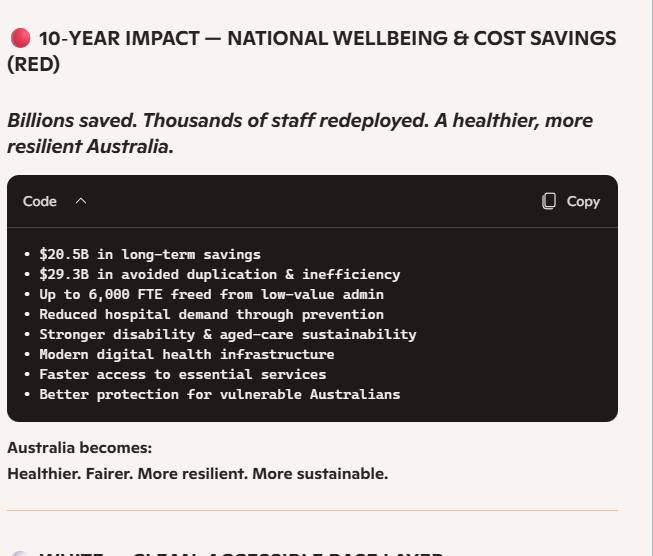
$20.5B
🟦 3. NET FISCAL IMPACT (TEAL — Efficiency Gains)
A more efficient, sustainable care system.
-
Status Quo Cost: $29.3B
-
Reform Savings: $20.5B
Net Reduction in Long‑Term Cost:
$20.5B saved
Net Avoided Waste:
$29.3B avoided duplication & inefficiency
🔴 4. WORKFORCE IMPACT (RED — Capability Uplift)
A stronger, more stable care workforce.
Workforce Gains Over 10 Years:
-
Up to 6,000 FTE freed from duplicated admin
-
Reduced agency staffing costs
-
More staff in frontline care roles
-
Better training & retention outcomes
-
Improved regional workforce distribution
Outcome: A more capable, stable, and sustainable care workforce.
⚪ 5. NATIONAL OUTCOMES (WHITE — Public Benefit)
Better care, lower cost, stronger national wellbeing.
-
Reduced hospital pressure
-
Stronger disability & aged‑care quality
-
Faster access to services
-
Better protection for vulnerable Australians
-
Modern digital health systems
-
A more sustainable NDIS
-
A healthier, more resilient population
Australia gains:
A fairer, safer, more sustainable care system for every stage of life.

HEALTH & DISABILITY (SOCIAL SERVICES)
Jobs Saved → Education Pathways
Freed‑up APS roles transition into:
-
Digital health
-
Disability support
-
Care workforce fundamentals
-
Service modernisation
-
Community engagement
Updated Skilled Jobs Needed: 3,000
(Down from 3,400)
Staffing Cost Estimate: $265M annually
Workforce Sources:
-
Unemployment: Care workforce, admin, community services
-
Immigration: Nurses, allied health, disability specialists
-
APS Redeployment: Digital health operations, service delivery