Future Australia governance framework
National capability, innovation and future readiness pillar
Preparing Australia for 2037, 2050 and beyond, Future Australia serves as our nation's primary pillar for sovereign development. Its core mandate ensures Australia systematically builds the people, knowledge, advanced technologies, vital industries, workforce capacity and strategic foresight essential for intergenerational prosperity, national resilience and global competitiveness.
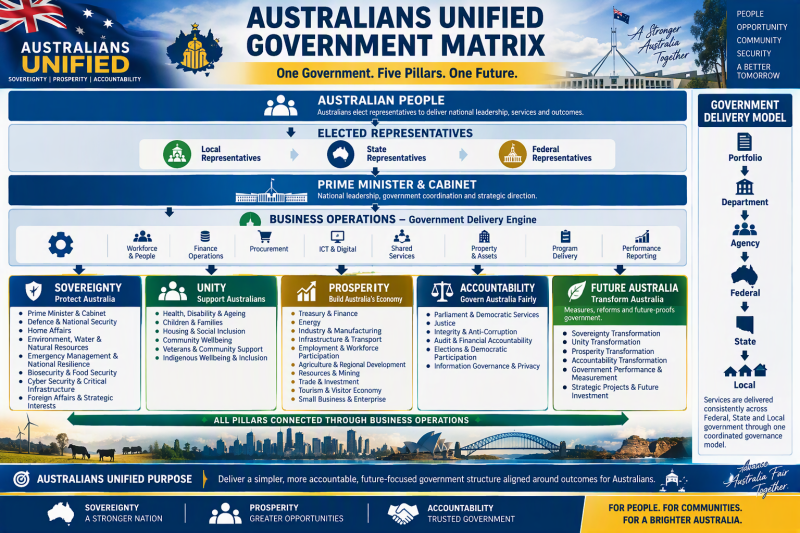
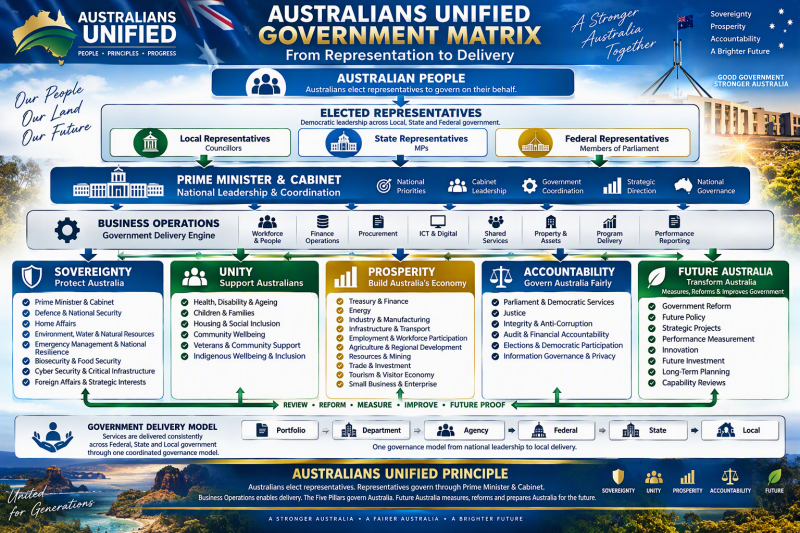
Operating at the apex of the Australians Unified Governance Matrix, Future Australia coordinates directly with the core supporting pillars: Prosperity, Sovereignty, Unity and Accountability to ensure balanced, whole-of-nation readiness.
Integrated portfolio structure and delivery cascade
Strategic delivery is organised into a unified operational cascade designed to translate vision into measurable outcomes across all tiers of Australian life:
Future Australia
↓ Department of Business Operations
↓ National Capability System
↓ Future People System
↓ Knowledge System
↓ Technology System
↓ Future Industries System
↓ Future Government System
↓ Federal Government → State Governments → Local Government → Communities and Citizens
Detailed breakdown of the Future Australia systems
Explore the four core operational tiers that build sovereign capability, human potential, breakthrough research, and next-generation technologies under the central coordination of the Department of Business Operations.
Tier 1: national capability system
Tier 1 drives strategic foresight, macro capability modelling, and intergenerational planning. Spearheaded by the National Capability Authority, National Future Readiness Commission, Strategic Futures Australia, and the Future Australia Delivery Office, it tracks key benchmarks including the National Capability Index, Future Readiness Index, Megatrends Analysis, and Australia 2050 and 2100 Frameworks.
Tier 2: future people system
Focusing on human potential across all life stages, Tier 2 aligns early learning through executive governance. Key entities include Future Generations Australia, Education Australia, Skills Australia, Future Workforce Australia, Leadership Australia, and Future Communities Australia—coordinating school readiness, VET and trade pipelines, community innovation, and lifelong learning.
Tier 3: knowledge system
Tier 3 accelerates scientific discovery and commercialisation. Comprising Science Australia, Research Australia, Innovation Australia, STEM Australia, and Biotechnology Australia, this pillar powers national laboratories, university research translation, start-up precincts, engineering pathways, genomics, precision medicine, and synthetic biology.
Tier 4: technology system
Securing Australia’s technological frontier, Tier 4 unites Digital Australia, Artificial Intelligence Australia, Robotics Australia, Quantum Australia, Space Australia, and Future Technologies Australia. Together, they deploy advanced AI standards, sovereign satellite launch systems, quantum computing, industrial robotics, semiconductors, and advanced materials.
Tiers 5 and 6: future industries and future government
Australia’s future capability pipeline must extend beyond education, skills and research into the industries, infrastructure and public systems that put national capability to work. Tier 5 builds strategic industrial capacity across advanced manufacturing, the blue economy, sustainability and infrastructure. Tier 6 provides the data, digital services and intergovernmental coordination needed to plan and deliver these priorities as one connected national system.

Manufacturing Capability Australia
Tier 5: Future Industries System
Manufacturing Capability Australia is a direct extension of the capability pipeline gaps identified in the Education Portfolio. It would build the advanced manufacturing base Australia needs by coordinating advanced manufacturing, engineering pipelines, automation capability and industry workforce forecasting.
National focus: connect education, trade and engineering pathways with modern factories, automation and long-term industry workforce demand.

Blue Economy Australia
Tier 5: Future Industries System
Blue Economy Australia would develop Australia’s ocean-based capability and opportunity through marine technology, ocean science, aquaculture innovation, offshore energy and maritime research.
National focus: strengthen the knowledge, technology, workforce and research partnerships required for a productive, sustainable and globally competitive maritime economy.

Sustainability and infrastructure futures
Tier 5: Future Industries System
Future Sustainability Australia would lead circular economy development, resource security, water innovation and climate adaptation technologies. Future Infrastructure Authority would coordinate smart cities, transport futures, utility futures, infrastructure forecasting and strategic infrastructure planning.
National focus: build resilient, resource-secure systems and plan the infrastructure Australia needs before capability gaps become constraints.

Future Government System
Tier 6: Future Government System
National Data & Intelligence Authority, aligned with the National Data & Intelligence Office, would manage national data systems, population modelling, predictive analytics and capability intelligence. Digital Government Australia, aligned with the Digital Government Office, would deliver government platforms, digital services, government automation and citizen services. Intergovernmental Relations Authority, aligned with the Intergovernmental Relations Office, would coordinate Federal, State and Local government, national reform agreements and shared service frameworks.
Australia’s future portfolio breakdown
Four nationally aligned portfolios build the foundations for Australia’s future: excellent education, job-ready skills, a secure and adaptable workforce, and world-class scientific capability. Together, they connect learning, training, workforce planning and research to stronger outcomes for every Australian.

Education Australia
Purpose: Build Australia’s future learners.
Responsible for: school education, curriculum development, educational standards, teacher excellence, educational equity and future learning systems.
Gold standard programs: National Future Curriculum, AI Literacy Program, National Robotics Program, Digital Learning Framework, Teacher Excellence Program and Future Schools Initiative.
Outcomes: higher student achievement, future skills development and stronger educational outcomes.

Skills Australia
Purpose: Build Australia’s future skills.
Responsible for: TAFEs, apprenticeships, trade training, technical skills, industry pathways and skills forecasting.
Gold standard programs: National Apprenticeship Network, Future Trades Program, Industry Skills Councils, Advanced Technical Training and the National Skills Dashboard.
Outcomes: reduced skills shortages, stronger workforce readiness and higher participation.

Future Workforce Australia
Purpose: Forecast and prepare Australia’s workforce needs.
Responsible for: workforce intelligence, labour forecasting, workforce mobility, future occupations and strategic workforce planning.
Gold standard programs: National Workforce Observatory, Future Jobs Forecasting, Workforce Transition Framework and National Talent Pipeline.
Outcomes: future workforce security, better workforce planning and reduced labour shortages.

Science Australia
Purpose: Strengthen Australia’s scientific capability.
Responsible for: national science programs, scientific research, strategic science priorities, national research infrastructure and scientific education.
Gold standard programs: National Science Mission Program, Scientific Infrastructure Fund, Strategic Research Program and National Research Laboratories.
Outcomes: world-class research, scientific leadership and knowledge generation.
Australia’s future portfolios: innovation, research, digital and AI
Portfolios 5–8 create the national capability Australia needs to turn ideas into outcomes. Together, Innovation Australia, Research Australia, Digital Australia and Artificial Intelligence Australia connect enterprise, discovery, digital participation and responsible technology growth.

Innovation Australia
Purpose: Translate ideas into capability.
Responsible for: start-ups, commercialisation, venture development, innovation precincts and emerging industries.
Gold standard programs: National Innovation Fund, Industry Accelerator Program, Innovation Precinct Network and Start-Up Growth Framework.
Outcomes: more start-ups, commercial success and industry diversification.

Research Australia
Purpose: Coordinate long-term research capability.
Responsible for: research funding, research translation, university partnerships, industry partnerships and national research priorities.
Gold standard programs: National Research Framework, Research Translation Fund, University-Industry Collaboration Network and Future Capability Research Program.
Outcomes: higher commercialisation, greater research impact and better industry connection.

Digital Australia
Purpose: Build national digital capability.
Responsible for: digital literacy, software capability, cloud infrastructure, national data systems and digital inclusion.
Gold standard programs: Digital Nation Program, National Digital Skills Framework, Community Digital Inclusion Program and Government Digital Transformation Network.
Outcomes: digital competitiveness, national productivity and higher digital participation.

Artificial Intelligence Australia
Purpose: Prepare Australia for the AI era.
Responsible for: AI research, AI standards, AI workforce development, AI adoption, AI governance and AI commercialisation.
Gold standard programs: National AI Mission, AI Skills Program, Government AI Framework, Responsible AI Standards and AI Innovation Network.
Outcomes: AI capability leadership, higher productivity and technology growth.
Australia’s future portfolios: space, technology and STEM
Portfolios 9–11 align sovereign space capability, next-generation technology and a national STEM talent pipeline. Together, they help Australia build the research, manufacturing, workforce and export capacity required to lead in future industries.

Space Australia
Purpose: Build sovereign space capability.
Responsible for: space industry development, satellite systems, space research, space manufacturing, launch capability and the space workforce.
Gold standard programs: Australian Space Growth Program, Sovereign Satellite Network, Space Workforce Academy and Launch Capability Framework.
Outcomes: space industry growth, sovereign capability and export development.

Future Technologies Australia
Purpose: Develop Australia’s next-generation technologies.
Responsible for: quantum computing, robotics, semiconductors, advanced materials, biotechnology and emerging technologies.
Gold standard programs: Quantum Australia Initiative, National Robotics Program, Advanced Materials Fund and Future Industries Mission.
Outcomes: technology leadership, sovereign capability and future industry creation.

STEM Australia
Purpose: Build Australia’s future talent pipeline.
Responsible for: STEM education, the STEM workforce, STEM participation, STEM scholarships and industry partnerships.
Gold standard programs: National STEM Strategy, Girls in STEM Program, STEM Excellence Scholarships and Regional STEM Networks.
Outcomes: higher STEM participation, a larger STEM workforce and national capability growth.

Connected national capability
Portfolio alignment: STEM talent supplies the people and partnerships needed for quantum, robotics, biotechnology and other emerging technologies. Those technologies, in turn, strengthen satellite systems, space research, manufacturing and launch capability.
National result: an integrated pathway from education and scholarships to research, industry growth, sovereign capability and export-ready future industries.
Department of Business Operations: strategic coordination for Future Australia
The proposed Department of Business Operations is the centrepiece of the Future Australia governance model: Australia’s Strategic Coordination Authority. Rather than operating as a conventional department, it aligns national priorities, portfolios, programs and delivery across government so long-term capability becomes practical outcomes for communities, regions and the nation.

Strategic coordination authority
Purpose: provide national coordination and clear delivery leadership across Future Australia.
Responsible for: national coordination, portfolio alignment, strategic planning, program integration, delivery governance and Future Australia delivery.
This authority connects priorities across Federal, State, regional and local levels, ensuring national programs work together rather than in isolation.

Integrated delivery agencies
Supporting agencies: National Budget Authority, National Performance Authority, Future Australia Delivery Office, Intergovernmental Relations Office, National Data & Intelligence Office, Government Efficiency Office, Risk & Resilience Office and Digital Government Office.
Together, these bodies align investment, performance, collaboration, evidence, efficiency, resilience and modern government delivery.

National Data & Intelligence Authority
Purpose: turn trusted national data into long-term capability and better public decisions.
Responsible for: a national data strategy, data integration, predictive analytics, AI-ready government data, national capability analytics and population forecasting.
As referenced through the National Data & Intelligence Office, this authority provides the evidence base for planning, investment and Future Australia delivery.

Digital Government Australia
Purpose: modernise how government serves Australians.
Responsible for: government platforms, digital service delivery, automation, citizen portals, government AI deployment and digital identity frameworks.
Distinct role: Digital Australia builds national digital capability; Digital Government Australia modernises government operations, access and service experiences.
Future Australia delivery and capability authorities
These proposed national authorities complete key gaps in the Future Australia governance model. They connect delivery, intergovernmental coordination, community capability, STEM and robotics, and manufacturing talent so Australia can turn reform commitments into measurable national outcomes.

Future Australia Delivery Office
Purpose: ensure nationally significant projects and reforms are actually delivered. The Future Australia Delivery Office leads reform delivery, program management, major projects, portfolio integration, outcome tracking and a transparent National Delivery Dashboard.

Intergovernmental Relations Authority
Purpose: make Federal, State and Local government work as one delivery system. This missing authority coordinates federal-state relations, local government partnerships, national reform agreements, shared funding frameworks and cross-jurisdiction projects.

Future Communities Australia
Purpose: build confident, connected and capable communities. A dedicated agency would lead community learning, community innovation, future skills access, digital inclusion and local capability building, bringing currently dispersed priorities into one national focus.

STEM, robotics and manufacturing capability
Purpose: create the talent and production capability Australia needs for future industries. The proposed National STEM & Robotics Authority addresses robotics, AI literacy, engineering and STEM shortages; Manufacturing Capability Australia builds manufacturing talent pipelines, robotics and engineering workforces, industry capability forecasting and advanced production skills.
Tier 1: national capability and future readiness
Future Australia is Australians Unified’s proposed National Future Capability Pillar—not simply an education, science or technology portfolio. It provides the long-range system needed to develop, coordinate and measure the people, knowledge, skills, leadership, technologies, industries, infrastructure and strategic capabilities Australia needs for 2037, 2050 and beyond. These four proposed national bodies establish the foundation for future generations, national readiness, strategic foresight and reliable reform delivery.
National Capability Authority
Purpose: measure and coordinate Australia’s capability development. Responsible for: a National Capability Index, capability gap analysis, workforce and future-industry forecasting, strategic capability reviews and a public national capability dashboard. Outcome: clear capability visibility, better long-term investment decisions and fewer critical national capability gaps.

National Future Readiness Commission
Purpose: assess Australia’s readiness for emerging opportunities, disruption and risk. Responsible for: a Future Readiness Index, national readiness assessments, megatrend analysis, technology forecasting, future-risk assessments and national opportunity assessments. Outcome: earlier preparation, stronger planning and fewer strategic surprises.

Strategic Futures Australia
Purpose: plan beyond election cycles and protect the interests of future generations. Responsible for: Australia 2050 and Australia 2075 frameworks, population modelling, strategic scenario planning, long-term national planning and intergenerational impact analysis. Outcome: national foresight, long-term resilience and practical preparedness for changing conditions.
Future Delivery Authority
Purpose: ensure long-term reforms become measurable results. Responsible for: project and reform delivery, national transformation programs, outcome tracking and transparent delivery dashboards. Working with the Department of Business Operations, it aligns portfolios and agencies around shared delivery goals. Outcome: faster implementation, better delivery success and reduced project failure.
Future Australia portfolio pathways
Australia’s Future Portfolio brings education, skills, workforce planning, science, innovation, digital capability, artificial intelligence, space and STEM into one connected national capability system. Each pathway below explains its purpose, key responsibilities, proposed programs and the measurable outcomes Australians Unified seeks for 2037 and beyond.
Learning, skills and workforce
Purpose: build the people Australia needs for a changing economy. Education Australia strengthens schools, curriculum, teacher excellence, equity, AI literacy and digital learning; Skills Australia expands TAFE, apprenticeships, trade training and industry pathways; Future Workforce Australia forecasts occupations, mobility and labour needs. Proposed programs include the National Future Curriculum, Future Schools Initiative, National Apprenticeship Network, Future Trades Program, National Skills Dashboard, National Workforce Observatory and National Talent Pipeline. Success is measured through stronger literacy and numeracy, school and apprenticeship completion, reduced skills shortages, secure workforce transitions and better employment outcomes.
Science, innovation and research
Purpose: turn Australian knowledge into lasting national capability. Science Australia supports national science priorities, research infrastructure and scientific education; Innovation Australia supports start-ups, commercialisation, venture development and innovation precincts; Research Australia coordinates funding, university partnerships, industry collaboration and research translation. Proposed programs include the National Science Mission Program, Scientific Infrastructure Fund, National Innovation Fund, Industry Accelerator Program, National Research Framework and Research Translation Fund. Outcomes include world-class research, more start-ups and patents, stronger university–industry links, diversified industries and greater global scientific leadership.
Digital, AI and future technologies
Purpose: make Australia digitally capable, productive and ready to use emerging technologies responsibly. Digital Australia develops digital literacy, inclusion, software capability, cloud infrastructure and data systems. Artificial Intelligence Australia leads AI research, standards, adoption, governance, skills and commercialisation. Future Technologies Australia advances quantum computing, robotics, semiconductors, advanced materials and biotechnology. Proposed programs include the Digital Nation Program, National Digital Skills Framework, National AI Mission, Responsible AI Standards, Quantum Australia Initiative and National Robotics Program. Outcomes include higher digital participation, an AI-ready workforce, responsible technology adoption and stronger sovereign technology capability.

Space, STEM and national readiness
Purpose: equip Australia to lead in future industries while planning beyond short-term cycles. Space Australia develops satellite systems, research, manufacturing, launch capability and a specialist workforce. STEM Australia builds participation, scholarships, regional networks and industry partnerships. The National Capability Authority, National Future Readiness Commission and Strategic Futures Australia would measure capability gaps, assess risks and opportunities, analyse megatrends and guide Australia 2050 and 2075 planning. Proposed programs include the Sovereign Satellite Network, Space Workforce Academy, National STEM Strategy and STEM Excellence Scholarships. Outcomes include a larger STEM workforce, sovereign space capability, export-ready industries, earlier preparedness and long-term national resilience.
Expected national outcomes for 2037 and beyond
Targeted capability milestones
By 2037, Future Australia establishes rigorous, nationwide benchmarks to secure sovereign advancement. Core deliverables include universal AI literacy in every school, high STEM participation pipelines, a world-class research network, and a fully operational Future Readiness Index. In addition, an active national capability dashboard and workforce forecasting system guarantee our industries and communities stay ahead of technological disruption, quantum development, and space industry growth.
Final portfolio definition and governance
Future Australia operates as our sovereign National Capability and Future Readiness Pillar, coordinated centrally through the Department of Business Operations. It deliberately develops the people, knowledge, advanced technologies, data platforms, and strategic foresight required for 2037, 2050, and beyond. Its enduring success is defined by Australia's capacity to anticipate change, eliminate intergovernmental duplication, achieve higher productivity, and safeguard prosperity for future generations.
⚖ Attorney-General's Department
Governance Matrix Position
Primary Pillar
⚖ Accountability
Supporting Pillars
🤝 Unity
🛡 Sovereignty
The Attorney-General's Department sits at the centre of Australia's legal and governance framework. Its responsibilities support the rule of law, democratic institutions, legal systems, human rights, integrity frameworks and public accountability. Through legislation, legal oversight and justice administration, the department helps ensure government operates fairly, transparently and in the interests of all Australians.
⚖ Govern Australia
The Accountability Pillar focuses on transparency, integrity, justice and responsible leadership. The Attorney-General's Department plays a critical role in protecting democratic institutions, supporting legal frameworks and ensuring governments remain accountable to the people they serve.
By strengthening public trust, supporting independent oversight and maintaining the rule of law, this portfolio helps create a fair, transparent and effective system of government for current and future generations.

Federal Government Role
The Attorney-General's Department supports Australia's legal and constitutional framework through:
✅ Legal Policy Development
✅ Constitutional and Administrative Law
✅ Human Rights Frameworks
✅ Electoral Integrity
✅ Anti-Corruption and Integrity Measures
✅ Privacy and Information Protection
✅ Consumer Protection
✅ National Security Legislation
✅ Civil Justice and Legal Services
✅ Legislative Reform

🏛 State Government Connection
State governments are responsible for many justice-related services that work alongside Federal legal frameworks.
Key Areas Include:
✅ Police
✅ Courts
✅ Victim Support
✅ Community Safety
✅ Corrections
✅ Emergency Services Oversight
✅ State Integrity Agencies

🏘 Local Government Connection
At the community level, accountability is supported through:
✅ Transparent Decision Making
✅ Public Participation
✅ Council Governance
✅ Community Consultation
✅ Financial Oversight
✅ Local Laws
✅ Public Accountability

Key Reform Areas
⚖ Crime
Supporting laws, policies and justice initiatives that improve community safety and reduce offending.
👮 Police
Strengthening public confidence through professional, accountable and community-focused policing.
🏛 Justice
Supporting fair, accessible and efficient justice systems that uphold the rights of all Australians.
⚖ Courts
Maintaining an independent and effective court system that delivers impartial justice.
🔒 Corrections
Promoting rehabilitation, reducing reoffending and improving long-term community outcomes.
✅ Electoral Integrity
Protecting democratic processes through transparent elections and accountable political systems.
📋 Government Transparency
Supporting open government, public access to information and responsible decision-making.
🛡 Consumer Protection
Protecting consumers through fair trading laws and effective regulatory oversight.
🤝 Victim Support
Ensuring victims of crime receive support, advocacy and access to justice.
Community Outcomes
✅ Public Trust
Strengthening confidence in government institutions and democratic processes.
✅ A Strong Justice System
Upholding the fair, impartial and effective administration of justice for all Australians.
✅ Transparent Government
Advancing openness, accountability and responsible public decision-making.
✅ Community Safety
Promoting safer communities through effective legislation, regulation and oversight.
✅ Rule of Law
Safeguarding rights, freedoms and equal treatment under the law.
✅ Accountable Leadership
Maintaining clear accountability of leaders and institutions to the public.
✅ Fair Representation
Supporting democratic participation and preserving electoral integrity.
Australians Unified Perspective
Australians Unified believes accountability is fundamental to a strong democracy. Effective government relies on transparency, integrity, public trust and a justice system that serves all Australians fairly. The Attorney-General's Department plays a central role in maintaining these foundations by supporting legal frameworks, democratic processes and the rule of law across Federal, State and Local Government.
Within the Australians Unified Governance Matrix, this portfolio serves as one of the cornerstone departments of the ⚖ Accountability Pillar, connecting justice, integrity, transparency and democratic participation to stronger community outcomes and a more resilient Australia.
Future Australia funding framework and success measures
Australians Unified’s 2037 vision establishes Future Australia as Australia’s National Capability Development System: a single Federal → State → Regional → Local framework aligning education, skills, workforce planning, science, innovation, research, digital capability, artificial intelligence, space and future technologies. The proposed annual investment is $140 billion, measured by Australia’s ability to learn faster, innovate better, adapt quicker and lead confidently in future industries, technologies and opportunities.

Learning, skills and workforce
Annual funding: $65 billion
Education Australia — $40B: world-class learning, school completion, literacy and numeracy, AI literacy, digital capability and strong STEM participation.
Skills Australia — $20B: apprenticeships, trade pathways, skills-shortage reduction and employment outcomes.
Future Workforce Australia — $5B: workforce forecasting, transition planning and long-term workforce security.
Success measures: school completion rate; literacy and numeracy; AI literacy; digital capability; apprenticeship completion; skills-shortage reduction; and employment outcomes.
Science, innovation and research
Annual funding: $37 billion
Science Australia — $15B: national scientific capability, research output and global research standing.
Innovation Australia — $10B: start-up creation, commercialisation, patents and stronger pathways from ideas to industry.
Research Australia — $12B: long-term discovery, research partnerships and global research leadership.
Success measures: research output, global rankings, scientific capability, start-up creation, commercialisation rate and patent growth.

Digital, AI and future technologies
Annual funding: $26 billion
Digital Australia — $10B: digital literacy, participation and nationally capable digital systems.
Artificial Intelligence Australia — $8B: responsible AI adoption, AI-ready skills and technology capability.
Future Technologies Australia — $8B: emerging technology development and a strong, advanced technology sector.
Success measures: AI adoption, digital literacy and technology capability. By 2037, this stream supports advanced digital capability, an AI-ready workforce and national capability leadership.
Space and STEM capability
Annual funding: $12 billion
Space Australia — $6B: sovereign satellite capability, a growing space workforce and space exports.
STEM Australia — $6B: stronger STEM participation and the talent pipeline needed for future industries.
Success measures: space workforce growth, satellite capability, space exports and STEM participation.
Gold Standard Future Australia, 2037: a top-10 global innovation nation with world-class education, global research leadership, sovereign space capability, a strong technology sector, future workforce security and national capability leadership.