Health, Disability & Ageing Portfolio
Health & Aged Care
Reform Stream: Care Workforce Development
-
Health support roles
-
Aged care training and capability
Protecting Public Health, Supporting Australians With Disability & Ensuring Dignity in Ageing
The Health, Disability & Ageing Portfolio leads Australia’s national health system, strengthens aged‑care quality, supports people with disability, and ensures essential services are accessible, safe, and effective. It oversees hospitals, Medicare, aged‑care regulation, disability supports, public health emergencies, and long‑term system reform to improve wellbeing for all Australians.
Australia’s Health & Care System
What They Do
-
Manage national health policy, hospitals, Medicare & primary care
-
Oversee aged‑care quality, safety & workforce capability
-
Support people with disability through national programs & safeguards
-
Lead public health preparedness, disease prevention & emergency response
Why It Matters
-
Protects the health and wellbeing of all Australians
-
Ensures safe, high‑quality aged‑care and disability supports
-
Strengthens national resilience to health crises
-
Reduces long‑term system pressures and improves quality of life
Key Outputs
-
National health frameworks & funding agreements
-
Aged‑care quality standards & regulatory oversight
-
Disability support programs & safeguards
-
Public health strategies & emergency response plans
Health intelligence reform by 2037
A four-part view of Australia’s health and welfare data challenge, the Australians Unified plan, and the federal, state and local responsibilities needed to move from retrospective reporting to earlier prevention.

Current direction: no reform
By 2037, without reform:
- Health and welfare data remains fragmented between agencies.
- National reporting remains largely retrospective.
- Policy decisions rely on delayed information.
- Population health forecasting remains limited.
- Workforce shortages in health analytics continue.
- Community outcome measurement remains inconsistent.
Unity performance summary: Australia continues measuring health outcomes after problems occur rather than predicting and preventing them.
Real-life example: A hospital identifies increasing chronic disease trends years after they begin, rather than responding earlier through preventative programs.

Australians Unified plan
Key reforms:
- National Health Intelligence Platform
- Real-Time Health Dashboard
- Predictive Population Health Analytics
- National Wellbeing Monitoring System
- AI-Enabled Health Forecasting
- Integrated Welfare Intelligence Network
- Community Outcome Measurement Framework
- State & Local Health Data Integration
- Preventative Health Early Warning System
- National Health & Wellbeing Scorecard
Summary: Transform AIHW from a reporting agency into Australia’s national health intelligence authority.
Real-life example: A council, hospital and state department can identify emerging health issues before they become major community problems.

Federal government alignment
Creates:
- National health data standards
- National reporting frameworks
- National policy intelligence
- Strategic funding
Summary: AIHW provides the national evidence base that supports government decision-making.
Federal leadership sets consistent standards, connects national datasets and directs strategic investment so health, disability, ageing and welfare policy can be guided by timely evidence.

State and local alignment
State government delivers:
- Health services
- Hospital systems
- Mental health services
- Health reporting
- Population health programs
State summary: States deliver healthcare and supply operational performance data.
Local government supports:
- Community wellbeing programs
- Maternal and child health
- Community health promotion
- Local health initiatives
- Community participation
Local summary: Councils use health intelligence data to improve local community wellbeing outcomes.
System summary: AIHW measures the nation, states deliver services and councils improve local wellbeing outcomes.
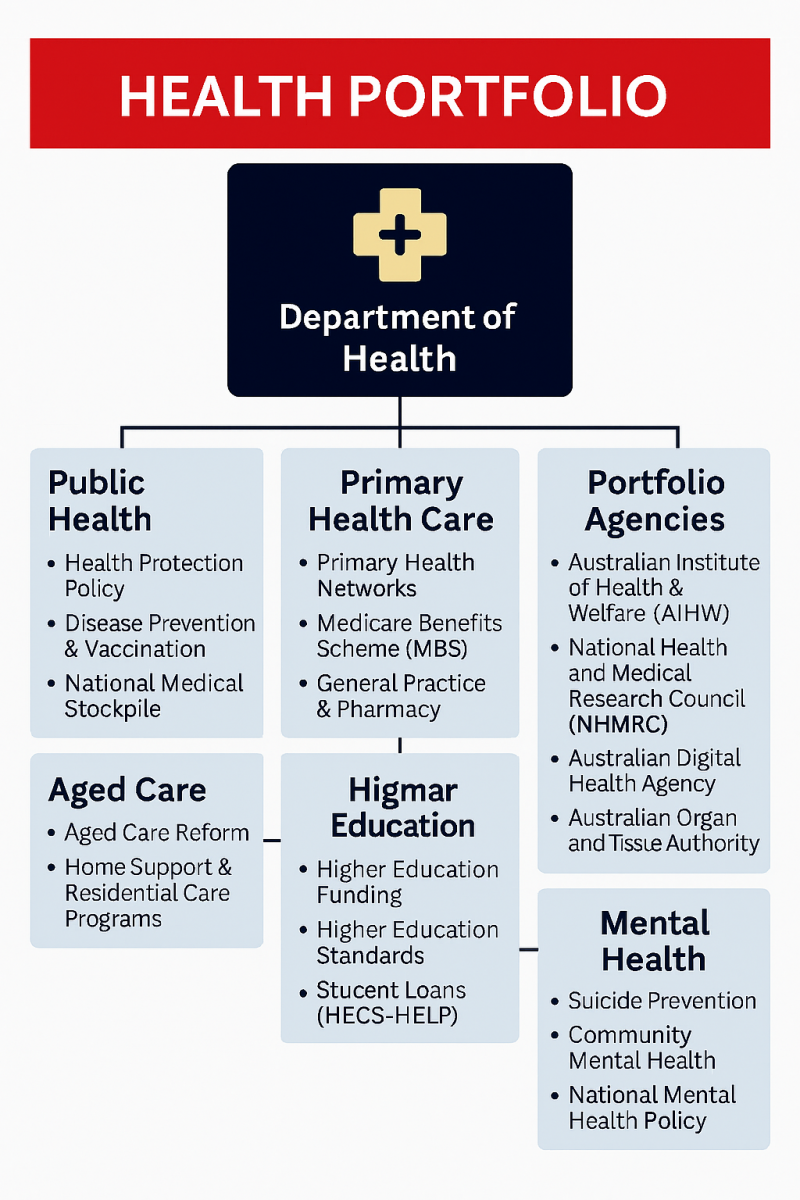
Divisions & Sub‑Departments

Health Policy & Primary Care Division
Strengthening Australia’s Health System
-
Manage Medicare, primary care & GP policy
-
Oversee hospital funding & national health agreements
-
Support preventive health & chronic disease programs
-
Coordinate national health workforce planning

Disability Support & Inclusion Division
Supporting Australians With Disability
-
Oversee disability programs & national supports
-
Strengthen disability inclusion & accessibility
-
Coordinate safeguarding & quality frameworks
-
Partner with states, providers & advocacy groups

Public Health & Emergency Response Division
Protecting Australia From Health Threats
-
Lead national disease prevention & immunisation programs
-
Coordinate emergency health response & preparedness
-
Monitor public health risks & outbreaks
-
Support national biosecurity & health surveillance

Public Health & Emergency Response Division
Protecting Australia From Health Threats
-
Lead national disease prevention & immunisation programs
-
Coordinate emergency health response & preparedness
-
Monitor public health risks & outbreaks
-
Support national biosecurity & health surveillance

Medical Research & Innovation Division
Driving Health Innovation & Future Capability
-
Support medical research funding & partnerships
-
Oversee clinical trials & innovation programs
-
Strengthen research translation into health practice
-
Partner with universities, institutes & industry

Aged Care Quality & Safety Commission
Regulating Aged‑Care Providers
-
Monitor compliance & quality standards
-
Investigate complaints & incidents
-
Support continuous improvement in aged‑care

National Disability Insurance Agency (NDIA)
Delivering the NDIS
-
Provide disability supports & funding
-
Strengthen participant outcomes & independence
-
Partner with providers & communities

Professional services
🔷 Australian Institute of Health & Welfare (AIHW)
Trusted National Health & Welfare Data
-
Produce health & aged‑care data reports
-
Support evidence‑based policy & planning
-
Maintain national health datasets
National Health & Medical Research Council (NHMRC)
Leading Medical Research Excellence
-
Fund medical research & innovation
-
Develop clinical guidelines & standards
-
Support ethical research practice

Key Problems in Health, Disability & Ageing
Australia faces rising healthcare costs, workforce shortages, ageing population pressures, and increasing demand for disability supports. Aged‑care quality concerns, hospital strain, and public health risks require stronger national coordination, long‑term investment, and system reform. This portfolio plays a critical role in protecting wellbeing, improving care quality, and ensuring sustainable services for future generations.
Health intelligence investment and outcomes framework
Australians Unified proposes a nationally connected health intelligence system that turns fragmented and delayed health and welfare information into timely insight, earlier action and better community outcomes. This framework sets out the proposed funding, measures, return on investment and 2037 destination for health, disability and ageing reform.
Funding framework
Current position: Baseline funding of $0.10 billion annually after proposed efficiency improvements.
Australians Unified investment priorities:
- National Health Dashboard
- AI-powered analytics
- Integrated health data systems
- Predictive health modelling
- National wellbeing measurement
- Population health forecasting
Investment outcomes: Faster reporting can reveal health trends in weeks rather than years; better forecasting can identify population health risks earlier; policy funding can be targeted where it is most needed; and hospitals and services can plan ahead for future demand.

KPI framework
Current measures:
- National health reporting
- Health data quality
- Welfare data coverage
- Data accessibility
- Policy support capability
Gold standard targets:
- Real-time reporting
- Predictive analytics capability
- National wellbeing measurement
- Full health system integration
- Community outcome measurement
KPI summary: Success is measured by how quickly and accurately Australia can understand and respond to emerging health and wellbeing challenges.
Real-life example: A rise in youth mental health concerns is identified months earlier, allowing services to respond before demand overwhelms the system.

Return on investment
Benefit areas:
- Better health planning
- Reduced healthcare costs
- Improved preventative health outcomes
- Reduced system duplication
- Better policy decisions
- Improved community wellbeing
Benefits in practice: Earlier identification of risks can reduce hospital admissions. Better resource allocation directs funding to communities most in need. Targeted public health programs act before problems escalate, while transparent reporting helps citizens see health and wellbeing outcomes.
Return summary: Better health intelligence helps governments spend smarter, intervene earlier and improve long-term health outcomes.

2037 vision and citizen benefit
Current direction: Reporting remains largely retrospective, national data systems remain fragmented, health risks are identified later and service planning remains reactive. Australia continues managing health challenges after they emerge.
Australians Unified gold standard:
- Real-time National Health Dashboard
- Integrated state and local data systems
- Predictive population health analytics
- National wellbeing monitoring
- Earlier health intervention capability
- Evidence-based investment decisions
National health intelligence and early intervention
Today, the Australian Institute of Health and Welfare collects, analyses, and reports vital information, but vital data remains fragmented, delayed, and isolated across state and federal boundaries. Under the Australians Unified plan, we transform retrospective data into real-time reporting and predictive health intelligence—driving proactive planning, targeted investments, and earlier intervention before minor health trends escalate.
Our 2037 outcome delivers a world-class health intelligence authority, enabling earlier intervention, improved government performance, and healthier communities. For example, an emerging health issue detected early in regional Victoria can be addressed swiftly before crisis point, ensuring everyday families receive meaningful care and support before challenges become severe.
Frequently asked questions
Find answers regarding policy reforms, service standards, and national frameworks across health, aged care, and disability support systems in Australia.