Department of Climate Change and environment & Water
Climate Change, Energy, the Environment & Water Portfolio
Climate & Environment
Reform Stream: Sustainability & Resilience
-
Water, energy, and climate adaptation
-
Environmental capability building
Protecting Australia’s Environment, Strengthening Climate Resilience & Securing Our Water Future
Australia’s Climate, Environment & Water Portfolio leads national action on climate change, environmental protection, biodiversity, energy transition, and water security. It coordinates scientific agencies, environmental regulators, climate intelligence services, and national water management systems to safeguard Australia’s natural environment and support long‑term national resilience.
The Department of Climate Change, Energy, the Environment and Water (DCCEEW) leads Australia's climate policy, environmental protection, water security, biodiversity conservation and environmental resilience programs. The department coordinates national efforts to protect natural assets while supporting sustainable economic development and climate adaptation.
Governance matrix position and agency snapshot
Governance matrix position
DCCEEW protects Australia's environmental assets, supports climate resilience, and safeguards water security for future generations.
Portfolio alignment
- Primary pillar: Prosperity
- Supporting pillars: Sovereignty, Future Australia, and Unity
Related reform areas
Key national focus areas include climate change, environment protection, water resources, biodiversity, renewable energy, environmental regulation, climate adaptation, and national resilience.
Agency snapshot
This department provides national leadership across climate policy, environmental protection, water management, and ecosystem stewardship.
Governance responsibilities
- Lead agency: Department of Climate Change, Energy, the Environment and Water
- Core roles: National leadership, environmental stewardship, climate coordination, water security, and biodiversity protection
- Victorian affiliates: Department of Energy, Environment and Climate Action (DEECA), Environment Protection Authority Victoria, and Catchment Management Authorities
- Local affiliates: Environment and sustainability services, climate resilience services, water and natural resource services, and community environmental programs
Strategic framework and portfolio pillars
A detailed breakdown of current objectives, pressing systemic challenges, active reform initiatives, and collaborative funding pathways shaping Australia's environmental and water future.

🚀 Current objectives
Summary: Australia's environmental and climate systems require stronger coordination, resilience and long-term planning.
- Strengthen climate resilience
- Improve biodiversity outcomes
- Modernise environmental monitoring
- Improve water security
- Restore ecosystems
- Improve environmental compliance
- Support sustainable economic development

⚠ Current challenges
Summary: Australia faces increasing environmental and climate pressures that require coordinated national action.
- Climate change impacts
- Biodiversity decline
- Water scarcity
- Habitat degradation
- Environmental data fragmentation
- Infrastructure pressures
- Growing demand for adaptation planning

🔄 Current initiatives
Summary: Australians Unified identifies several reform priorities already reflected across environmental and water portfolio discussions.
- National Climate Adaptation Strategy
- Environmental monitoring modernisation
- Biodiversity restoration
- Water security planning
- Climate resilience programs
- Integrated environmental intelligence systems
- National hazard preparedness improvements

💰 Funding sources
Summary: Funding supports climate resilience, biodiversity protection, water management and environmental stewardship.
Commonwealth government funding:
- Environmental programs
- Climate initiatives
- Water management
Research partnerships:
- Universities
- Scientific agencies
- Environmental organisations
Industry partnerships:
- Sustainability projects
- Environmental restoration
- Climate adaptation initiatives
Environmental funding, policy and community outcomes
Australians Unified supports environmental investment that strengthens climate resilience, protects natural systems, improves water security and delivers measurable benefits for communities, businesses and future generations. Effective delivery requires clear national policy, coordinated federal–state–local action and strong partnerships.

Funding eligibility criteria
Funding generally supports projects that improve climate resilience, environmental outcomes and sustainable resource management.
Eligible applicants include:
- Local governments and catchment authorities
- Environmental organisations and conservation partnerships
- Universities and research institutions
- First Nations organisations
- Community groups and water authorities
Australians Unified perspective: funding should prioritise projects that build resilience, sustainability and measurable community outcomes.

Policy framework
The department’s activities align with national environmental, climate and water frameworks.
- Climate change and adaptation: national adaptation planning, climate resilience and risk management
- Environmental protection: biodiversity conservation, habitat protection and species recovery
- Water security: river system management, groundwater protection and sustainable allocation
- Environmental intelligence: monitoring systems, scientific research and data integration
Australians Unified perspective: environmental protection should balance prosperity, resilience and sustainability so future generations inherit healthy natural systems.

Federal, state and local alignment
Federal affiliate — DCCEEW: climate policy, environmental protection, water resources, biodiversity, national regulation and environmental science.
Victorian affiliate — Department of Energy, Environment and Climate Action (DEECA): environmental management, climate action, water and biodiversity programs, public land management, conservation initiatives.
Local affiliate — environment and sustainability services: environmental planning, climate resilience programs, urban forest management, water-sensitive urban design, waste and resource recovery, community environmental education and sustainability programs.

Delivery partners and community outcomes
Delivery partners: catchment management authorities, water authorities, Traditional Owners, universities, environmental organisations, Landcare networks, community groups, research agencies and industry partners.
Environmental investment supports stronger communities, healthier ecosystems and long-term prosperity:
- Residents: cleaner environments, improved public health, climate resilience and better quality of life
- Communities: sustainability, reduced environmental risk, stronger resilience and improved natural assets
- Businesses: risk reduction, sustainable development, environmental certainty and long-term investment confidence
- Australia: biodiversity protection, water security, climate preparedness and environmental stewardship

Climate Change
Climate Policy & Emissions Reduction Division
Safeguarding Australia’s Natural Environment & Wildlife
🟡 WHAT THEY DO
-
Develop national climate policy & emissions frameworks
-
Coordinate adaptation planning across governments
-
Support industry transition & climate innovation
-
Monitor national emissions performance
🟦 KEY OUTPUTS
-
National climate policy
-
Emissions reduction frameworks
-
Adaptation plans
-
Emissions reporting & analysis
- deal with climate change and its climate challenges

Environmental protection
Safeguarding Australia’s Natural Environment & Wildlife
🟡 WHAT THEY DO
-
Manage environmental regulation & approvals
-
Protect threatened species & ecosystems
-
Oversee national parks & conservation programs
-
Lead biodiversity monitoring & restoration
🟦 KEY OUTPUTS
-
Environmental assessments
-
Conservation programs
-
Biodiversity monitoring
-
National park management

Energy & Sustainability Division
Supporting Australia’s Renewable Energy Transition
🟡 WHAT THEY DO
-
Develop clean energy policy & programs
-
Support renewable energy investment & innovation
-
Improve energy efficiency & sustainability standards
-
Coordinate national energy transition planning
🟦 KEY OUTPUTS
-
Renewable energy programs
-
Clean energy policy
-
Efficiency standards
-
Transition planning tools
- supergrid planning

Water Resources & River Systems Division
Securing Australia’s Water Future
🟡 WHAT THEY DO
-
Manage national water policy & river systems
-
Oversee Murray–Darling Basin planning & compliance
-
Provide hydrological modelling & water data
-
Support water security for communities & industry
- nation water grid including taking flood plans water
🟦 KEY OUTPUTS
-
Water policy & planning
-
Basin management frameworks
-
Hydrological modelling
-
National water data
- bridging the water channels
- for sustainable water systems

Environmental Science, Data & Monitoring Division
Delivering Environmental Intelligence for National Decision‑Making
🟡 WHAT THEY DO
-
Monitor air, water, soil & ecological health
-
Provide environmental data & reporting
-
Support scientific research & modelling
-
Strengthen national environmental information systems
🟦 KEY OUTPUTS
-
Environmental monitoring data
-
National environmental reports
-
Scientific modelling
-
Information system upgrades

Hazard Preparedness & Climate Resilience Division
Protecting Australians from Extreme Weather & Climate Impacts
🟡 WHAT THEY DO
-
Coordinate national hazard preparedness
-
Support emergency services with climate intelligence
-
Lead resilience planning & risk reduction programs
-
Strengthen community preparedness & adaptation
🟦 KEY OUTPUTS
-
Hazard preparedness frameworks
-
Climate resilience programs
-
Emergency service intelligence
-
Community adaptation tools

Bureau of Meteorology (BoM)
Australia’s National Weather & Climate Intelligence Agency
🟡 WHAT THEY DO
-
Deliver weather forecasts & severe weather warnings
-
Provide climate outlooks & long‑range modelling
-
Support emergency services during extreme weather
-
Maintain radar, satellite & environmental monitoring
🟦 KEY OUTPUTS
-
Forecasts & alerts
-
Climate modelling
-
Hazard intelligence
-
Environmental monitoring

Australian Climate Service (ACS)
Integrating Climate, Hazard & Impact Data for National Resilience
🟡 WHAT THEY DO
-
Combine climate, hazard, exposure & impact data
-
Support emergency management & national planning
-
Provide climate risk intelligence to governments
-
Strengthen national resilience to extreme weather
🟦 KEY OUTPUTS
-
Integrated climate datasets
-
Climate risk assessments
-
Emergency management intelligence
-
Adaptation planning tools
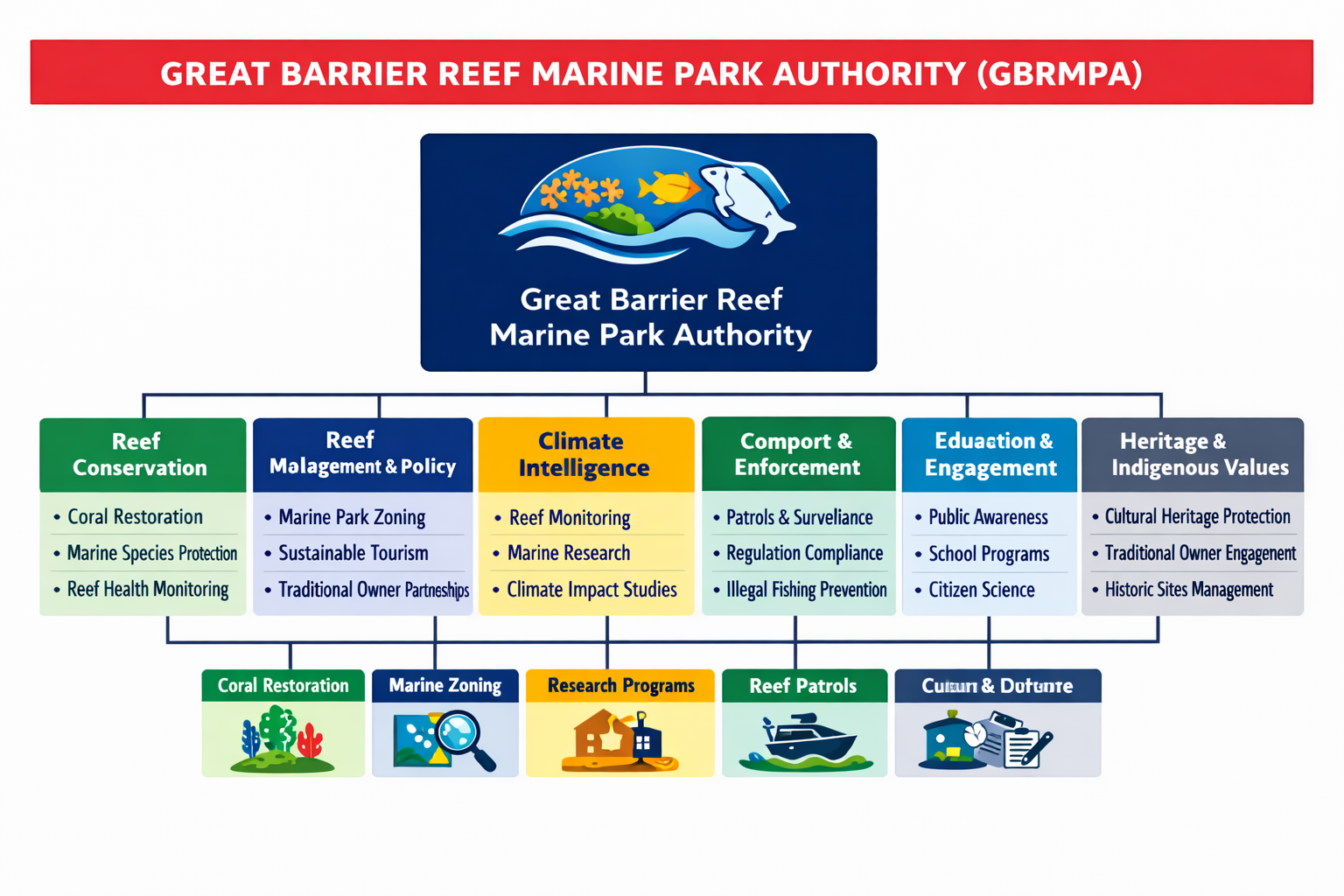
Great Barrier Reef Marine Park Authority (GBRMPA)
Protecting the World’s Largest Coral Reef System
-
Manage reef protection & conservation programs
-
Monitor reef health & climate impacts
-
Support tourism, science & community partnerships
-
Lead reef resilience planning
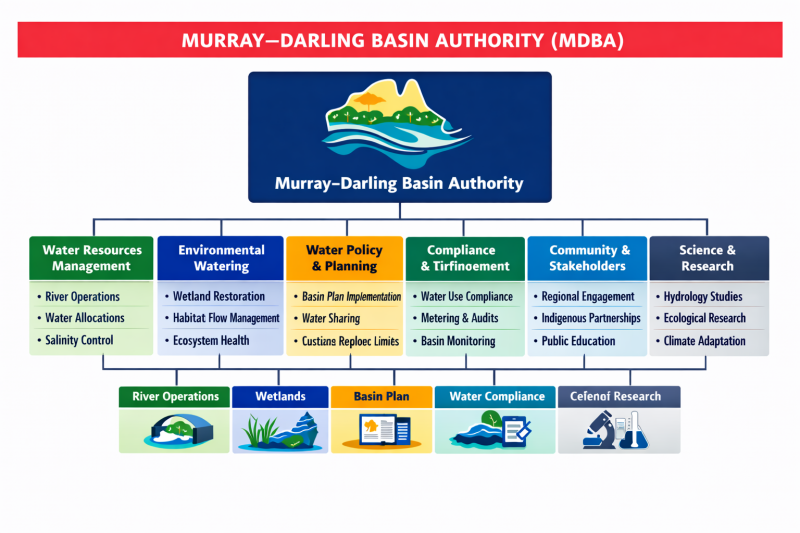
Murray–Darling Basin Authority (MDBA)
Managing Australia’s Most Important River System
-
Oversee Basin planning & compliance
-
Support sustainable water use
-
Monitor river health & environmental flows
-
Coordinate Basin‑wide water management
- integrate into the national energy and water grid
- intergrate into the national water grid
Systemic policy shifts for climate and environmental resilience
Australia faces compounding climate hazards, ecosystem decline, water insecurity, and fragmented governance. To replace slow, legalistic processes with enduring national capability, Australians Unified outlines comprehensive legislative solutions: passing a binding National Nature Act, legislating five-year carbon budgets under a Climate Stability Act, fast-tracking a National Super-Grid and Storage Plan, and enforcing strict extraction caps via a National Water Security Framework. By establishing independent regulators and aligning funding directly with real ecological and emissions outcomes, Australia can secure stable 30-year settings for regional communities, industries, and ecosystems alike.
Summary of key problems and policy shifts in Australia's climate and environment system
Core challenges across the environmental portfolio
Australia faces compounding climate hazards, severe biodiversity loss, critical water scarcity, and increasingly destructive extreme weather events. The current governance architecture is slow, legalistically encumbered, fragmented across federal and state boundaries, underfunded, and subject to persistent political volatility.
Key operational breakdowns include:
- Environmental protection and biodiversity: Outdated EPBC Act frameworks, weak penalties, lagging assessments, and fragmented data systems.
- Climate policy and emissions: Policy instability, safeguard mechanism loopholes, unverified carbon offset integrity, and lagging adaptation frameworks.
- Energy transition bottlenecks: Grid transmission lagging renewable deployment, storage shortfalls, gas volatility, and compounding retail cost pressures.
- Water security: Basin over-allocation, degraded river systems, lack of water market transparency, and vulnerable regional supplies.
- Hazard preparedness and monitoring: Disconnected scientific information, siloed Antarctic intelligence, and under-resourced compliance baselines.
System-level reforms and structural architecture
Australians Unified outlines structural policy shifts designed to provide 20 to 30 years of regulatory certainty, transparent accountability, and measurable ecological outcomes, moving beyond mere procedural compliance.
Key legislative shifts and delivered outcomes include:
- National Nature Act: Replaces the EPBC Act with legally binding environmental standards, mandatory net gain habitat rules, and an independent national environment regulator.
- Climate Stability Act: Legislates rolling five-year carbon budgets to 2050, tightens the safeguard mechanism with real abatement caps, and overhauls ACCU integrity.
- National Super-Grid and Storage Plan: Fast-tracks priority energy corridors, locks in firm storage targets, and secures long-term household bill stability.
- National Water Grid Act: Mandates enforceable extraction caps, climate-adjusted environmental flows, diversified urban sources, and live public trade registers.
- Integrated national data spine: Connects water hydrology, renewable infrastructure, and Antarctic climate science into unified coastal and regional planning models.
Legislative breakdown and reform matrix
A structured overview detailing current legislative instruments across environmental, climate, energy, water, hazard, and governance streams alongside proposed Australian policy amendments, repealed legacy instruments, and new national implementations.
| Portfolio stream and core instruments | Policy amendments, cancellations and new implementations |
|---|---|
|
1. Environmental protection and biodiversity • Environment Protection and Biodiversity Conservation Act 1999 (EPBC Act) • National Environment Protection Council Act 1994 and NEPMs • Biodiversity conservation strategies and threatened species lists |
Amendments: Embed binding national environmental standards, enforce net gain tests for critical habitats, mandate digital assessments, and tighten NEPM pollution and clearing baselines. Cancellations: Sunset broad land clearing exemptions and weak offset provisions. New implementations: Enact the National Nature Act and establish an independent national environment regulator. |
|
2. Climate policy and emissions reduction • Climate Change Act 2022 (Cth) • National Greenhouse and Energy Reporting Act 2007 (NGER) • Safeguard Mechanism • Carbon Credits (Carbon Farming Initiative) Act 2011 (ACCU scheme) |
Amendments: Legislate 5-year carbon budgets, tighten Safeguard baselines toward 1.5–2°C, and institute independent crediting with full project audit transparency. Cancellations: Sunset low-integrity offset methods and consolidate overlapping piecemeal programs. New implementations: Pass the Emissions Reduction and Climate Accountability Act and establish statutory National Adaptation Plans. |
|
3. Energy systems and transition • National Electricity Law (NEL) and National Gas Law (NGL) • Australian Energy Market Agreement and AEMO/AER rules • Clean energy support schemes (ARENA, CEFC, RET) |
Amendments: Prioritise transmission corridors, lock in storage hosting targets, embed capacity mechanisms, and tighten gas reservation and transition rules. Cancellations: Phase out legacy fossil-fuel production subsidies and non-transition capacity payments. New implementations: Enact the National Super-Grid & Storage Act to fast-track renewable zones and unified connection standards. |
|
4. Water security, Murray–Darling and national grid • Water Act 2007 (Cth) • Murray–Darling Basin Plan 2012 and water resource plans • National Water Initiative |
Amendments: Tighten extraction caps, climate-adjust environmental river flows, and mandate standardised digital metering and compliance across states. Cancellations: Retire over-allocated water entitlements and legacy rules exceeding sustainable limits. New implementations: Legislate the National Water Security & Catchment Health Framework and expand the National Water Grid Authority. |
|
5. Hazard preparedness, monitoring and data integration • Emergency management, meteorology, and infrastructure statutes • Bureau of Meteorology and Geoscience Australia enabling Acts |
Amendments: Mandate multi-agency data sharing, cross-system interoperability, and integrated climate-risk modelling across Commonwealth bodies. Cancellations: Discontinue fragmented, siloed data reporting practices. New implementations: Deploy the National Climate and Environment Intelligence System and embed national hazard preparedness standards into planning law. |
|
6. Governance and accountability • DCCEEW portfolio legislation • Climate Change Authority, Clean Energy Regulator, and NEPC • Basin governance authorities |
Amendments: Clarify single-point lead responsibilities across portfolio legislation and guarantee statutory independence for regulatory bodies. Cancellations: Eliminate ambiguous jurisdictional demarcations and opaque advisory mechanisms. New implementations: Establish the statutory National Climate–Energy–Environment Council and mandate a transparent public data platform. |
Australians Unified accountability chain and recommendations
Australians Unified assessment and recommendations
DCCEEW serves as one of Australia's most essential long-term stewardship agencies because environmental protection, water security, and climate resilience directly underpin national prosperity and community wellbeing.
Priority recommendations
- Create a unified environmental intelligence system
- Expand cross-sector climate resilience planning
- Improve biodiversity and habitat monitoring
- Strengthen First Nations partnerships and land stewardship
- Modernise environmental regulation and streamline assessments
- Improve local government delivery and community support
- Increase long-term investment into environmental restoration
Success measures
- Measurable biodiversity and habitat protection outcomes
- Completed environmental restoration initiatives
- Water security and extraction compliance indicators
- Climate adaptation outcomes and hazard preparedness
- Active community participation and compliance transparency
Accountability chain and future state governance
Our future state envisions a nationally connected environmental governance model where climate resilience, biodiversity protection, water security, and community wellbeing are seamlessly integrated across all tiers of administration.
Integrated delivery chain
- National leadership: DCCEEW leads national climate, biodiversity, and water strategy.
- State environmental delivery: State departments, including DEECA, drive on-ground conservation and regulatory enforcement.
- Local services: Environment and sustainability services spearhead climate programs, environmental planning, water management, and community education.
- Delivery partners: Water authorities, Traditional Owners, universities, Landcare networks, and community groups execute local works.
- Community outcomes: Long-term water security, healthy ecosystems, environmental protection, and enduring national prosperity.
Healthy environments support healthy communities. Healthy communities support prosperity. Together they create a resilient and sustainable future for Australia.
Climate, energy, environment and water: the 2037 pathway
A four-part breakdown of Australia’s likely direction without reform, the Australians Unified plan, and the responsibilities shared across federal, state and local government. The focus is practical: stronger climate resilience, reliable water, healthy ecosystems, modern approvals and a secure renewable energy transition.

Current direction without reform
By 2037, without coordinated reform:
- Climate risks continue increasing, exposing households, farms, businesses and infrastructure to more frequent disruption.
- The energy transition remains fragmented, delaying dependable renewable generation, transmission and storage.
- Water security pressures worsen as droughts, competing demand and stressed catchments intensify.
- Environmental approvals remain slow and difficult to navigate, creating uncertainty for communities, conservation and responsible investment.
- Biodiversity decline continues as habitats and threatened species face compounding pressure.
- Extreme-weather recovery costs increase following floods, storms, heatwaves and bushfires.
- Environmental and climate intelligence remains fragmented across systems and jurisdictions.
Portfolio performance score: 130 / 250
Real-life example: A regional community experiences longer droughts, increased water restrictions and rising infrastructure repair costs following floods and storms.

Australians Unified plan
Key reforms:
- National Climate Adaptation Authority to coordinate long-term resilience planning.
- Environmental Intelligence Network to connect environmental monitoring and decision-making.
- National Water Security Framework to strengthen sustainable supply, catchments and drought preparedness.
- Integrated Climate & Hazard Data Platform for shared risk intelligence.
- Biodiversity Recovery Program to restore habitats and protect species.
- Environmental Approvals Modernisation to deliver clearer, faster and accountable assessments.
- Renewable Energy Sovereignty Program to support secure Australian energy capability.
- National Hazard Preparedness Standards and local Climate Resilience Hubs.
- Water & Environment Dashboard for transparent public information.
Real-life example: Residents can access real-time information about drought conditions, flood risks, water availability and environmental health through a single national platform.

Federal, state and local alignment
Federal Government creates:
- Climate policy
- Environmental policy
- Water security strategy
- National energy transition frameworks
- National standards
Summary: The Federal Government sets Australia’s long-term climate, environment, energy and water strategy.
State Government delivers:
- Water programs
- Environmental regulation
- Renewable energy projects
- Climate adaptation planning
- Biodiversity management
Summary: State Governments manage environmental and resource systems across each state.

Local delivery and system outcomes
Local Government supports:
- Community sustainability initiatives
- Open spaces, parks and urban nature
- Water conservation
- Environmental education
- Community resilience programs
Summary: Local Governments deliver the practical environmental outcomes residents experience every day, from neighbourhood parks and water-saving programs to local preparedness and education.
System summary: Federal Government creates policy, State Governments manage systems, and Councils deliver community outcomes. Clear roles, shared data and accountable delivery can turn national strategy into safer, healthier and more resilient communities.
Investment, performance and return framework
Australians Unified links strategic funding, targeted key performance metrics, and economic returns to deliver climate, energy, environment and water sovereignty across Australia by 2037.
💰 Funding framework
Current focus areas:
- Climate adaptation and hazard preparedness
- Renewable energy transition and water security
- Environmental protection and monitoring systems
Investment priorities:
- National Climate Intelligence System
- Water security infrastructure and environmental networks
- Grid resilience and biodiversity recovery programs
What additional investment delivers:
- +40% environmental monitoring capability: earlier identification of threats.
- +50% climate adaptation capability: better flood, bushfire and heatwave preparation.
- +35% water security resilience: improved drought management and supply planning.
- +60% renewable integration: stronger reliability and reduced grid risks.
📊 KPI framework
Target trajectories (baseline vs 2037):
- Climate resilience: 130 → 245 (+88%)
- Water security: 135 → 245 (+81%)
- Environmental health: 125 → 240 (+92%)
- Energy transition readiness: 130 → 245 (+88%)
- Community resilience: 130 → 235 (+81%)
Delivered outcomes:
- Climate resilience: communities significantly better prepared for adverse weather events.
- Water security: dependable, secure water access throughout prolonged droughts.
- Environmental health: accelerated biodiversity recovery and ecosystem renewal.
- Energy readiness: rapid transition to low-emission, dependable grids.
- Community resilience: accelerated physical and economic recovery after disasters.
📈 ROI and 2037 sovereign pathway
Benefit areas and real-life return:
- Reduced disaster damage: proactive adaptation planning lowers structural repair bills.
- Reliable water supplies: towns avoid harsh restrictions during dry spells.
- Stronger renewable energy: sovereign network lowers long-term household energy bills.
- Productivity and nature: healthy ecosystems support regional tourism and farming.
2037 gold standard outcome:
Lifting portfolio performance from 130 to 245 / 250 (+115 points, +88% improvement). Every dollar invested in climate, energy, and water sovereignty curtails future losses while establishing an integrated national resilience framework where farmers, councils, and citizens access unified intelligence for better decisions.
Frequently asked questions
Key answers regarding DCCEEW policy, environmental reforms, and national water and energy grid transitions under the Australians Unified framework.