Australians Unified helps Australians understand how government portfolios turn public priorities into practical services, protections and opportunities. Explore the areas of responsibility that connect ministers, departments, agencies and communities across Australia.
Government portfolios organise public administration, policy development and service delivery. Each is led by ministers and supported by departments, agencies and public institutions working to deliver outcomes for Australians. Start with these key areas to see how governance is put into action.

Understand the institutions, rules and oversight that support transparent decisions, responsible use of public resources and confidence in government.

Explore the portfolios that shape economic opportunity, jobs, skills, industry, finance, infrastructure, and strong regional communities.

See how health, education, social services, cultural inclusion and community participation can strengthen shared purpose across Australia.
The Australians Unified Governance Matrix links five governance pillars to government structure, portfolios, departments and agencies, then to programs, services and real-world outcomes. It is a clear way to follow how decisions made in government can affect everyday Australian life.

A portfolio brings related responsibilities together under a ministerial area. Departments provide advice and administration, while agencies and public institutions deliver specialised functions. This structure helps connect national priorities with coordinated policy, services, and protections.
From healthcare, education and agriculture to infrastructure, national security, climate and the economy, Australians Unified provides a starting point for exploring the responsibilities that shape Australian communities. Browse the governance matrix to understand where portfolios sit and how they relate to the broader system.

Government portfolios structure public administration and policy delivery across Australia. Understanding how they operate connects high-level national policies to everyday services, public accountability and democratic participation.
Portfolios provide the practical framework for converting federal and state priorities into frontline services. From healthcare networks and primary schools to national road transport, ministerial portfolios direct resources where communities need them most.
Every portfolio is led by ministers and backed by government departments, regulatory bodies and statutory agencies. Pinpointing portfolio boundaries enables citizens to know exactly which elected officials and bodies hold responsibility for public decisions.
When citizens understand Australia's portfolio structures, democratic engagement becomes more direct and effective. It helps communities advocate for policy changes, scrutinise departmental reviews and participate meaningfully in local and national dialogues.
Our matrix maps the five governance pillars—sovereignty, prosperity, accountability, unity and future Australia—down to agencies, programs and outcomes. Exploring portfolio structures clarifies how systemic governance delivers real-world impact.
How Portfolios Fit Within the Australians Unified Governance Matrix
The Australians Unified Governance Matrix connects governance principles to practical outcomes.
Understanding portfolios helps explain how governance decisions become real-world actions

Sovereignty
Portfolios supporting Australia's security, resilience and national interests.
Key Portfolio Areas
- Defence
- Foreign Affairs & Trade
- Home Affairs
- Border Protection
- Strategic Resources
Focus
Protecting Australia's sovereignty, security, resilience and ability to make independent decisions.
Explore Sovereignty Portfolios →

Prosperity
Portfolios supporting economic growth, productivity, and opportunity.
Key Portfolio Areas
- Treasury
- Finance
- Industry
- Employment & Skills
- Trade
- Small Business
Focus
Creating economic opportunity, sustainable growth, and national prosperity.
Explore Prosperity Portfolios →

Accountability
Portfolios supporting transparency, governance and public trust.
Key Portfolio Areas
- Attorney-General
- Finance
- Public Service
- Regulatory Agencies
- Integrity & Oversight
Focus
Supporting responsible governance, transparency and accountability.
Explore Accountability Portfolios →

Unity
Portfolios supporting communities, participation, and social cohesion.
Key Portfolio Areas
- Health
- Education
- Social Services
- Indigenous Affairs
- Community Development
Focus
Building connected, inclusive, and resilient communities.
Future Australia
Portfolios supporting innovation, development, and long-term planning.
Key Portfolio Areas
Focus
Preparing Australia for future challenges, opportunities, and generations.
Explore Future Australia Portfolios →
Why Understanding Portfolios Matters
Government portfolios provide the structure through which governments deliver services, manage resources, and pursue national priorities.
Understanding portfolios helps citizens:
- Understand how government operates
- Identify who is responsible for key decisions
- Connect policies with outcomes
- Participate more effectively in democratic processes
- Better understand Australia's governance system
A comprehensive examination of the 2025–26 federal budget snapshot, assessing national fiscal management, strategic risks, and reform pathways across Australian portfolios.
The federal government recorded an underlying cash deficit of -$22.3 billion for the 2025–26 financial year. Notably, this final outcome represented an improvement of approximately $6 billion better than earlier forecasts, supported by targeted expenditure restraint.
Gross debt represents 33.2% of Australia's gross domestic product. Strategic planning across the five-year forward estimates horizon focuses on stabilising balance sheets while safeguarding investment in health, housing, defence, and critical infrastructure.
Budget allocations are evaluated through our five foundational pillars: sovereignty, prosperity, accountability, unity, and future Australia. This framework connects high-level departmental spending directly to frontline community outcomes.
Rising debt servicing costs, population growth pressures on infrastructure, and nationwide skills shortages present real delivery risks. Australians Unified outlines systematic policy reforms to build productivity, transparency, and long-term economic resilience.
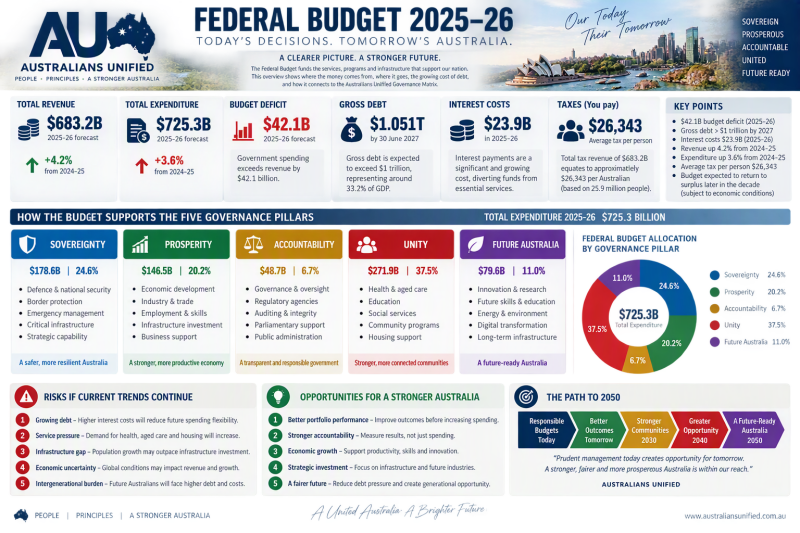
Key Outcomes (Brief Overview)
Federal Budget 2025-26
- Revenue: $683.2B
- Expenditure: $725.3B
- Budget Deficit: $42.1B
- Gross Debt: $1.051T
- Interest Costs: $23.9B annually
- Average Tax Contribution: $26,343 per Australian
⚠️ What This Means
- Government spending exceeds annual revenue.
- Debt has surpassed the trillion-dollar mark.
- Interest costs now consume billions that cannot be spent on services or infrastructure.
- Future taxpayers will continue carrying the burden of current deficits.
- Population growth is placing increasing pressure on health, housing, infrastructure, and social services.
✅ Australians Unified Opportunity Areas
- Better performance measurement across portfolios.
- Stronger accountability and transparency.
- Investment focused on outcomes rather than expenditure.
- Long-term infrastructure and productivity planning.
- Future Australia initiatives focused on innovation, skills and national capabilities
-
AUSTRALIANS UNIFIED FUTURE APPROACH
-
- Security, infrastructure and resilience.
- Jobs, productivity, industry and economic growth.
- Governance, oversight and financial stewardship.
- Health, education, housing and community wellbeing.
- Innovation, research, future skills and strategic development.
State Governments deliver many of the services Australians rely on every day. Through healthcare, education, transport, emergency management, infrastructure and economic development, States play a critical role in turning governance into practical outcomes for communities.
Within the Australians Unified Governance Matrix, State Government portfolios form the service delivery layer between national priorities and local outcomes.
Governance Matrix → State Government → State Portfolios → Departments & Agencies → Services & Programs → Community Outcomes
State Government delivers outcomes through: schools, hospitals, public transport, emergency services, infrastructure, economic development, community services and regional development.

Protecting communities through emergency management, public safety, infrastructure resilience and strategic resource management.
Key responsibilities
- Emergency management
- Public safety
- Energy security
- Critical infrastructure
- Resource management
Governance focus: Sovereignty | Accountability | Future Australia

Supporting economic growth, employment, business development and investment across cities, regions and communities.
Key responsibilities
- Economic development
- Employment and skills
- Industry growth
- Regional development
- Infrastructure investment
Governance focus: Prosperity | Unity | Future Australia

Promoting transparent government through oversight, auditing, integrity systems and public accountability.
Key responsibilities
- Auditor-General
- Ombudsman
- Integrity commissions
- Parliamentary review
- Public administration
Governance focus: Accountability | Sovereignty | Unity

Building stronger communities through education, health, participation, inclusion and social wellbeing, while preparing for future opportunities through innovation, technology, skills development and strategic planning.
Key responsibilities
- Education and health
- Community services and regional communities
- Social participation
- Innovation, future skills and research
- Digital transformation and strategic infrastructure
Governance focus: Unity | Prosperity | Future Australia | Sovereignty
Taxpayer impact dashboard
Evaluating the real-world implications of Victoria's budget trajectory, escalating debt levels and frontline delivery challenges across state portfolios.
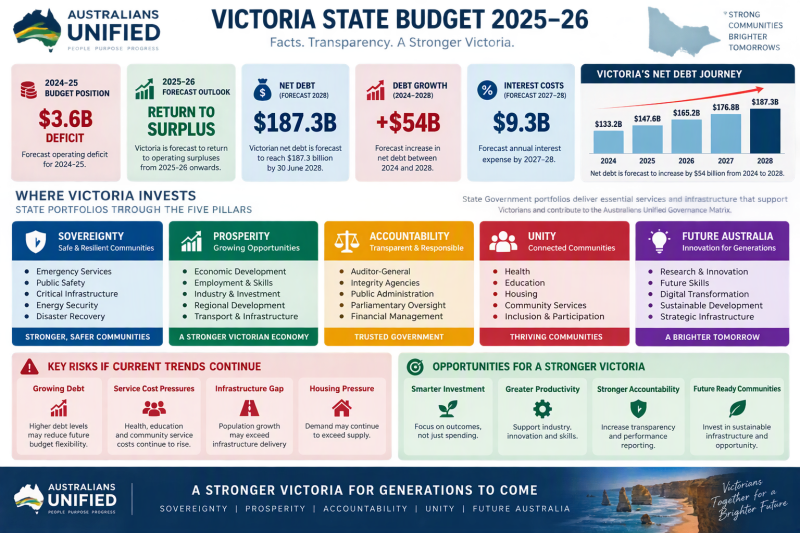
As government debt grows, future budgets have less flexibility. Rising debt burdens reduce fiscal head-room to manage unexpected economic shocks or fund critical future initiatives.
Every dollar spent on debt interest cannot be spent on services or infrastructure. Escalating annual debt servicing directly competes with funding for healthcare, policing and schools.
Housing, hospitals, schools, and infrastructure continue to experience increasing demand. Sustained population inflows require rapid capacity expansion and proactive capital delivery.
Health, education and community service costs continue increasing each year. Managing expanding operational overheads requires disciplined portfolio performance and clear integrity frameworks.
Quick Takeaways
Victoria 2025-26
- 🔴 $3.6B Deficit (2024-25 forecast)
- 🟢 Return to Surplus forecast from 2025-26
- 🔴 $187.3B Net Debt forecast by 2028
- 🔴 +$54B Debt Growth between 2024 and 2028
- 🔴 $9.3B Interest Costs forecast by 2027-28
What Taxpayers Should Watch
- Rising debt means rising interest payments.
- Interest costs reduce money available for:
- Hospitals
- Schools
- Infrastructure
- Community services
- Population growth continues to increase demand for services and infrastructure.
- Long-term planning becomes more important as debt servicing grows.
Local governments are the closest level of government to communities. Councils deliver local services, maintain public spaces, support local development and help build stronger, more resilient communities.
Within the Australians Unified Governance Matrix, local government portfolios represent the community delivery layer, where governance directly connects to residents, businesses and neighbourhoods.
Governance Matrix → Local Government → Local Portfolios → Council Services → Community Programs → Community Outcomes
Local government helps create safe communities, strong local economies, community participation, local infrastructure, environmental sustainability, community resilience, local leadership and future-ready communities.
Through planning, services, infrastructure and participation, councils transform governance principles into practical outcomes for residents, businesses and future generations.

Supporting safe, resilient and prepared communities through emergency planning, infrastructure management and environmental stewardship.
Key local responsibilities
- Emergency preparedness
- Community resilience
- Local infrastructure
- Environmental management
- Community recovery
Governance pillars: Sovereignty | Accountability | Future Australia

Supporting local businesses, investment, employment opportunities and sustainable economic growth.
Key local responsibilities
- Local economic development
- Business support
- Tourism promotion
- Planning and development
- Community infrastructure
Governance pillars: Prosperity | Unity | Future Australia

Promoting transparent decision-making, financial responsibility and community participation in local government.
Key local responsibilities
- Council governance
- Public consultation
- Financial reporting
- Strategic planning
- Community representation
Governance pillars: Accountability | Unity | Sovereignty

Creating connected, inclusive and engaged communities through local services and community development, while preparing for future opportunities through planning, innovation and sustainable development.
Key local responsibilities
- Community development
- Libraries and community facilities
- Cultural events and volunteer support
- Smart communities and sustainability
- Future infrastructure and youth engagement
Local Future Australia focuses on preparing communities for future opportunities through innovation, sustainability, long-term planning and future-focused infrastructure. By aligning community vision planning, smart initiatives and youth engagement, local governance builds enduring prosperity.
Community vision planning
Developing strategic foresight, digital innovation and comprehensive long-term roadmaps to ensure neighbourhoods evolve with resilience, purpose and local voice.
Smart communities and sustainability
Harnessing technology, renewable systems and local environmental initiatives to create energy-efficient, interconnected and future-proof council areas.
Future infrastructure and youth engagement
Investing in modern public assets and active youth pathways to ensure the next generations inherit vibrant opportunities, skills and resilient community infrastructure.

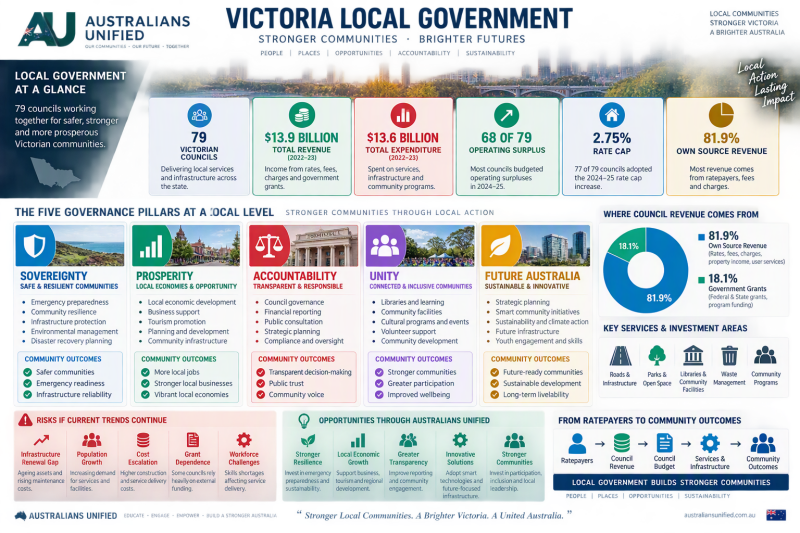
Risks facing Victorian local government
A transparent governance assessment identifying the critical pressures and financial risks that impact ratepayer value and municipal service delivery across Victoria.
Infrastructure renewal gap
Many councils manage ageing local assets requiring substantial renewal and replacement. Potential impact: escalating long-term costs, deferred maintenance liabilities, and reduced reliability across roads, bridges, and community facilities.
Population growth pressures
Rapidly growing communities place unprecedented demand on roads, parks, early childhood centres, and recreation hubs. Potential impact: service demand frequently outpaces current infrastructure capacity and local capital planning.
Cost escalation and rate caps
Construction, material supply, and operational maintenance costs continue escalating above general inflation. Potential impact: compressed council margins leave less funding available for new community projects and discretionary services.
Grant dependency and workforce shortages
Regional councils rely heavily on external state and federal funding support while facing stiff workforce competition. Potential impact: reduced grant allocations directly compromise frontline delivery capacity and project timelines.
Key Takeaway
Victorian councils generated approximately $13.9 billion in revenue and spent approximately $13.6 billion delivering local services, infrastructure and community programs across 79 councils. Around 81.9% of council revenue came directly from rates, fees and charges paid by residents and businesses, while council rate caps increased from 1.75% (2022-23) to 3.5% (2023-24) and 2.75% (2024-25), averaging approximately 2.67% per year. The key question for ratepayers is whether this growing investment is delivering stronger outcomes through Sovereignty, Prosperity, Accountability, Unity and Future Australia.