Australian federal sovereignty FAQs
Australians Unified believes national sovereignty means Australians retain the democratic capacity to make decisions about our country’s laws, security, resources, economy and future. This page answers common questions about the Federal Government’s role, national self-reliance and how everyday Australians can engage with these ideas respectfully and constructively.
Frequently asked questions
Explore clear, practical answers about Australian federal sovereignty. Australians Unified supports informed discussion, democratic participation and common ground for Australians from every background.
What is national sovereignty?
National sovereignty is Australia's ability to govern itself, make its own laws, protect its borders, manage its resources, and make decisions in the national interest without undue influence from external governments, organisations, or interests.
Sovereignty includes political independence, economic resilience, border security, national defence, food security, energy security, and the ability to maintain control over critical infrastructure and strategic assets.
A sovereign nation has the capacity to protect its citizens, uphold its democratic institutions, and respond to national challenges while preserving Australia's identity, freedoms, and interests.

What Sovereignty reforms does Australians Unified support?
Australians Unified supports strengthening Australia's ability to make independent decisions in the national interest through improved national resilience, strategic planning, critical infrastructure protection, and long-term capability development. Sovereignty is strengthened when Australia can provide essential services, protect strategic assets, and respond effectively to future challenges.

How can Australia strengthen strategic self-reliance?
Australia can improve self-reliance by supporting domestic manufacturing, strengthening supply chains, investing in critical industries, developing workforce skills, and encouraging innovation. The goal is to maintain the ability to meet national needs during global disruptions while remaining connected to international markets.

How can critical infrastructure be better protected?
Critical infrastructure such as energy networks, water systems, communications, transport corridors, and digital systems can be protected through long-term planning, maintenance programs, cybersecurity measures, resilience strategies, and coordinated oversight between governments.
Be part of Australia’s conversation
Sovereignty is strengthened when Australians are informed, engaged and willing to find common ground. Join Australians Unified for free to follow the conversation, explore federal reform ideas and stand with a community focused on Australia’s future.

Defence Force
A–Z Reforms
-
ADF Infrastructure Support Partnership (AISP)
-
ADFHQ Modernisation
-
Base & Logistics Hardening
-
Civil–Defence Joint Mobilisation Model
-
Cyber Defence Expansion (ASD)
-
Disaster Response Integration
-
Engineering & Technical Workforce Expansion
-
Infrastructure Resilience (Dual‑Use Assets)
-
Intelligence Interoperability Upgrade
-
Joint Operations Command Modernisation
-
Joint Capabilities Group Reform
-
Northern Defence Network Strengthening
-
Sovereign Defence Industry Expansion
-
Space & Multi‑Domain Capability Growth

EDUCATION PORTFOLIO
A–Z Reforms
-
Adaptation of National Curriculum (Faster Cycles)
-
Community‑Led First Nations Education
-
Digital Learning Infrastructure Modernisation
-
Early Childhood Expansion & Affordability
-
Equity Programs for Vulnerable Learners
-
Integrated Data‑Sharing Platform (National)
-
International Education Strengthening
-
Lifelong Learning Pathways
-
National Education Data Spine
-
National Teacher Workforce Strategy
-
Outcome‑Linked Funding Models
-
Regional & Remote Education Access
-
Skills & Workforce Transition Pipelines
-
Teacher Wellbeing & Retention Programs

EMPLOYMENT & WORKPLACE RELATIONS
A–Z Reforms
-
Apprenticeship & Trades Expansion
-
Behaviour‑Change & Reintegration Programs
-
Digital Workplace‑Compliance Tools
-
Dispute Resolution Acceleration
-
Employer Incentives for Structured Placements
-
Fair Work Modernisation
-
First Nations Employment Pathways
-
Gig‑Economy Worker Protections
-
Justice → Employment Pipelines
-
Labour‑Market Forecasting Platform
-
National Workforce Capability Board
-
Regional Workforce Development Programs
-
Safety Standards Strengthening
-
Skills Transition & Reskilling Programs
-
Workplace Relations System Modernisation

FOREIGN AFFAIRS & TRADE
A–Z Reforms
-
Aid & Development Modernisation
-
Consular Crisis‑Response Strengthening
-
Diplomatic Capability Expansion
-
Economic Diversification (Indo‑Pacific)
-
Export & Investment Support Expansion
-
Global Partnerships Strengthening
-
International Legal & Treaty Reform
-
Regional Stability & Security Programs
-
Trade Agreement Modernisation
-
Workforce Capability for Overseas Posts

HOME AFFAIRS
A–Z Reforms
-
Autonomous Border Surveillance
-
Biometric & AI‑Enabled Screening
-
Border Fleet Renewal
-
Counter‑Foreign Interference Expansion
-
Cyber Security Skills Pipeline
-
Emergency Management Interoperability
-
Immigration Digital Transformation
-
Integrity & Anti‑Corruption Systems (ABF)
-
Maritime & Aviation Security Modernisation
-
Multicultural Cohesion Programs
-
National Resilience Grid (NEMA)
-
Smart Borders (AI + Biometrics)
-
Visa Backlog Reduction & System Reform
INFRASTRUCTURE, TRANSPORT & REGIONAL DEVELOPMENT
(From your integrated reforms across portfolios)
A–Z Reforms
-
Airfield & Remote Access Upgrades
-
Critical Infrastructure Hardening
-
Disaster‑Resilient Transport Corridors
-
National Infrastructure Priority List
-
Northern Development Corridors
-
Regional Connectivity Upgrades
-
Strategic Fuel & Logistics Hubs
PRIME MINISTER & CABINET (PM&C)
A–Z Reforms (Condensed, Bullet‑Pointed, Matching Your Model)
-
AI‑Enabled Cabinet Automation
-
AI‑Enabled National Forecasting & Risk Modelling
-
AI‑Supported Policy Modelling
-
Business Operations Reform (Central Agency Efficiency)
-
Cabinet Secretariat Modernisation
-
Central Agency Consolidation
-
Crisis Coordination Centre Strengthening
-
Cyber‑Resilience Upgrades for Governance Systems
-
Digital Self‑Service Tools for Ministers & Departments
-
Governance & Integrity System Reform
-
Independent National Governance Board
-
Intergovernmental Relations Modernisation
-
National Governance Data Architecture (Unified)
-
National Governance Intelligence Network
-
National Performance Visibility (Real‑Time)
-
Predictive National Risk, Economic & Security Forecasting
-
Public Transparency & Audit Upgrades
-
Reduction of Consultant Reliance
-
Streamlined National Governance Architecture
-
Unified National Crisis, Resilience & Security Platform
-
Workflow Automation Across Cabinet & Central Agencies

SOCIAL SERVICES (DSS)
A–Z Reforms (Condensed, Bullet‑Pointed, Matching Your Model)
(All facts sourced from your open tab )
-
AI‑Enabled Service Delivery
-
Automated Eligibility & Real‑Time Case Management
-
Community & Crisis Support Network Expansion
-
Community‑Led Prevention Programs
-
Disability, Aged Care & Carer Integration
-
Domestic & Family Violence Prevention System (Integrated)
-
Early‑Intervention & Prevention Systems
-
Homelessness & Housing Response Network (National)
-
National Social Data Architecture (Unified)
-
National Social Outcomes Intelligence Network
-
NDIS, Aged Care & DSS System Integration
-
Predictive Modelling for Hardship, Risk & Service Needs
-
Prevention‑Led Social Policy Framework
-
Real‑Time Social Wellbeing Dashboards
-
Shared Workforce & Training Systems (Care Sectors)
-
Single Digital Platform for All Payments & Services
-
Unified Customer Experience Across DSS, NDIA, Aged Care & Services Australia
-
Workflow Automation Across All Social Programs

Explain the Sovereign Energy Triangle is best for Australia
Hero Speech — The Sovereign Energy Triangle
Australia is building a new era of national strength through the Sovereign Energy Triangle — a unified system linking the North West Shelf, the Port Augusta–Whyalla Refinery Corridor, and the Portland Manufacturing & Export Hub. Together, these three nodes form the backbone of a fully sovereign fuel and energy system: one that refines Australian light crude, moves it through a national pipeline spine, and distributes it through the National Energy Grid to every state and territory. This is a Defence‑aligned, low‑emissions, high‑capacity network designed to secure our nation against global shocks, restore industrial capability, and power the next generation of Australian manufacturing.
At the northern apex, the North West Shelf provides the nation’s most stable, high‑volume supply of light crude and condensate. At the centre, the Port Augusta–Whyalla Corridor becomes Australia’s sovereign refinery heart — a Joint‑Force build powered by ADF mobilisation, green‑factory innovation, and direct grid integration. And in the south, Portland anchors the system with deep‑water export capacity, renewable‑powered industry, and a strategic distribution hub for Victoria and the eastern states. Together, these three locations form a single, unified national system — the Sovereign Energy Triangle — delivering security, resilience, and prosperity for generations to come.

🌍 What are Best Oil Trade Partners for Petrol Production
Australia needs light, sweet crude to produce petrol efficiently and effectively to meet its energy demands. Below are the top countries with compatible oil grades that offer robust strategic trade potential for Australia:
Why These Countries Work for Australia
-
Refinery Compatibility: Australia’s planned sovereign refinery, such as the upcoming facilities at Port Augusta or Whyalla, is specifically optimized for light crude, making it a suitable choice for local production.
-
Petrol Yield Efficiency: Light, sweet crudes are known to produce more gasoline per barrel, thereby offering a better yield with significantly lower refining costs associated with the process.
-
Strategic Access: Many of these countries are part of the Commonwealth, OPEC+, or have established and existing trade frameworks with Australia that facilitate smoother transactions and partnerships.
-
Diversification: Aligning with multiple suppliers from different regions reduces exposure to geopolitical shocks, ensuring a more stable supply chain and better pricing in the global market.

🟩 Why Are These are The Next Steps for Australia’s Sovereign Refinery Strategy
-
Secure long-term contracts with Nigeria, UAE, and Libya for Bonny Light, Murban, and Es Sider, ensuring a consistent and reliable supply of essential crude oil. This strategy aims to stabilize our resources and fortify the reliability of our energy sector.
-
Blend domestic condensate with imported light crude for optimal refinery input, enhancing the overall quality and efficiency of our refining processes while minimizing waste and maximizing output.
-
Use the Sovereign Fuel Pipeline to effectively move refined petrol to Portland and eastern states, thereby facilitating smoother distribution and ensuring that vital fuels reach areas where they are most needed without unnecessary delays.
-
Integrate with the National Energy Grid for low-emissions, electrified refining, aiming to create a sustainable framework that supports Australia’s commitment to reducing its carbon footprint and promoting renewable energy sources.

National Super Grid — Australia’s Unified Backbone
Hero paragraph: Australia is currently in the process of building an ambitious and transformative National Super Grid that expertly unifies essential services such as electricity, fuel, water, and data into a comprehensive and single sovereign backbone. This innovative grid seamlessly connects every state and territory through robust high‑capacity transmission networks, efficient pipeline systems, and well-planned logistics corridors, effectively transforming fragmented infrastructure into one coordinated and cohesive national system. It is truly the vital spine that supports Defence mobilization, promotes clean industry initiatives, and ensures long‑term economic resilience and sustainability for the country as a whole, paving the way for a brighter and more interconnected future.
if Australia invested in and ev car manufacturing, solid state batteries ship building and defence contractors with private contractors he a great way to rebuild our economy combined with an ai businees operations system for government and a national buy back system, a federal bank, insurance and super company ?
FULL PORTFOLIO INTEGRATION MAP
(Superguide + EV + Batteries + Defence + AI + Shipbuilding + Infrastructure Buy‑Back)
1. NATIONAL SUPERGRID — THE CENTRAL SPINE
What it enables:
-
Powers EV factories, battery plants, shipyards, and Defence bases
-
Reduces energy costs → lowers inflation
-
Connects renewable sources into a national backbone
-
Supports AI-driven automation
-
Enables electrified logistics and ports
Key Outputs:
-
Cheap, stable energy
-
National electrification
-
Industrial competitiveness
-
Sovereign energy security
2. EV MANUFACTURING (HONDA PARTNERSHIP) — NATIONAL AUTOMOTIVE REBIRTH
Why Honda:
-
Leads in solid-state battery commercialisation
-
Offers logistics networks in Asia-Pacific
-
Manufacturing discipline for Australia
-
Aligns with Australia’s mineral advantage
What Australia gains:
-
A sovereign EV industry
-
Export to ASEAN, India, Pacific
-
Resilient domestic supply chain
-
High-skill manufacturing jobs
Integration Points:
-
Powered by the Supergrid
-
Batteries from domestic solid-state plants
-
AI-optimised production lines
-
Defence logistics for national distribution
3. SOLID-STATE BATTERY MANUFACTURING — THE VALUE ENGINE
Why it’s essential:
-
Batteries are the highest-value component of EVs
-
Australia has lithium, nickel, cobalt, manganese
-
Solid-state tech is safer and faster-charging
Integration Points:
-
Powered by the Supergrid
-
Supplies Honda EV factories
-
Supports Defence electrified vehicles
-
Supplies shipbuilding (electric tugs, port vehicles)
-
AI-optimised mineral processing
4. DEFENCE + SHIPBUILDING — NATIONAL MOBILISATION ENGINE
Defence provides:
-
Workforce mobilisation
-
Engineering capability
-
Logistics and supply chain discipline
-
Cybersecurity for AI systems
-
National resilience
Shipbuilding provides:
-
Industrial base for large-scale manufacturing
-
Skilled trades pipeline
-
Export capability (patrol boats, support vessels)
Integration Points:
-
Electrified shipyards powered by Supergrid
-
Solid-state batteries for naval crafts
-
AI-driven shipyard operations
-
Defence workforce for EV and battery plants
5. AI BUSINESS OPERATIONS SYSTEM — THE NATIONAL BRAIN
What AI does:
-
Removes duplication in government
-
Optimises workforce allocation
-
Automates procurement, logistics, approvals
-
Reduces admin staff → frees labour for manufacturing
-
Boosts productivity (Australia’s key weakness)
Integration Points:
-
AI-optimised EV factories
-
AI-driven battery production
-
AI-managed Supergrid load balancing
-
AI-enhanced Defence logistics
-
AI-coordinated shipbuilding
6. BUYING BACK INFRASTRUCTURE — THE SOVEREIGN FOUNDATION
What it enables:
-
Control of ports, rail, energy, water, telecoms
-
National coordination of supply chains
-
Lower prices (public control reduces inflation)
-
Integration with Supergrid and manufacturing.
Integration Points:
-
Ports as EV export hub

AUSTRALIA’S SOVEREIGN ECONOMY INTEGRATION MAP
Supergrid • EV Manufacturing (Honda) • Solid‑State Batteries • Defence & Shipbuilding • AI Operations • Infrastructure Buy‑Back • Federal/State Bank • Super Company • Insurance Company
🔵 1. NATIONAL SUPERGRID — THE ENERGY BACKBONE
Role:
-
Powers EV plants, battery factories, shipyards, Defence bases, AI data centres
-
Reduces energy costs → lowers inflation
-
Enables national electrification
Economic Effect:
-
Cheaper energy = lower production costs
-
Attracts manufacturing and export industries
🔵 2. HONDA EV MANUFACTURING — SOVEREIGN AUTOMOTIVE INDUSTRY
Role:
-
Domestic EV production
-
Export capability to Asia & Pacific
-
High‑skill manufacturing jobs
Economic Effect:
-
Reduces import dependence
-
Keeps value‑add in Australia
🔵 3. SOLID‑STATE BATTERY INDUSTRY — THE VALUE ENGINE
Role:
-
Uses Australian minerals
-
Supplies EVs, Defence vehicles, shipyards
-
Supports grid‑scale storage
Economic Effect:
-
High‑value exports
-
Strengthens supply chain sovereignty
🔵 4. DEFENCE + SHIPBUILDING — NATIONAL MOBILISATION
Role:
-
Workforce mobilisation
-
Engineering capability
-
Cyber + logistics backbone
Economic Effect:
-
Accelerates national projects
-
Builds sovereign industrial capability
🔵 5. AI BUSINESS OPERATIONS SYSTEM — THE NATIONAL BRAIN
Role:
-
Removes duplication across government
-
Optimises workforce allocation
-
Automates logistics, procurement, approvals
Economic Effect:
-
Major productivity uplift
-
Lower operating costs across all sectors
🔵 6. INFRASTRUCTURE BUY‑BACK — SOVEREIGN CONTROL
Role:
-
Public ownership of ports, rail, water, energy, telecoms
-
Aligns infrastructure with national priorities
Economic Effect:
-
Lower long‑term prices
-
Stops profit leakage overseas
🟣 FINANCIAL SOVEREIGNTY LAYER
These three institutions stabilise, fund, and de‑risk the entire system.
🟣 7. FEDERAL OR STATE BANK — NATIONAL CAPITAL ENGINE
Role:
-
Provides long‑term, low‑cost loans for national projects
-
Counter‑cyclical lending during downturns
-
Funds Supergrid, EV plants, shipyards, housing
Economic Effect:
-
Stabilises credit cycles
-
Reduces reliance on foreign capital
-
Lowers project financing costs → reduces inflation
🟣 8. NATIONAL SUPER COMPANY — $3 TRILLION OF PATIENT CAPITAL
Role:
-
Redirects a portion of Australia’s super pool into:
-
Energy
-
Manufacturing
-
Infrastructure
-
Housing
-
-
Aligns retirement savings with national productivity
Economic Effect:
-
Keeps investment returns onshore
-
Funds long‑duration nation‑building assets
-
Strengthens national wealth
🟣 9. SOVEREIGN INSURANCE COMPANY — RISK STABILISER
Role:
-
Insures critical infrastructure
-
Covers climate risk
-
Supports Defence, EV, battery, and shipbuilding sectors
Economic Effect:
-
Stabilises premiums
-
Prevents insurance withdrawal from high‑risk regions
-
Reduces fiscal shocks from disasters
🟩 THE UNIFIED OUTCOME — A PRODUCTIVE, LOW‑INFLATION, SOVEREIGN ECONOMY
This integrated system delivers:
-
Lower inflation (cheap energy, domestic manufacturing, sovereign finance)
-
Higher wages (high‑skill industrial jobs)
-
Higher productivity (AI + integrated planning)
-
Stronger sovereignty (infrastructure, energy, defence, finance)
-
Export capability (EVs, batteries, ships, energy tech)
-
National resilience (Defence workforce + sovereign insurance)


INFLATION REFORM
.
Inflation in Australia is not just a number — it’s a symptom of structural weakness. High energy costs, housing shortages, supply chain dependency, and government waste have driven up prices and eroded national confidence. Australians Unified rejects the idea that interest rates alone can fix this. We offer a sovereign solution.
Through cross‑portfolio reform, we reduce the real cost of doing business, increase supply, and restore capability. We simplify taxation, build housing faster, secure energy inputs, revive manufacturing, and align migration with capacity. We cut duplication, strengthen infrastructure, and deliver cost‑of‑living relief where it matters most — to families, workers, and small businesses.
This is not inflation management. This is inflation elimination — through national planning, sovereign investment, and economic clarity. Over 10 years, we return $6.01T to the economy, restore wage–price stability, and rebuild Australia’s productive base.
We don’t wait for global markets to fix our problems. We fix them ourselves. That is the Australians Unified model — strong, secure, sovereign.
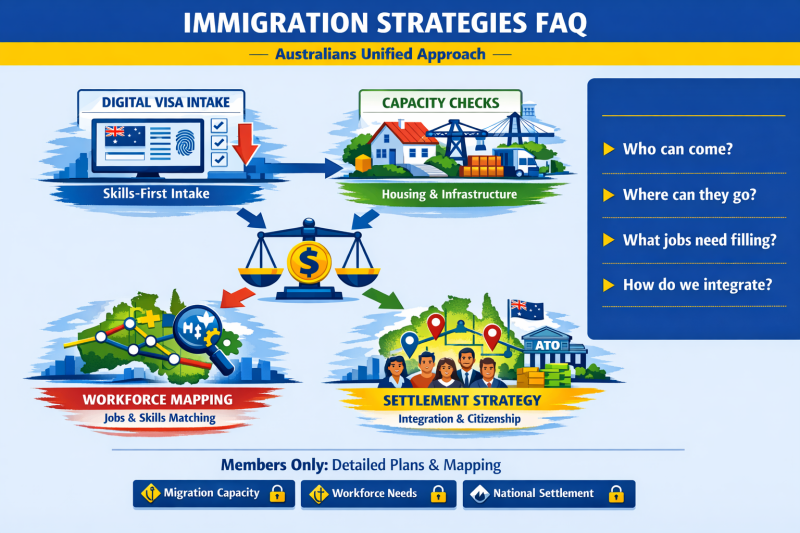
🟩 IMMIGRATION STRATEGIES — FAQ
Q1. What is the goal of Australia’s immigration reform?
A: To build a fair, secure, and sustainable system that aligns migration with national capacity. Australians Unified replaces fragmented visa systems with one digital portal, linking workforce mapping, housing capacity, and values alignment. 🔗 Immigration Reform
Q2. How does the new system balance skilled and unskilled migration?
A: Through a skills‑first intake model. Migration is capped and prioritised for sectors with genuine shortages — energy, defence, health, agriculture, and infrastructure — while low‑skill and non‑essential streams are reduced. 🔗 Immigration Reform
Q3. How will migration align with housing and infrastructure capacity?
A: The system uses capacity‑linked intake. Before visas are issued, regional housing and infrastructure data are checked to ensure communities can absorb new arrivals without increasing cost‑of‑living pressure. 🔗 Housing Reform
Q4. What is workforce mapping and how does it work?
A: Workforce mapping connects migration directly to labour demand. AI‑enabled modelling identifies real gaps in the workforce and matches migrants to those roles — not to arbitrary quotas. 🔒 Members: /members/project-workspaces/workforce-migration
Q5. How does it connect to other reforms?
A: Immigration reform is part of a unified national model that links:
-
Housing Reform — capacity‑linked intake
-
Workforce Reform — skills‑first mapping
-
Treasury Reform — fiscal sustainability
-
Energy & Infrastructure Reform — regional development corridors 🔗 Housing Reform 🔗 Treasury Reform 🔗 Infrastructure Reform
Q6. How does the reform strengthen border integrity and citizenship?
A: By integrating border, visa, and citizenship systems into one secure digital platform. It includes biometric verification, agent regulation, and a national values test before permanent residency. 🔗 Immigration Reform
Q7. What is the National Settlement Strategy?
A: A coordinated plan showing where people go, why, and how capacity determines intake. It aligns migration with regional workforce needs, housing supply, and infrastructure readiness. 🔒 Members: /members/project-workspaces/national-settlement-strategy
Q8. How does this reform support Australia’s long‑term sustainability?
A: By reducing population pressure, protecting wages, and strengthening national cohesion. Migration becomes a strategic tool — not a volume target — supporting sovereign capability and balanced growth. 🔗 Immigration Reform
Q9. What are the benefits for Australians?
-
Lower housing and cost‑of‑living pressure
-
Stronger job protection and wage growth
-
Faster, fairer visa processing
-
Clearer citizenship pathways
-
Restored integrity and national cohesion
Agriculture, Fisheries & Forestry — Food Security FAQ
FAQ 1 — What is the biggest threat to Australia’s food security right now?
Answer: Climate extremes — droughts, floods, heatwaves and bushfires — are the most immediate threat to stable food production. These events reduce yields, damage soil, strain water systems and disrupt supply chains.
Operational Response:
-
Climate‑resilient farming systems
-
Regenerative agriculture
-
Water‑security and drought‑ready planning
Policy Reform Path:
-
Amend the Water Act to modernise water governance
-
Embed climate‑risk standards in agricultural policy
-
Modernise land‑management legislation to prioritise soil and water sustainability
How is Australia protecting itself from pests and diseases?
Answer: Australia relies on strong biosecurity systems, but rising global movement increases the risk of exotic pests and diseases entering the country.
Operational Response:
-
Digital surveillance and national traceability
-
Rapid response capability
-
Strong border biosecurity
Policy Reform Path:
-
Amend the Biosecurity Act to mandate digital monitoring and emergency powers
-
Update the Export Control Act for streamlined certification
-
Modernise the Fisheries Management Act to address climate impacts
Why is agricultural innovation so important?
Answer: Food security depends on farmers having access to modern tools — precision agriculture, advanced crop genetics, digital monitoring and climate‑ready technologies.
Operational Response:
-
Strategic R&D hubs
-
Technology‑transfer programs
-
Digital literacy and rural connectivity
Policy Reform Path:
-
Create a National Agri‑Innovation Framework
-
Modernise R&D funding rules to prioritise on‑farm adoption
-
Embed digital‑inclusion targets for rural communities
Why is there a workforce shortage in agriculture?
Answer: Agriculture faces labour shortages due to an ageing workforce, limited regional services, and competition from other industries.
Operational Response:
-
Targeted training and apprenticeships
-
Rural infrastructure investment
-
Support for 2,800 skilled roles in biosecurity, water systems and digital monitoring
Policy Reform Path:
-
Establish a National Agricultural Workforce Strategy
-
Align education policy to priority skill areas
-
Integrate regional‑development funding with food‑security outcomes
Why are agricultural regulations so complex?
Answer: Producers navigate overlapping rules across agriculture, environment, trade and biosecurity — slowing approvals and increasing costs.
Operational Response:
-
Streamlined regulations
-
Digital‑first approvals
-
Unified data systems
Policy Reform Path:
-
Modernise core agricultural legislation
-
Create unified data standards across DAFF, Trade, Environment and Home Affairs
-
Annual regulatory impact review
What is being done to strengthen Australia’s food supply chains?
Answer: Australia’s long supply chains are vulnerable to disruption and lack domestic processing capacity.
Operational Response:
-
Investment in cold‑chain logistics
-
Regional processing hubs
-
Value‑adding incentives
Policy Reform Path:
-
Embed supply‑chain resilience in national infrastructure planning
-
Create value‑adding incentives for domestic manufacturing
-
Develop a National Food Supply Chain Resilience Plan
How are First Nations communities involved in food security?
Answer: First Nations land management, cultural knowledge and economic participation are essential to sustainable agriculture and natural resource protection.
Operational Response:
-
Co‑management of land and water
-
Cultural‑heritage protection
-
Economic participation in agriculture and carbon farming
Policy Reform Path:
-
Amend land‑management frameworks to strengthen co‑management
-
Establish a First Nations Land & Resource Partnership Framework
-
Integrate First Nations knowledge into climate and biodiversity programs
What is the overall path forward for Australia’s food security?
Answer: A modern, resilient food system built on strong biosecurity, climate‑ready agriculture, innovation, skilled workers, efficient supply chains and First Nations partnerships.
Policy Reform Path (Full):
-
Modernise the Biosecurity Act, Export Control Act, Water Act, Fisheries Management Act
-
Build climate‑resilient agriculture and water systems
-
Strengthen national biosecurity and digital traceability
-
Drive innovation and technology adoption
-
Develop a skilled agricultural workforce
-
Secure supply chains and expand domestic value‑adding
-
Embed First Nations co‑management and cultural protection