DEPARTMENT OF EDUCATION
Education
Reform Stream: Curriculum Alignment
-
AUTS transition school
-
Migrant qualification mapping
-
Literacy and digital skills
Australians Unified – Education, Skills & Lifelong Learning Portfolio
The Department of Education leads Australia’s national approach to schooling, early childhood development, tertiary education, skills, and lifelong learning. It delivers policy, regulation, funding, and partnerships that ensure every Australian — regardless of background — can access high‑quality, inclusive, future‑ready education.
The department works with states and territories, schools, universities, training providers, First Nations communities, industry, and families to build a strong, equitable, and globally competitive education system.
OUR ROLE
The Department of Education exists to:
-
Strengthen early childhood, school, and tertiary education
-
Improve equity, access, and outcomes for all learners
-
Support teachers, educators, and school leaders
-
Deliver national curriculum, assessment, and quality frameworks
-
Expand skills, apprenticeships, and vocational pathways
-
Support First Nations education and community‑led learning
-
Provide research, data, and evidence to guide policy
The department ensures Australia’s education system is inclusive, high‑performing, and future‑focused.


OUR STRENGTHS
Educational & System Strengths
-
Strong national curriculum and quality frameworks
-
Trusted partnerships with states, territories, and providers
-
Deep expertise in education policy and research
-
Established early childhood and school funding systems
-
National leadership in skills and workforce development
Sovereign Strengths
-
Critical to national productivity and social cohesion
-
Essential for future workforce capability
-
Supports Australia’s global competitiveness

OUR WEAKNESSES
Structural Weaknesses
-
Fragmented data systems across jurisdictions
-
Uneven educational outcomes across regions
-
Slow modernisation of digital learning infrastructure
-
Limited long‑term funding certainty for key programs
-
Under‑resourced support for vulnerable learners
Operational Weaknesses
-
Workforce shortages in teaching and early childhood
-
Rising complexity of student needs
-
Limited outreach to remote and First Nations communities
-
Increasing demand for rapid skills development

OUR THREATS
External Threats
-
Workforce shortages across teaching and training
-
Digital inequity affecting student access
-
Global competition in tertiary education
-
Rising cost‑of‑living pressures on families
Internal Threats
-
Resource constraints
-
Outdated digital systems
-
Workforce fatigue and retention challenges
-
Limited surge capacity for major reforms
OUR OPPORTUNITIES
Strategic Opportunities
-
Modernise national digital learning and data platforms
-
Strengthen teacher workforce capability and wellbeing
-
Expand early childhood access and affordability
-
Improve First Nations education partnerships
-
Enhance international education and research leadership
Operational Opportunities
-
Recruit and retain specialist educators
-
Improve digital tools for schools and training providers
-
Strengthen partnerships with universities and industry
-
Expand community and regional engagement
This is where our journey begins. Get to know our business and what we do, and how we're committed to quality and great service. Join us as we grow and succeed together. We're glad you're here to be a part of our story.
🛡️🔧 ADF Training Integration for Civilian Redeployment
✅ Why ADF Training Works
-
Already delivers technical, logistics, cyber, and engineering training
-
Proven systems for discipline, safety, and rapid skill acquisition
-
Can be adapted for civilian workforce modules
-
Supports Defence + Industry crossover roles
🧠 Skill Pathways via ADF Training
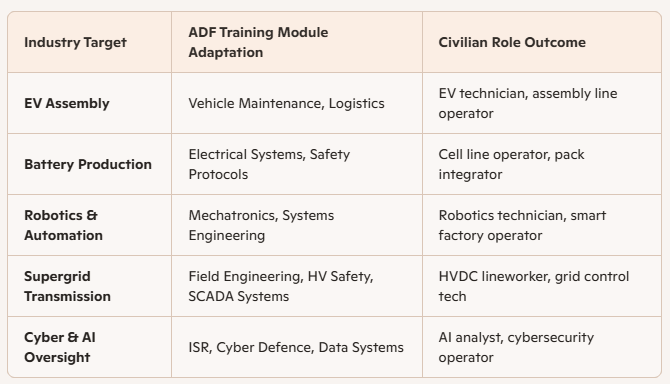
📍 Deployment Strategy
-
Use ADF Cadets + Reserves + Civilian Training Centres
-
Partner with TAFE, Defence Industry Schools, and RTOs
-
Deliver 12–18 month micro‑credential programs
-
Embed training into Defence EV rollout, battery hubs, and supergrid build zones
🚀 Outcome
-
Thousands of freed‑up APS staff retrained via ADF‑aligned pathways
-
Rapid workforce mobilisation for sovereign industries
-
Stronger Defence–Industry integration
-
Export‑ready smart factory and logistics teams

4. BETTER INTEGRATION WITH GOVERNMENT, INDUSTRY & COMMUNITY
One national education ecosystem
Key Actions
-
Integrated data‑sharing platforms
-
Stronger partnerships with universities, TAFEs, and industry
-
National community and regional engagement
-
Shared analytics and intelligence systems
Outcome: A more coordinated, community‑connected education network.
5. A MORE EQUITABLE, FUTURE‑READY AUSTRALIA
Supporting learners, families, and communities
Key Actions
-
Early childhood expansion and affordability
-
Equity programs for vulnerable learners
-
First Nations community‑led education
-
Public transparency and open data
Outcome: A more inclusive, skilled, and confident nation.
THE FUTURE‑READY DEPARTMENT OF EDUCATION
A national blueprint for equity, excellence, and lifelong learning
1. FASTER, MORE EFFECTIVE EDUCATION SYSTEMS
Strengthening national learning capability
Key Actions
-
Modern digital learning and data systems
-
Faster curriculum and assessment pathways
-
Improved school and tertiary performance tools
-
Strengthened coordination with states and territories
Outcome: A more agile, responsive national education system.
2. STRONGER SOVEREIGN EDUCATION CAPABILITY
Building Australian capability for future skills and knowledge
Key Actions
-
Specialist teaching and learning teams
-
National education data and modelling platform
-
Strengthened oversight and governance
-
Expanded skills and workforce planning
Outcome: A more resilient, future‑focused education system.
3. A MODERN, RESILIENT EDUCATION WORKFORCE
Supporting the people who shape Australia’s future
Key Actions
-
Workforce wellbeing and retention programs
-
Specialist training pathways for teachers and educators
-
Diversity and inclusion initiatives
-
Modern digital and pedagogical tools
Outcome: A strong, supported education workforce.
CONDENSED YEARLY COSTING MODEL — DEPARTMENT OF EDUCATION
Baseline + Uplift Investment Framework
BASELINE FUNDING (Already Provided)
-
Core education operations: $1.20B
-
School & early childhood programs: $0.60B
-
Tertiary, skills & workforce development: $0.40B
Total Baseline Funding:
$2.20B per year
PHASE 1 — FOUNDATION (Years 1–2)
Annual uplift: $1.40B – $1.90B 2‑year uplift total: $2.80B – $3.80B
PHASE 2 — ACCELERATION (Years 2–4)
Annual uplift: $1.90B – $2.50B 3‑year uplift total: $5.70B – $7.50B
PHASE 3 — EXPANSION (Years 4–6)
Annual uplift: $2.40B – $3.10B 2‑year uplift total: $4.80B – $6.20B
PHASE 4 — FUTURE‑READY (Years 6–10)
Annual uplift: $3.00B – $3.80B 4‑year uplift total: $12.00B – $15.20B
TOTAL INVESTMENT SUMMARY
6‑YEAR TOTAL
-
Uplift: $13.30B – $17.50B
-
Baseline: $13.20B
Total 6‑Year Investment:
$26.50B – $30.70B
10‑YEAR TOTAL
-
Uplift: $24.50B – $32.70B
-
Baseline: $22.00B