INDUSTRY, SCIENCE & RESOURCES DEPARTMENT
Driving Australia’s sovereign capability, innovation, and economic resilience
The Industry, Science & Resources Department leads Australia’s national effort to build a productive, competitive, and future‑ready economy. We strengthen sovereign manufacturing, accelerate scientific innovation, support responsible resource development, and ensure Australia remains globally competitive in critical technologies and advanced industries.
This department delivers the operational, regulatory, and strategic functions that bring the national reform agenda to life.
1. PURPOSE OF THE DEPARTMENT
The department exists to:
-
Build sovereign industrial capability
-
Strengthen national science, research, and innovation
-
Support advanced manufacturing and value‑added production
-
Develop critical technologies and digital capability
-
Ensure responsible, sustainable resource development
-
Improve national supply chain resilience
-
Drive productivity, competitiveness, and economic growth
WHAT THE DEPARTMENT DOES

Industry & Manufacturing
-
Support advanced manufacturing and industrial modernisation
-
Strengthen sovereign capability in essential goods
-
Improve national supply chain resilience

Science, Research & Innovation
-
Support national research infrastructure
-
Accelerate commercialisation of scientific breakthroughs
-
Build partnerships between universities, CSIRO, and industry

Critical Technologies & Digital Capability
-
Develop national frameworks for AI, quantum, robotics, and advanced computing
-
Support technology adoption across industry
-
Strengthen cyber‑secure digital infrastructure
Resources & Critical Minerals
-
Oversee responsible resource development
-
Support critical minerals extraction, processing, and value‑adding
-
Align resource policy with national clean energy and industrial strategies
Energy Transition & Industrial Decarbonisation
-
Support clean energy industries
-
Enable industrial decarbonisation pathways
-
Align energy policy with national manufacturing and resource strategies
Workforce, Skills & Training
-
Build national STEM and advanced manufacturing skills pipelines
-
Support industry‑aligned training and apprenticeships
-
Coordinate workforce transition for emerging industries
HOW THE DEPARTMENT OPERATES
The department operates as a unified national system, integrating policy, regulation, research, and industry development.
National Coordination
We work across government, industry, research institutions, and international partners to deliver a coordinated national approach.
Evidence‑Based Policy
We use data, research, and industry insights to guide national investment and regulatory settings.
Industry Partnerships
We collaborate with businesses, peak bodies, and innovators to accelerate growth and commercialisation.
Sustainability & Responsibility
We ensure resource development and industrial growth align with environmental, community, and long‑term national interests.
.

SUB‑DEPARTMENTS
Each sub‑department inherits the national reform logic and supports the department’s mission:
Industry & Manufacturing Modernisation
Strengthening sovereign capability, advanced manufacturing, and supply chain resilience.
Science, Research & Innovation
Supporting national research infrastructure and accelerating commercialisation.
Critical Technologies & Digital Capability
Developing national capability in AI, quantum, robotics, and advanced computing.
Resources & Critical Minerals
Ensuring responsible development, processing, and value‑adding of Australia’s resources.
Energy Transition & Industrial Decarbonisation
Supporting clean energy industries and industrial transformation.
Workforce, Skills & Training
Building a future‑ready workforce for advanced industries and technologies.
CROSS‑PORTFOLIO ALIGNMENT
The department works closely with:
-
Treasury — economic strategy, investment, productivity
-
Education — STEM, research, skills pipelines
-
Defence — sovereign capability, critical technologies
-
Energy — clean energy, hydrogen, critical minerals
-
Infrastructure — industrial precincts, freight, logistics
-
Home Affairs — supply chain security, cyber resilience
-
Foreign Affairs — trade, global partnerships, Indo‑Pacific cooperation
This ensures a unified national approach to industry, science, and resources.
BENEFITS TO AUSTRALIA
This department delivers:
-
Stronger sovereign capability
-
A more competitive and productive economy
-
Faster commercialisation of research
-
Secure and resilient supply chains
-
High‑value jobs in science, technology, and manufacturing
-
Sustainable resource development
-
A future‑ready national industrial base
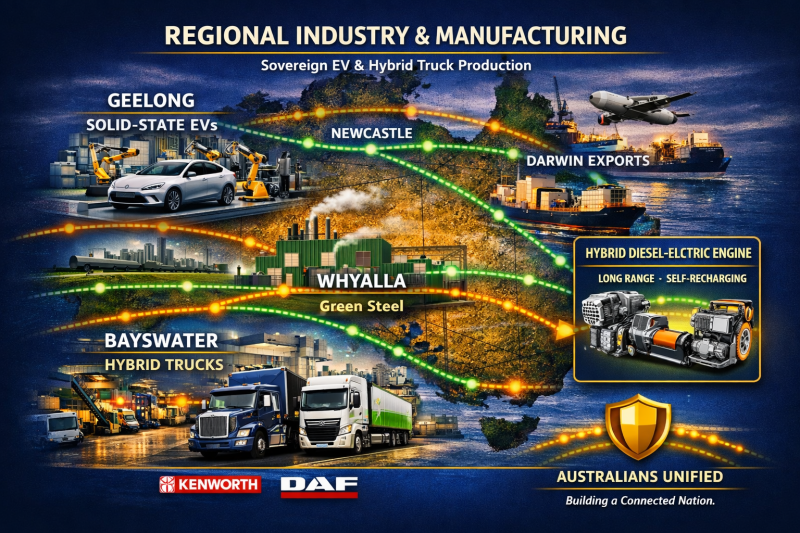
Regional Industry & Manufacturing
Australia’s regional manufacturing network powers sovereign EV and hybrid truck production using green steel from Whyalla. Geelong and Bayswater lead the transition to solid‑state vehicles and self‑recharging engines for Kenworth and DAF. The legend below defines the unified national systems connecting energy, water, defence, and mobility under the Australians Unified framework.

Tile 6 — Regional Industry & Manufacturing
Theme: Australia’s sovereign EV + hybrid truck + green‑steel industrial spine Placement: Middle or lower row, left or centre tile (pairs beautifully with your Defence and Export tiles)
What this tile now communicates
-
Geelong → Solid‑state EV cars
-
Bayswater → Kenworth & DAF hybrid solid‑state trucks
-
Whyalla → Green‑steel feedstock
-
Newcastle → Industrial logistics
-
Darwin → Export terminal
-
National grid lines → Energy + supply chain integration
Regional Industry & Manufacturing

7️⃣ Unified Industry Network — National Integration
The Unified Industry Network connects Geelong, Bayswater, Whyalla, Newcastle, and Darwin through glowing corridors of energy and logistics. It visualises Australia’s industrial unity — a nation working as one system.
This network is the embodiment of Australians Unified. It represents a sovereign manufacturing ecosystem powered by clean energy, innovation, and national pride — a connected nation built to endure and lead.

Geelong — Solid‑State EV Manufacturing
Geelong stands at the forefront of Australia’s electric‑vehicle transformation. Its advanced assembly lines combine solid‑state battery technology with green‑steel chassis production, creating vehicles that are lighter, stronger, and emission‑free. Solar‑powered facilities and robotic precision define this new era of automotive innovation.
This hub represents the rebirth of Australian car manufacturing — sovereign, sustainable, and export‑ready. Geelong’s EV industry connects directly to the national Super‑Grid, ensuring clean power supply and positioning the region as a global leader in next‑generation mobility.

2️⃣ Bayswater — Hybrid Truck Production
Bayswater drives Australia’s heavy‑vehicle renaissance. The Kenworth and DAF plants now integrate hybrid diesel‑electric systems with solid‑state battery modules, producing trucks capable of self‑recharging and long‑range operation. These vehicles deliver high torque and reliability for both Defence and commercial logistics.
This manufacturing hub embodies sovereign capability — combining engineering heritage with modern electrification. Bayswater’s hybrid truck program strengthens national supply chains and ensures Australia remains competitive in global transport innovation.

3️⃣ Whyalla — Green Steel Supply
Whyalla’s transformation into a green‑steel powerhouse is central to Australia’s industrial future. Hydrogen‑based furnaces and renewable‑powered smelters produce low‑carbon steel for EVs, ships, and infrastructure. The plant’s output fuels sustainable growth across the manufacturing network.
By replacing traditional coal‑based processes, Whyalla sets a benchmark for clean industrial production. Its green‑steel supply underpins every Australians Unified initiative — from vehicle frames to export terminals — proving that sustainability and strength can coexist.

4️⃣ Newcastle — Port & Rail Integration
Newcastle connects Australia’s inland industries to the world. Its integrated port and rail systems move green steel, EVs, and hybrid trucks efficiently across the nation and into export markets. Advanced logistics and automation ensure seamless coordination between manufacturing zones.
This hub is the beating heart of Australia’s industrial mobility. Newcastle’s infrastructure supports both domestic resilience and international trade, reinforcing the unified network that powers Australia’s modern economy.

5️⃣ Darwin — Northern Export Gateway
Darwin anchors Australia’s Indo‑Pacific export strategy. Its deep‑water port handles hydrogen, green steel, and advanced vehicles bound for regional partners. The terminal’s design integrates renewable energy storage and smart logistics for efficient global distribution.
As the northern gateway, Darwin connects Australia’s industrial output to Asia’s growing markets. It embodies the Australians Unified vision — a resilient, outward‑looking economy built on clean technology and strategic cooperatio

6️⃣ Hybrid Diesel‑Electric Engine — Technology Showcase
Australia’s hybrid diesel‑electric engine represents a leap in sovereign innovation. Combining solid‑state battery storage with efficient diesel generation, it recharges itself while operating, enabling long‑range, high‑torque performance for trucks and Defence vehicles.
This technology bridges the gap between traditional fuel systems and full electrification. It ensures reliability across vast distances while reducing emissions — a practical, scalable solution for Australia’s transport and logistics future.

7️⃣ Unified Industry Network — National Integration
The Unified Industry Network visually connects Geelong, Bayswater, Whyalla, Newcastle, and Darwin through glowing energy and logistics corridors. It symbolises Australia’s integrated manufacturing ecosystem — powered by clean energy, green steel, and sovereign innovation.
This network is more than infrastructure; it’s a national identity. Under Australians Unified, each region contributes to a cohesive industrial map that restores pride, capability, and resilience across the nation.