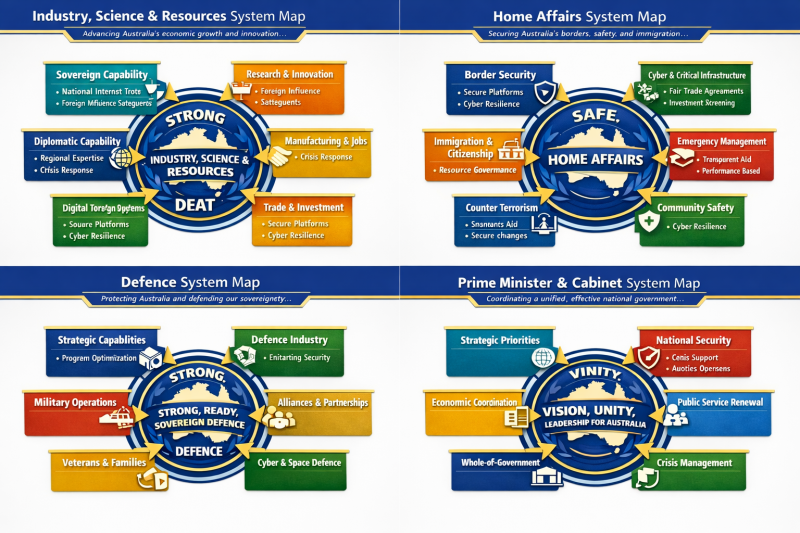
DEPARTMENT OF THE PRIME MINISTER & CABINET
Australians United Reform & Modernisation Framework
National Coordination • Strategic Governance • Whole‑of‑Government Reform
🔵 1. Portfolio Purpose
The Department of the Prime Minister & Cabinet (PM&C) is the central coordination engine of the Australian Government. It supports:
-
The Prime Minister
-
Cabinet
-
Portfolio Ministers
-
Assistant Ministers
-
Intergovernmental partners
-
National reform programs
-
Community engagement and public participation
Its purpose is to ensure coordinated, transparent, accountable, and community‑aligned national governance.
⚠️ 2. Why Change Is Needed
Australia faces rising complexity across economic, security, digital, and social systems. PM&C must evolve to meet these challenges.
Key Challenges
-
Fragmented policy coordination across portfolios
-
Slow, manual Cabinet and intergovernmental processes
-
Rising cyber, misinformation, and national security threats
-
Limited real‑time visibility of national performance
-
Overlap between central agencies
-
High administrative burden and duplicated systems
If Unchanged
-
Slower national decision‑making
-
Reduced resilience to crises
-
Inefficient policy delivery
-
Lower public trust
-
Weaker national coordination across states and territories

National Coordination Capability Model
(Mirrors the Infrastructure “National Capability Corridors” model)
A. National Coordination & Governance
-
Cabinet Secretariat
-
Intergovernmental relations
-
National agreements
-
Governance & integrity systems
B. Strategic Policy & Reform Integration
-
Cross‑portfolio reform programs
-
National priorities alignment
-
Whole‑of‑government strategy
-
Predictive modelling for economic, security & social risks
C. National Risk, Crisis & Security
-
Crisis Coordination Centre
-
National risk monitoring
-
Emergency response
-
Cyber, misinformation & resilience systems
D. Public Transparency & Performance
-
National dashboards
-
Real‑time performance visibility
-
Open data
-
Public reporting

What PM&C Delivers
(Structured like Infrastructure’s “What the Reform Delivers”)
Faster, Smarter Government
Streamlined decision‑making, reduced duplication, and faster reform execution.
Unified National Strategy
Whole‑of‑government planning aligned to national priorities and sovereign capability.
Transparent Reform Delivery
Public dashboards, performance reporting, and open data.
Integrated Capability Systems
Treasury, Infrastructure, Defence, Social Services, and Home Affairs aligned under a single reform logic.
Stronger Intergovernmental Partnerships
Federal, state, and local governments working together on shared outcomes.

Sub‑Departments
(Reconstructed from your editor content)
1. National Coordination & Governance
-
Cabinet Secretariat
-
Governance & Integrity
-
Intergovernmental Relations
2. Strategic Policy & Reform Integration
-
National priorities
-
Cross‑portfolio reform
-
Whole‑of‑government strategy
3. National Risk, Crisis & Security
-
Crisis Coordination Centre
-
National risk monitoring
-
Emergency response
-
Cyber & misinformation resilience
4. Public Transparency & Performance
-
National dashboards
-
Open data
-
Public reporting
5. First Nations Affairs
-
Policy coordination
-
Funding
-
Community partnerships
6. Business Operations Department
(Your new department — fully integrated)
-
HR, finance, ICT, security
-
Ministerial services
-
Cabinet workflow support
-
Governance systems
-
Interdepartmental coordination
AMEND
-
Modernise Cabinet processes with automation and transparency
-
Strengthen national risk and crisis coordination
-
Improve intergovernmental agreements and accountability
-
Update governance frameworks to reduce duplication
AMEND
-
Modernise Cabinet processes with automation and transparency
-
Strengthen national risk and crisis coordination
-
Improve intergovernmental agreements and accountability
-
Update governance frameworks to reduce duplication
CREATE
-
A unified national governance data architecture
-
Real‑time national performance dashboards
-
A governance intelligence network
-
Predictive modelling for national risks
-
Digital self‑service tools for ministers and departments
-
A fully integrated Business Operations Department

Strategic Roadmap (Years 1–10)
(Rebuilt using Infrastructure’s roadmap structure)
Phase 1 — Foundation (Years 1–2)
-
Merge overlapping central agency functions
-
Reduce duplicated staffing and systems
-
Deploy workflow automation
-
Begin AI forecasting pilots
-
Build unified governance data architecture
-
Establish independent oversight board
Phase 2 — Acceleration (Years 2–4)
-
AI‑enabled monitoring
-
Automated Cabinet workflows
-
Digital tools for ministers
-
Automated reporting dashboards
-
Strengthened cyber‑resilience
Phase 3 — Expansion (Years 4–6)
-
Whole‑of‑government AI adoption
-
Governance intelligence network
-
Real‑time dashboards
-
Workforce augmentation
-
Enhanced transparency
Phase 4 — Future‑Ready (Years 6–10)
-
Fully automated Cabinet cycles
-
Predictive modelling
-
Misinformation detection
-
Integrated governance ecosystem
-
Continuous improvement
🟫 9. First Nations Leadership
(Reformatted into Infrastructure‑style tile)
Community‑Led Reintegration
Structured Employment with Cultural Safety
Victim Payback & Community Restitution
Local Economic Capability Building
Reduced Re‑offending through Cultural Integration
Costing Model (10‑Year Reform)
(Directly from your page, formatted like Infrastructure)
Baseline Funding (Reduced)
$1.10B per year (Down from $1.57B — 30% efficiency gain)
Phase 1 — Years 1–2
$0.82B – $1.10B Foundation: Unify & Stabilise
-
AI pilots
-
Workflow automation
-
Legacy system consolidation
-
Governance board
-
Unified data architecture
Phase 2 — Years 2–4
$1.80B – $2.40B Acceleration: Modernise & Automate
-
AI‑enabled monitoring
-
Automated Cabinet workflows
-
Digital self‑service tools
-
National dashboards
-
Cyber‑resilience upgrades
Phase 3 — Years 4–6
$1.40B – $1.90B Expansion: Strengthen Capability
-
Governance intelligence network
-
Real‑time dashboards
-
Workforce augmentation
-
Transparency upgrades
-
National resilience systems
Phase 4 — Years 6–10
$3.60B – $4.80B Future‑Ready: Transform & Protect
-
Fully automated Cabinet cycles
-
Predictive modelling
-
Misinformation detection
-
Integrated governance ecosystem
Total Investment
-
6‑Year Total: $4.02B – $5.40B
-
10‑Year Total: $7.92B – $10.20B
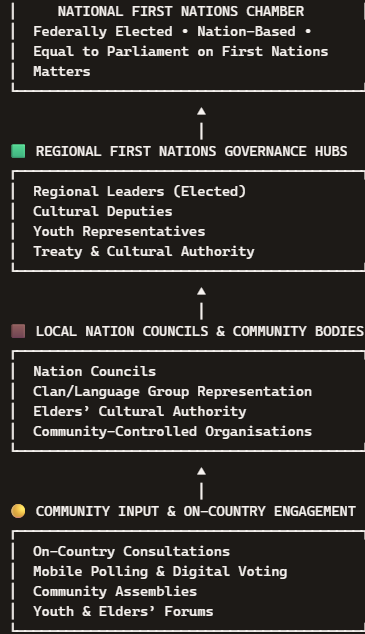
🌿 NATIONAL FIRST NATIONS LEADERSHIP CHAMBER
Brand‑coloured, public‑facing simplified version — BULLET POINTS
🔵 NATIONAL FIRST NATIONS CHAMBER (AU Navy)
-
Federally elected chamber
-
Represents every First Nation
-
Sits alongside Parliament
-
Makes decisions on all First Nations matters
-
Approves laws affecting First Nations people
-
Leads treaty, culture, land, and heritage decisions
-
Oversees First Nations programs and funding
-
Ensures community‑led governance
🟩 REGIONAL FIRST NATIONS GOVERNANCE HUBS (AU Teal)
-
Elected regional leaders
-
Cultural deputies
-
Youth representatives
-
Lead regional treaty work
-
Provide cultural authority
-
Oversee regional services and outcomes
-
Connect local Nations to the national chamber
🟫 LOCAL NATION COUNCILS & COMMUNITY BODIES (Charcoal + Sand)
-
Nation‑level decision‑making
-
Clan and language group representation
-
Elders’ cultural authority
-
Community‑controlled organisations
-
Local program design
-
Local priorities and planning
🟡 COMMUNITY INPUT & ON‑COUNTRY ENGAGEMENT (AU Gold)
-
On‑Country consultations
-
Mobile polling
-
Digital voting
-
Community assemblies
-
Elders’ forums
-
Youth forums
-
Community‑driven decision‑making
🌏 HOW IT CONNECTS TO PARLIAMENT
-
Three chambers work together
-
House of Representatives
-
Senate
-
National First Nations Chamber
-
All First Nations matters require agreement from all three
-
Ensures shared decision‑making
-
Moves beyond symbolic consultation