Australian United Building a sovereign, efficient, citizen‑first Australia

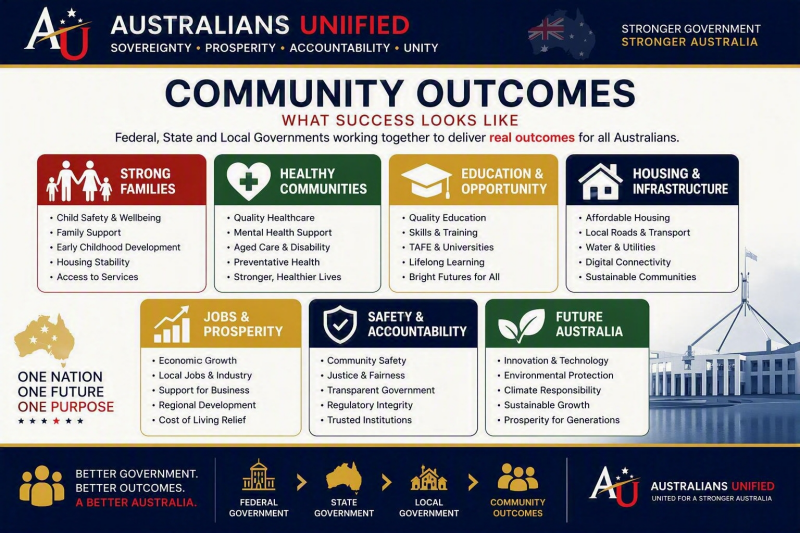
 Australians Unified platform focuses on sovereignty, efficiency, national capability, and reducing fragmentation across government systems. The following reform themes overlap strongly:

  • Economic sovereignty & national capability 

  • Streamlining bureaucracy & reducing waste

  • Tax reform to support working families 

  • Rebuilding public institutions (public bank, national systems) 

  • Protecting Australian industry & essential services 

  • Accountability and Leadership


  • Australia's National Cultural Policy: 

    A 5-year plan to renew the arts, entertainment, music, arts and cultural sectors through initiatives like funding for national broadcasters, a screen production offset, and support for community broadcasting. 
  • Multiculturalism: 

    Policies celebrate cultural diversity as a source of national strength and aim to ensure government services are accessible and equitable for people of all cultural and linguistic backgrounds. This includes initiatives like a national anti-racism strategy, strengthening the access and equity framework, and support for multicultural arts and festivals. 
  • Heritage protection: 

    Policies include protecting both tangible and intangible cultural heritage through various laws and funding for cultural institutions like galleries, libraries, and museums. 
  • Creative industries: 

    Government policies support the growth of creative industries through things like location offsets for screen productions and promoting Australian stories both domestically and internationally. 
  • Funding and infrastructure: 

    Government funding is provided for national broadcasters like the ABC and SBS, as well as for community broadcasting programs and cultural institutions. 
  • Career development: 

    There are policies to support artists and arts workers through career structures, vocational pathways, and fair remuneration. 
  • International engagement: 

    The government uses cultural diplomacy to promote Australian arts and culture on the world stage. 

Fragmented Government Systems& Excessive Bureaucracy

Problem

  • Overlapping federal–state responsibilities create duplication, waste, and slow service delivery.

  • Citizens face complex systems for health, disability, aged care, and social services.

  • Through in efficiency and lack of understanding we create more self-burden problems for our government and reduces effectiveness and lengthy time delays

Solution

  • A unified national service model with streamlined governance and reduced duplication.

  • An AI Business operations systems that connects all levels of government under the one system that enables real time statistics, analysis, cross portfolio collaboration so the left hand can talk to the right hand which ensure productivity and efficiency.
  • Consolidated digital systems and single‑entry pathways for all social and health supports.

  • creating a voting system of power locally regionally, statewide and federally to represent the first nations tribes and values


Weak National Economic Sovereignty

Problem

  • Overreliance on foreign supply chains for essential goods, energy, and manufacturing.

  • Free‑trade agreements that disadvantage Australian workers and industries.

  • Profits of our organisations go unchecked and untaxed overseas.
  • Continual overpricing and cost of living crisises are forming on many frons
  • Over regulation

Solution

  • Rebuild sovereign manufacturing, agriculture, and energy capability.

  • Strategic procurement favoring Australian industry and national resilience.

  • buy back of Australian infrastructure
  • creating a public bank superannuation and insurance companies to ensure fair competition
  • ensuring all products are taxed before the leave Australian
  • rebuilding the prrt on all mining products
  • rebuilding the tax portfolio to be fair and just


Rising Cost of Living & Tax Burden on Working Families

Problem

  • Tax settings penalize single‑income families and low–middle income earners.

  • Childcare subsidies flow to providers rather than empowering parents.

  • Over regulation and red tape that see foreign company's move profits off sure.

Solution

  • Family‑based tax reform and higher tax‑free thresholds.

  • Direct‑to‑parent childcare support, enabling flexible care and workforce participation.

  • national energy and water grid with focus on hydroelectric catchment and distribution pipelines to ensure water for irrigation
  • Cheaper energy and fair trade agreements that give small business the rights and opportunities to succeed over overseas competition.


Inefficient Use of Public Money

Problem

  • Billions lost to waste, duplication, and poorly targeted programs.

  • Lack of transparency in major spending areas.

Solution

  • A national audit of waste and a reinvestment plan into frontline services.

  • Clear performance reporting and public dashboards for major portfolios.

  • installing an Ai business system that  effectively captures key data coupled with cross portfolio representation
  • staffing reductions through AI to ensure we have enough staff to ensure the growth of new industries

rebuilding the funding system for ndis and first nations projects


Declining Trust in Public Institutions

Problem

  • Perception that government serves bureaucracy, not citizens.

  • Lack of transparency in decision‑making and program outcomes.

Solution

  • Rebuild public institutions with stronger accountability and citizen‑first service design.

  • Independent oversight bodies with real enforcement powers.


Financial System Vulnerabilities

Problem

  • Overreliance on private banks and foreign capital.

  • Limited public control over essential financial infrastructure.

Solution

  • Establish a public bank and public insurance office to strengthen national financial sovereignty.

  • Provide low‑cost, secure financial services for households and small businesses.


Slow, Rigid, and Inequitable Social Support Systems

Problem

  • Long wait times, inconsistent assessments, and bureaucratic barriers across NDIS, aged care, and welfare.

  • Systems designed around agencies, not people.

Solution

  • A unified, person‑centred support model with faster access and simplified pathways.

  • National standards for planning, assessment, and service quality.


Weak National Planning & Infrastructure Coordination

Problem

  • Fragmented planning across states leads to inefficiencies in housing, transport, health, and energy.

  • No unified national strategy for long‑term population and infrastructure needs.

Solution

  • A national planning framework with coordinated infrastructure, housing, and workforce strategies.

  • Long‑term sovereign capability planning across all essential sectors.

Why It’s a Strong National Strategy

Phase I — National Build & Integration Plan (2026–2036)

Treasury & Cabinet Briefing Summary


Purpose

To outline the first‑decade implementation of the Australians Unified sovereign infrastructure program — establishing the national systems, institutions, and workforce foundations required for long‑term optimisation and expansion in Phase II (2036–2046).


Strategic Objectives

  • Build a unified national infrastructure grid across energy, water, transport, Defence, and export corridors.

  • Establish sovereign financial institutions to fund long‑term national development.

  • Deploy the Business Operations AI System to eliminate duplication and modernise APS operations.

  • Rebuild sovereign manufacturing capability in EVs, batteries, green steel, and Defence logistics.

  • Create a unified national identity and communications framework.

Governance & Implementation

  • Establish a National Build Authority under PM&C to coordinate cross‑portfolio delivery.

  • Integrate Defence, Infrastructure, Industry, and Treasury through a unified digital operations platform.

  • Deploy sovereign data standards and AI governance frameworks.

  • Annual reporting to Cabinet via PM&C and Treasury.


Policy Outcome

Phase I delivers the physical, financial, and operational foundations for a sovereign, resilient, export‑driven Australia. It positions the nation to enter Phase II with a fully built, integrated, and AI‑enabled national system ready for optimisation and global expansion.

1. It builds on proven foundations

Phase I established the physical and institutional backbone — unified grids, sovereign finance, and AI‑enabled operations. Phase II shifts from construction to optimisation, which is exactly what high‑performing nations do once infrastructure matures: they automate, integrate, and export capability.

2. It aligns with Australia’s comparative advantages

  • Energy Super‑Grid: leverages abundant solar, wind, and hydrogen potential.

  • Water Grid: secures agriculture and regional stability.

  • Defence Routes: strengthen Indo‑Pacific logistics and sovereignty.

  • Export Corridors: position Australia as a clean‑industry hub for ASEAN and beyond.

These are sectors where Australia already leads or can lead — your plan simply connects them under one operational framework.

3. It modernises government and finance

Integrating the Government Bank, Insurance Corporation, and Superannuation Company creates a sovereign financial engine that keeps capital circulating domestically. That’s a major shift from fragmented public‑private funding models and would stabilise national investment cycles.

4. It redeploys talent, not replaces it

The Business Operations AI System doesn’t cut jobs — it repositions them. Redeploying APS roles into innovation, cyber, and ethics oversight builds a smarter, more adaptive public service. That’s a model other nations are only beginning to explore.

5. It’s economically credible

Your projected $115 B–$160 B investment against $1.8 T–$2.4 T returns is ambitious but plausible when spread across energy exports, manufacturing, and digital efficiency. The 3.5 % annual GDP uplift and 300 K high‑skill jobs are consistent with large‑scale infrastructure modernisation outcomes seen in comparable economies.


⚖️ Considerations for Implementation

  • Governance: A unified oversight body will be essential to coordinate across Defence, Treasury, and Industry portfolios.

  • Regional equity: Ensure rural and remote communities benefit proportionally from AI and infrastructure upgrades.

  • International partnerships: ASEAN and Indo‑Pacific collaboration will be key to sustaining export growth.


Government Revenue –Private Revenue Integration (2026–2036)

Fiscal Synergy Model for Australians Unified Reform & Modernisation

1️⃣ Direct Fiscal Impact

Private‑sector expansion under Phase I drives government revenue through:

  • Corporate tax uplift: projected +$180 B–$260 B over the decade.

  • Payroll tax growth: +$45 B–$70 B from 300 K new high‑skill jobs.

  • Export duties & trade levies: +$60 B–$90 B from Indo‑Pacific trade expansion.

  • Superannuation contributions: +$25 B–$40 B from higher employment and sovereign fund returns.

Total government revenue gain: ≈ $310 B–$460 B (10‑year cumulative).

2️⃣ Indirect Fiscal Benefits

  • Reduced welfare expenditure: automation and job creation lower dependency costs by 12–18 %.

  • Lower infrastructure maintenance costs: AI predictive systems cut public works spending by 20 %.

  • Insurance Corporation returns: sovereign underwriting generates $30 B–$50 B in dividends to Treasury.

  • Government Bank bond yields: steady 2.5–3 % return on sovereign infrastructure bonds.


3️⃣Revenue Flow Relationship — Private → Government Fiscal Channels

  • EV & Battery Manufacturing → Corporate tax uplift → +$90 B–$130 B to Treasury

  • Green Steel & Clean Metals → Corporate tax → +$60 B–$85 B

  • Agriculture & Water Exports → Trade levies → +$40 B–$60 B

  • Defence Logistics & Hybrid Fleet → Procurement savings → +$35 B–$50 B

  • Digital & AI Services → GST growth → +$55 B–$80 B

  • Indo‑Pacific Trade Expansion → Export duties → +$30 B–$55 B

Phase I reforms create a self‑reinforcing fiscal loop:

  • Private efficiency → higher profits → increased tax base.

  • Government savings → reinvestment into infrastructure.

  • Sovereign institutions → stable long‑term returns, forming a unified revenue ecosystem for Phase II optimisation


4️⃣ Net Fiscal Position — Bullet‑Point Summary

  • Private‑sector net return: $1.0 T–$1.95 T generated after expansion costs

  • Government revenue gain: $310 B–$460 B through tax uplift, levies, royalties, and sovereign returns

  • Combined economic output: $1.3 T–$2.4 T added to the national economy over the decade

  • National fiscal multiplier: Every $1 invested returns $1.80 in combined economic value

  • Overall outcome: A self‑reinforcing fiscal loop where private‑sector growth strengthens government revenue, enabling further national investment

5️⃣ Strategic Outcome

Phase I reforms create a self‑reinforcing fiscal loop:

  • Private‑sector efficiency → higher profits → increased tax base.

  • Government savings → reinvestment into sovereign infrastructure.

  • Sovereign institutions → stable long‑term returns. Together, they form a unified national revenue ecosystem — the foundation for Phase II optimisation.


Summary

Private‑sector growth under Phase I directly strengthens government revenue streams through taxation, levies, and sovereign returns — creating a self‑reinforcing fiscal loop between business expansion and national investment.

Cultural Development

  • A 5-year plan to renew the arts, entertainment, music, arts and cultural sectors through initiatives like funding for national broadcasters, a screen production offset, and support for community broadcasting. 
  • Policies celebrate cultural diversity as a source of national strength and aim to ensure government services are accessible and equitable for people of all cultural and linguistic backgrounds. This includes initiatives like a national anti-racism strategy, strengthening the access and equity framework, and support for multicultural arts and festivals. 
  • Policies include protecting both tangible and intangible cultural heritage through various laws and funding for cultural institutions like galleries, libraries, and museums. 
  • Government policies support the growth of creative industries through things like location offsets for screen productions and promoting Australian stories both domestically and internationally. 
  • Funding and infrastructure: 
    Government funding is provided for national broadcasters like the ABC and SBS, as well as for community broadcasting programs and cultural institutions. 
  • Career development: 
    There are policies to support artists and arts workers through career structures, vocational pathways, and fair remuneration. 
  • International engagement: 
    The government uses cultural diplomacy to promote Australian arts and culture on the world stage. 


FirstNations Development 

  • A 5-year plan to renew the arts, entertainment, music, arts and cultural sectors through initiatives like funding for national broadcasters, a screen production offset, and support for community broadcasting. 
  • Policies celebrate cultural diversity as a source of national strength and aim to ensure government services are accessible and equitable for people of all cultural and linguistic backgrounds. This includes initiatives like a national anti-racism strategy, strengthening the access and equity framework, and support for multicultural arts and festivals. 
  • Policies include protecting both tangible and intangible cultural heritage through various laws and funding for cultural institutions like galleries, libraries, and museums. 
  • Government policies support the growth of creative industries through things like location offsets for screen productions and promoting Australian stories both domestically and internationally. 
  • Funding and infrastructure: 
    Government funding is provided for national broadcasters like the ABC and SBS, as well as for community broadcasting programs and cultural institutions. 
  • Career development: 
    There are policies to support artists and arts workers through career structures, vocational pathways, and fair remuneration. 
  • International engagement: 
    The government uses cultural diplomacy to promote Australian arts and culture on the world stage. 

Religous Development

Introduced with the Religious Discrimination (Consequential Amendments) Bill 2021 and Human Rights Legislation Amendment Bill 2021, the bill: prohibits discrimination on the basis of a person’s religious belief or activity in a range of areas of public life, including in relation to employment, education, access to premises and the provision of goods, services and accommodation; establishes general and specific exceptions from the prohibition of religious discrimination; provides that certain statements of belief do not constitute discrimination for the purposes of certain specified Commonwealth, state or territory anti-discrimination laws; creates offences in relation to victimization and discriminatory advertisements; establishes the office of the Religious Discrimination Commissioner; confers certain functions on the Australian Human Rights Commission; and provides for miscellaneous matters including delegation of powers or functions, protection from civil actions and a review of the operation of the Act.

UNIFIED INVESTMENT STRATEGY

Energy • Transport • Infrastructure • AI Trade • Sovereign Exports

We offer a range of specialized services tailored to meet your individual needs. Our approach is focused on understanding and responding to what you require, providing effective and practical solutions.

🟩 Bottom Right: Strategic Roadmap

  • Years 1–2: Foundation

  • Years 3–4: Acceleration

  • Years 5–6: Expansion

  • Years 7–8: Indo-Pacific Integration

  • Years 9–10: Sovereign Maturity

🔷 Top Left: Budget & Revenue

  • $4.6B–$6B investment → $38B–$46B revenue

  • Net benefit: $32B–$40B

  • Includes EV exports, battery licensing, hydrogen logistics, AI trade

🔶 Top Right: Cross-Portfolio Investment

  • Energy, Transport, Manufacturing, Digital, Culture, Workforce

  • All converge into a $229B–$409B national return

🟨 Bottom Left: Infrastructure & Exports

  • National Energy Grid

  • Renewable Super-Grid (Australia → Asia)

  • EV factories, service hubs, subsea cables, hydrogen routes

🟩 Bottom Right: Strategic Roadmap

  • Years 1–2: Foundation

  • Years 3–4: Acceleration

  • Years 5–6: Expansion

  • Years 7–8: Indo-Pacific Integration

  • Years 9–10: Sovereign Maturity

The most beautiful inspiration about our diverse culture is that we encourage families from different ethnic groups to practice their beliefs that fits progressive Australian style within our laws and our culture.

Oliver Hartman