This is where our journey begins. Get to know our business and what we do, and how we're committed to quality and great service. Join us as we grow and succeed together. We're glad you're here to be a part of our story.
Services
LEGISLATIVE REFORM PACKAGE

AMEND — Detailed Policy Reform Targets
1. Biosecurity Act
Purpose of Amendment:
-
Strengthen national coordination and emergency response powers
-
Mandate real‑time threat detection and reporting systems
-
Expand scope to include climate‑linked biosecurity risks
-
Integrate First Nations land stewardship into biosecurity planning
Key Changes:
-
National Biosecurity Command creation
-
Mandatory digital surveillance and reporting
-
Surge workforce provisions
-
Cross‑portfolio integration with Health, Environment, and Home Affairs
2. Water Act
Purpose of Amendment:
-
Align water governance with national food security and climate resilience
-
Integrate water infrastructure with national energy and agriculture grids
-
Strengthen drought and flood planning powers
-
Embed First Nations water rights and co‑management
Key Changes:
-
National Water Grid integration
-
Smart irrigation and water‑energy synchronisation
-
Regional water resilience standards
-
Transparent water allocation and trading reforms
3. Export Control Act
Purpose of Amendment:
-
Modernise export certification and compliance
-
Enable automated, AI‑driven export systems
-
Strengthen traceability and biosecurity safeguards
-
Support high‑value, value‑added agricultural exports
Key Changes:
-
Digital export certification platform
-
Real‑time compliance monitoring
-
Integration with Agriculture Data Platform
-
Streamlined approvals for regional processors
4. Regional Development Frameworks
Purpose of Amendment:
-
Align regional development with agriculture, energy, water, and transport reforms
-
Support co‑located service hubs and surge capability
-
Embed community resilience and First Nations partnerships
Key Changes:
-
Regional One‑Stop Service Hubs
-
Infrastructure alignment mandates
-
Workforce mobility and training incentives
-
Integrated funding and performance reporting
5. Environmental Protection Laws
Purpose of Amendment:
-
Align environmental protections with climate‑smart agriculture
-
Support regenerative farming and soil restoration
-
Strengthen biodiversity and land stewardship
-
Enable real‑time environmental monitoring
Key Changes:
-
Climate‑Smart Agriculture Program
-
Soil and biodiversity restoration incentives
-
Integration with Agriculture Data Platform
-
First Nations land and cultural heritage protections

❌ REMOVE — Detailed Policy Reform Targets
What gets dismantled, consolidated, or replaced to modernise Australia’s agriculture system
1. Fragmented State‑by‑State Biosecurity Systems
Why it must be removed: Australia currently operates eight separate biosecurity systems, each with different rules, reporting standards, and response capabilities. This fragmentation slows down national responses, weakens border protection, and increases the risk of pests and diseases spreading before detection.
What removing it achieves:
-
A single National Biosecurity Command with unified powers
-
One national surveillance and reporting system
-
Faster outbreak response
-
Consistent standards for imports, exports, and interstate movement
-
Reduced duplication across states and territories
What replaces it:
-
National Biosecurity Act amendments
-
Real‑time digital threat detection
-
Surge workforce capability
-
Integrated border, agriculture, and emergency systems
2. Duplicated Water Planning Frameworks
Why it must be removed: Water governance is split across multiple state agencies, catchment authorities, and federal programs — all using different models, rules, and priorities. This duplication leads to inefficiency, waste, and poor coordination during droughts, floods, and irrigation cycles.
What removing it achieves:
-
A unified National Water Grid
-
Smart irrigation linked to renewable energy availability
-
Transparent, nationally consistent water allocation
-
Faster drought and flood response
-
Reduced administrative overhead
What replaces it:
-
National Water & Agriculture Integration Framework
-
Climate‑smart water modelling
-
Regional water resilience standards
-
First Nations water co‑management
3. Outdated Agricultural Extension Models
Why it must be removed: The old extension model relies on slow, manual, paper‑based advisory systems that cannot keep up with modern farming, climate variability, or technology adoption. Many programs are fragmented, under‑resourced, or disconnected from real‑time data.
What removing it achieves:
-
Modern, digital extension services
-
Real‑time farm support through the Agriculture Data Platform
-
Predictive tools for pests, soil, water, and climate
-
Faster adoption of ag‑tech, robotics, and precision farming
-
Stronger regional capability
What replaces it:
-
Regional One‑Stop Service Hubs
-
Digital extension networks
-
Climate‑smart agriculture programs
-
First Nations land stewardship units
4. Inefficient Grants & Subsidies
Why it must be removed: Current grants are slow, inconsistent, and often misaligned with national capability needs. Many programs overlap, lack transparency, or fail to deliver measurable outcomes.
What removing it achieves:
-
Streamlined, performance‑based funding
-
Faster delivery of support to farmers and regional communities
-
Reduced administrative burden
-
Better alignment with climate, water, and export priorities
What replaces it:
-
Unified Agriculture Investment Framework
-
Transparent digital grants system
-
Outcome‑based funding tied to resilience and capability
5. Legacy Reporting Systems
Why it must be removed: Agriculture still relies on outdated reporting systems — spreadsheets, manual forms, siloed databases, and inconsistent state reporting. This slows down decision‑making and weakens national coordination.
What removing it achieves:
-
Real‑time national dashboards
-
Automated compliance and export reporting
-
Integrated climate, water, and biosecurity data
-
Faster emergency response
-
Reduced duplication across agencies
What replaces it:
-
Australians Unified Agriculture & Biosecurity Data Platform
-
National performance reporting standards
-
Digital‑first administrative rules

✅ CREATE — Detailed Policy Reform Targets
New national systems, institutions, and frameworks that modernise Australia’s agriculture, biosecurity, water, and regional capability.
🟦 1. National Biosecurity Command
Purpose: Create a single, sovereign national authority with full operational control over biosecurity threats, replacing fragmented state systems.
Core Functions:
-
National surveillance and early‑warning system
-
Real‑time pest, disease, and contamination alerts
-
Unified import/export risk management
-
National surge workforce for rapid response
-
Integrated border, agriculture, health, and emergency operations
-
Centralised data, modelling, and intelligence
Why it matters: Australia’s food security, trade access, and environmental protection depend on a single chain of command, not eight separate systems.
🟩 2. National Agriculture Data Platform
Purpose: Unify all agriculture, water, climate, soil, livestock, pest, and supply chain data into one national platform.
Core Functions:
-
Real‑time dashboards for farmers, states, and Commonwealth
-
Predictive modelling for drought, yield, pests, and water stress
-
Automated export certification and compliance
-
Integrated climate, water, and energy forecasting
-
First Nations data sovereignty controls
-
Role‑based access for industry, researchers, and government
Why it matters: This becomes the digital backbone of the entire agriculture system — enabling faster decisions, stronger exports, and climate‑ready farming.
🟧 3. Regional One‑Stop Service Hubs
Purpose: Deliver integrated, co‑located services for agriculture, water, energy, climate, and community capability.
Core Functions:
-
Biosecurity support & rapid response units
-
Water management & irrigation optimisation
-
Climate adaptation & emergency coordination
-
Farm business support & extension services
-
Ag‑tech demonstration and training
-
First Nations stewardship units
-
Mobile and digital outreach for remote communities
Why it matters: Regional communities get one door, one team, one system — ending the maze of disconnected agencies.
🟫 4. Climate‑Smart Agriculture Program
Purpose: Transform farming practices to withstand climate volatility while increasing productivity and sustainability.
Core Functions:
-
Soil health, carbon, and biodiversity restoration
-
Smart irrigation linked to renewable energy availability
-
Drought‑resilient crop and livestock systems
-
On‑farm renewable energy and storage
-
Climate‑aligned water allocation
-
Robotics, sensors, and precision farming
Why it matters: Climate change is already reshaping agriculture — this program ensures Australia adapts, thrives, and leads.
🔵 5. National Water & Agriculture Integration Framework
Purpose: Unify water, agriculture, climate, and energy planning into a single national framework.
Core Functions:
-
National Water Grid integration
-
Smart irrigation powered by renewable energy
-
Transparent water allocation and trading
-
Regional water resilience standards
-
Flood, drought, and fire modelling
-
Cross‑portfolio coordination (Water, Energy, Infrastructure, Agriculture)
Why it matters: Water is the backbone of agriculture — this framework ensures it is managed strategically, transparently, and nationally.
🟤 6. First Nations Land & Water Stewardship Units
Purpose: Embed First Nations leadership, knowledge, and co‑management across land, water, and agriculture systems.
Core Functions:
-
Cultural land and water management
-
Joint decision‑making on water allocation
-
Indigenous ranger and stewardship programs
-
Cultural fire and land restoration practices
-
First Nations data sovereignty
-
Local economic development pathways
Why it matters: This is not symbolic — it is a structural reform that strengthens environmental outcomes and regional capability.
🟨 7. National Skills Pipeline for Agriculture
Purpose: Build a modern, high‑skill agricultural workforce aligned to national capability needs.
Core Functions:
-
National training pathways for vets, agronomists, inspectors, and technicians
-
Micro‑credentials in climate‑smart agriculture and ag‑tech
-
Regional training hubs linked to One‑Stop Centres
-
Youth pathways, apprenticeships, and school‑to‑farm programs
-
Workforce mobility and surge capacity
-
Migration pathways aligned to skills shortages
Why it matters: Agriculture cannot modernise without a workforce that is skilled, mobile, and future‑ready.
Beyond the ordinary
This is where our journey begins. Get to know our business and what we do, and how we're committed to quality and great service. Join us as we grow and succeed together. We're glad you're here to be a part of our story.

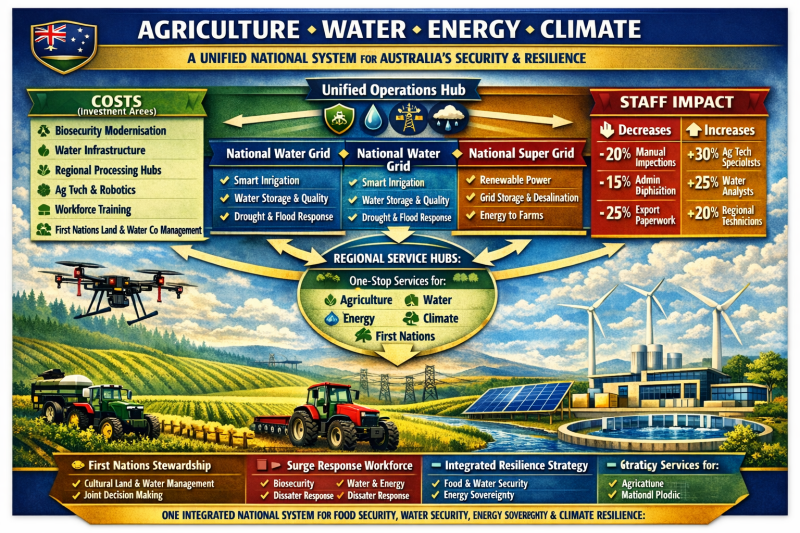
NATIONAL ENERGY & WATER GRID — REGIONAL HUB TILE
(Directly from your page, rebuilt cleanly for Webador)
Core Functions
-
Smart irrigation & pumping
-
Reliable power for critical services
-
Integrated water management
-
Crisis coordination
-
Support for on‑farm renewables
-
Lower costs for regional communities
Why It Matters
A national energy & water grid transforms regional hubs into resilience anchors — powering agriculture, protecting communities, and enabling coordinated national responses.
STRATEGIC ROADMAP
Immediate (0–12 months)
-
Establish National Biosecurity Command
-
Launch Agriculture Data Platform (Phase 1)
-
Begin One‑Stop Hub rollout
-
Integrate water & climate modelling
Medium Term (1–3 years)
-
National skills pipeline operational
-
Climate‑smart agriculture programs scaled
-
Export certification modernised
-
Regional infrastructure alignment
Long Term (3–10 years)
-
Fully unified national agriculture system
-
Climate‑ready, water‑secure regions
-
High‑tech, high‑productivity agriculture sector
-
Strong export competitiveness
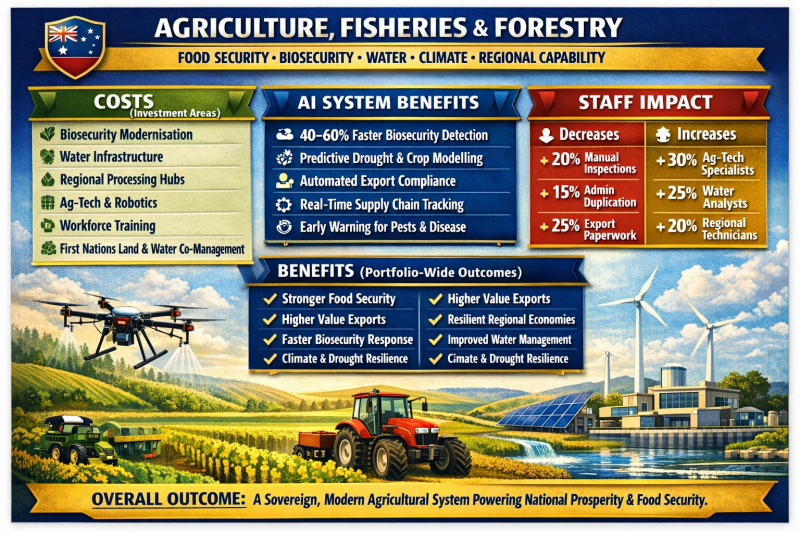
Agriculture, Fisheries & Forestry — Infographic Overview
This Australians Unified–branded visual presents a modular, campaign‑style map of national agriculture reform. It’s divided into five clear sections:
🟩 COSTS (Investment Areas)
Highlights strategic investments in biosecurity, water infrastructure, ag‑tech, regional processing, workforce training, and First Nations land & water co‑management.
🔵 AI SYSTEM BENEFITS
Shows how AI enables faster biosecurity detection, predictive drought and crop modelling, automated export compliance, and real‑time supply chain tracking.
🟥 STAFF IMPACT
Split into decreases (manual inspections, admin duplication, export paperwork) and increases (ag‑tech specialists, water analysts, regional technicians).
🟦 BENEFITS (Portfolio‑Wide Outcomes)
Summarises national gains: stronger food security, higher‑value exports, resilient regional economies, improved water management, and climate resilience.
🟨 OVERALL OUTCOME
A bold campaign statement:
“A Sovereign, Modern Agricultural System Powering National Prosperity & Food Security.”
