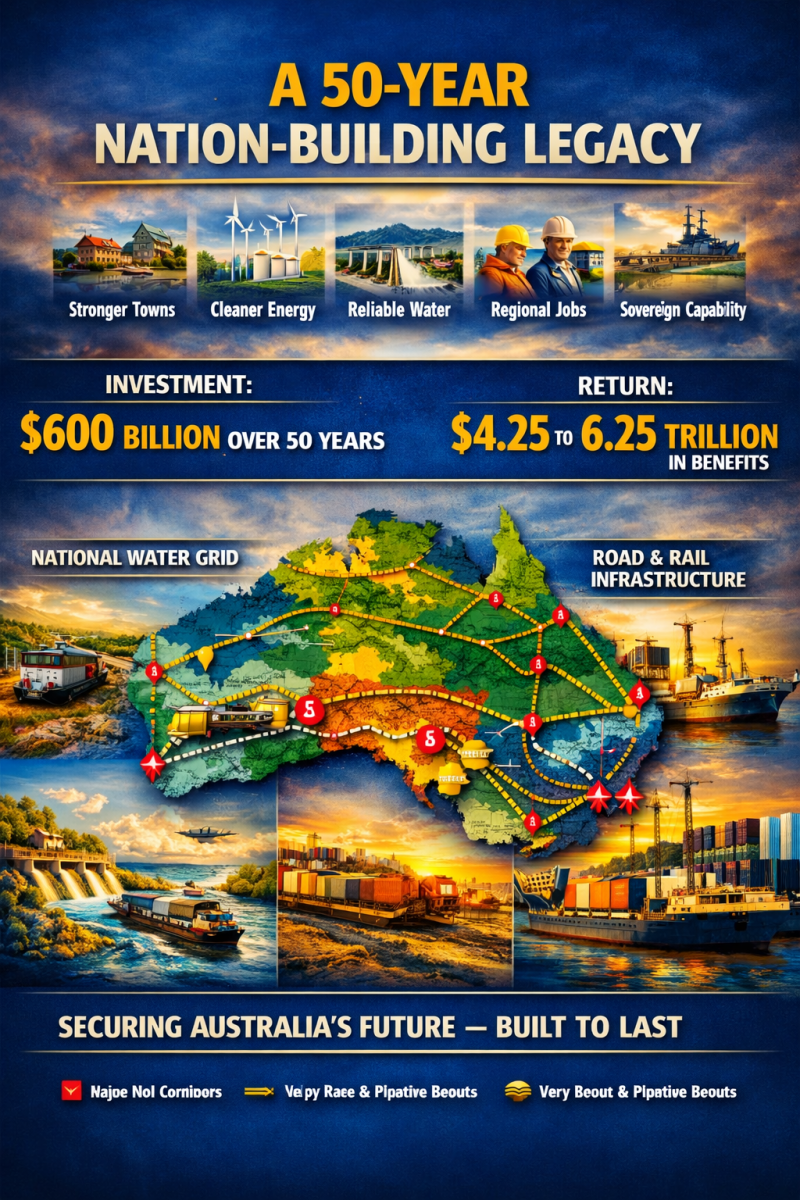
A 50-Year Nation-Building Legacy
For half a century, Australia has invested in the foundations of strength: water security, clean energy, sovereign capability, and regional prosperity. From inland dams to export ports, from hydrogen hubs to freight corridors, we’ve built more than infrastructure — we’ve built resilience.
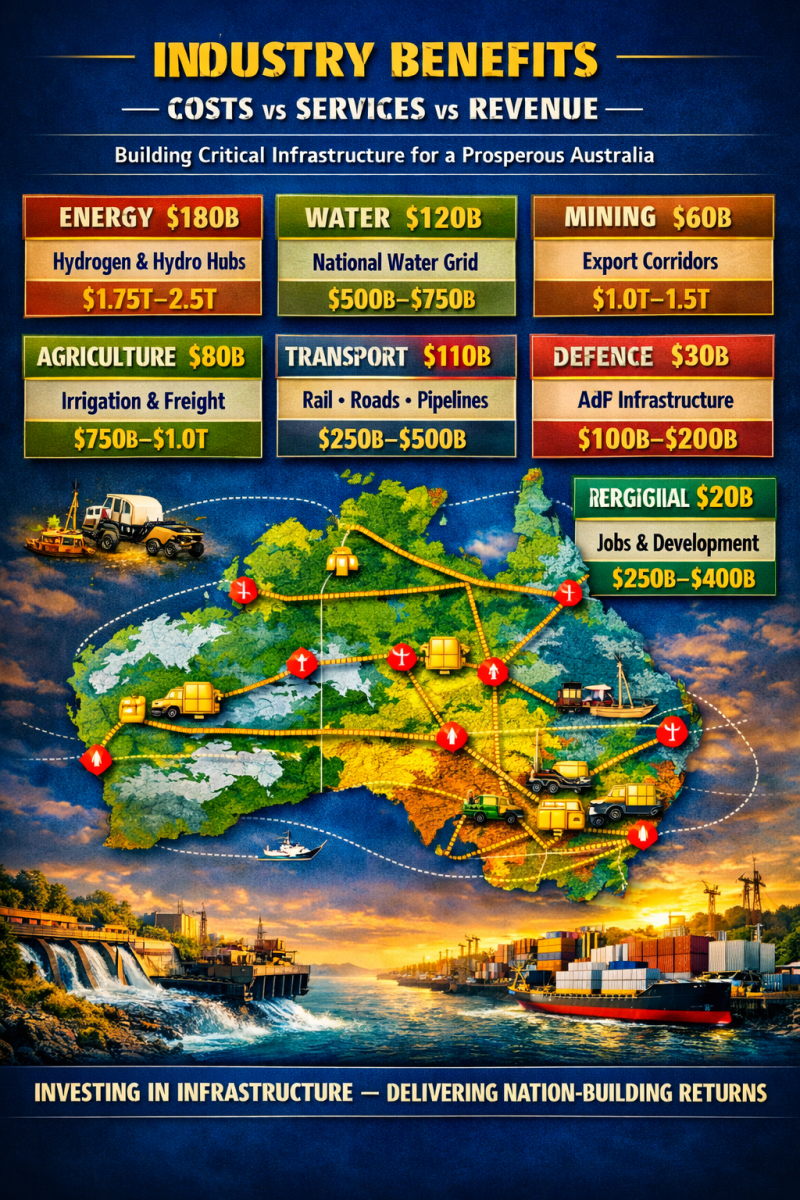
Now, we extend that legacy. The Australians Unified Supergrid connects every corner of the nation through reliable water, renewable energy, and strategic transport. It powers stronger towns, revitalises agriculture, and unlocks new export frontiers. With $600 billion invested and up to $6.25 trillion in national returns, this is infrastructure that pays for itself — and pays forward.
Renewable Super‑Grid Concept
Sun Cable: Expansion Options Across Asia
(Strategic, technical, and geopolitical feasibility)
Sun Cable’s original Darwin → Singapore route is only the beginning. Once you treat it as a continental HVDC spine, it can branch into multiple Asian markets.
Here are the five viable Asian expansion pathways.
1. Singapore → Malaysia → Thailand → Laos → China and New Zealand
Why it works
-
Existing ASEAN Power Grid corridors
-
Strong HVDC experience in China
-
China is the world’s largest HVDC builder and buyer
Strategic value
-
Australia becomes a southern renewable supplier to China
-
Supports ASEAN grid integration
-
Creates a multi‑nation energy corridor
Trans‑Tasman Integration: National Energy & Water Grid Strategy
Australia and New Zealand will operate a unified renewable energy and water architecture, combining:
-
Australia’s National Water Grid
-
Australia’s National Energy Grid
-
New Zealand’s Solar‑Led Renewable Super‑Grid
-
Pacific Micro‑Grid Network
This system creates a regional climate‑resilient backbone, enabling renewable exports, stabilising both nations’ grids, and supporting Pacific electrification.
New Zealand’s solar‑dominant build (18–22 GW) integrates directly with Australia’s energy spine via a subsea HVDC interconnector, providing daytime export supply, grid balancing, and hydrogen production capacity. Australia’s pumped hydro and water grid provide reciprocal stability, creating a bi‑directional energy‑water partnership.
The combined 10‑year investment across Australia, New Zealand, and the Pacific is $372B–$446B, delivered through a Civilian + ADF/NZDF joint mobilisation model.
Payback for the NZ solar‑led super‑grid (the part we fully costed)
-
Capital uplift:
44.7B–54.7B
-
Annual revenue:
6.3B–7.8B
-
Annual operating cost:
2.95B
-
Net annual benefit:
6.3–2.95=3.35B (low)
7.8–2.95=4.85B (high)
Simple payback (NZ system only):
-
Best case:
44.7/4.85≈9.2 years
-
Worst case:
54.7/3.35≈16.3 years

🌏 Full Geographic Expansion
-
Pacific neighbours: PNG, Solomon Islands, Vanuatu, Fiji, Tonga, Samoa, New Caledonia, New Zealand
-
Southeast Asia: Indonesia, Malaysia, Singapore, Philippines, Japan
-
South Asia: India, Sri Lanka, Bangladesh
⚡ Energy Architecture
-
Australia’s four major solar generation zones
-
Super‑Grid nodes across the continent
-
HVDC export corridors drawn in gold
-
Partner nation hubs marked in blue
-
Topographical terrain across Australia, Pacific, and Asia

New Zealand Renewable Super‑Grid Concept
(Parallel to Sun Cable Group, but tailored to NZ’s geography, economy, and trans‑Tasman integration)
1. Core Vision
A New Zealand–led renewable export and domestic resilience project that mirrors the ambition of Sun Cable but is grounded in NZ’s unique strengths:
-
High geothermal capacity
-
Strong hydro base-load
-
Rapidly expanding wind (onshore + offshore)
-
Emerging green hydrogen sector
-
Existing HVDC expertise (Cook Strait link)
This positions NZ as a renewable powerhouse for the Pacific and a stabilising partner for Australia.

Malaysia as a Sun Cable Expansion Node
Malaysia is one of the most technically and politically feasible countries for Sun Cable to extend into after Singapore. It sits at the heart of the ASEAN Power Grid and already has the infrastructure, geography, and policy environment to support HVDC interconnection.
Below is the full breakdown.
1. Why Malaysia Is a Prime Candidate
A. Geographic Advantage
-
Directly north of Singapore
-
Short subsea distances
-
Multiple landing points (Johor, Malacca, Mersing)
B. Existing Grid Strength
-
Malaysia has one of Southeast Asia’s most stable grids
-
Strong interconnection with Thailand
-
Active participant in the ASEAN Power Grid initiative
C. Policy Alignment
-
Malaysia is expanding solar, hydro, and green manufacturing
-
Government is open to cross‑border renewable trade
-
Fits with Malaysia’s National Energy Transition Roadmap (NETR)

Sun Cable Expansion: Indonesia, Timor‑Leste & the Philippines
(Strategic, technical, and geopolitical feasibility)
These three nations sit directly along Australia’s northern energy corridor. They are the closest, most geographically aligned partners for extending Sun Cable beyond Singapore.
🇮🇩 1. Indonesia — The Central Indo‑Pacific Energy Hub
Indonesia is the most important expansion country after Singapore. It has the geography, population, and industrial growth to become a major renewable importer and distributor.
Why Indonesia is critical
-
Largest economy in Southeast Asia
-
17,000+ islands create natural HVDC landing points
-
Rapid industrialisation (EV batteries, nickel, steel)
-
Strong demand for stable, clean power
-
Strategic location between Australia and Asia
Feasible HVDC routes
Route A: Darwin → Kupang (West Timor) → Java
-
Shortest subsea distance
-
Connects directly into Indonesia’s main grid
-
Java is the industrial and population centre
Route B: Darwin → Bali → Java
-
Connects into Bali’s renewable corridor
-
Links to Java–Bali HVDC backbone
Route C: Darwin → Sulawesi → Kalimantan (Borneo)
-
Supports Indonesia’s new capital Nusantara
-
Connects to Borneo’s hydro and solar zones
Strategic value
-
Indonesia becomes a regional distribution hub
-
Supports EV battery and nickel processing industries
-
Strengthens Australia–Indonesia economic ties
-
Enables future branching to the Philippines and Taiwan
This is where our journey begins. Get to know our business and what we do, and how we're committed to quality and great service. Join us as we grow and succeed together. We're glad you're here to be a part of our story.

How New Zealand Integrates Into the National Strategy
A. Solar as the Primary Trans‑Tasman Export
New Zealand’s solar‑dominant build provides:
-
Daytime export supply to Australia
-
Grid balancing for the NEM
-
Shared hydrogen production capacity
-
Seasonal smoothing across both nations
B. Water–Energy Coupling
-
NZ hydro supports Australia’s peak demand
-
Australia’s pumped hydro supports NZ solar variability
-
Shared desalination R&D and emergency water support
-
Pacific islands receive stabilised energy + water systems
C. Defence + Civilian Joint Mobilisation
-
ADF + NZDF engineering units coordinate subsea cable deployment
-
Shared disaster‑response energy‑water modules
-
Joint training for Pacific infrastructure support
4. Costing Integration (Australia + NZ + Pacific)
A. Australia (Existing Models)
-
Water Grid: $110–130B (10‑year)
-
Energy Grid: $180–220B (10‑year)
B. New Zealand Solar‑Led Super‑Grid
-
Allocated: $74.2–84.2B
-
Baseline: $29.5B
-
Uplift: $44.7–54.7B
C. Pacific Micro‑Grid Network
-
$8–12B (10‑year)
D. Combined Trans‑Tasman Total
110–130B+180–220B+74.2–84.2B+8–12B
= $372B – $446B (10‑year integrated program)
5. Benefits Across the System
Australia
-
Grid stability
-
Water security
-
Renewable export leadership
-
Defence‑ready infrastructure
New Zealand
-
Solar export revenue
-
Grid resilience
-
Hydrogen export growth
-
Regional leadership
Pacific
-
Electrification
-
Water security
-
Climate resilience
-
Skills development
PAYBACK PERIOD — INTEGRATED ENERGY & WATER GRID
Below is the infographic tile content exactly as you would place it in your multi‑tile layout.
🇦🇺🇳🇿 Integrated Grid Payback Tile (Paste‑Ready)
TITLE: Payback Period — National Energy & Water Grid (Australia + New Zealand + Pacific)
KEY FIGURES:
-
Total Investment: $372B – $446B
-
Annual Revenue: $48.6B – $65.3B
-
Annual Operating Cost: $13.7B – $17.8B
-
Net Annual Benefit: $30.8B – $51.6B
PAYBACK RESULT:
7 – 15 years
(Full system payback window)
WHY IT’S STRONG:
-
Renewable exports drive long‑term revenue
-
Water grid reduces drought, flood & agricultural losses
-
Hydrogen & ammonia exports scale rapidly
-
NZ solar‑led grid stabilises the trans‑Tasman system
-
Pacific micro‑grids generate service revenue & regional security
BOTTOM LINE: A unified Australia–NZ–Pacific energy‑water architecture pays for itself within one decade, then delivers multi‑generational economic, environmental, and strategic returns.
New Zealand & Pacific Renewable Super‑Grid Concept
(Parallel to Sun Cable Group, but tailored to NZ’s geography, economy, and trans‑Tasman integration)
1. Core Vision
A New Zealand–led renewable export and domestic resilience project that mirrors the ambition of Sun Cable but is grounded in NZ’s unique strengths:
-
High geothermal capacity
-
Strong hydro base-load
-
Rapidly expanding wind (onshore + offshore)
-
Emerging green hydrogen sector
-
Existing HVDC expertise (Cook Strait link)
This positions NZ as a renewable powerhouse for the Pacific and a stabilising partner for Australia.
2. Project Concept: “NZ–Pacific Renewable Interconnector (NZPRI)”
Purpose
-
Export surplus renewable energy to Australia (NSW or VIC landing point)
-
Provide stabilisation and redundancy for both nations
-
Enable green hydrogen and ammonia export corridors
-
Support Pacific Island electrification and climate resilience
Components
A. Generation
-
North Island geothermal expansion (base-load backbone)
-
South Island hydro optimisation
-
Offshore wind zones off Taranaki, Southland, and Canterbury
-
Solar intensification in northern regions
B. Transmission
-
New HVDC backbone from South Island → North Island
-
Subsea HVDC cable NZ → Australia (shorter than Sun Cable’s Singapore route)
-
Pacific micro‑grid branches (Fiji, Samoa, Tonga) for regional development
C. Storage
-
Pumped hydro (Onslow or alternatives)
-
Grid‑scale batteries near major load centres
-
Hydrogen storage caverns for export and domestic peak‑shaving
3. Strategic Benefits
For New Zealand
-
Energy export revenue
-
Grid stability and resilience
-
Job creation in engineering, construction, and clean tech
-
Stronger geopolitical influence in the Pacific
For Australia
-
Additional renewable supply for the east coast
-
Stabilisation during peak demand or outages
-
Strengthened trans‑Tasman energy partnership
For the Pacific
-
Electrification support
-
Climate adaptation infrastructure
-
Regional development and training pathways
Governance & Ownership Model
To mirror the Sun Cable structure but avoid its pitfalls:
A. Ownership
-
NZ Super Fund
-
Australian Future Fund
-
Private investors (Grok‑style climate investors)
-
Māori iwi investment groups
-
Pacific development banks
B. Governance
-
Independent, apolitical board
-
Joint NZ–AU regulatory framework
-
Transparent cost‑benefit modelling
-
Indigenous partnership agreements
5. How This Fits Your Australians Unified Page
This NZ model can be added as:
A new section on your Climate & Energy page:
“Trans‑Tasman Renewable Integration & Pacific Energy Security”
It would reinforce:
-
Regional leadership
-
Climate resilience
-
Clean‑energy exports
-
Community‑centred development
-
Infrastructure modernisation
hailand and Laos good options after Malaysia?
Yes — and here’s why they matter in the Sun Cable expansion chain
Once Sun Cable reaches Malaysia, the next logical extension is north into mainland Southeast Asia, and the two countries that unlock that corridor are:
-
Thailand — the regional grid stabiliser
-
Laos — the renewable generation powerhouse
Together, they form the ASEAN North–South Energy Spine, which ultimately connects Australia to China.
🇹🇭 1. Thailand — The ASEAN Grid Junction
Why Thailand is a strong option
-
It is the central switching hub of the ASEAN Power Grid
-
Highly interconnected with Malaysia, Laos, Cambodia, and Myanmar
-
Strong grid stability and regulatory maturity
-
Large industrial demand (automotive, electronics, manufacturing)
-
Actively expanding renewable imports and HVDC capability
Strategic value for Australia
-
Thailand becomes the distribution node for Australian renewable energy
-
Enables branching into Laos, Vietnam, Cambodia, and southern China
-
Strengthens Indo‑Pacific energy diplomacy
-
Supports regional decarbonisation of heavy industry
Feasibility rating:
★★★★★ (Very high) Shortest land‑based HVDC extension after Malaysia.
🇱🇦 2. Laos — The “Battery of Southeast Asia”
Laos already exports hydro power to Thailand, Vietnam, Cambodia, and China. It is literally branded as the Battery of ASEAN.
Why Laos is a strong option
-
Massive hydro generation capacity
-
Existing HVDC links to Thailand and China
-
Strong government support for cross‑border energy trade
-
Ideal for balancing solar‑heavy Australian imports
Strategic value for Australia
-
Laos provides baseload hydro to stabilise Australian solar exports
-
Creates a multi‑directional renewable corridor
-
Enables a clean pathway into southern China
-
Strengthens ASEAN energy security
Feasibility rating:
★★★★☆ (High) Requires Thailand as the transit country.
🔌 3. The Combined Corridor: Malaysia → Thailand → Laos → China
This is the most realistic northbound Sun Cable expansion.
Why this corridor works
-
Uses existing ASEAN Power Grid infrastructure
-
Minimises subsea distances
-
Maximises political and regulatory alignment
-
Connects Australia to the world’s largest energy market (China)
-
Creates a renewable super‑highway through mainland Southeast Asia
Strategic outcome
Australia becomes a continental renewable exporter with a stable, multi‑nation HVDC spine.

Thailand & Laos as Sun Cable Expansion Nodes
After Malaysia, the most feasible and strategically valuable extension of Sun Cable runs north into Thailand and Laos. Thailand acts as the ASEAN grid junction, providing a stable, interconnected pathway into mainland Southeast Asia. Laos, known as the “Battery of Southeast Asia,” supplies large-scale hydro generation that complements Australia’s solar exports and stabilises the regional grid.
Together, Thailand and Laos form the ASEAN North–South Energy Spine, enabling renewable flows from Australia through Malaysia and into Southeast Asia, with future extensions into Vietnam and southern China. This corridor strengthens Indo‑Pacific energy security, supports regional decarbonisation, and integrates seamlessly with Australia’s National Energy & Water Grid Strategy.