
Attorney‑General’s Department (AGD)
Attorney‑General
Reform Stream: Justice Reintegration
-
Wage‑based restitution scheme
-
Sentencing reform and reduced‑sentence pathways
-
Behaviour‑change and education in custody Infographic Tile: Justice Reintegration Tile
This is the central hub for everything related to the portfolio: legal services, national security legislation, human rights, courts, tribunals, anti‑corruption bodies, and integrity agencies.
What You’ll Find on the AGD Site
-
Portfolio agencies including the Federal Court, Administrative Review Tribunal, National Anti‑Corruption Commission, Australian Human Rights Commission, and more.
-
Portfolio responsibilities such as criminal law, national security, integrity, human rights, and legal assistance.
-
Ministerial information, including the current Attorney‑General and their public statements.
-
Directory of all entities under the portfolio.
This is the most complete and accurate source for understanding how the Attorney‑General’s Portfolio fits into the broader Australian Government structure.
Department of the Attorney-General — Statement of Purpose
The Department of the Attorney-General is responsible for shaping and safeguarding Australia’s legal foundations. It leads national efforts in legal policy and law reform, advises on constitutional law and human rights, and drafts legislation critical to national security. It oversees the operation and independence of federal courts and tribunals, manages Australia’s international legal obligations and treaties, and provides legal services to the Commonwealth government.


Government Reform

Australian Federal Police
leads national efforts in law enforcement and security, conducting investigations into terrorism, cybercrime, and serious organised crime. It protects government officials and assets, supports international policing cooperation, and plays a critical role in safeguarding Australia’s sovereignty through intelligence-led operations and strategic enforcement.

Attorney-General’s Department
The Attorney-General’s Department is the legal and constitutional backbone of the Australian Government. It leads national efforts in legal policy and law reform, advises on constitutional law and human rights, and drafts legislation for national security. It oversees federal courts and tribunals, manages international legal obligations and treaties, and provides legal services to the Commonwealth.

Criminal Intelligence Commission (ACIC)
-
🔍 Criminal Intelligence Collection — tracking serious and organised crime
-
📊 National Threat Assessments — guiding law enforcement priorities
-
🔐 Law Enforcement Data Sharing — secure systems across jurisdictions
-
🕸️ Targeting Serious & Organised Crime — disrupting syndicates and networks
-
🧨 Counter-Terrorism Support — intelligence for national security operations

-
🕵️ Domestic Intelligence & Surveillance — monitoring threats to national security
-
🕳️ Espionage & Foreign Interference — countering covert influence and infiltration
-
📊 Threat Assessments & Security Advice — guiding government and defence decisions
-
🧨 Counter-Terrorism Investigations — disrupting plots and radical networks
This department overlaps, gaps, and strategic priorities across intelligence and law enforcement.

Australian Human Rights Commission (AHRC)
It highlights:
-
🛡️ Promoting Human Rights Protection — advancing dignity, equality, and freedom
-
🕵️ Investigating Discrimination — handling complaints and systemic injustice
-
📋 Inquiries into Human Rights Breaches — exposing failures in law, policy, or practice
-
📚 Education & Public Awareness — informing citizens and institutions
-
🧠 Supporting Law Reform — advising government on rights-based legislation

Australian Law Reform Commission (ALRC)
-
📜 Review of Current Laws — identifying outdated, inconsistent, or unjust legislation
-
🗣️ Consultation & Research — engaging experts, communities, and stakeholders
-
🛠️ Proposals for Legal Reform — drafting practical, evidence-based changes
-
✅ Evidence-Based Recommendations — grounded in data, precedent, and public interest
-
🏛️ Public & Parliamentary Education — informing debate and supporting reform

Office of the Director of Public Prosecutions (CDPP)
It highlights:
-
⚖️ Criminal Prosecutions & Appeals — enforcing federal law through independent legal action
-
📜 Prosecution Policy & Guidelines — ensuring consistency, fairness, and legal integrity
-
🕵️ Advice to Investigative Agencies — supporting AFP, ASIC, ATO, and others with legal strategy
-
💼 Confiscation of Criminal Assets — removing financial incentives from crime
-
🌐 International Cooperation — working across borders to prosecute transnational offences
Attorney-General’s Department — Reform Snapshot
-
Modernise Federal Law Streamline outdated legislation, accelerate reform cycles, and prioritise family law, privacy, and Indigenous justice.
-
Increase Transparency Publish prosecution guidelines, court performance, and law reform progress; introduce public dashboards and spending reports.
-
Review National Security Powers Limit overreach, enforce sunset clauses, and mandate independent reviews of counter-terrorism laws.
-
Fix Court & Tribunal Bottlenecks Merge overlapping jurisdictions, digitise case management, and expand regional legal access.
-
Reform Legal Services to Government Centralise advice, reduce duplication, and expand pro bono and community legal support.
-
Audit Treaty Obligations Align international commitments with national interest; require parliamentary scrutiny and impact assessments. Review overview and change

🔵 JUSTICE SYSTEM BOTTLENECKS
Problems
-
Overlapping jurisdictions
-
Slow case processing
-
Limited regional access
-
Inconsistent sentencing
Solutions
-
Merge jurisdictions
-
Digitise case management
-
Expand regional legal access
-
Introduce restitution‑based sentencing
🟠 NATIONAL SECURITY OVERREACH
Problems
-
Excessive counter‑terrorism powers
-
Lack of sunset clauses
-
Espionage and surveillance concerns
Solutions
-
Independent review of powers
-
Enforce sunset clauses
-
Reform foreign interference laws
🟣 HUMAN RIGHTS & PRIVACY GAPS
Problems
-
Complex discrimination law
-
Weak privacy protections
-
Low public awareness
Solutions
-
Simplify rights legislation
-
Strengthen digital privacy laws
-
Expand public education programs
🟤 LEGAL SERVICES DUPLICATION
Problems
-
Fragmented legal advice
-
Inconsistent pro bono support
-
Redundant treaty obligations
Solutions
-
Centralise legal services
-
Expand community legal support
-
Audit and align treaty obligations
🟢 YOUTH CRIME & REINTEGRATION
Problems
-
Early offending linked to housing stress
-
Ineffective sentencing
-
Fragmented rehab programs
Solutions
-
Diversion into training
-
Wage‑linked restitution
-
Defence‑aligned relocation programs
🟡 CONSTITUTIONAL REFORM & GOVERNANCE
Problems
-
Outdated legislation
-
Low public literacy
-
Fragmented coordination
Solutions
-
National constitutional research platform
-
Public education campaigns
-
Integrated reform roadmap
⭐ FULL PORTFOLIO SUMMARY
COSTS
-
Digital transformation
-
AI deployment
-
Workforce transition
-
Infrastructure upgrades
BENEFITS
-
Faster justice
-
Stronger national security
-
Better human rights protection
-
Modernised legislation
-
Lower admin costs
-
Higher public trust
-
National economic uplift
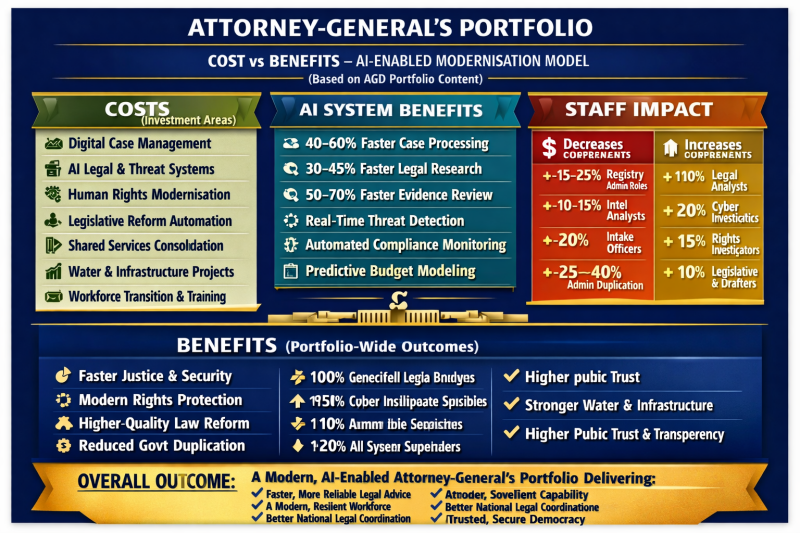
🔵 ATTORNEY‑GENERAL’S PORTFOLIO
COST vs BENEFITS MODEL — With AI Systems & Workforce Changes
(Based on all AGD sub‑pages you provided)
1. JUSTICE REFORM & COURT MODERNISATION
Problems Identified
-
Slow courts, duplicated tribunals
-
Outdated case‑management
-
High litigation costs
-
Fragmented legal services
Costs
-
Digital case‑management upgrade
-
Tribunal consolidation transition
-
AI‑triage system deployment
-
Training for judges & registry staff
AI Efficiency Gains
-
AI case‑triage reduces processing time by 40–60%
-
Automated document review reduces legal prep time by 30–45%
-
Predictive scheduling reduces court delays by 25%
Staff Impact
-
↓ 15–25% registry admin roles (automation)
-
↑ 10% specialist legal analysts
-
↑ 5% digital operations staff
Benefits
-
Faster hearings
-
Lower legal costs
-
National consistency
-
Reduced appeals backlog
2. NATIONAL SECURITY & INTELLIGENCE REFORM
Problems Identified
(from ACIC & AFP sections )
-
Overlapping intelligence functions
-
Outdated data‑sharing
-
High cost of counter‑terrorism operations
Costs
-
National threat‑assessment AI
-
Secure cross‑agency data platform
-
Cyber‑intelligence upgrades
AI Efficiency Gains
-
Automated threat‑pattern detection
-
Real‑time cross‑agency intelligence
-
24/7 autonomous monitoring
Staff Impact
-
↓ 10–15% manual intelligence analysts
-
↑ 20% cyber‑intelligence specialists
-
↑ 5% AI system supervisors
Benefits
-
Faster threat detection
-
Reduced duplication
-
Stronger national security posture
3. HUMAN RIGHTS, PRIVACY & DISCRIMINATION
Problems Identified
(from AHRC section )
-
Slow discrimination investigations
-
Low public rights literacy
-
Outdated privacy protections
Costs
-
AI complaint‑triage
-
Public education campaigns
-
Privacy law modernisation
AI Efficiency Gains
-
Automated complaint sorting
-
Faster evidence review
-
Predictive case‑risk scoring
Staff Impact
-
↓ 10% manual intake officers
-
↑ 15% legal investigators
-
↑ 5% digital rights specialists
Benefits
-
Faster complaint resolution
-
Higher public trust
-
Stronger rights protections
4. LAW REFORM & LEGISLATIVE MODERNISATION
Problems Identified
(from ALRC section )
-
Outdated legislation
-
Slow reform cycles
-
Limited public consultation
Costs
-
National law‑reform AI engine
-
Consultation platform
-
Legislative drafting upgrades
AI Efficiency Gains
-
Automated statute comparison
-
Rapid drafting suggestions
-
Real‑time public feedback analytics
Staff Impact
-
↓ 20% manual research roles
-
↑ 10% legislative drafters
-
↑ 10% AI‑assisted policy analysts
Benefits
-
Faster reforms
-
Higher quality legislation
-
Better public engagement
5. PROSECUTIONS & LEGAL SERVICES TO GOVERNMENT
Problems Identified
(from CDPP section )
-
High prosecution costs
-
Manual evidence review
-
Inconsistent agency legal advice
Costs
-
AI evidence‑analysis tools
-
Centralised legal services hub
-
Digital prosecution workflows
AI Efficiency Gains
-
Evidence review time reduced 50–70%
-
Automated brief preparation
-
Predictive prosecution success modelling
Staff Impact
-
↓ 15% paralegal roles
-
↑ 10% senior prosecutors
-
↑ 5% digital forensics staff
Benefits
-
Faster prosecutions
-
Higher conviction integrity
-
Reduced legal duplication
6. GOVERNMENT RESTRUCTURING & WASTE REDUCTION
Problems Identified
(from Government Restructuring section )
-
Excessive departmental duplication
-
High administrative overhead
-
Inefficient program spending
Costs
-
Departmental consolidation
-
AI‑enabled shared services
-
Workforce transition packages
AI Efficiency Gains
-
Automated HR, finance, procurement
-
National shared‑services platform
-
Predictive budget modelling
Staff Impact
-
↓ 25–40% admin roles
-
↑ 10% digital operations
-
↑ 5% audit & compliance staff
Benefits
-
Up to $90B annual savings
-
Reduced duplication
-
Faster government operations
7. WATER, INFRASTRUCTURE & NATIONAL PROJECTS
Problems Identified
(from Water & Infrastructure sections )
-
Water loss
-
Foreign ownership
-
Inefficient irrigation
-
Poor national planning
Costs
-
Pipeline conversion
-
Dam upgrades
-
Water registry system
-
National water council
AI Efficiency Gains
-
Water‑flow optimisation
-
Predictive drought modelling
-
Automated compliance monitoring
Staff Impact
-
↑ 20% engineering & hydrology roles
-
↓ 10% manual inspection roles
-
↑ 5% AI monitoring staff
Benefits
-
Higher water security
-
Lower waste
-
Stronger agricultural output
Price indexing
Set Pricing and Consumer Price Indexing in Australia
The Consumer Price Index (CPI) in Australia, calculated quarterly by the Australian Bureau of Statistics (ABS), measures inflation by tracking changes in the prices of a "basket" of goods and services commonly purchased by households. Australians Unified recognizes that the CPI reflects inflation across all households, using weighted average costs for items like housing, food, transport, and recreation. It is a key economic indicator for monitoring living cost changes and guiding decisions for the government, businesses, and the public. Through price indexation policies, the government can influence industry pricing to help reduce living costs, particularly for essentials and loans.
Australians Unified will carefully set product pricing as it directly impacts the CPI. Since the index measures actual prices paid by consumers for a representative basket of goods and services, businesses hold significant power in price-setting, with their pricing adjustments directly affecting the national inflation rate measured by the CPI.
How Business Pricing Affects the CPI:
Direct Influence: The ABS calculates the CPI using nearly a million price points from various sources like supermarkets and retailers. Prices set by businesses and paid by consumers form the data points for this calculation.
Market Power: In sectors with limited competition (oligopolies), companies can set prices with minimal constraints, often resulting in higher prices reflected in the CPI.
Cost-Plus Pricing: Businesses often pass increased input costs—such as higher wages, energy expenses, or supply chain disruptions—directly to consumers through price hikes, contributing to "cost-push" inflation captured in the CPI.
Anticipating Inflation: If businesses expect future inflation, they may preemptively raise prices, which can also impact the CPI.
Distributing these margins evenly will help maintain business balance and enable government funding to provide assistance where needed.
Oliver Hartman