Department of Climate Change and environment & Water
Climate Change, Energy, the Environment & Water Portfolio
Climate & Environment
Reform Stream: Sustainability & Resilience
-
Water, energy, and climate adaptation
-
Environmental capability building
Protecting Australia’s Environment, Strengthening Climate Resilience & Securing Our Water Future
Australia’s Climate, Environment & Water Portfolio leads national action on climate change, environmental protection, biodiversity, energy transition, and water security. It coordinates scientific agencies, environmental regulators, climate intelligence services, and national water management systems to safeguard Australia’s natural environment and support long‑term national resilience.
Our Purpose
We create policies and programs to:
- combat climate change and develop a smart energy system for the future
- protect our unique environment, wildlife, and heritage
- manage Australia’s water resources for industries and local communities
- take care of Australia’s interests in Antarctica and the Southern Ocean.
We rely on science. We’re innovative and work together. We focus on what’s ahead.
Our Role
Our work covers many areas.
We manage Australia’s valuable resources on land and water, in towns and cities. We:
- promote actions for climate change and invest in cleaner technologies
- ensure we have a reliable and affordable energy system
- protect Australia’s wildlife and natural heritage
- support wise management of natural resources
- oversee Australia’s water resources for the environment, industries, and communities
- provide information and analysis on climate, energy, and the environment.
Working with You
We collaborate with stakeholders, governments, and the community to meet our goals.
We welcome feedback through:
- public consultations
- industry meetings
- advisory committees
- international discussions
- connections with Aboriginal and Torres Strait Islander communities
Our Business
To achieve our goals, we:
- provide advice to the Australian Government
- run programs
- oversee laws and regulations.
We are a regulatory body.
We enforce laws regarding:
- protection of the environment and wildlife
- use of harmful substances and pollutants
- import and export of wildlife
- fuel quality
- offshore greenhouse gas storage.

Climate Change
Climate Policy & Emissions Reduction Division
Safeguarding Australia’s Natural Environment & Wildlife
🟡 WHAT THEY DO
-
Develop national climate policy & emissions frameworks
-
Coordinate adaptation planning across governments
-
Support industry transition & climate innovation
-
Monitor national emissions performance
🟦 KEY OUTPUTS
-
National climate policy
-
Emissions reduction frameworks
-
Adaptation plans
-
Emissions reporting & analysis
- deal with climate change and its climate challenges

Environmental protection
Safeguarding Australia’s Natural Environment & Wildlife
🟡 WHAT THEY DO
-
Manage environmental regulation & approvals
-
Protect threatened species & ecosystems
-
Oversee national parks & conservation programs
-
Lead biodiversity monitoring & restoration
🟦 KEY OUTPUTS
-
Environmental assessments
-
Conservation programs
-
Biodiversity monitoring
-
National park management

Energy & Sustainability Division
Supporting Australia’s Renewable Energy Transition
🟡 WHAT THEY DO
-
Develop clean energy policy & programs
-
Support renewable energy investment & innovation
-
Improve energy efficiency & sustainability standards
-
Coordinate national energy transition planning
🟦 KEY OUTPUTS
-
Renewable energy programs
-
Clean energy policy
-
Efficiency standards
-
Transition planning tools
- supergrid planning

Water Resources & River Systems Division
Securing Australia’s Water Future
🟡 WHAT THEY DO
-
Manage national water policy & river systems
-
Oversee Murray–Darling Basin planning & compliance
-
Provide hydrological modelling & water data
-
Support water security for communities & industry
- nation water grid including taking flood plans water
🟦 KEY OUTPUTS
-
Water policy & planning
-
Basin management frameworks
-
Hydrological modelling
-
National water data
- bridging the water channels
- for sustainable water systems

Environmental Science, Data & Monitoring Division
Delivering Environmental Intelligence for National Decision‑Making
🟡 WHAT THEY DO
-
Monitor air, water, soil & ecological health
-
Provide environmental data & reporting
-
Support scientific research & modelling
-
Strengthen national environmental information systems
🟦 KEY OUTPUTS
-
Environmental monitoring data
-
National environmental reports
-
Scientific modelling
-
Information system upgrades

Hazard Preparedness & Climate Resilience Division
Protecting Australians from Extreme Weather & Climate Impacts
🟡 WHAT THEY DO
-
Coordinate national hazard preparedness
-
Support emergency services with climate intelligence
-
Lead resilience planning & risk reduction programs
-
Strengthen community preparedness & adaptation
🟦 KEY OUTPUTS
-
Hazard preparedness frameworks
-
Climate resilience programs
-
Emergency service intelligence
-
Community adaptation tools

Bureau of Meteorology (BoM)
Australia’s National Weather & Climate Intelligence Agency
🟡 WHAT THEY DO
-
Deliver weather forecasts & severe weather warnings
-
Provide climate outlooks & long‑range modelling
-
Support emergency services during extreme weather
-
Maintain radar, satellite & environmental monitoring
🟦 KEY OUTPUTS
-
Forecasts & alerts
-
Climate modelling
-
Hazard intelligence
-
Environmental monitoring

Australian Climate Service (ACS)
Integrating Climate, Hazard & Impact Data for National Resilience
🟡 WHAT THEY DO
-
Combine climate, hazard, exposure & impact data
-
Support emergency management & national planning
-
Provide climate risk intelligence to governments
-
Strengthen national resilience to extreme weather
🟦 KEY OUTPUTS
-
Integrated climate datasets
-
Climate risk assessments
-
Emergency management intelligence
-
Adaptation planning tools
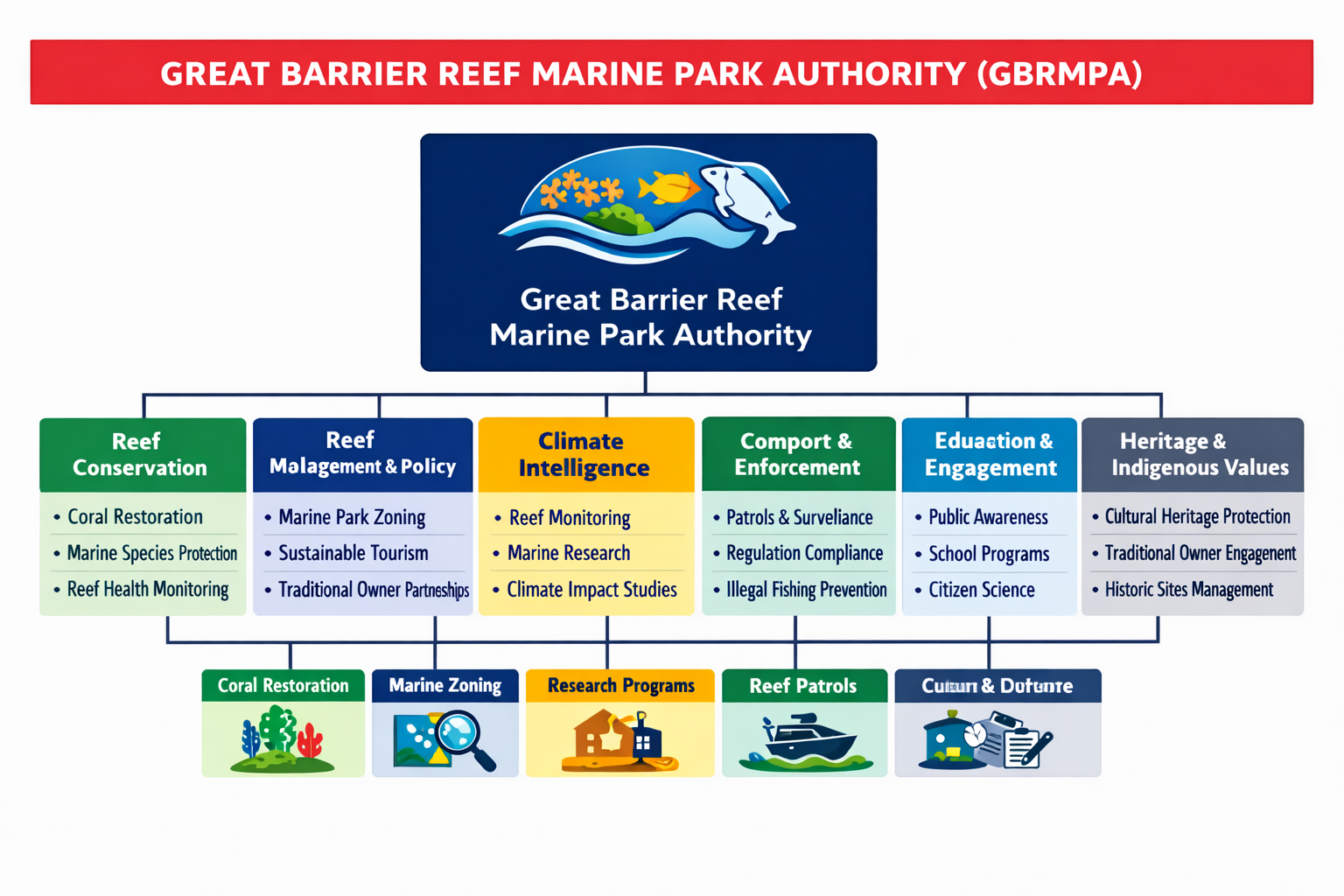
Great Barrier Reef Marine Park Authority (GBRMPA)
Protecting the World’s Largest Coral Reef System
-
Manage reef protection & conservation programs
-
Monitor reef health & climate impacts
-
Support tourism, science & community partnerships
-
Lead reef resilience planning
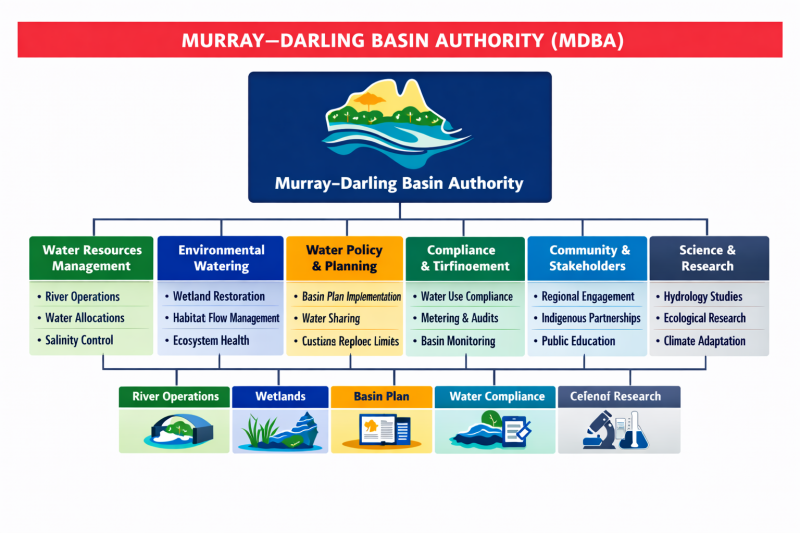
Murray–Darling Basin Authority (MDBA)
Managing Australia’s Most Important River System
-
Oversee Basin planning & compliance
-
Support sustainable water use
-
Monitor river health & environmental flows
-
Coordinate Basin‑wide water management
- integrate into the national energy and water grid
- intergrate into the national water grid
Key Problems in Australia’s Climate & Environment System
Australia faces escalating climate risks, biodiversity decline, water scarcity, and increasing extreme weather events. Ageing environmental monitoring systems, fragmented climate data, and inconsistent national coordination weaken resilience. Water security challenges, habitat loss, and slow environmental approvals further strain ecosystems and communities. Strengthening climate intelligence, environmental protection, and national adaptation capability is essential for Australia’s long‑term prosperity and safety.
Core system problem
Current pattern: Slow, legalistic, fragmented, underfunded, and politically volatile—so the portfolio can’t deliver stable climate, energy, environment, or water outcomes.
System-level policy shift:
-
Legislate long‑term, bipartisan climate and environment targets
-
Create a single national environmental & climate regulator with clear powers and funding
-
Tie funding and approvals to measurable ecological and emissions outcomes, not just process compliance
System outcomes:
-
Stable 20–30 year settings for investors and states
-
Shorter approval times with stronger protections
-
Clear accountability for missed climate, biodiversity, and water targets
1. Environmental protection & biodiversity
Key problems (from your overview):
-
Outdated EPBC Act, slow and legalistic
-
Weak enforcement and penalties
-
Fragmented state–federal roles
-
Underfunded recovery plans and poor data
Policy changes:
-
Replace EPBC with a National Nature Act including:
-
Legally binding national environmental standards
-
Mandatory “no net loss, net gain for critical habitat” test
-
-
Create a National Environment Data Service (shared mapping, monitoring, species data)
-
Minimum enforcement baseline: inspector ratios, penalty floors, and mandatory public reporting of breaches
-
10‑year funded Threatened Species & Habitat Recovery Program with rolling, performance‑based grants
Outcomes:
-
Faster, clearer approvals with higher protection standards
-
Real‑time habitat and species dashboards for public and industry
-
Measured recovery trajectories for priority species and ecosystems
2. Climate change policy & emissions reduction
Key problems: policy instability, safeguard loopholes, offset integrity concerns, slow adaptation, no long‑term framework.
Policy changes:
-
Climate Stability Act with:
-
5‑year carbon budgets to 2050
-
Independent Climate Commission to advise and publicly track progress
-
-
Tighten Safeguard Mechanism:
-
Declining baselines aligned with 1.5–2°C
-
Hard cap on use of offsets; priority on on‑site abatement
-
-
ACCU integrity overhaul:
-
Independent crediting authority
-
Full project‑level transparency and audit trails
-
-
National Adaptation & Resilience Plans for each sector (energy, agriculture, cities, coasts) with mandatory state alignment
Outcomes:
-
Predictable emissions trajectory and investment certainty
-
Higher‑integrity carbon market with fewer “junk” offsets
-
Adaptation projects sequenced and funded, not just planned
3. Energy systems & transition
Key problems: grid lagging renewables, storage gaps, high prices, gas volatility, policy swings.
Policy changes:
-
National Super‑Grid & Storage Plan:
-
Priority transmission corridors legislated and fast‑tracked
-
Capacity targets for storage (batteries, pumped hydro, demand response)
-
-
Firm, technology‑neutral capacity mechanism to support reliability during transition
-
Retail and network reform to reduce bill shock:
-
Default tariff protections
-
Stronger oversight of network spending
-
-
Gas transition pathway:
-
Domestic reservation where needed
-
Clear decline schedule for unabated gas in power generation
-
Outcomes:
-
Higher renewable hosting capacity and fewer connection bottlenecks
-
Improved reliability metrics (fewer outages, better firming)
-
Flattened or reduced real household energy bills over time
4. Water resources & national water grid
Implied role from the portfolio page: national water security, basin management, environmental flows, regional and agricultural water.
Policy changes:
-
National Water Security & Resilience Framework:
-
Basin‑wide and cross‑jurisdictional water plans with enforceable extraction caps
-
Climate‑adjusted environmental flow rules
-
-
Integrated Urban & Regional Water Planning:
-
Mandate diversified sources (recycling, stormwater, desalination where appropriate)
-
-
Transparent Water Markets:
-
Real‑time public registers of trades, prices, and ownership
-
Outcomes:
-
Reduced over‑extraction and better river health
-
More resilient town and city supplies under drought and heat
-
Fairer, more transparent water markets for communities and farmers
5. Environmental regulation & harmful substances
From your page: regulation of pollutants, wildlife trade, fuel quality, offshore greenhouse gas storage.
Policy changes:
-
Modernise pollutant and fuel standards to align with best‑practice OECD benchmarks
-
National Harmful Substances Register with mandatory industry reporting and public access
-
Offshore carbon storage regime with strict liability, monitoring, and decommissioning rules
Outcomes:
-
Lower air and water pollution exposure for communities
-
Higher compliance and fewer major incidents
-
Credible CCS projects where used, with clear accountability
6. Antarctica, Southern Ocean, and climate science
Role: protect Antarctic environment, support science, uphold treaty obligations, and feed climate intelligence into policy.
Policy changes:
-
Long‑term Antarctic & Southern Ocean Science Strategy tied directly to national climate risk assessments
-
Data‑sharing mandates: Antarctic and ocean data integrated into national climate and coastal planning tools
-
Stronger environmental protocols for all Australian activities in Antarctica
Outcomes:
-
Better climate risk foresight for coasts, infrastructure, and agriculture
-
Stronger Australian influence in Antarctic governance
-
Reduced environmental footprint of national operations
Integrated Policy Architecture
National Energy Grid + National Water Grid
How they transform the Climate, Energy, Environment & Water Portfolio
The two nation‑building projects act as structural reforms, not just infrastructure builds. They change what the department can do, how it operates, and what outcomes it can guarantee.
1. Climate Change & Emissions Reduction Division
Policy Shifts Enabled by the National Grids
-
Carbon budgets tied to real infrastructure capacity (e.g., renewable hosting capacity, pumped hydro availability, hydrogen corridors)
-
Hard caps on industrial emissions because the super‑grid provides firmed clean power
-
National adaptation planning aligned with water‑grid drought buffers and coastal desalination nodes
Outcomes
-
Predictable emissions trajectory to 2050
-
Lower reliance on offsets due to real abatement
-
Climate risk exposure reduced for agriculture, cities, and industry
2. Energy Systems, Reliability & Transition Division
Policy Shifts
-
National Super‑Grid Act: legislated transmission corridors, renewable zones, and storage targets
-
Unified dispatch model: integrates pumped hydro, batteries, hydrogen, and demand response
-
Gas transition pathway supported by water‑grid desalination for hydrogen production
Outcomes
-
Higher renewable penetration without instability
-
Lower wholesale prices through reduced congestion
-
Firmed, export‑ready clean energy for Indo‑Pacific markets
3. Environment Protection & Biodiversity Division
Policy Shifts
-
Environmental approvals linked to grid corridors with pre‑assessed biodiversity zones
-
National Nature Data Service fed by water‑grid hydrology sensors and energy‑grid environmental monitoring
-
Mandatory net‑gain habitat offsets for all grid‑related works
Outcomes
-
Faster approvals with stronger protections
-
Real‑time ecological monitoring
-
Measurable recovery of priority species and ecosystems
Water Resources, Murray–Darling & National Water Security Division
Policy Shifts
-
National Water Grid Act: enforceable extraction caps, climate‑adjusted environmental flows
-
Integrated urban water planning: recycling, stormwater harvesting, desalination nodes powered by the energy grid
-
Transparent water markets with real‑time trade and ownership registers
Outcomes
-
Drought resilience for towns, agriculture, and industry
-
Healthier rivers and wetlands
-
Fairer, more transparent water allocation
5. Pollution, Harmful Substances & Fuel Standards Division
Policy Shifts
-
Modernised fuel and pollutant standards aligned with electrification and hydrogen uptake
-
National Harmful Substances Register integrated with grid monitoring
-
Offshore CCS regulation tied to grid‑powered monitoring systems
Outcomes
-
Lower air and water pollution
-
Higher compliance and fewer major incidents
-
Credible CCS where used
6. Antarctica, Southern Ocean & Climate Science Division
Policy Shifts
-
Antarctic climate data integrated into national grid planning (sea‑level, storm surge, ocean heat)
-
Long‑term science strategy feeding into water‑grid coastal desalination and energy‑grid resilience
-
Environmental protocols strengthened for Australian operations
Outcomes
-
Better foresight for coastal planning
-
Stronger Australian influence in Antarctic governance
-
Reduced environmental footprint
7. Cross‑Portfolio System Reform (the big picture)
Structural Policy Changes
-
Single National Environmental & Climate Regulator
-
Bipartisan long‑term climate, energy, water and biodiversity targets
-
Unified national data spine: hydrology, energy, emissions, biodiversity
-
Civilian + ADF joint mobilization model for accelerated delivery
System Outcomes
-
20–30 year stability for investors and states
-
Faster approvals with stronger protections
-
Lower national emissions and higher resilience
-
Regional development aligned with grid corridors
-
Export‑ready clean energy and hydrogen
Australians Unified anchor this to real instruments and then show what we are implicitly amending.
. Environmental protection & biodiversity
Existing core laws/instruments
-
Environment Protection and Biodiversity Conservation Act 1999 (EPBC Act)
-
National Environment Protection Council Act 1994 and NEPMs
-
Biodiversity Conservation strategies & threatened species lists
Implied AU policy amendments
-
Amend EPBC Act to:
-
Embed binding national environmental standards (not just objects).
-
Require “no net loss / net gain” tests for critical habitat.
-
Mandate time‑bound approvals with digital assessment tools.
-
-
Amend NEPC/NEPM framework to tighten pollution, land clearing and monitoring baselines.
Implied cancellations
-
Repeal or sunset broad clearing exemptions and weak offset rules under EPBC and related state‑aligned instruments.
New implementations
-
National Nature Act / National Environmental Standards Regulations (new primary or framework law).
-
Independent national environment regulator with explicit enforcement powers and public reporting duties.
2. Climate policy & emissions reduction
Existing core laws/instruments
-
Climate Change Act 2022 (Cth) – national targets.
-
National Greenhouse and Energy Reporting Act 2007 (NGER).
-
Safeguard Mechanism (under NGER framework).
-
Carbon Credits (Carbon Farming Initiative) Act 2011 – ACCU scheme.
Implied AU policy amendments
-
Amend Climate Change Act to:
-
Introduce 5‑year carbon budgets and sectoral pathways.
-
-
Amend NGER/Safeguard rules to:
-
Tighten baselines, cap offset use, and align with 1.5–2°C pathways.
-
-
Amend ACCU framework to:
-
Create an independent crediting authority, full project‑level transparency, and stronger integrity tests.
-
Implied cancellations
-
Sunset low‑integrity offset methods and legacy crediting rules.
-
Remove piecemeal, overlapping climate programs that duplicate transition support.
New implementations
-
Unified national emissions framework (could be a consolidated “Emissions Reduction & Climate Accountability Act”).
-
National Adaptation & Resilience Plans with statutory review cycles.
3. Energy systems & transition
Existing core laws/instruments
-
National Electricity Law (NEL) and National Gas Law (NGL) (via state application Acts).
-
Australian Energy Market Agreement and AEMO/AER rule‑sets.
-
Various renewable support schemes (ARENA, CEFC, RET legacy).
Implied AU policy amendments
-
Amend NEL/NGL and associated rules to:
-
Prioritise transmission corridors, storage capacity targets, and renewable hosting.
-
Embed capacity mechanisms and firming requirements.
-
-
Tighten gas market and reservation rules to support a managed decline in unabated gas.
Implied cancellations
-
Phase out fossil‑fuel production subsidies and legacy capacity payments that don’t support transition.
New implementations
-
National Super‑Grid & Storage Act (or equivalent intergovernmental scheme) to lock in:
-
Priority corridors, renewable zones, storage targets, and connection standards.
-
4. Water security, Murray–Darling & national water grid
Existing core laws/instruments
-
Water Act 2007 (Cth) – including Murray–Darling Basin Plan.
-
Basin Plan 2012 and associated water resource plans.
-
National Water Initiative (intergovernmental).
Implied AU policy amendments
-
Amend Water Act/Basin Plan to:
-
Tighten extraction caps, climate‑adjust environmental flows, and strengthen compliance.
-
-
Standardise metering, reporting and enforcement across jurisdictions.
Implied cancellations
-
Retire over‑allocated entitlements and legacy rules that exceed sustainable diversion limits.
New implementations
-
National Water Security & Catchment Health Framework (could be a new schedule under Water Act or a new Act).
-
National Water Grid Authority powers expanded to integrate climate resilience and environmental flows, not just infrastructure spend.
5. Hazard preparedness, monitoring & data integration
Existing core laws/instruments
-
Patchwork across emergency management, meteorology, environment, and infrastructure statutes.
-
Bureau of Meteorology, Geoscience Australia, and other agencies operate under separate enabling Acts.
Implied AU policy amendments
-
Amend enabling Acts and portfolio arrangements to:
-
Create a unified climate–hazard–environment data spine.
-
Mandate data sharing and interoperability across agencies.
-
New implementations
-
National Climate & Environment Intelligence System (could be statutory or a mandated cross‑agency platform).
-
National hazard preparedness standards embedded in emergency management and infrastructure planning law.
6. Governance & accountability
Existing core structures
-
DCCEEW portfolio, Climate Change Authority, Clean Energy Regulator, ACCU review structures, NEPC, Basin governance bodies.
Implied AU policy amendments
-
Clarify lead responsibility for climate, energy, environment, water in portfolio legislation and MoGs.
-
Strengthen independence and transparency of advisory and regulatory bodies.
New implementations
-
National Climate–Energy–Environment Council (statutory or COAG‑style body) with public reporting duties.
-
Public environmental & climate data platform mandated in