Australian Business Department
Australia does not have a single department called the Business Department. Instead, business responsibilities are split across several major federal departments. Australia’s business system is fragmented, with responsibilities spread across multiple departments. This leads to:
-
Slow approvals
-
Conflicting regulations
-
High compliance costs
-
Weak accountability
A prime area for reform under Australians Unified.

Industry, Science & Resources (DISR)
Closest thing to a business department.
-
Industry development
-
Manufacturing & sovereign capability
-
Mining & critical minerals
-
Innovation, science, technology Core role: Builds national industrial strength and competitiveness.

Treasury
Sets the economic rules businesses operate under.
-
Tax policy
-
Competition (ACCC)
-
Foreign investment (FIRB)
-
Economic forecasting Core role: Shapes the economic environment for all businesses.

Employment & Workplace Relations (DEWR)
Controls the workforce side of business.
-
Fair Work system
-
Industrial relations
-
Skills & training
-
Workforce participation Core role: Determines labor costs, rights, and workforce supply
Australian Business Operations & Performance Office
Australians Unified proposed reform — not current law. Proposed within the Prime Minister & Cabinet portfolio, the Australian Business Operations & Performance Office (ABOPO) would create a single coordination, analytics and accountability layer for business-facing government decisions. It would help Ministers, Cabinet, Secretaries, department heads and economic agencies remove bottlenecks, reduce duplication and improve outcomes for Australian businesses and communities.

Business performance analytics
Monitor business approvals, regulatory delays, investment pipelines, manufacturing performance, workforce shortages, export performance and business confidence. A national business dashboard would track investment approvals, major projects, manufacturing activity, export growth, skills availability, energy costs, regulatory burden and SME performance.

Cross-department coordination
Coordinate DISR, Treasury, DEWR, DAFF, Home Affairs, Infrastructure, the ATO and state governments through one practical delivery layer. Business impact statements would consider business, workforce, small business, regional, sovereignty and compliance impacts before major government decisions.

Regulatory efficiency and accountability
A national regulatory register and business red tape scorecard would track requirements, approval timeframes, compliance costs, responsible departments, reform progress, regulatory complexity, duplication and agency performance—supporting faster approvals and clearer accountability.

Cabinet business briefings
Provide monthly business performance reports for Cabinet, including emerging industry risks, regulatory bottlenecks, supply-chain risks, investment opportunities and sovereign capability updates. The proposed approach uses existing coordination, data and reporting systems first, with targeted investment in a dashboard, analytics platform and cross-agency team.
Infrastructure, Transport & Regional Development (DITRDCA)
Provides the physical and digital backbone for business.
-
Roads, rail, ports, airports
-
Freight & supply chains
-
Regional development
-
Communications & digital connectivity Core role: Enables movement, logistics, and regional growth.
Agriculture, Fisheries & Forestry (DAFF)
For agribusiness and food industries.
-
Farm policy
-
Biosecurity
-
Water & irrigation
-
Export markets Core role: Supports food production and regional economies.
Home Affairs (Business Functions)
Regulates business‑critical systems.
-
Skilled visas
-
Cybersecurity
-
Border & trade compliance Core role: Controls workforce access and supply chain security.

Australian Taxation Office (ATO)
(Not a department, but essential.)
-
Business tax
-
GST
-
Superannuation compliance Core role: Shapes the financial reality of doing business.
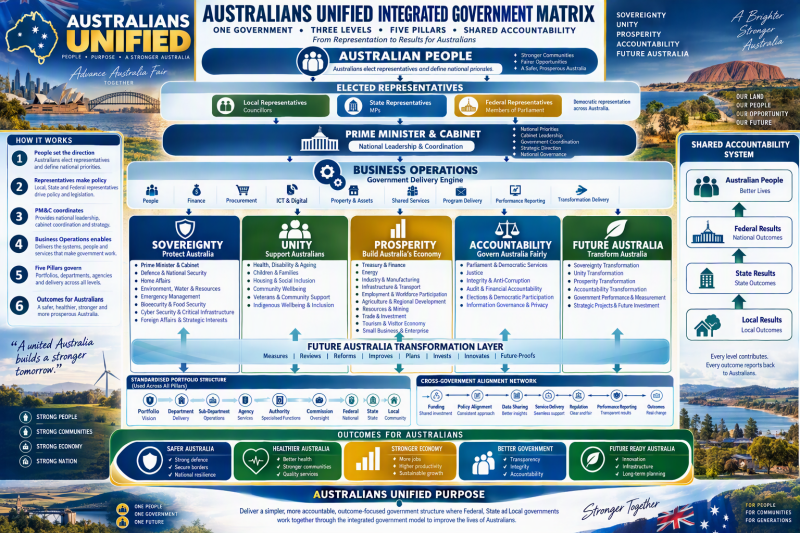
Australians Unified structural breakdown
To eliminate systemic fragmentation and administrative friction across trade and enterprise, the Australians Unified structure groups related departments and statutory authorities across clear foundational pillars, supported directly by Prime Minister and Cabinet leadership.
Sovereignty pillar: protect Australia
Integrates national defence, secure border trade, cybersecurity, critical infrastructure, and foreign strategic interests. Key departments including Defence, Home Affairs, and Biosecurity unite with agencies such as the Australian Border Force and the Australian Cyber Security Centre to secure supply corridors and national resilience.
Unity pillar: support Australians
Focuses on essential social fabric, healthcare, housing, disability support, and community wellbeing. By synchronising the Department of Health, Housing Authorities, and Veterans Support, public programmes deliver dignified living conditions and a healthy workforce without bureaucratic bottlenecks.
Prosperity pillar: build Australia's economy
Consolidates commerce, industry, resources, and trade. Connecting Treasury, Energy, Manufacturing, Austrade, and the Department of Small Business ensures cohesive fiscal settings, reduced red tape, and robust domestic manufacturing capabilities for enterprise growth.
Accountability & future Australia: govern and transform
Pairs democratic oversight with dedicated future transformation portfolios. While independent integrity bodies and public audit agencies enforce transparency, mirror reform units deliver measurable productivity improvements across every federal tier.
Department of Business & Trade FAQ
Key answers explaining why Australia currently lacks a unified business department and how proposed reforms resolve structural fragmentation across federal agencies.