Connecting government, communities and outcomes across Australia. Our challenges are interconnected, and resilient communities require effective governance, coordinated services, modern infrastructure and principled long-term planning. Discover how our strategic pillars align federal, state and local responsibilities to build a unified nation.
The Five Governance Pillars
The Governance Matrix is built around five interconnected pillars that organise government responsibilities, reform priorities and community outcomes.
🛡 Sovereignty
Protecting Australia's security, borders, strategic interests and national resilience.
💰 Prosperity
Supporting economic growth, infrastructure, industry, jobs and opportunity.
⚖ Accountability
Promoting transparency, justice, integrity and responsible government.
🤝 Unity
Supporting health, education, housing, families and community wellbeing.
🚀 Future Australia
Preparing Australia through innovation, science, technology and future skills.
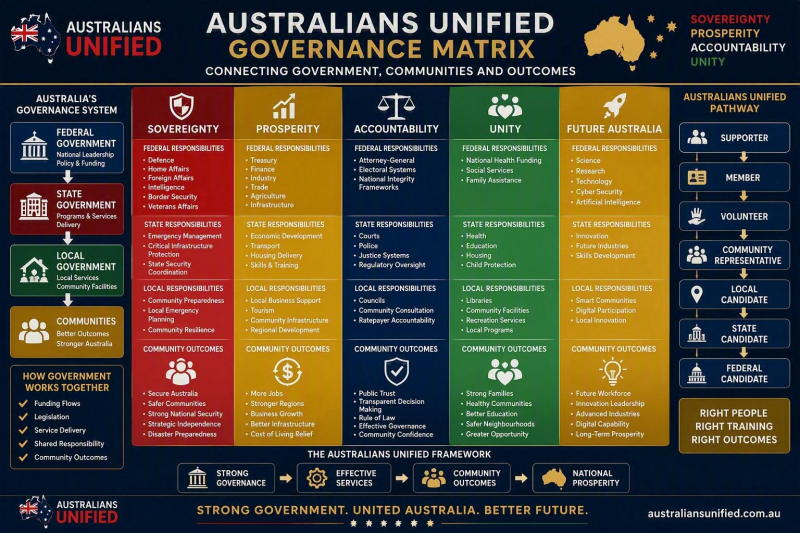
The Australians Unified Governance Matrix
The Australians Unified Governance Matrix is the foundation of our national governance framework. It is designed to help Australians understand how government responsibilities, community priorities, reform areas and public policy are connected across Federal, State and Local Government. Rather than viewing issues in isolation, the matrix provides a clear structure that links governance, reform and community outcomes through a consistent and transparent framework.
At the centre of the matrix are five interconnected Governance Pillars: 🛡 Sovereignty, 💰 Prosperity, ⚖ Accountability, 🤝 Unity and 🚀 Future Australia. These pillars organise the major responsibilities of government, helping Australians identify where issues sit, which portfolios are responsible, and how reform can be developed to create better outcomes. Every reform area, government portfolio and policy initiative can be mapped back to one or more of these pillars, creating a logical pathway from understanding government to delivering real change.
The Governance Matrix also demonstrates how responsibilities are shared across all levels of government. Federal, State and Local Governments each play an important role in delivering services, supporting communities and addressing national challenges. By connecting these responsibilities to reform priorities and community outcomes, the framework provides a practical roadmap for understanding how Australia works and how positive change can be achieved.
Through this model, Australians can move from understanding government structures to exploring reform areas, government portfolios, policy development and opportunities for community participation. It forms the blueprint of Australians Unified and supports our vision of a more informed, engaged and empowered Australia.
Understand Government. Explore Reform. Build Australia's Future
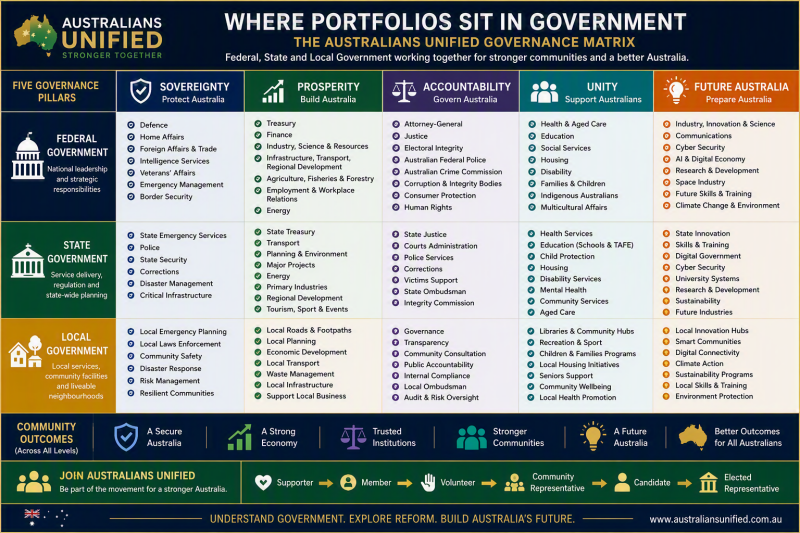

Protecting Australia's security, independence and national interests begins with clear collaboration across all levels of government. At the federal level, defence, home affairs, foreign affairs, intelligence, border security and veterans' affairs safeguard our borders and democratic values. State and local frameworks maintain critical infrastructure security and emergency response readiness.
Key outcomes delivered: a secure Australia, safer neighbourhoods, resilient national defence, sustained strategic autonomy and rapid disaster preparedness nationwide.

True sovereignty relies on robust local foundations. State governments lead essential emergency management, critical infrastructure protection and multi-agency security coordination. Working hand-in-hand, local councils steer community preparedness, tailored emergency planning and neighbourhood support networks.
This connected governance ensures grassroots resilience, protecting vital regional networks and ensuring no Australian community faces adversity alone.

Building jobs, supporting industry and securing sustained economic strength is central to the Australians Unified mission. Our governance matrix aligns federal trade and fiscal policies with regional enterprise initiatives, creating opportunities for local manufacturing, sustainable business operations and skilled Australian jobs.
Explore our wider policy framework and discover how every citizen can contribute to an independent, prosperous future.
The Australians Unified Governance Framework
The Australians Unified Governance Framework is designed to help Australians understand how government responsibilities connect to community outcomes and meaningful reform.
Rather than focusing solely on individual policies or political issues, the framework begins with an understanding of Government Structure and the roles performed by Federal, State and Local Government. Through the Australians Unified Governance Matrix, these responsibilities are organized into five core pillars that provide a clear pathway from governance to reform, policy development and community participation.
Together, the framework creates a structured approach to understanding how government works, where responsibilities sit, and how positive change can be achieved.
.

Federal Government
The Federal Government is responsible for protecting Australia's national interests, security, borders, and international relationships.
🪖 Defence
Protects Australia from external threats and maintains military capability across land, sea, air, cyber and space domains.
🛂 Home Affairs
Coordinates national security, immigration, border protection, emergency management and domestic security policy.
🌏 Foreign Affairs
Builds international relationships, diplomacy, trade partnerships and Australia's global influence.
🕵️ Intelligence
Provides intelligence gathering, threat assessment and strategic advice to protect national security.
🚧 Border Security
Monitors and protects Australia's borders from illegal activities, biosecurity threats and security risks.
🎖 Veterans Affairs
Supports former service personnel and their families through health, wellbeing and transition services.

🏛 State Government
State Governments support sovereignty through emergency management, infrastructure protection and public safety systems.
🚨 Emergency Management
Coordinates disaster response, recovery efforts and emergency preparedness across Victoria.
⚡ Critical Infrastructure Protection
Protects essential services and infrastructure including transport, water, energy and communications networks.
🏛 State Security Coordination
Works with Federal agencies to manage state-level security planning and emergency response arrangements.

🏘 Local Government
Local Government strengthens sovereignty by building resilient communities prepared for emergencies and local challenges.
👥 Community Preparedness
Supports community education, planning and readiness for emergencies and natural disasters.
📋 Local Emergency Planning
Coordinates local emergency management plans and supports response activities during incidents.
💪 Community Resilience
Helps communities recover from disasters, adapt to change and remain strong during challenges.

🌏 Community Outcomes
✅ Secure Australia
✅ Safer Communities
✅ Strong National Security
✅ Strategic Independence
✅ Protected Critical Infrastructure
✅ Effective Emergency Response
✅ Disaster Preparedness
✅ Resilient Communities
Australians Unified Perspective
Understand Government. Explore Reform. Build Australia's Future.
The Australians Unified Governance Framework connects Government Structure, Reform Areas, Portfolios, Policies, and Community Participation through a clear pathway designed to educate, engage, and empower Australians.
Australians Unified believes sovereignty is more than military defense. It includes secure borders, resilient communities, strong institutions, emergency preparedness, critical infrastructure protection, and Australia's ability to make decisions in its own national interest.
Australians Unified Vision
Australians Unified seeks to create a more informed, engaged and empowered Australia by connecting governance, reform and community participation through a single national framework. By understanding how government operates and how responsibilities are shared across all levels of government, Australians can better contribute to building stronger communities, better outcomes and a more resilient future.
🔘 Related Portfolios