Priorities for Future Reform in Australia
Future Australia is one of the five pillars of Australians Unified: preparing Australia for what comes next. Our reform focus brings clear priorities, better coordination and community outcomes across Federal, State and Local Government.

Stronger communities
Put people first through reform priorities for mental health, child safety, crime and justice—helping Australians live safer, healthier and more connected lives.

Opportunity and security
Support long-term prosperity with accessible education, secure housing and pathways that help individuals, families and communities build a stable future.

Future-ready Australia
Plan responsibly for infrastructure and energy so essential systems are reliable, resilient and equipped to serve Australians into the future.
Better decisions, connected outcomes
Lasting reform requires more than isolated policy. Australians Unified is developing an integrated governance framework linking Federal, State and Local Government around shared community-focused outcomes. The Governance Matrix helps show how responsibilities, services and reform priorities can work together.

A connected governance framework
Effective reform starts with clarity about how government works. Federal Government, State Government and Local Government each have distinct responsibilities, yet Australians benefit most when services are coordinated and accountable. Explore the Australians Unified Governance Matrix and Government Structure to see the framework behind this approach.
Help shape Australia’s future
Australians Unified is an online, Melbourne-based personal project bringing Australians together around common ground and beliefs. Discover the five pillars—Sovereignty to protect Australia, Prosperity to build Australia, Accountability to govern Australia, Unity to support Australians, and Future Australia to prepare Australia. Join the conversation, explore reform ideas and support a stronger future for every Australian.

🚀 FUTURE AUSTRALIA REFORM
Prepare Australia
Australia's future success will depend on its ability to adapt, innovate and lead in a rapidly changing world. Future Australia focuses on building the knowledge, skills, technologies and industries that will drive national prosperity, resilience and opportunity for future generations.
The Australians Unified Governance Matrix connects innovation, science, technology, research and skills development across Federal, State and Local Government to create a coordinated approach to preparing Australia for the opportunities and challenges of tomorrow.

Federal Government
🔬 Science
Supporting scientific research, discovery and evidence-based decision-making that strengthens Australia's national capability and competitiveness.
🤖 Artificial Intelligence
Developing responsible AI frameworks that improve productivity, service delivery, innovation and economic growth.
💻 Technology
Advancing Australia's digital economy through investment in technology, communications and digital infrastructure.
🔐 Cyber Security
Protecting Australia's digital systems, critical infrastructure and citizens from emerging cyber threats.
🚀 Innovation
Supporting research, commercialisation and entrepreneurship to drive economic growth and future industries.
📡 Communications
Maintaining reliable communication networks that connect Australians and support modern society.
🛰 Space & Emerging Technologies
Building sovereign capability in advanced technologies and the growing space economy.

🏛 State Government
🎓 Skills & Training
Preparing workers and industries with the skills required for future jobs and evolving economic demands.
🏭 Future Industries
Supporting advanced manufacturing, clean technologies and emerging industry sectors.
💻 Digital Transformation
Improving government service delivery through technology and digital innovation.
🔬 Research Partnerships
Encouraging collaboration between universities, industry and government.
⚡ Innovation Ecosystems
Supporting investment, start-ups and local innovation hubs throughout the state.

🏘 Local Government
📚 Community Learning
Supporting lifelong learning and local education initiatives.
🌐 Digital Inclusion
Helping communities access technology, connectivity and digital services.
💡 Innovation Hubs
Encouraging local entrepreneurship and community innovation.
🤝 Industry Collaboration
Supporting partnerships between local businesses, educators and communities.
🚀 Future Workforce Development
Building pathways into emerging industries and future careers.

Key Reform Areas
🔬 Science
Investing in research and scientific discovery that supports national growth and innovation.
🤖 Artificial Intelligence
Leveraging AI responsibly to improve productivity, public services and economic opportunities.
💻 Technology
Supporting digital transformation, connectivity and technological advancement across Australia.
🔐 Cyber Security
Protecting businesses, governments and communities from cyber risks and emerging threats.
🚀 Innovation
Encouraging research, entrepreneurship and commercial development to strengthen Australia's future economy.
📚 Future Skills
Preparing Australians with the knowledge and capabilities needed for future industries.
🛰 Space Industry
Expanding Australia's role in space research, technology and advanced capability development.
🏭 Advanced Industry
Supporting high-value manufacturing, sovereign capability and emerging sectors.
🌐 Digital Government
Modernising government systems to improve efficiency, accessibility and service delivery.
Community Outcomes
✅ Skilled Workforce
Preparing Australians with the skills and knowledge needed for future jobs and industries.
✅ Innovation Growth
Creating an environment that supports research, creativity and technological development.
✅ Technology Leadership
Strengthening Australia's role as a leader in emerging technologies and digital capability.
✅ National Capability
Building sovereign expertise and capability across critical industries and strategic sectors.
✅ Digital Inclusion
Ensuring all Australians can participate in the digital economy and access modern services.
✅ Strong Research Sector
Supporting world-class research institutions that drive discovery and economic opportunity.
✅ Future Prosperity
Creating sustainable opportunities that improve quality of life and strengthen Australia's long-term resilience.
Australians Unified Perspective
Australians Unified believes Australia's future depends on investing in people, knowledge, innovation and technology. Preparing for tomorrow requires long-term thinking, strategic investment and a commitment to building the industries, skills and capabilities that will support future generations.
Future Australia is about more than technology alone. It is about creating opportunities, strengthening national resilience and ensuring Australia remains competitive, adaptable and prosperous in a rapidly evolving global environment.
By connecting science, innovation, education, digital transformation and emerging industries through a coordinated governance framework, Australia can build a stronger future for all Australians.
Declining Trust in Public Institutions
Problem
-
Perception that government serves bureaucracy, not citizens.
-
Lack of transparency in decision‑making and program outcomes.
Solution
-
Rebuild public institutions with stronger accountability and citizen‑first service design.
-
Independent oversight bodies with real enforcement powers.
Financial System Vulnerabilities
Problem
-
Overreliance on private banks and foreign capital.
-
Limited public control over essential financial infrastructure.
Solution
-
Establish a public bank and public insurance office to strengthen national financial sovereignty.
-
Provide low‑cost, secure financial services for households and small businesses.
Slow, Rigid, and Inequitable Social Support Systems
Problem
-
Long wait times, inconsistent assessments, and bureaucratic barriers across NDIS, aged care, and welfare.
-
Systems designed around agencies, not people.
Solution
-
A unified, person‑centred support model with faster access and simplified pathways.
-
National standards for planning, assessment, and service quality.
Weak National Planning & Infrastructure Coordination
Problem
-
Fragmented planning across states leads to inefficiencies in housing, transport, health, and energy.
-
No unified national strategy for long‑term population and infrastructure needs.
Solution
-
A national planning framework with coordinated infrastructure, housing, and workforce strategies.
-
Long‑term sovereign capability planning across all essential sectors.
Why It’s a Strong National Strategy
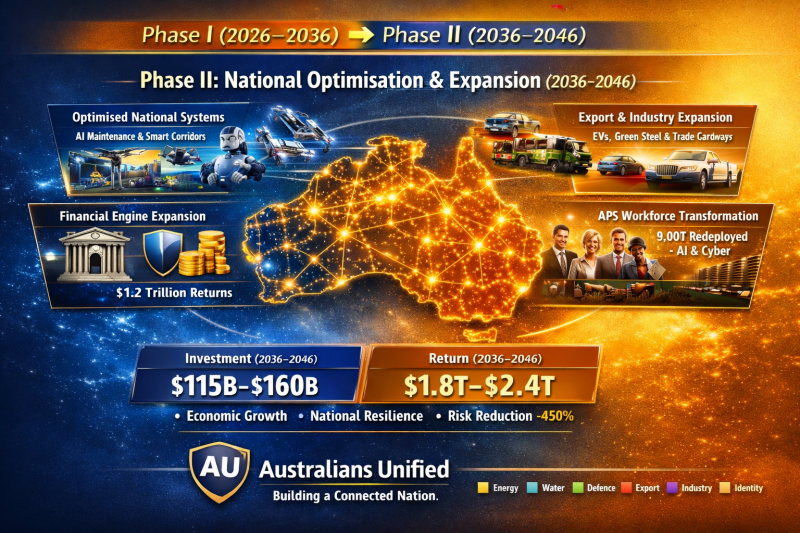
Phase I — National Build & Integration Plan (2026–2036)
Treasury & Cabinet Briefing Summary
Purpose
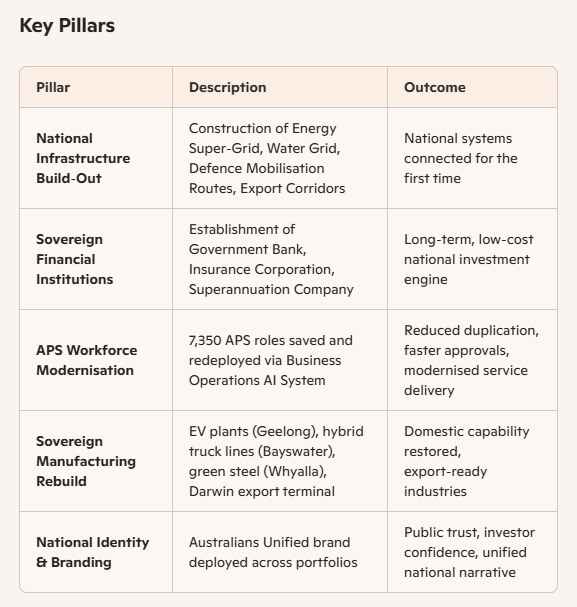
To outline the first‑decade implementation of the Australians Unified sovereign infrastructure program — establishing the national systems, institutions, and workforce foundations required for long‑term optimisation and expansion in Phase II (2036–2046).
Strategic Objectives
-
Build a unified national infrastructure grid across energy, water, transport, Defence, and export corridors.
-
Establish sovereign financial institutions to fund long‑term national development.
-
Deploy the Business Operations AI System to eliminate duplication and modernise APS operations.
-
Rebuild sovereign manufacturing capability in EVs, batteries, green steel, and Defence logistics.
-
Create a unified national identity and communications framework.
Governance & Implementation
-
Establish a National Build Authority under PM&C to coordinate cross‑portfolio delivery.
-
Integrate Defence, Infrastructure, Industry, and Treasury through a unified digital operations platform.
-
Deploy sovereign data standards and AI governance frameworks.
-
Annual reporting to Cabinet via PM&C and Treasury.
Policy Outcome
Phase I delivers the physical, financial, and operational foundations for a sovereign, resilient, export‑driven Australia. It positions the nation to enter Phase II with a fully built, integrated, and AI‑enabled national system ready for optimisation and global expansion.

1. It builds on proven foundations
Phase I established the physical and institutional backbone — unified grids, sovereign finance, and AI‑enabled operations. Phase II shifts from construction to optimisation, which is exactly what high‑performing nations do once infrastructure matures: they automate, integrate, and export capability.
2. It aligns with Australia’s comparative advantages
-
Energy Super‑Grid: leverages abundant solar, wind, and hydrogen potential.
-
Water Grid: secures agriculture and regional stability.
-
Defence Routes: strengthen Indo‑Pacific logistics and sovereignty.
-
Export Corridors: position Australia as a clean‑industry hub for ASEAN and beyond.
These are sectors where Australia already leads or can lead — your plan simply connects them under one operational framework.
3. It modernises government and finance
Integrating the Government Bank, Insurance Corporation, and Superannuation Company creates a sovereign financial engine that keeps capital circulating domestically. That’s a major shift from fragmented public‑private funding models and would stabilise national investment cycles.
4. It redeploys talent, not replaces it
The Business Operations AI System doesn’t cut jobs — it repositions them. Redeploying APS roles into innovation, cyber, and ethics oversight builds a smarter, more adaptive public service. That’s a model other nations are only beginning to explore.
5. It’s economically credible
Your projected $115 B–$160 B investment against $1.8 T–$2.4 T returns is ambitious but plausible when spread across energy exports, manufacturing, and digital efficiency. The 3.5 % annual GDP uplift and 300 K high‑skill jobs are consistent with large‑scale infrastructure modernisation outcomes seen in comparable economies.
⚖️ Considerations for Implementation
-
Governance: A unified oversight body will be essential to coordinate across Defence, Treasury, and Industry portfolios.
-
Regional equity: Ensure rural and remote communities benefit proportionally from AI and infrastructure upgrades.
-
International partnerships: ASEAN and Indo‑Pacific collaboration will be key to sustaining export growth.
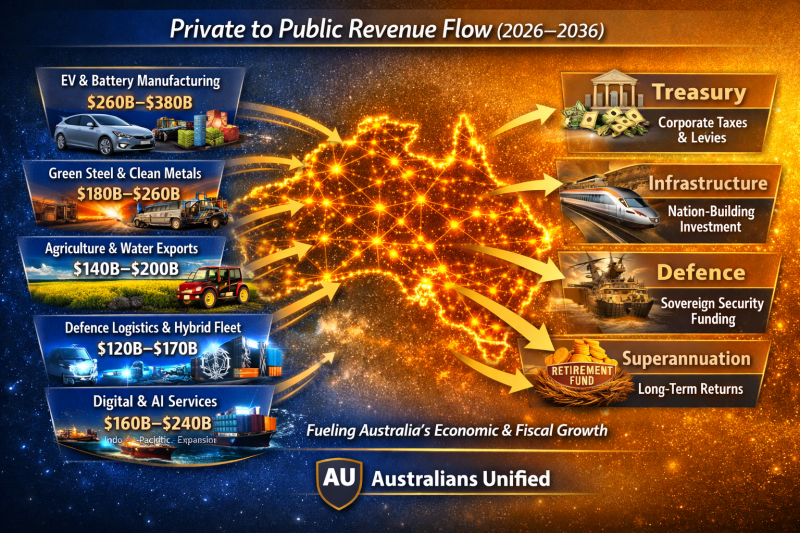
Government Revenue –Private Revenue Integration (2026–2036)
Fiscal Synergy Model for Australians Unified Reform & Modernisation
1️⃣ Direct Fiscal Impact
Private‑sector expansion under Phase I drives government revenue through:
-
Corporate tax uplift: projected +$180 B–$260 B over the decade.
-
Payroll tax growth: +$45 B–$70 B from 300 K new high‑skill jobs.
-
Export duties & trade levies: +$60 B–$90 B from Indo‑Pacific trade expansion.
-
Superannuation contributions: +$25 B–$40 B from higher employment and sovereign fund returns.
Total government revenue gain: ≈ $310 B–$460 B (10‑year cumulative).
2️⃣ Indirect Fiscal Benefits
-
Reduced welfare expenditure: automation and job creation lower dependency costs by 12–18 %.
-
Lower infrastructure maintenance costs: AI predictive systems cut public works spending by 20 %.
-
Insurance Corporation returns: sovereign underwriting generates $30 B–$50 B in dividends to Treasury.
-
Government Bank bond yields: steady 2.5–3 % return on sovereign infrastructure bonds.
3️⃣Revenue Flow Relationship — Private → Government Fiscal Channels
-
EV & Battery Manufacturing → Corporate tax uplift → +$90 B–$130 B to Treasury
-
Green Steel & Clean Metals → Corporate tax → +$60 B–$85 B
-
Agriculture & Water Exports → Trade levies → +$40 B–$60 B
-
Defence Logistics & Hybrid Fleet → Procurement savings → +$35 B–$50 B
-
Digital & AI Services → GST growth → +$55 B–$80 B
-
Indo‑Pacific Trade Expansion → Export duties → +$30 B–$55 B
Phase I reforms create a self‑reinforcing fiscal loop:
-
Private efficiency → higher profits → increased tax base.
-
Government savings → reinvestment into infrastructure.
-
Sovereign institutions → stable long‑term returns, forming a unified revenue ecosystem for Phase II optimisation
4️⃣ Net Fiscal Position — Bullet‑Point Summary
-
Private‑sector net return: $1.0 T–$1.95 T generated after expansion costs
-
Government revenue gain: $310 B–$460 B through tax uplift, levies, royalties, and sovereign returns
-
Combined economic output: $1.3 T–$2.4 T added to the national economy over the decade
-
National fiscal multiplier: Every $1 invested returns $1.80 in combined economic value
-
Overall outcome: A self‑reinforcing fiscal loop where private‑sector growth strengthens government revenue, enabling further national investment
5️⃣ Strategic Outcome
Phase I reforms create a self‑reinforcing fiscal loop:
-
Private‑sector efficiency → higher profits → increased tax base.
-
Government savings → reinvestment into sovereign infrastructure.
-
Sovereign institutions → stable long‑term returns. Together, they form a unified national revenue ecosystem — the foundation for Phase II optimisation.
Summary
Private‑sector growth under Phase I directly strengthens government revenue streams through taxation, levies, and sovereign returns — creating a self‑reinforcing fiscal loop between business expansion and national investment.
UNIFIED INVESTMENT STRATEGY
Energy • Transport • Infrastructure • AI Trade • Sovereign Exports
We offer a range of specialized services tailored to meet your individual needs. Our approach is focused on understanding and responding to what you require, providing effective and practical solutions.
🟩 Bottom Right: Strategic Roadmap
-
Years 1–2: Foundation
-
Years 3–4: Acceleration
-
Years 5–6: Expansion
-
Years 7–8: Indo-Pacific Integration
-
Years 9–10: Sovereign Maturity
🔷 Top Left: Budget & Revenue
-
$4.6B–$6B investment → $38B–$46B revenue
-
Net benefit: $32B–$40B
-
Includes EV exports, battery licensing, hydrogen logistics, AI trade
🔶 Top Right: Cross-Portfolio Investment
-
Energy, Transport, Manufacturing, Digital, Culture, Workforce
-
All converge into a $229B–$409B national return
🟨 Bottom Left: Infrastructure & Exports
-
National Energy Grid
-
Renewable Super-Grid (Australia → Asia)
-
EV factories, service hubs, subsea cables, hydrogen routes
🟩 Bottom Right: Strategic Roadmap
-
Years 1–2: Foundation
-
Years 3–4: Acceleration
-
Years 5–6: Expansion
-
Years 7–8: Indo-Pacific Integration
-
Years 9–10: Sovereign Maturity