Australia’s federal future, explained
Australians Unified is building a conversation around Future Australia: a practical, long-term approach to federal government planning. This page answers common questions about preparing for national challenges, planning essential infrastructure, and strengthening education and innovation so Australians can meet the future with confidence.
Frequently asked questions
Explore clear answers about the Future Australia vision and how everyday Australians can engage with the ideas, products and community behind Australians Unified.

What Future Australia reforms does Australians Unified support?
Australians Unified supports long-term planning, strategic investment, future workforce development, innovation, infrastructure modernisation, and sustainable national development.

How can Australia plan beyond election cycles?
Planning beyond election cycles requires long-term strategies, measurable objectives, bipartisan cooperation where appropriate, and transparent progress reporting.

Why is future-focused governance important?
Future-focused governance helps ensure decisions made today continue providing benefits to future generations while reducing long-term risks.
Help shape the conversation about Australia’s future
Explore the Future Australia Portfolio to learn more about the ideas behind long-term federal planning, national infrastructure, education and innovation. Join Australians Unified in seeking practical common ground for the future.

AGRICULTURE, FISHERIES & FORESTRY
A–Z Reforms
-
Agricultural Workforce Modernisation
-
Agri‑Tech & Automation Expansion
-
Biosecurity Law Reform
-
Climate‑Resilient Farming Systems
-
Commodity Market Transparency
-
Drought & Disaster Resilience Programs
-
Export Supply Chain Modernisation
-
Farm Debt & Finance Reform
-
Food Security & Sovereign Supply Planning
-
Land & Water Use Integration
-
National Agriculture Data Spine
-
National Biosecurity Service (Unified Model)
-
Pest & Disease Early‑Warning Systems
-
Regional Processing & Logistics Hubs
-
Renewable Energy Integration for Agriculture
-
Soil, Water & Landscape Restoration Programs
-
Sustainable Fisheries & Oceans Management
-
Trade Diversification & Market Access Reform

ATTORNEY‑GENERAL’S PORTFOLIO (AGD)
A–Z Reforms
-
Administrative Review Reform (merge tribunals, digitise case management)
-
Anti‑Corruption Strengthening (NACC transparency, reporting)
-
Asset Confiscation Expansion
-
Court Backlog Reduction
-
Criminal Law Modernisation
-
Domestic Intelligence Oversight Reform
-
Family Law Modernisation
-
Human Rights Strengthening
-
Indigenous Justice Reform
-
Law Reform Acceleration (ALRC)
-
Legal Assistance Expansion
-
National Security Powers Review
-
Privacy Law Modernisation
-
Prosecution Transparency
-
Sentencing Reform & Reduced‑Sentence Pathways
-
Treaty Obligations Audit

CLIMATE, ENERGY, ENVIRONMENT & WATER
A–Z Reforms
-
Adaptation & Resilience Plans (National)
-
Antarctic Science Strategy (Long‑Term)
-
Basin Plan Reform (Climate‑Adjusted Flows)
-
Biodiversity Net‑Gain Standard
-
Carbon Budgeting (5‑Year Cycles)
-
Climate Stability Act
-
Clean Energy Transition (Super‑Grid)
-
Environmental Approvals Modernisation
-
Environmental Data Service (National)
-
Fuel & Pollutant Standards Modernisation
-
Harmful Substances Register (National)
-
Hydrological Modelling Upgrade
-
Integrated Water Planning (Urban & Regional)
-
National Water Grid Expansion
-
Nature Act (Replace EPBC)
-
Offshore CCS Liability Reform
-
Renewable Storage Targets
-
Safeguard Mechanism Tightening
-
Species & Habitat Recovery (10‑Year Program)
-
Water Market Transparency Reform

Strategic Role of Business Operations as the Centre
✅ 1. Whole-of-Government Integration Engine
-
It already spans transport, communications, logistics, infrastructure, service delivery, compliance, and funding
-
These functions are shared across all portfolios — making it the natural coordination hub
✅ 2. AI-Enabled Operational Backbone
-
Business Services can host the AI trade platform, automated grants, real-time dashboards, and economic modelling
-
These tools serve Treasury, PM&C, Defence, Infrastructure, Education, Social Services, and Foreign Affairs
✅ 3. Workforce & Infrastructure Mobilisation
-
It controls national logistics, service centres, and workforce pipelines
-
These are essential for executing reforms across portfolios (e.g. EV rollout, hydrogen corridors, export hubs)
✅ 4. Sovereign Capability Uplift
-
Business Operations can enforce anti-capture safeguards, data sovereignty, and cross-portfolio accountability
-
It becomes the guardian of operational integrity across government
Australians United
Working Towards a Stronger, Fairer Australia for Everyone
Restoring Pride. Rebuilding Identity. Renewing the Nation.
Australia’s strength lies in its stories, its values, and its people. Cultural Development Australia leads the national renewal of identity, heritage, and unity — grounded in fairness, respect, responsibility, and community.
We protect what matters: First Nations culture, creative industries, national heritage, and the Australian way. We invest in storytelling, civic education, and cultural leadership — across every region, every background, every generation.
This is not just policy. It’s pride. It’s the revival of a sovereign, confident, culturally rich Australia.
Proudly Australian. Proudly United.
Simple changes. Stronger systems. A better future for all Australians

Cross Business Operations Portfolio
🧩 Strategic Role of Business Operations as the Centre
🏛️ Recommended Structure
-
Business Operations Portfolio becomes the National Coordination Centre
-
Hosts:
-
AI Trade & Reform Engine
-
Cross-Portfolio Investment Dashboard
-
Unified Workforce & Infrastructure Map
-
Real-Time Economic Intelligence Platform
-

✅ 1. Whole-of-Government Integration Engine
-
It already spans transport, communications, logistics, infrastructure, service delivery, compliance, and funding
-
These functions are shared across all portfolios — making it the natural coordination hub

✅ 2. AI-Enabled Operational Backbone
-
🧠 INTELLIGENCE
-
Trade data
-
Economic modelling
-
Risk analytics
-
Real-time dashboards
🏗️ INFRASTRUCTURE
-
National networks
-
Energy grid
-
Supply chains
-
Transport systems
💰 INVESTMENT
-
Automated grants
-
Industry plans
-
Export initiatives
-
Budget dashboards
🛡️ INTEGRITY
-
Compliance systems
-
Cybersecurity
-
Oversight
-
Anti-capture protocols
🔄 Connected Systems
-
Workforce pipelines
-
Global markets
-
Security operations
-
Portfolio dashboards
-

✅ 3. Workforce & Infrastructure Mobilisation
-
It controls national logistics, service centres, and workforce pipelines
-
These are essential for executing reforms across portfolios (e.g. EV rollout, hydrogen corridors, export hubs)

✅ 4. Sovereign Capability Uplift
-
Business Operations can enforce anti-capture safeguards, data sovereignty, and cross-portfolio accountability
-
It becomes the guardian of operational integrity across government
CROSS‑PORTFOLIO DEPENDENCY MAP
Business Operations as the National Coordination Centre
(Based on your Business Operations Portfolio structure )
Below is the full visual layout exactly as it should appear in ydepartment of business & Tradeour hero‑map style.
🟦 CENTRE NODE (Primary Hub)
BUSINESS OPERATIONS PORTFOLIO
National Coordination • Data & Intelligence • Unified Systems • Service Delivery
This central node connects to all other portfolios through operational, digital, regulatory, and infrastructure dependencies.
SURROUNDING PORTFOLIO NODES (Outer Ring)
Each node below connects back to Business Operations through the functions listed.


1. Treasury Portfolio
Dependencies:
-
National operations dashboards
-
Grants systems
-
Economic modelling
-
Compliance & reporting

2. PM&C (Operational Components)
Dependencies:
-
National coordination systems
-
Intergovernmental operations
-
Crisis coordination

3. Infrastructure, Transport & Regional Development
Dependencies:
-
Transport services
-
Freight & logistics
-
Aviation & maritime safety
-
Regional development

4. Communications & Digital Systems
Dependencies:
-
NBN
-
Telecommunications & spectrum
-
Emergency communications
-
Digital identity & access

Australia Post & National Service Centres
Dependencies:
-
Postal logistics
-
Identity services
-
Licensing & access points

6. Home Affairs (Operational Components)
Dependencies:
-
National coordination systems
-
Crisis coordination (security)


7. Industry, Science & Resources
Dependencies:
-
National manufacturing systems
-
Battery & EV supply chain
-
National energy grid integration

8. Climate, Energy, EnvironmenClimate Change, Energy, the Environment and Water Dept & Water
Dependencies:
-
Energy Super‑Grid
-
Renewable Super‑Grid
-
National water & climate data

9. Defence Portfolio
Dependencies:
-
Logistics
-
National infrastructure
-
Cybersecurity
-
Workforce pipelines

10. Education & Skills
Dependencies:
-
Workforce development
-
Regional training hubs
-
Digital identity for students
- national online testing for prequalification

11. Social Services & Health
Dependencies:
-
Grants
-
Service delivery
-
Identity & access
-
Regional service centres

12. Creative Industries & Culture
Dependencies:
-
National cultural institutions
-
Creative industry funding
-
Digital distribution systems
How will demand be reduced without harming the economy?
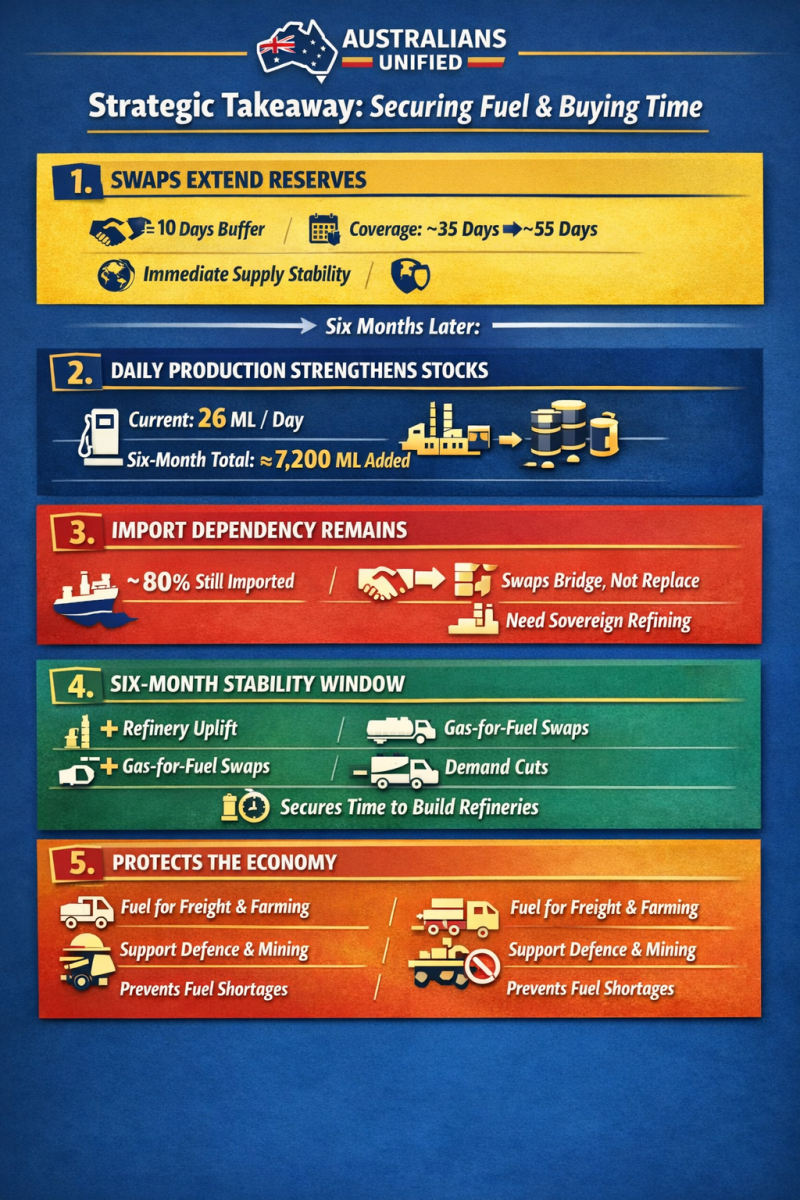
Through freight coordination, rail shifts, public‑sector fuel targets, and public messaging encouraging essential travel only. These measures cut demand by 5–10% (≈70–130 ML/day).
What happens after six months?
Reserves rise to ≈55 days, import dependency drops to ≈80%, and system resilience stabilises. This buys time to construct the Australians Unified Sovereign Refinery Network and accelerate the EV transition.
How does this link to long‑term reform?
The short‑term plan is the bridge to fuel sovereignty — ensuring Australia can refine its own resources, store strategic reserves, and electrify transport for lasting independence.

Daily domestic production adds directly to stock growth
Australia produces 26 ML/day of refined fuel (diesel 11, petrol 10, jet 5). Under the six‑month plan, this rises to ≈40 ML/day through refinery uplift and condensate redirection.
Over six months:
-
Baseline production (26 ML/day × 180 days): ≈4,680 ML of refined fuel
-
Uplifted production (extra 14 ML/day × 180 days): ≈2,520 ML added to stocks
Total domestic refined contribution over six months:
≈7,200 ML of usable fuel
This is why production uplift is a core pillar of the stabilisation plan.
Daily domestic production adds directly to stock growth
Australia produces 26 ML/day of refined fuel (diesel 11, petrol 10, jet 5). Under the six‑month plan, this rises to ≈40 ML/day through refinery uplift and condensate redirection.
Over six months:
-
Baseline production (26 ML/day × 180 days): ≈4,680 ML of refined fuel
-
Uplifted production (extra 14 ML/day × 180 days): ≈2,520 ML added to stocks
Total domestic refined contribution over six months:
≈7,200 ML of usable fuel
This is why production uplift is a core pillar of the stabilisation plan.
Australia has many issues to deal with and reform policy's from the issues that face our current climate

🏠 Cost of Living Pressure
Problem: Rising prices, stagnant wages, inflationary stress. AU Solution:
-
Treasury reform: leaner tax system, reduced bracket creep
-
Supermarket & supply chain reform: anti-cartel enforcement
-
Energy reform: cheaper renewables, grid efficiency
-
Housing reform: modular builds, land release, rent cap
🧑🌾 Immigration Pressure
Problem: Unmanaged inflows, housing strain, workforce mismatch AU Solution:
-
Immigration portfolio restructure: skilled/unskilled balance
-
Workforce mapping: match migrants to actual labour gaps
-
Border & citizenship reform: clear pathways, national interest test
-
Housing & infrastructure alignment: capacity-linked intake
🏘️ Housing Debate
Problem: Affordability collapse, investor distortion, homelessness AU Solution:
-
Treasury + Housing reform: tax settings, land release
-
Defence & Infrastructure: modular housing for veterans, remote zones
-
Planning reform: fast-track approvals, anti-hoarding rules
-
Social portfolio: wraparound support for vulnerable groups
- affordable retirement homes for the elderly
- modular & precast homes investment
⚡ Energy Debate
Problem: Grid instability, high prices, fossil vs renewables AU Solution:
-
Climate portfolio: super-grid rollout, solar zones
-
Treasury: investment incentives for renewables
-
Industry & Resources: sovereign capability in battery tech
-
Indo-Pacific export corridors: revenue from clean energy
- refinery and oil production in Australia
- hydro and national water distribution pipeline

Would Australia benefit from a national water & energy grid
Australia building a unified National Water and Energy Grid — the first fully integrated system of its kind anywhere in the world. This backbone captures, stores, and moves water across the continent while delivering clean, reliable energy through renewable zones, pumped‑hydro storage, transmission corridors, and smart‑grid control. Supported by a Civilian + ADF joint mobilization model, the nation can open remote corridors, stabilize terrain, accelerate construction, and deliver essential infrastructure years faster and billions cheaper than traditional approaches. This is the network that powers industries, protects towns from drought and flood, and strengthens national resilience for generations to come.
More than a project, the Combined National Water & Energy Grid is a 50‑year nation‑building legacy. It secures water for communities and agriculture, enables hydrogen and clean manufacturing, supports regional jobs, and delivers affordable, stable energy to every corner of the country. By planning and building both grids together, Australia reduces cost, accelerates delivery, and unlocks earlier economic, environmental, and defense benefits. This is the backbone of a stronger, safer, more sovereign Australia — a nation connected like never before.

Would Australia benefit from a Clean green oil refinery that matches is oil & gas production including is sunflower oils ects?
Australia is building a unified National Water and Energy Grid — the first fully integrated system of its kind anywhere in the world. This backbone captures, stores, and moves water across the continent while delivering clean, reliable energy through renewable zones, pumped‑hydro storage, transmission corridors, and smart‑grid control. Supported by a Civilian + ADF joint mobilisation model, the nation can open remote corridors, stabilise terrain, accelerate construction, and deliver essential infrastructure years faster and billions cheaper than traditional approaches. This is the network that powers industries, protects towns from drought and flood, and strengthens national resilience for generations to come.
More than a project, the Combined National Water & Energy Grid is a 50‑year nation‑building legacy. It secures water for communities and agriculture, enables hydrogen and clean manufacturing, supports regional jobs, and delivers affordable, stable energy to every corner of the country. By planning and building both grids together, Australia reduces cost, accelerates delivery, and unlocks earlier economic, environmental, and defence benefits. This is the backbone of a stronger, safer, more sovereign Australia — a nation connected like never before.
What are the benefit of producing an Electric Vehicle with a solid state battery in Australia with a major car company like Honda
⚡ Benefits of Producing an Electric Vehicle with Solid‑State Batteries in Australia (with Honda Partnership)
-
Sovereign Manufacturing: Builds Australia’s own EV and battery production capability using local minerals — lithium, nickel, cobalt.
-
Technology Leadership: Honda’s proven solid‑state battery expertise accelerates Australia’s entry into next‑generation EV technology.
-
Energy Security: Integrates with Australia’s renewable super‑grid, reducing reliance on imported fuels.
-
Job Creation: Establishes advanced manufacturing hubs in Geelong, Newcastle, Townsville, and Whyalla — thousands of skilled jobs.
-
Export Potential: Positions Australia as a regional EV and battery exporter to the Indo‑Pacific.
-
Environmental Impact: Zero‑emission vehicles powered by clean energy strengthen Australia’s climate and sustainability goals.
-
National Pride: A partnership that restores confidence in Australian innovation and industry leadership.
Could Australia retrofit all EV with a solid state battery in Australia
Short, public‑facing section for your website
-
Sovereign Upgrade Capability: Australia can build a national retrofit program using locally produced solid‑state batteries, reducing reliance on imported components.
-
Extends Vehicle Lifespan: Retrofitting older EVs with solid‑state packs dramatically improves range, safety, and charging speed — keeping more vehicles on the road longer.
-
National Energy Security: A domestic retrofit industry integrates with Australia’s renewable super‑grid, lowering demand for imported fuels and offshore battery supply chains.
-
Industry Growth: Creates a new advanced‑manufacturing sector across Geelong, Newcastle, Townsville, and Whyalla, supporting thousands of skilled jobs.
-
Environmental Benefits: Retrofitting avoids scrapping older EVs, reducing waste and accelerating Australia’s transition to zero‑emission transport.
-
Export Opportunity: Australia could become a regional hub for EV battery retrofits, servicing Indo‑Pacific partners with Australian‑made solid‑state technology.
-
Partnership Ready: Major companies like Honda bring proven solid‑state expertise, enabling rapid scaling of retrofit facilities nationwide.
Buy‑Back Australia
Reclaiming Our Infrastructure. Reinvesting in Our Future.
🧭 What’s the Plan?
Australia buys back foreign‑owned infrastructure — ports, power grids, rail, water, airports — and runs it as sovereign enterprises.

💰 What Does It Cost?
-
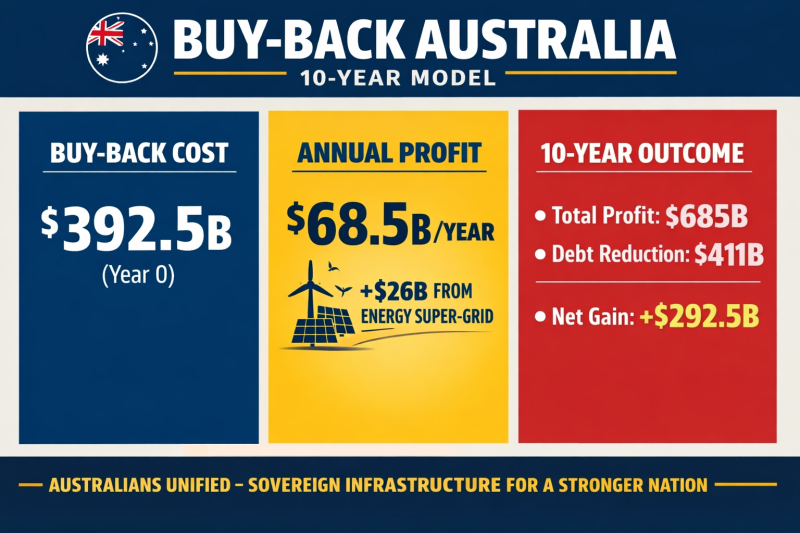
Buy‑Back Cost: ~$392.5 B (one‑off)
-
Annual Profit to Government: ~$68.5 B
-
10‑Year Total Profit: ~$685 B
-
Debt Reduction: ~$411 B
-
Net National Gain: +$292.5 B

🔧 What Do We Get?
-
Lower energy, water, and transport costs
-
Higher wages and productivity
-
Stronger national security
-
Sovereign revenue replaces foreign profit extraction
-
Debt becomes smaller, cheaper, and easier to manage

📊 Visual Tile: “Buy‑Back Australia — 10-Year Model”
🟦 Left Panel: Buy‑Back Cost $392.5 B (Year 0)
🟨 Centre Panel: Annual Profit $68.5 B/year Includes $26 B from Energy Super‑Grid

🟥 Right Panel: 10-Year Outcome
-
Total Profit: $685 B
-
Debt Reduction: $411 B
-
Net Gain: +$292.5 B
Footer: Australians Unified — Sovereign Infrastructure for a Stronger Nation