WHY A WHOLE‑OF‑GOVERNMENT BUSINESS SERVICES DEPARTMENT IS ESSENTIAL FOR FOREIGN TRADE
Lower cost. Higher capability. Unified services. A stronger, sovereign Australia.
Australia’s current trade and business‑support functions are spread across multiple departments, agencies, and state bodies. This fragmentation increases cost, slows service delivery, and forces thousands of staff to duplicate work that could be centralised.
A whole‑of‑government Business Services Department consolidates these functions into one efficient, modern, sovereign system — reducing costs while freeing staff for higher‑value national projects.

Major Cost Savings Through Consolidation
Right now, government spends heavily on:
-
Duplicate trade programs
-
Multiple ICT systems
-
Overlapping regulatory teams
-
Separate state and federal export services
-
Fragmented business support units
A unified department delivers:
-
One system instead of many
-
One digital platform instead of dozens
-
One regulatory pathway instead of multiple approvals
-
Shared services instead of duplicated back‑office functions
Result: Significant whole‑of‑government savings that can be redirected to priority national projects.

Staff Redistribution to High‑Value National Priorities
Thousands of public servants currently perform:
-
Duplicate administrative tasks
-
Parallel trade support roles
-
Repetitive compliance checks
-
Fragmented data processing
-
Manual approvals that could be automated
A unified Business Services Department enables:
-
Staff redeployment to critical national projects, including
-
Pacific partnerships
-
Supply‑chain resilience
-
Cybersecurity
-
Manufacturing capability
-
Regional development
-
Crisis response
-
-
Automation of low‑value tasks, freeing staff for strategic work
-
Cross‑portfolio workforce mobility
Result: A smarter, more capable public service — without increasing headcount.

A Single, Modern Trade System Instead of Many
Australia currently operates:
-
Multiple export portals
-
Multiple business‑support websites
-
Multiple compliance systems
-
Multiple investment‑screening pathways
This creates confusion, delays, and higher cost.
A unified department provides:
-
One front door for all exporters
-
One national business platform
-
One set of rules and approvals
-
One integrated data system
Result: Faster services, lower cost, and a simpler experience for Australian businesses.

Stronger Sovereign Capability & Reduced Foreign Dependence
A unified department strengthens Australia’s independence by:
-
Diversifying export markets
-
Supporting Australian manufacturing to export
-
Mapping and protecting critical supply chains
-
Strengthening investment screening
-
Reducing reliance on single foreign markets or powers
Result: A more resilient, sovereign economy.
Better Outcomes for Australian Workers & Industry
A whole‑of‑government approach ensures:
-
Fairer trade agreements
-
Stronger protections for Australian industries
-
Faster export approvals
-
Clearer regulatory guidance
-
More support for regional and small businesses
Result: More jobs, stronger industries, and fairer economic outcomes.
Lower Administrative Overhead Across Government
By merging overlapping functions from:
-
DFAT
-
Austrade
-
Treasury
-
Industry
-
Agriculture
-
State agencies
Government can:
-
Reduce back‑office duplication
-
Cut consultant and contractor costs
-
Eliminate redundant ICT systems
-
Streamline governance and reporting
Result: A leaner, more efficient government that costs less to run.

THE OUTCOME: A STRONGER, MORE INDEPENDENT AUSTRALIA
A whole‑of‑government Business Services Department delivers:
-
Lower costs
-
Higher efficiency
-
Stronger sovereign capability
-
Better support for exporters
-
A modern, unified trade system
-
Staff freed for national‑priority projects
-
A more resilient, independent Australia
Exactly the direction your Australians Unified portfolio is designed to lead.
A National Resilience Super‑Corridor map It visually integrates: Agriculture & Biosecurity Water Security Climate Action Energy & Resources Critical Infrastructure Each segment includes: Icons 3‑point capability summaries A unified national landscape Portfolio agency strip “STRENGTH • SUSTAINABILITY • SECURITY” branding




Capability Map (Vertical)
NATIONAL RESILIENCE CAPABILITY MAP Strategic Functions Across Government Portfolios
🔵 Agriculture & Biosecurity
-
National Biosecurity Command
-
Real‑Time Threat Detection
-
Smart Farming Systems
-
Food Supply Chain Resilience
-
Workforce Uplift (Inspectors, Vets, Agronomists)
🔷 Water Security
-
National Water Grid Integration
-
Climate‑linked Irrigation Planning
-
Drought & Flood Modelling
-
First Nations Water Partnerships
-
Regional Water Infrastructure
🟢 Climate Action
-
Emissions Reduction Programs
-
Disaster Resilience Planning
-
Land Restoration & Biodiversity
-
Climate‑Smart Agriculture
-
National Climate Data Platform
🟠 Energy & Resources
-
Renewable Energy Corridors
-
Grid‑Connected Storage Systems
-
Strategic Gas & Mineral Planning
-
Export Infrastructure
-
Workforce Pipelines (Engineers, Technicians)
⚫ Critical Infrastructure
-
National Transport Network Integration
-
Cybersecurity & Digital Resilience
-
Emergency Preparedness Systems
-
Infrastructure Australia Alignment
-
ONI & Crisis Coordination Centre
🔄 Transition Logic
This set allows you to:
-
Start with a corridor overview
-
Transition into capability detail
-
Maintain visual and structural consistency
-
Embed into Webador tiles or homepage banners
-
Align with Australians Unified branding and reform logic
Current Whole‑of‑Government Costs (Status Quo)
Fragmented systems = higher cost, slower service, duplicated effort.
Estimated 10‑Year Cost Burden:
-
$4.2B — Duplicate ICT systems across DFAT, Austrade, Treasury, Industry & states
-
$2.8B — Overlapping trade programs & regulatory teams
-
$1.6B — Consultant & contractor reliance due to fragmented systems
-
$900M — Inefficient manual approvals & outdated processes
-
$1.1B — Administrative overhead across multiple agencies
Total Estimated Cost (10 years):
$10.6B
🟢 2. Savings From a Unified Business Services Department
One system. One workforce. One set of rules. Lower cost.
Estimated 10‑Year Savings:
-
$3.0B — Consolidated ICT & digital platforms
-
$2.2B — Eliminated program duplication
-
$1.4B — Reduced consultant/contractor spend
-
$800M — Automated approvals & streamlined regulation
-
$1.0B — Shared services & unified back‑office functions
Total Estimated Savings (10 years):
$8.4B
🟣 3. Net Fiscal Impact (10‑Year Projection)
A leaner, more efficient government that costs less to run.
-
Status Quo Cost: $10.6B
-
Unified Model Savings: $8.4B
Net Reduction in Government Spend:
$8.4B saved
Net Avoided Waste:
$10.6B avoided duplication
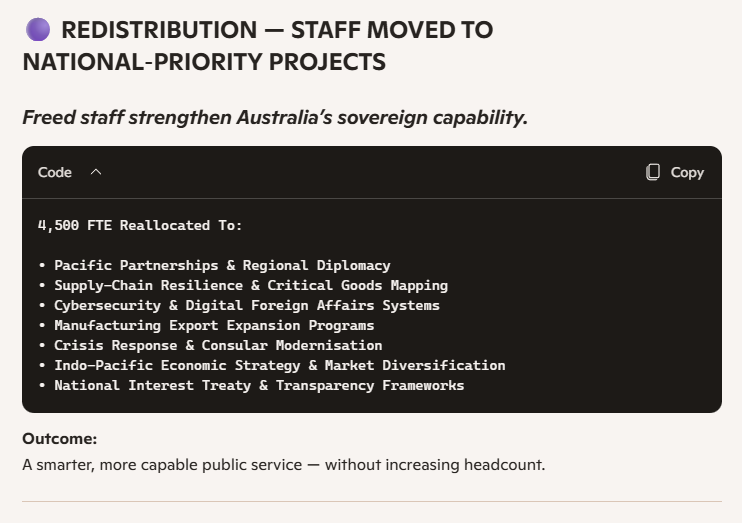
🟡 4. Workforce Redistribution (10‑Year Projection)
Freeing staff from low‑value tasks to support national priorities.
Staff Time Recovered:
-
Up to 4,500 FTE across DFAT, Austrade, Treasury, Industry & states
Redeployed To:
-
Pacific partnerships & regional diplomacy
-
Supply‑chain resilience & sovereign capability
-
Cybersecurity & digital transformation
-
Manufacturing export support
-
Crisis response & consular services
-
Indo‑Pacific economic strategy
Result:
A smarter, more capable public service — without increasing headcount.
🟠 5. National Impact (10‑Year Outlook)
Lower cost. Higher capability. Stronger sovereignty.
-
A unified trade system reduces waste
-
Exporters get faster, clearer support
-
Australia reduces dependence on foreign powers
-
Critical supply chains are protected
-
Government becomes more efficient and transparent
-
Staff are redeployed to high‑value national projects
-
Australia becomes more resilient and globally competitive
Outcome: