Department of the Treasury
Treasury is the Government’s principal economic adviser, providing critical insights and guidance. We are dedicated to delivering comprehensive advice to the Government and implementing a wide range of policies and programs aimed at achieving strong, sustainable economic and fiscal outcomes for all Australians. Our team diligently anticipates and thoroughly analyses policy issues with a holistic, whole-of-economy perspective. We take the time to understand the complexities of government and stakeholder circumstances, enabling us to respond rapidly and effectively to changing events and emerging directions in the economic landscape.


STRENGTHS
-
Strong national mandate
-
Highly skilled economic and analytical workforce
-
Deep institutional knowledge
-
Strong international credibility
-
Comprehensive data and modelling capability

WEAKNESSES
-
Legacy systems and slow modelling cycles
-
Fragmented data across agencies
-
Limited real‑time economic visibility
-
High complexity in tax and regulatory systems
-
Workforce shortages in digital and modelling roles

THREATS
-
Global economic shocks
-
Cybersecurity risks
-
Inflation and cost‑of‑living pressures
-
Ageing population and workforce decline
-
Geopolitical instability
Current operations and structural scope of Treasury
Core agency network:
Department of the Treasury
Australian Taxation Office (ATO)
Australian Bureau of Statistics (ABS)
Productivity Commission
Foreign Investment Review Board (FIRB)
Australian Competition & Consumer Commission (ACCC)
Australian Prudential Regulation Authority (APRA)
Australian Securities & Investments Commission (ASIC)
Primary responsibilities:
National economic policy and forecasting
Budget strategy and fiscal policy management
Taxation policy and revenue systems administration
Competition, consumer protections, and market regulation
Foreign investment oversight and national security reviews
Financial system stability and prudential supervision
Economic modelling, national accounts, and statistics
Long-term economic planning and productivity reform
Key stakeholders served:
Government and Parliament
Businesses, institutional investors, and Australian industry
Households and individual workers
Banking and financial institutions
State, territory, and local government bodies
International economic partners and multilateral institutions
Operational characteristics:
Operates within a high-analysis, high-integrity regulatory environment
Exerts direct, whole-of-government policy influence
Relies heavily on quantitative modelling and national data pipelines
Maintains high visibility and public accountability
Performs a central role in guaranteeing macroeconomic stability
Treasury portfolio current position
The Treasury Portfolio serves as Australia's primary economic management authority, responsible for guiding financial systems, investment governance, and long-term prosperity. Its core operations span comprehensive fiscal and economic policy, taxation system oversight, capital markets regulation, and public finance management to guarantee national stability and intergenerational wealth.
Through strategic public capital investment, digital government modernisation, and structured productivity reforms, Treasury equips national agencies and markets with the resilience needed to face evolving global and domestic economic environments.
Portfolio operating model and scope:
Economic policy → Public finance → Investment management → Digital government → Government efficiency → Productivity growth → Community prosperity → Australia 2055.
Strategic priorities:
Economic growth: Supporting sustainable national development.
Financial sustainability: Managing responsible fiscal balances and public value.
Government productivity: Streamlining systems through digital transformation.
Sovereign investment: Growing long-term capital assets and superannuation safeguards.
Community prosperity: Delivering tangible benefits to households, workers, and industry.
Why change is needed
Key challenges facing Treasury:
Increasing economic volatility and global uncertainty
Rising cost-of-living pressures across Australian households
Ageing population dynamics and widespread workforce shortages
Persistent slow productivity growth across key industries
Fragmented data systems across separate portfolio agencies
Legacy modelling tools and inefficient manual workflows
Need for stronger long-term economic planning frameworks
Escalating cyber threats and systemic financial system risks
Projected risks if left unchanged:
Slower economic responses: Delayed policy intervention during international shocks and fiscal disruptions.
Reduced productivity: Weakened national competitiveness across export and trade sectors.
Higher fiscal pressures: Intergenerational budgetary imbalances and strained public capital assets.
Weaker resilience: Elevated exposure to systemic shocks across banking and financial markets.
Erosion of trust: Declining public confidence in key economic institutions and governance.
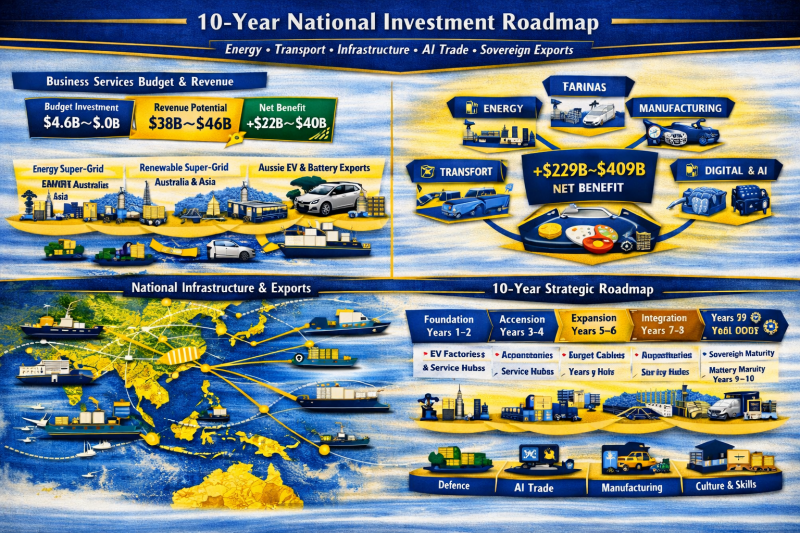
⭐ HERO BANNER — UNIFIED INVESTMENT STRATEGY
Energy • Transport • Infrastructure • AI Trade • Sovereign Exports
🔷 Top Left: Budget & Revenue
-
$4.6B–$6B investment → $38B–$46B revenue
-
Net benefit: $32B–$40B
-
Includes EV exports, battery licensing, hydrogen logistics, AI trade
🔶 Top Right: Cross-Portfolio Investment
-
Energy, Transport, Manufacturing, Digital, Culture, Workforce
-
All converge into a $229B–$409B national return
🟨 Bottom Left: Infrastructure & Exports
-
National Energy Grid
-
Renewable Super-Grid (Australia → Asia)
-
EV factories, service hubs, subsea cables, hydrogen routes
🟩 Bottom Right: Strategic Roadmap
-
Years 1–2: Foundation
-
Years 3–4: Acceleration
-
Years 5–6: Expansion
-
Years 7–8: Indo-Pacific Integration
-
Years 9–10: Sovereign Maturity
🧩 Outcome
Australia builds a sovereign economic engine powered by unified investment, AI governance, and Indo-Pacific export capability.
OPPORTUNITIES
-
AI‑enabled economic forecasting
-
Unified national economic data platform
-
Modernised tax and revenue systems
-
Stronger productivity and innovation agenda
-
Transparent, real‑time economic reporting
FUTURE MODEL (AI‑ENABLED, RESILIENT, LONG‑TERM)
A. National Economic Intelligence Platform
-
Unified economic data architecture
-
Real‑time dashboards for inflation, wages, productivity and markets
-
AI‑enabled forecasting and scenario modelling
-
Integrated Treasury–Finance–ABS modelling environment
B. Modernised Tax & Revenue System
-
Automated compliance and risk detection
-
Real‑time revenue forecasting
-
Simplified tax administration
-
Digital identity and secure payments integration
C. Productivity & Innovation Strategy
-
National productivity roadmap
-
Industry transformation modelling
-
Workforce capability and skills forecasting
-
Innovation, R&D and technology adoption incentives
D. Financial System Stability & Regulation
-
Real‑time prudential monitoring
-
Cyber‑resilience and digital finance oversight
-
AI‑enabled risk modelling for banks and insurers
-
Stronger consumer protections
E. Competition, Markets & Consumer Policy
-
Modernised competition frameworks
-
Digital platform regulation
-
Transparent pricing and market fairness systems
-
National consumer data protections
F. Long‑Term Economic Planning
-
10‑, 20‑ and 30‑year economic outlooks
-
Climate, demographic and technological modelling
-
National resilience and supply chain forecasting
Why change is needed
Key challenges
Australia's economic landscape faces significant structural pressures that require urgent modernisation. Key issues include:
- Increasing economic volatility and global uncertainty
- Rising cost-of-living pressures impacting households
- An ageing population and worsening workforce shortages
- Persistent slow productivity growth across major sectors
- Fragmented data systems across portfolio agencies
- Legacy modelling tools and manual workflows
- The need for stronger long-term economic planning
- Escalating cyber and systemic financial system risks
Risks if left unchanged
Maintaining outdated institutional practices threatens Australia's ongoing economic stability and sovereign capability. Projected outcomes include:
- Slower economic responses to international shocks and crises
- Reduced productivity and diminished global competitiveness
- Higher long-term fiscal pressures and intergenerational imbalances
- Weaker financial system resilience under market stress
- Reduced public trust and confidence in economic institutions
Treasury strategic roadmap
A phased ten-year strategy modernising economic governance, AI-enabled forecasting, and national intelligence architecture to deliver enduring prosperity for households and businesses.
Phase 1: Foundation (years 1–2)
Establishing a unified national economic data architecture, deploying initial AI forecasting pilots, modernising core tax and revenue workflows, and launching accessible national performance dashboards.
Phase 2: Acceleration (years 2–4)
Rolling out the National Economic Intelligence Platform, executing targeted productivity and innovation strategies, upgrading financial resilience, and updating competition and consumer frameworks.
Phase 3: Expansion (years 4–6)
Expanding advanced predictive modelling capability, deploying live public economic intelligence dashboards, and instituting cohesive multi-decade economic planning frameworks.
Phase 4: Future-ready (years 6–10)
Achieving a fully integrated national economic ecosystem featuring autonomous reporting, continuous data refinement, and world-class systemic resilience for the Australian economy.
Costing model (phased)
Baseline funding reduced to $3.2B per year from $4.6B, achieving a 30% efficiency gain across Treasury operations through targeted, four-phase technological modernisation.
Phase 1 — years 1–2 ($2.2B – $3.2B)
Initial capital deployment focused on high-impact foundational infrastructure, including AI pilots for economic forecasting and scenario modelling, unified economic data architecture, automated tax and revenue processes, and initial national economic dashboard prototypes.
Phase 2 — years 2–4 ($6.0B – $8.0B)
Accelerated transformation delivering the full National Economic Intelligence Platform rollout, modernised compliance systems across taxation agencies, national productivity and innovation programs, and comprehensive financial system resilience upgrades.
Phase 3 — years 4–6 ($4.0B – $6.0B)
Broader expansion of predictive economic modelling capabilities, deployment of live public-facing transparency dashboards, and institutionalised long-term economic planning frameworks for whole-of-nation stability.
Phase 4 — years 6–10 ($10.0B – $14.0B)
Consolidation into a mature, fully integrated national economic ecosystem, complete with automated real-time financial reporting, sovereign capability safeguards, and continuous system improvements across portfolio agencies.
Frequently asked questions about the Treasury portfolio
Explore key insights and clarifications regarding the proposed modernisation, structural reforms, and strategic economic initiatives across the national Treasury framework.