Explore Australians Unified’s Sovereignty Portfolio Framework—a practical way to understand the departments, agencies and reform areas that protect Australia’s security, national interests, strategic assets and national resilience. Built for Australians who value strong communities, stable institutions and future prosperity.
Within the Australians Unified Governance Matrix, sovereignty means protecting Australia through clear public understanding of the portfolios that shape national security, border integrity, international interests, emergency readiness, veterans’ support and critical infrastructure protection.

Explore how defence capability, strategic security and supporting agencies help safeguard Australia, its people and its long-term national interests.

Understand the roles of border security, immigration settings, and foreign affairs in protecting Australia’s sovereignty and representing its interests abroad.

Follow the connections between emergency management, veterans’ services and critical infrastructure protection that support prepared, resilient communities.
The Sovereignty Portfolio Framework follows a clear path: Sovereignty—Protect Australia, then reform areas, government portfolios, departments and agencies, policy development, and community outcomes. It helps Australians see how public responsibilities connect and where informed reform can strengthen the nation.

Australians Unified is an online community and resource platform developed in Melbourne, Australia, for Australians seeking common ground and shared beliefs. Use this portfolio to navigate the Sovereignty Framework, connect portfolio responsibilities with the relevant departments and agencies, and explore policy development in a structured way.
Help protect Australia through informed engagement
Strong sovereignty relies on Australians who understand the systems that protect the country and take part in constructive discussion. Explore the detailed portfolio breakdown, consider the reform priorities, and join a growing community focused on security, resilience, stable institutions and a prosperous Australian future.

The Sovereignty Portfolio serves as the resilience and security foundation of the Australians Unified Governance Matrix. Sovereignty extends far beyond defence capability and border integrity—it encompasses economic resilience, critical infrastructure, food security, energy reliability, strategic capability, and institutional strength. A truly sovereign nation possesses the domestic capacity to protect its citizens, manage vital resources, and pursue its future with unyielding confidence and self-determination.
Digital sovereignty is also essential to national independence in an increasingly connected world. Australia must retain secure control over its data, communications networks, cyber defences, and critical digital systems, while building trusted domestic capability in areas such as cloud infrastructure, artificial intelligence, semiconductor supply chains, and secure software. By reducing dependence on vulnerable foreign-controlled platforms and strengthening cyber resilience across government, business, and essential services, the nation can safeguard its information, maintain continuity during disruption, and protect the freedoms and prosperity of future generations.
While Australia benefits from stable democratic institutions and extensive natural resources, our independence faces challenges from global supply chain vulnerabilities, foreign technological dependencies, and geopolitical uncertainty. Effective sovereignty requires coordinated, long-term planning across domestic manufacturing, emergency preparedness, workforce capabilities, and resource stewardship to ensure Australia remains secure, resilient, and prepared for future generations.
Digital sovereignty is also essential to Australia’s long-term security. Protecting critical data, communications networks, cloud infrastructure, and cyber capabilities reduces exposure to disruption, espionage, and coercion by foreign actors. By investing in trusted technology, stronger cybersecurity standards, local skills, and secure public-sector systems, Australia can retain greater control over the digital foundations that underpin its economy, services, and national security.
We offer a range of specialized services tailored to meet your individual needs. Our approach is focused on understanding and responding to what you require, providing effective and practical solutions.

🪖 Department of Defence
Portfolio Purpose
Protecting Australia's national security, strategic interests and defence capability.
Related Reform Areas
- Defence
- National Security
- Strategic Capability
- Defence Industry
- Defence Procurement
Community Outcomes
✅ National Security
✅ Defence Readiness
✅ Strategic Resilience
✅ Sovereign Capability

🛂 Home Affairs
Portfolio Purpose
Supporting border protection, immigration systems, emergency management and national security coordination.
Related Reform Areas
- Border Security
- Immigration
- Emergency Management
- National Security
- Critical Infrastructure Protection
Community Outcomes
✅ Secure Borders
✅ Public Safety
✅ Emergency Preparedness
✅ National Resilience
Explore Home Affairs Portfolio →

🎖 Veterans' Affairs
Portfolio Purpose
Supporting veterans and their families through healthcare, wellbeing, recognition and transition services.
Related Reform Areas
- Veterans Support
- Defence Transition
- Health Services
- Family Support
- Recognition Programs
Community Outcomes
✅ Veteran Wellbeing
✅ Family Support
✅ Community Recognition
✅ Better Transition Outcomes
Explore Veterans Affairs Portfolio →

🚨 Emergency Management
Portfolio Purpose
Improving preparedness, response and recovery for natural disasters and national emergencies.
Related Reform Areas
- Disaster Preparedness
- Emergency Services
- Community Resilience
- Recovery Planning
- National Coordination
Community Outcomes
✅ Safer Communities
✅ Emergency Preparedness
✅ Disaster Recovery
✅ Community Resilience
Explore Emergency Management →
Federal sovereignty intelligence summary
Strong sovereignty supports security, resilience and long-term national capability.
Australians Unified estimates Federal Sovereignty Investment currently sits at approximately $130 billion annually, with long-term growth driven by defence capability, cyber security, energy security, critical infrastructure protection and national resilience. The pathway ahead is clear: security and preparedness by 2035, resilient infrastructure by 2045, integrated sovereignty systems by 2055, and a highly resilient Australia for generations to come. The long-term goal is a secure, resilient and sovereign Australia capable of protecting its people, infrastructure and future prosperity.
Federal sovereignty intelligence dashboard
Australians Unified estimates current federal sovereignty investment sits at approximately $130 billion annually. This unified intelligence overview tracks defence expenditure, strategic capital flow, national security threats, and long-term capability planning toward 2055.
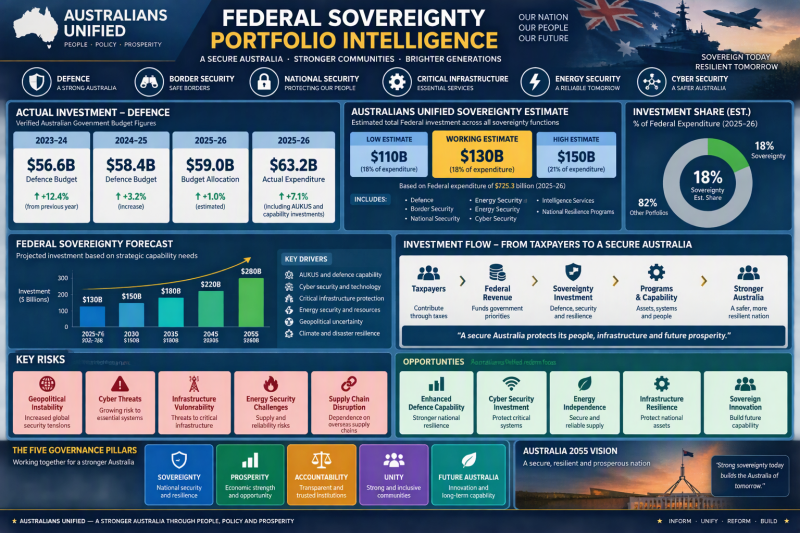
Defence expenditure benchmarks
2023–24 Defence Budget: $56.6 billion (verified federal defence funding)
2024–25 Defence Budget: $58.4 billion (verified federal defence funding)
2025–26 Budget Allocation: $59.0 billion baseline projection
2025–26 Actual Expenditure: $63.2 billion actual spending including vital strategic capability investments.
Sovereignty investment estimates
Australians Unified multi-tier national sovereignty funding analysis:
• Low estimate: $110 billion
• Working estimate: $130 billion
• High estimate: $150 billion
Encompasses whole-of-nation funding across defence, border security, critical infrastructure, energy resilience, national intelligence, and advanced cyber operations.
Investment flow and 2055 timeline
Federal capital flow: Taxpayers → Federal Revenue → National Security → Defence → Border Protection → Critical Infrastructure → National Resilience → Australia 2055.
Strategic growth forecast:
• 2030: $150 billion
• 2035: $180 billion
• 2045: $220 billion
• 2055: $280 billion sovereign capability base.
Threat mitigation and governance pillars
Monitored security risks: Cyber threats, critical infrastructure vulnerability, energy supply disruption, and geopolitical shifts.
Active resilience measures: Advanced defence capability, border protection, grid hardening, and industrial supply integrity.
The five governance pillars: Sovereignty, prosperity, accountability, unity, and future Australian capability.
State Government Responsibilities
State & Territory Role
State and Territory Governments play a critical role in supporting sovereignty through emergency management, critical infrastructure, resource management, energy resilience, public safety and strategic state development.
While national sovereignty is primarily managed at the Federal level, States contribute significantly by building resilience, preparedness and capability across their jurisdictions.
Strong States help create a stronger and more resilient Australia.

Emergency Management & Disaster Resilience
State Governments coordinate planning, response, and recovery efforts for major emergencies and natural disasters.
Their responsibilities may include:
- Emergency management coordination
- Bushfire preparedness
- Flood management
- Disaster recovery programs
- State emergency response frameworks
- Community resilience initiatives
These systems help protect communities and support long-term recovery.
State Emergency Services
Support emergency preparedness, response and recovery.
Fire & Rescue Services
Protect communities from fire, natural hazards and emergencies.

Critical Infrastructure
States are responsible for significant infrastructure networks that support economic activity and community wellbeing.
Responsibilities may include:
- Roads and highways
- Rail networks
- Public transport systems
- Water infrastructure
- Energy infrastructure
- Essential services planning
Reliable infrastructure strengthens resilience and supports prosperity.
Police Services
Maintain public safety, law enforcement and community security.
Infrastructure Authorities
Plan and manage major infrastructure systems essential to economic and community resilience.

Energy Security
States help manage and develop energy systems that support households, businesses and communities.
This may include:
- Energy policy implementation
- Electricity distribution networks
- Renewable energy development
- Grid reliability planning
- Energy market participation
Secure and reliable energy systems contribute to Australia's long-term capability.
Resource & Energy Agencies
Oversee resource development, energy systems, and long-term sustainability planning.

Resource Management
States manage many natural resources located within their jurisdictions.
Responsibilities may include:
- Minerals and resources
- Water management
- Forestry
- Land management
- Resource development approvals
- Environmental oversight
Responsible resource stewardship supports both present and future generations.
Public Safety & Emergency Services
States maintain systems that help protect communities and support public confidence.
These responsibilities may include:
- Police services
- Fire services
- Ambulance services
- Emergency communications
- Public safety coordination
Safe and resilient communities strengthen national capability.


Strategic State Development
States help plan for future growth and long-term resilience.
This may include:
- Population planning
- Regional development
- Economic resilience strategies
- Strategic infrastructure planning
- Future industry development
Long-term planning helps ensure communities remain strong and adaptable.
Community Outcomes
Effective sovereignty initiatives help support:
- Community Safety
- Emergency Preparedness
- Infrastructure Reliability
- Energy Security
- Resource Stewardship
- Regional Resilience
- Economic Stability
- Long-Term Sustainability
State sovereignty is about building capable, resilient and prepared communities that contribute to Australia's overall security, prosperity and future readiness.
Victoria State Government intelligence and expenditure report, tracking verified investments, resilience capability, and future sovereignty funding models.
Actual investment (verified)
2024–25 Emergency services investment: $206 million dedicated to personnel, frontline equipment, and critical operational infrastructure.
2025–26 Community safety package: $1.6 billion allocated to Victoria Police, justice system integrity, and community safety reforms.
2025–26 Justice & emergency funding: $2+ billion in expanded baseline funding across public safety capabilities.
Sovereignty focus areas: Police, Emergency Services, Public Safety, Disaster Recovery, and Infrastructure Resilience.
Australians Unified state estimates
2023–24: Low $12B | Mid $15B | High $18B
2024–25: Low $15B | Mid $18B | High $22B
2025–26: Low $17B | Mid $20B | High $25B
Analytical note: Modelled by Australians Unified. Encompasses Victoria Police, Emergency Management Victoria, CFA, SES, disaster recovery programs, and critical infrastructure hardening.
Current state sovereignty position
Working analytical estimate: $20 billion annually committed to state sovereign readiness.
Share of state expenditure: Estimated at 14% of overall Victorian state spending.
Core strategic pillars: Community protection, disaster preparedness, and critical infrastructure resilience.
Investment flow and forecast horizon
Investment flow pathway: Victorian Taxpayers → State Budget → Police & Emergency Services → Public Safety → Infrastructure Resilience → Community Protection → Victoria 2055.
Capability projections:
• 2030: $24 billion — Emergency capability and fleet expansion.
• 2035: $28 billion — Critical infrastructure and grid resilience growth.
While local governments do not manage national defence, border protection or foreign affairs, they contribute directly to sovereignty by anchoring community resilience, emergency preparedness, local infrastructure, environmental stewardship and long-term viability. At the municipal level, sovereignty is lived through strong, capable and self-reliant communities that support themselves, respond dynamically to challenges and contribute to Australia's broader capability.
Councils underpin everyday life by managing critical local infrastructure—including local roads, bridges, drainage networks, community facilities and public spaces. Maintaining and safeguarding these foundational assets preserves local capability, supports domestic economic activity and keeps regions functioning smoothly during times of crisis.
Local preparedness directly shapes national security. Through municipal emergency management plans, risk awareness programs, community education, recovery frameworks and climate adaptation, local councils empower citizens to withstand unexpected shocks and major natural disasters. Concurrently, environmental stewardship—such as biodiversity protection, land conservation and coastal management—safeguards natural resources for future generations.
Local sovereignty is not about international diplomacy or military command. It is about building reliable, connected and sustainable communities that underpin national stability, ensuring our towns and regions remain secure, resilient and strong.
While municipal councils do not handle foreign diplomacy or national defence, they form the bedrock of Australian self-reliance. Through robust infrastructure, disaster readiness, environmental care, and sustainable regional development, local governance protects our collective sovereignty every day.
Emergency management and community resilience
Councils help communities prepare for emergencies and natural disasters through municipal emergency planning, community preparedness programs, disaster recovery support, resilience initiatives, and grassroots emergency coordination. Strong local resilience directly underpins Australia's broader national resilience.
Municipal Emergency Management Plans
Local plans designed to prepare communities for emergencies and recovery.
Community Resilience Programs
Initiatives that improve preparedness, awareness and local capability.
Local infrastructure protection
Local governments manage foundational community assets including roads, bridges, drainage systems, community facilities, and public spaces. Consistent local asset management safeguards essential daily operations, keeps commerce flowing, and bolsters community preparedness during crises.
Infrastructure Maintenance Programs
Projects that maintain and improve essential community assets.
Environmental stewardship
Protecting natural heritage and ecological assets is vital for long-term viability. Through land management, biodiversity protection, waterway upkeep, coastal management, and targeted conservation initiatives, councils ensure our natural resources remain resilient for future generations.
Environmental Management Strategies
Programs that support sustainable management of local resources and natural environments.
Regional and local sustainability
Long-term independence requires stable local economies and thoughtful growth. By implementing strategic planning, local development strategies, community infrastructure roadmaps, climate adaptation, and prudent resource management, local councils build self-sufficient and enduring communities.
Community Recovery Planning
Frameworks that help communities recover and adapt following significant events.
Community Outcomes
Effective local sovereignty initiatives help support:
- Community Resilience
- Emergency Preparedness
- Infrastructure Reliability
- Environmental Sustainability
- Local Capability
- Community Safety
- Long-Term Stability
- Regional Strength
Local sovereignty is not about national defence or foreign policy. It is about building strong, resilient and self-reliant communities that contribute to Australia's overall security, sustainability and future capability.
Victorian local government average
Australians Unified estimates Victorian councils invest approximately $680 million to $1.09 billion annually in sovereignty-related activities, with a working estimate of $950 million supporting emergency preparedness, community resilience, disaster recovery, and local infrastructure protection across all 79 Victorian councils.

Victorian local government average
A comprehensive governance intelligence briefing by Australians Unified, tracking municipal emergency management, disaster recovery funding, resilience benchmarks, and local sovereignty investments across Victoria's 79 councils.
Actual investment (verified)
Municipal Emergency Resourcing Program: $4.89 million in annual Victorian Government funding supporting council emergency management responsibilities.
Emergency recovery support: $10 million in additional assistance following major storm and disaster events.
Victorian councils: 79 councils delivering local resilience and frontline emergency functions.
Total council expenditure: $13.6 billion invested annually across Victorian local government operations.
AU local sovereignty estimate
Australians Unified analytical multi-tier funding estimate:
• Low estimate: $680 million (5% of council expenditure)
• Working estimate: $950 million (7% of council expenditure)
• High estimate: $1.09 billion (8% of council expenditure)
Scope includes: Emergency preparedness, community resilience, asset protection, environmental management, recovery planning, disaster preparedness, public safety support, and infrastructure protection.
Current local sovereignty position
Working AU estimate: $950 million dedicated annual investment.
Estimated expenditure share: 7% of overall Victorian council operating budgets.
Primary focus pillars: Preparedness, community resilience, and critical infrastructure protection across all municipalities.
Investment flow and forecast horizon
Local capital flow: Ratepayers → Council Revenue → Emergency Planning → Community Resilience → Asset Protection → Disaster Recovery → Community Safety → Victoria 2055.
Capability forecast:
• 2030: $1.1 billion — Community resilience growth.
• 2035: $1.3 billion — Infrastructure protection expansion.
Local Sovereignty Key Takeaway
Australians Unified estimates Victorian councils invest approximately $950 million annually in sovereignty-related functions, representing around 7% of total council expenditure. This investment helps build community resilience, emergency preparedness, disaster recovery capability, and infrastructure protection across Victoria's 79 councils.
⚡ Critical Infrastructure
Portfolio Purpose
Protecting essential infrastructure networks that support Australia's economy, security and communities.
Related Reform Areas
Community Outcomes
✅ Reliable Services
✅ Infrastructure Security
✅ Economic Stability
✅ National Resilience
Explore Critical Infrastructure →
Australians Unified Perspective
Australians Unified believes sovereignty provides the foundation for a secure, resilient, and independent Australia. By strengthening national security, supporting veterans, protecting essential infrastructure, and improving emergency preparedness, Sovereignty portfolios help safeguard Australia's future and support stronger outcomes for communities across the nation.
Protect Australia. Strengthen Resilience. Secure Our Future.