Business Operations Centre Prosperity
The Business Operations Portfolio is Australia's operational engine room. We unite previously fragmented public services into one streamlined, AI-enabled operational system designed to be leaner, faster, and completely transparent for every Australian community.

Critical transport and freight logistics
We coordinate national logistics frameworks across road, maritime, rail, and aviation sectors. By integrating postal dispatch, supply corridor integrity, and real-time transit intelligence, our operational hub guarantees that essential goods, regional produce, and critical supplies reach Australian communities with absolute reliability.

Digital infrastructure and emergency communications
Overseeing national high-speed broadband resilience and emergency broadcast networks, the portfolio safeguards communication continuity. Through advanced national data systems and intelligent telemetry, we connect remote localities with central services, keeping every citizen informed and secure during national contingencies.

Regional enterprise, culture, and compliance
Beyond physical infrastructure, our operational mandate manages sport integrity, screen arts enablement, safety compliance enforcement, and regional development initiatives. We deliver a lean regulatory framework that supports domestic industries, protects Australian integrity, and unites communities under a shared national vision.
Business Operations Centre overview
The engine room that turns strategy into measurable results. The Business Operations Centre (BOC) is the operational nerve centre of the Future Australia Prosperity Portfolio. Its vision is to create Australia’s most efficient, accountable and productive government and economic delivery system through one unified framework for projects, programs, departments, businesses and communities. Its mission is to deliver every Future Australia initiative on time, within budget and against measurable outcomes aligned with Australia 2030, Australia 2037 and Australia 2050.
Positioned alongside the Treasury, Industry & Manufacturing, Housing, Employment, Skills, Infrastructure and Small Business departments, the BOC coordinates portfolio performance, project delivery, productivity improvement, business support, investment tracking and national prosperity reporting.

Strategic operations
Coordinate portfolio monitoring, program delivery, project oversight and resource allocation across Prosperity Portfolio departments. This addresses duplicated programs and fragmented reporting, creating aligned government delivery with clear milestones and shared priorities.

Performance and investment
Use KPI monitoring, productivity reports, department scorecards, benchmarking, funding oversight, return-on-investment analysis, cost-benefit monitoring and economic impact reporting to make performance and public-fund use measurable and consistent.

Risk, assurance and cost control
Identify delivery risks, conduct independent reviews and manage escalations while monitoring cost overruns, scope changes and procurement performance. A consistent assurance framework helps reduce project blowouts, failures and delays across departments.

Digital delivery and productivity
Build real-time dashboards, AI analytics, digital reporting and performance forecasting through a National Operations Dashboard, Prosperity Delivery Office, National Productivity Command Centre and Business Intelligence & Analytics Hub—improving transparency, decisions and prosperity outcomes.
Consolidated review of prosperity portfolio functions and projects
Current government functions and ongoing projects
Australia's prosperity apparatus is currently managed through fragmented portfolios across Treasury, industry, workforce, infrastructure, and resources:
- Treasury and economic strategy: Oversees revenue collection, budget forecasts, superannuation oversight, digital tax compliance, and revenue protection.
- Industry, manufacturing and sovereignty: Governs manufacturing grants, industry capability programs, business innovation, and supply chain projects.
- Employment, workforce and skills: Directs job services, workforce planning, TAFE, apprenticeships, traineeships, and industry training partnerships.
- Science, tech and digital economy: Delivers research grants, AI initiatives, digital transformation, cyber resilience, and regional connectivity.
- Infrastructure, housing and resources: Administers freight rail, national roads, social housing funding, critical minerals strategies, and energy grid transitions.
- Agriculture, trade and tourism: Manages biosecurity, farm productivity, water security, trade agreements, export promotion, and destination marketing.
Investment, regional development and coordination
Australia’s prosperity agenda also depends on attracting productive investment and ensuring its benefits reach metropolitan, regional and remote communities. This includes coordinating foreign investment settings, major project approvals, regional growth funds, place-based economic development, and partnerships with states, territories, local government and First Nations communities. Stronger coordination across these functions can help align capital, infrastructure, skills and industry policy around long-term national priorities, while improving delivery for communities and businesses.
Future Australia projects and the Business Operations Centre
Australians Unified unifies these distributed portfolios into a single, high-accountability operating system orchestrated by the Business Operations Centre:
- Master statutory authorities: Establishing dedicated authorities including the National Manufacturing Authority, Housing Delivery Authority, Skills Forecasting Authority, Australia Investment Authority, Food Security Authority, and Digital Economy Authority.
- Live performance dashboards: Implementing interconnected dashboards for real-time visibility over prosperity, cost of living, jobs, housing, infrastructure, trade, and government productivity.
- Economic and tax reforms: Launching tax simplification, family income splitting, tax-free threshold revisions, and profit shifting prevention frameworks.
- Strategic national corridors: Developing productivity corridors, strategic development zones, sovereign capability programs, and domestic resource value-adding initiatives.
- Operational governance: Delivering early warning systems for cost blowouts, project accountability registries, and target tracking for Australia 2030, 2037, and 2050.
Community partnership and regional delivery: Future Australia projects will be shaped and delivered with local communities, councils, industry, and First Nations partners to ensure national priorities translate into practical regional outcomes. The Business Operations Centre will coordinate transparent consultation, monitor delivery milestones, and connect investment decisions to the needs of growing cities, regional centres, and remote communities—supporting jobs, essential services, resilient infrastructure, and long-term local prosperity.
Prosperity, industry, employment and skills
Four connected departments within the Business Operations Centre Portfolio coordinate Australia’s economic management, sovereign industrial capability, workforce participation and practical skills pathways. Each combines current programs with Future Australia projects designed to make national progress visible, accountable and achievable.

Treasury and economic strategy
Responsible for: economic management, budget strategy, fiscal policy, tax policy and national accounts.
Agencies: Australian Treasury, Australian Taxation Office (ATO), Australian Bureau of Statistics (ABS), Productivity Commission, Australian Prudential Regulation Authority (APRA) and Australian Securities & Investments Commission (ASIC).
Current projects: Federal Budget, Intergenerational Report, Competition Reform, National Housing Accord funding and tax compliance programs.
Future Australia: National Prosperity Dashboard, Tax Simplification Framework, Cost of Living Authority, Family Tax Reform Framework and Australia 2037 Prosperity Framework.

Industry, manufacturing and sovereignty
Department: Industry, Manufacturing & Sovereignty.
Agencies and programs: Department of Industry, Industry Growth Program, CSIRO Industry Partnerships and Defence Industry Development Office.
Current projects: National Reconstruction Fund, Modern Manufacturing Initiative, Critical Technologies Programs and Defence Industry Development Grants.
Future Australia: Australian Manufacturing Authority, Sovereign Capability Framework, National Industrial Precinct Network, Supply Chain Resilience Authority and Australian Made Procurement Framework.

Employment and workforce participation
Department: Employment & Workforce Participation.
Agencies: Workforce Australia, Jobs and Skills Australia, Fair Work Commission and Fair Work Ombudsman.
Current projects: Workforce Australia Services, employment services programs, Disability Employment Services and regional jobs programs.
Future Australia: Jobs Accelerator Program, National Workforce Mobility Network, Workforce Participation Dashboard, Regional Employment Corridors and Mature Age Workforce Initiative.

Skills, training and apprenticeships
Department: Skills, Training & Apprenticeships.
Agencies: TAFE Network, Jobs and Skills Australia and Australian Skills Quality Authority.
Current projects: Free TAFE, Australian Apprenticeships, vocational education programs and skills agreements.
Future Australia: National Skills Forecasting Authority, Trades Australia Pathway, School-to-Trade Framework, Apprenticeship Completion Incentives and Australia 2037 Skills Dashboard.
Science, digital economy, investment and trade
Four connected Business Operations Centre departments strengthen Australia’s innovation capability, digital productivity, investment attraction and export growth. Each combines current agencies and programs with Future Australia projects that make delivery, outcomes and national competitiveness visible.

Science, technology and innovation
Department: Science, Technology & Innovation. Agencies: CSIRO, Australian Research Council and Cooperative Research Centres. Current work: research infrastructure programs, innovation grants, CRC programs and AI research initiatives. Future Australia: Innovation Authority, AI Commercialisation Network, National Innovation Dashboard, Research-to-Industry Pipeline and Intellectual Property Retention Strategy.

Digital economy
Department: Digital Economy. Agencies: Digital Transformation Agency, National AI Centre and Australian Cyber Security Centre. Current work: myGov modernisation, digital identity, cyber security strategy and digital business programs. Future Australia: Digital Economy Authority, National AI Readiness Framework, SME Technology Upgrade Program, National Digital Skills Network and Digital Productivity Dashboard.

Investment and economic development
Department: Investment & Economic Development. Agencies: Austrade, Infrastructure Australia and Major Projects Facilitation Offices. Current work: investment attraction, regional development and economic precinct development programs. Future Australia: Australian Investment Authority, Strategic Development Zones, Prosperity Investment Fund, Regional Investment Corridors and Investment Performance Dashboard.

International trade and exports
Department: International Trade & Export. Agencies: Austrade and Export Finance Australia. Current work: free trade agreements, Export Market Development Grants and trade missions. Future Australia: Export Growth Authority, Trade Expansion Framework, Strategic Market Diversification Program and Global Competitiveness Dashboard.
Resources, food, housing and enterprise
Four connected Business Operations Centre departments coordinate vital productive capacity across Australia: secure resources and energy, resilient food systems, housing supply and small-business growth. Each brings current agencies and projects together with Future Australia initiatives designed for transparent, measurable delivery.

Resources, energy and mining
Department: Resources, Energy & Mining. Agencies: Geoscience Australia and the Australian Renewable Energy Agency (ARENA). Current projects: Critical Minerals Strategy, resources development projects and energy security programs. Future Australia: Critical Minerals Processing Authority, Resource Sovereignty Framework, Energy Security Dashboard and Strategic Resource Corridors.

Agriculture and food security
Department: Agriculture & Food Security. Agencies: Department of Agriculture, ABARES and Food Standards Australia New Zealand. Current projects: biosecurity programs, drought support and agricultural export programs. Future Australia: National Food Security Authority, Agricultural Innovation Network, Water Security Framework, Farm Productivity Dashboard and Export Agriculture Strategy.

Housing supply and construction
Department: Housing Supply & Construction. Agencies: Housing Australia, the National Housing Finance and Investment Corporation, and state housing authorities. Current projects: Housing Australia Future Fund, National Housing Accord and social housing programs. Future Australia: Housing Delivery Authority, Fast Track Approvals Framework, Construction Capacity Program, Workforce Housing Strategy and Housing Dashboard.

Small business and enterprise
Department: Small Business & Enterprise. Agency: Australian Small Business and Family Enterprise Ombudsman. Current projects: small-business grants, business recovery programs and startup support initiatives. Future Australia: Small Business Growth Authority, Startup Accelerator Network, SME Productivity Framework and Business Investment Network.
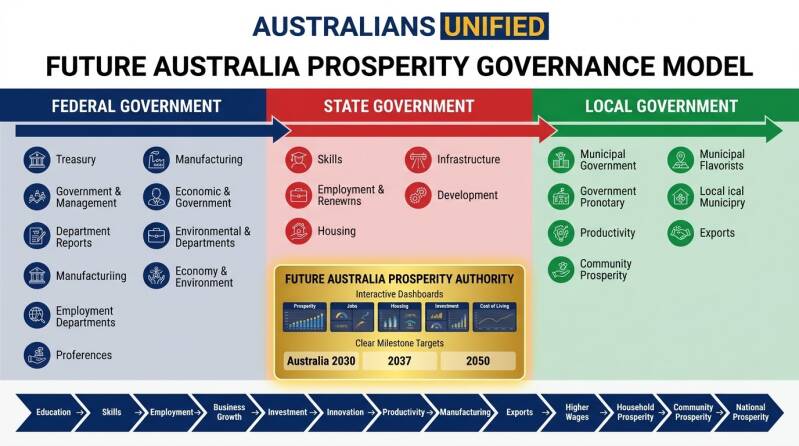
Prosperity delivery across Australia’s three levels of government
Australians Unified maps how federal, state and local governments can work together across treasury, industry, jobs, skills, housing, infrastructure, digital capability, agriculture, small business and tourism. The Business Operations Centre (BOC) connects these responsibilities through transparent reporting, coordinated investment and measurable prosperity outcomes.

Federal strategy and national capability
National leadership, policy and system-wide coordination. Treasury, the ATO, Productivity Commission, ABS, APRA and ASIC guide the national Budget, taxation, economic forecasting, superannuation, inflation and fiscal policy, supported by a National Prosperity Dashboard.
Federal responsibilities also include manufacturing strategy, national industry and defence-industry policy, sovereign capability, trade protection and the National Reconstruction Framework; Workforce Australia, migration alignment, jobs forecasting and industrial relations; skills agreements, national qualifications and apprenticeship incentives; Housing Australia, the Housing Accord, funding and tax settings; national infrastructure pipelines, freight and transport corridors; cyber security, telecommunications, AI regulation, digital identity and digital strategy; export markets, biosecurity, food security and trade negotiations; national business, competition and small-business policy; and Tourism Australia, international promotion and aviation policy.
The National Prosperity Command Centre reports national performance, coordinates portfolios and tracks Australia 2030, Australia 2037 and Australia 2050, including the National Prosperity Dashboard.
State delivery and investment
State Treasury and Finance departments turn national settings into place-based delivery. Their responsibilities include state Budgets, payroll tax, economic development funding, infrastructure financing and state productivity programs.
States establish industrial precincts and manufacturing hubs, administer industry grants, attract workers and strengthen supply chains; deliver workforce programs, regional employment initiatives, industry-aligned planning and public-sector workforce delivery; operate TAFE, vocational training, apprenticeship support and skills investment; manage planning systems, housing delivery, social housing, construction workforce and land supply; and deliver roads, rail, ports, utilities and major projects.
State roles also cover digital government services, cyber capability, innovation programs and smart-city support; agricultural development, water management, rural support and industry productivity; business grants, investment attraction, regulatory reform and industry development; plus destination development, state tourism bodies, major-event attraction and visitor infrastructure.
The State Prosperity Operations Centre provides delivery oversight, infrastructure, housing and employment monitoring, and state scorecards.

Local action and community prosperity
Local Prosperity Boards connect strategy with businesses, workers and neighbourhoods. They lead economic development planning, investment attraction, business precinct development and community prosperity reporting.
Local delivery supports industrial land and business parks, supplier networks and manufacturing workforce pathways; employer engagement, local jobs networks, community workforce support and skills matching; school-to-trade pathways, apprentice placements, industry partnerships and community training centres; development approvals, local infrastructure, community housing projects and growth-area planning; and local roads, facilities, recreation assets and maintenance.
Councils and local partners also advance digital inclusion, connectivity, business digital adoption and technology hubs; farming initiatives, regional food production, agricultural workforce support and community food programs; main-street activation, business networking, start-up support and local procurement; and community events, visitor experiences, attractions and visitor engagement.
The Community Prosperity Operations Centre tracks local jobs, small-business performance, housing delivery, community investment and local prosperity scorecards.
Operating model architecture: tourism, delivery assurance, and performance
Tourism and visitor economy
Led at policy level by the Department of Tourism and Visitor Economy and delivered in partnership with agencies such as Tourism Australia, current national campaigns, event attraction programs, and regional tourism frameworks are revitalised under the Future Australia model. Key initiatives include:
- Visitor economy dashboard: real-time monitoring of domestic and international traveler flows, spend metrics, and regional dispersal.
- Tourism infrastructure fund: targeted co-investment in regional gateways, visitor precincts, and national parks.
- Regional destination network: direct delivery alignment between local councils and national operators.
- Australia 2037 tourism strategy: long-term blueprint for high-yield, sustainable tourism capacity.
Business Operations Centre (Future Australia)
Consolidating delivery functions from PM&C, Treasury reporting, state PMOs, and infrastructure delivery offices, the Business Operations Centre directly overcomes siloed reporting, delayed accountability, and costly program duplication:
- National prosperity & productivity dashboards: live performance registries delivering immediate operational visibility across portfolios.
- Cost blowout early warning system: automated triggers to safeguard public funds before delays impact delivery.
- National Delivery Assurance Office: independent continuous oversight replacing retrospective annual reports.
- Australia 2030 reporting & 2037 Outcomes Authority: accountable statutory oversight securing Australia's long-term sovereign prosperity.
From annual reporting to live public outcomes
The Future Australia Business Operations Centre modernises how national priorities move from policy to delivery. It replaces fragmented, retrospective reporting with a connected operating model that tracks performance, risk, investment and outcomes in real time—supporting Australia 2037.

Current Australia model
Project → Department → Delivery → Annual report
The current model follows a linear path, with results commonly assessed after delivery through annual reporting. This can make it harder to see issues, progress and public value as they emerge.
Continuous feedback and learning
Introducing regular feedback loops throughout delivery would give teams, departments and stakeholders a clearer view of performance in real time. Shared measures, timely data and structured check-ins can help identify risks earlier, support informed adjustments and demonstrate public value before the end of the reporting cycle.

Future Australia model
Policy → Project → Operations Centre → Live dashboard → Performance monitoring → Outcome measurement → Public reporting
The future model connects policy to delivery through a Business Operations Centre, making progress visible, measurable and accountable throughout the life of each initiative.
Continuous improvement and early intervention — By bringing delivery data, operational insights and stakeholder feedback into one coordinated view, the Operations Centre can identify emerging risks, unblock dependencies and redirect resources before issues affect outcomes. This creates a disciplined cycle of learning that strengthens future policy, improves project delivery and ensures public investment continues to deliver meaningful value.

Business Operations Centre divisions
Performance & Reporting: department KPIs, service delivery and productivity indicators.
Financial Performance: budget delivery, cost control and investment returns.
Project Delivery: milestones, schedules and strategic program delivery.
Risk & Governance: risks, audit findings and assurance reviews.
Digital Intelligence: AI insights, forecasting and productivity analytics.
People & Capability: workforce capacity, skills development, employee engagement and succession planning to support sustainable organisational performance.
Current vs Future Australia costing
A comparison of the current operating model with the proposed Future Australia Business Operations Centre, including the investment required to 2037, projected benefits and the dashboards that make performance visible.
Current and future costs
Annual operating model comparison
$2.8B → $4.9B
Current model → Future Australia
Operational reporting: $0.8B → $0.8B
Project coordination: $1.2B → $1.4B
Dashboard systems: $0.2B → $0.8B
AI analytics: $0.1B → $0.6B
Performance management: $0.3B → $0.8B
Risk & assurance: $0.2B → $0.5B
Additional Australian investment: $2.1 billion to 2037.
Benefits to 2037
Projected public value from better delivery
$29B–$73B total benefits
Benefit-to-cost ratio: 14:1–35:1
Reduced cost blowouts: $8B–$20B
Increased productivity: $10B–$25B
Faster project delivery: $5B–$12B
Reduced duplication: $2B–$6B
Better investment returns: $4B–$10B
The model is designed to turn coordinated reporting, earlier intervention and clearer accountability into measurable national value.
Key public dashboards
Live performance, delivery and forecasting
10 connected dashboards
National reporting at a glance
Prosperity Dashboard
Economic Performance Dashboard
Jobs Dashboard
Housing Dashboard
Infrastructure Dashboard
Manufacturing Dashboard
Cost of Living Dashboard
Australia 2030 Dashboard
Australia 2037 Dashboard
Australia 2050 Forecasting Dashboard
The Business Operations Centre serves as the operational command centre of the Future Australia Prosperity Portfolio, coordinating performance, projects, investments, productivity, risk management and accountability through real-time dashboards, measurable outcomes and Australia 2030, 2037 and 2050 prosperity targets.
Frequently asked questions
Everything you need to know about how the Business Operations Centre streamlines public service delivery, eliminates project blowouts, and ensures transparency across Australia's prosperity initiatives.