Treasury portfolio current position and operating model
Treasury portfolio core functions
The Treasury Portfolio drives the core economic machinery and sovereign financial architecture of Australia. It delivers across ten critical functions:
Economic policy: Develops national economic policy, fiscal strategy, and productivity reform to support sustainable growth and long-term prosperity.
Taxation: Designs and administers taxation frameworks that fund essential government services and stimulate economic activity.
Financial regulation: Maintains systemic stability and public confidence in Australia's financial system through proactive regulation, governance, and market oversight.
Public finance: Manages federal budgeting, expenditure discipline, debt issuance, financial reporting, and intergenerational fiscal sustainability.
Investment management: Oversees public capital, sovereign funds, and strategic long-term investment systems protecting Australia's financial future.
Government business systems: Modernises finance, procurement, reporting, and operational infrastructure across federal agencies.
Digital government: Champions public-sector automation, digital transformation, and AI-enabled government service delivery.
Capital markets oversight: Ensures liquid, resilient, and transparent financial markets that attract capital and underpin national development.
Sovereign wealth management: Safeguards and grows sovereign wealth through long-term asset management and intergenerational planning.
Productivity reform: Streamlines government processes, reduces administrative burdens, and expands nationwide competitiveness.
Treasury portfolio operating model
Our integrated operating model links policy directly to long-term national outcomes in an unbroken chain of accountability:
Economic Policy → Taxation → Financial Regulation → Public Finance → Investment Management → Digital Government → Government Business Systems → Productivity Reform → Community Prosperity → Australia 2055

Treasury portfolio priorities
Australians Unified delivers targeted economic reform across Treasury to restore national resilience and drive long-term prosperity. Our portfolio focus centers on driving strong economic growth, guaranteeing sovereign financial sustainability, lifting multi-factor productivity, and cutting government operational waste. By establishing sovereign investment capabilities, expediting digital transformation across fiscal operations, and ensuring community wealth generation, we pave a clear trajectory toward Australia 2055.
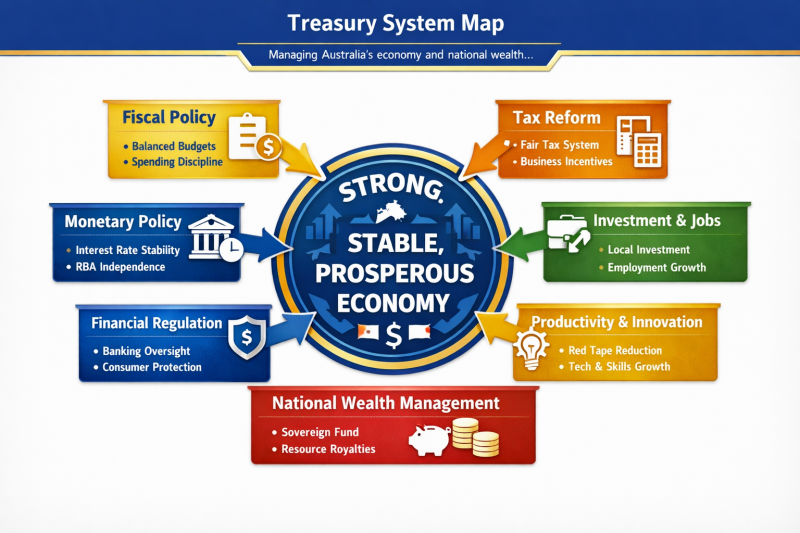

TREASURY — Economic Rules & Market Conditions
The Problem
-
Tax settings are complex and uncompetitive.
-
Competition policy is weak; major sectors are dominated by a few players.
-
Foreign investment rules lack strategic clarity.
-
Economic forecasting is reactive, not strategic.
Australians Unified Reform
-
Simplify business tax and reduce compliance burden.
-
Strengthen competition laws to break up market concentration.
-
Strategic foreign investment rules protecting national interests.
-
Long‑term economic modelling tied to sovereign capability and productivity.

-
INDUSTRY, SCIENCE & RESOURCES — National Capability & Growth
The Problem
-
Australia exports raw materials instead of value‑added products.
-
Manufacturing base hollowed out.
-
Innovation funding unstable and bureaucratic.
-
Critical minerals strategy underdeveloped.
Australians Unified Reform
-
Build sovereign processing and manufacturing capacity.
-
National industrial strategy focused on energy, defence, agriculture, and tech.
-
Stable innovation funding with commercialisation pathways.
-
Critical minerals kept onshore for value‑added production.
-

EMPLOYMENT & WORKPLACE RELATIONS — Workforce & Skills
The Problem
-
Fair Work system too complex for small business.
-
Skills shortages across construction, agriculture, mining, and tech.
-
Training system fragmented and outdated.
-
Skilled visa system slow and unpredictable.
Australians Unified Reform
-
Simplify workplace laws while protecting workers.
-
National skills pipeline aligned with industry needs.
-
Modernise TAFE and apprenticeships for emerging industries.
-
Fast, targeted skilled visa pathways for critical sectors.

INFRASTRUCTURE, TRANSPORT & REGIONAL DEVELOPMENT — National Backbone
The Problem
-
Major projects plagued by cost blowouts and delays.
-
Freight networks outdated and inefficient.
-
Regional infrastructure decades behind demand.
-
Digital connectivity gaps hurting rural business.
Australians Unified Reform
-
Independent, transparent project selection.
-
National freight corridors linking ports, rail, and regions.
-
Rebuild regional roads, bridges, and rail.
-
Universal high‑speed digital connectivity.
THE CORE SYSTEM FAILURE
Australia’s business environment is fragmented across seven departments
causing:
-
Slow approvals
-
Conflicting regulations
-
High compliance costs
-
Weak accountability
-
Poor coordination
-
Lost investment
-
Reduced competitiveness
This fragmentation is a national economic risk.
THE AUSTRALIANS UNIFIED SOLUTION
A National Business & Industry Framework that:
-
Aligns all seven departments under shared goals
-
Sets national standards for approvals, regulation, and coordination
-
Reduces duplication and red tape
-
Strengthens sovereign capability
-
Supports regional development
-
Drives productivity and competitiveness
One system. One strategy. One accountable government.

AGRICULTURE, FISHERIES & FORESTRY — Food Security & Regional Economy
The Problem
-
Biosecurity threats increasing.
-
Water insecurity and over‑extraction.
-
Farmers squeezed by supermarket and processor dominance.
-
Labour shortages and high input costs.
Australians Unified Reform
-
Modern biosecurity with real‑time surveillance.
-
Water reform protecting long‑term food production.
-
Fairer markets through competition reform.
-
Agricultural workforce strategy + regional infrastructure upgrades.

HOME AFFAIRS — Workforce Access, Trade & Security
The Problem
-
Skilled visa system slow and unpredictable.
-
Cybersecurity threats rising faster than capability.
-
Border and trade compliance inconsistent.
-
Supply chain vulnerabilities exposed by global shocks.
Australians Unified Reform
-
Fast, targeted skilled migration for critical industries.
-
National cybersecurity uplift for business and government.
-
Streamlined trade compliance to reduce delays and costs.
-
National supply chain resilience strategy.

AUSTRALIAN TAXATION OFFICE — Financial Reality of Business
The Problem
-
High compliance burden for small and medium businesses.
-
Complex GST and reporting requirements.
-
Slow dispute resolution.
-
Superannuation compliance burdensome for employers.
- Opposes profit shifting via fees, royalties, and charges that escape taxation.
Australians Unified Reform
-
Simplify GST and reporting for SMEs.
-
Faster, fairer dispute resolution.
-
Streamlined superannuation compliance.
-
Digital‑first business tax systems.
- Multinationals must pay their fair share of tax while operating in Australia
-
Close loopholes that allow multinationals to report low taxable income.
-
Align with sovereign capability and national revenue protection.
Business services budget and revenue framework
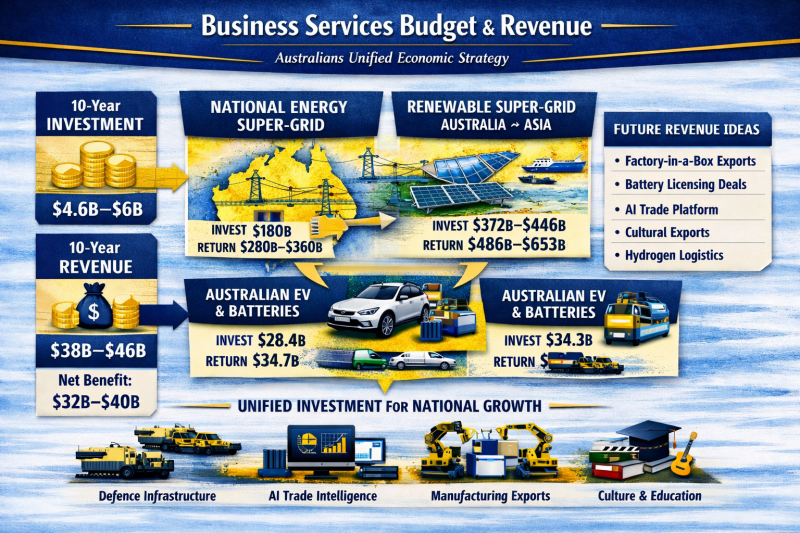
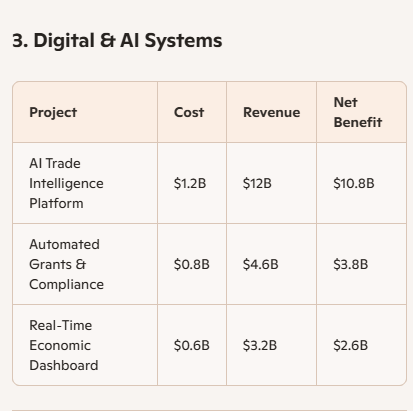
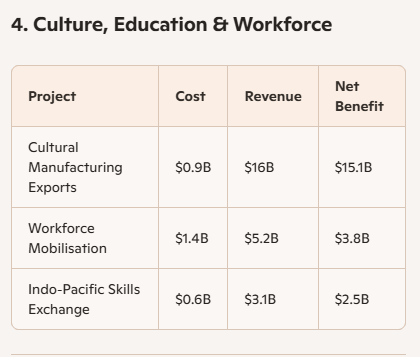
Operating across Australians Unified and the Foreign Affairs & Trade portfolio, the Business Services Department acts as a vital economic engine for national growth. By unifying trade approvals, automated grants, regulatory compliance, and AI-enabled export intelligence into an independent framework, we deliver transparent, real-time economic performance while expanding Australia's sovereign capability.
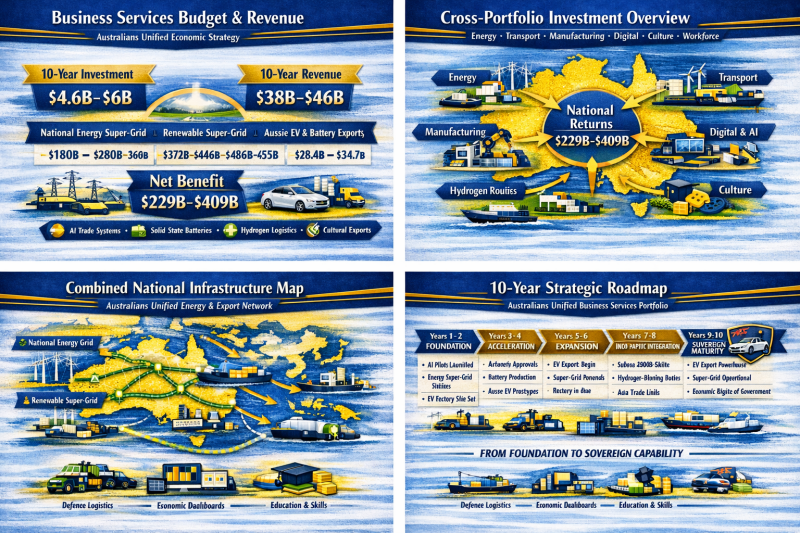
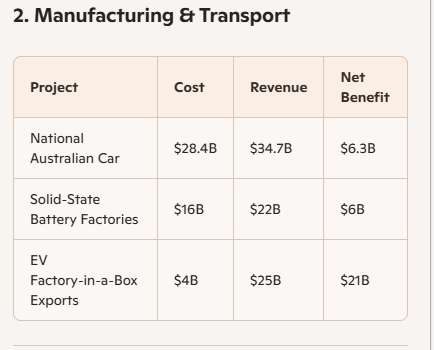
With a projected 10-year budget investment of $4.58B–$5.96B and revenue potential reaching $38B–$46B, the department targets a net national benefit of $32B–$40B. This financial engine underpins transformative national infrastructure, including the National Energy Super-Grid ($100B–$180B net benefit), the export-oriented Renewable Super-Grid to Asia ($114B–$207B net benefit), and domestic manufacturing for the National Australian Car and solid-state batteries ($6.3B net benefit)—driving faster approvals, lower costs of government, and coordinated workforce mobilisation.
Ten-year sovereign capability roadmap
Australians Unified outlines an ambitious decade of economic renewal to establish sovereign manufacturing and independent financial infrastructure across the nation.
Years 1–2 — Foundation
Merge Business Services functions into an integrated delivery unit.
Deploy AI pilots for trade facilitation and regulatory compliance.
Begin comprehensive National Energy Super-Grid planning.
Establish key EV factory sites across Geelong, Newcastle, Townsville, and Whyalla.
Years 3–4 — Acceleration
Launch automated grants and export approval pathways.
Commence domestic solid-state battery production.
Initiate prototype builds for the National Australian Car.
Begin hydrogen corridor construction and roll out real-time economic dashboards.
Years 5–6 — Expansion
Bring full EV assembly lines into commercial operation.
Commence vehicle exports across ASEAN, India, and the Pacific.
Commission Super-Grid Stage 1 and launch Factory-in-a-Box export models.
Inaugurate the national cultural manufacturing export program.
Years 7–8 — Indo-Pacific integration
Complete subsea cable links connecting directly to Singapore and Japan.
Open operational hydrogen shipping corridors.
Fully deploy the AI trade intelligence platform and scale the workforce mobilisation pipeline.
Years 9–10 — Sovereign maturity
Establish Australia as the pre-eminent Indo-Pacific EV and battery manufacturing hub.
Deliver the fully operational Super-Grid and achieve mass export volume for the National Australian Car.
Anchor Business Services as the primary economic engine of national government, generating a total net national benefit of $229B–$409B.
National capabilities cost and return on investment Ev cars and super grid systems




Sovereign infrastructure bank and financial security
Australians Unified champions decisive monetary reform to finance sovereign assets and protect household wealth. By introducing a national Infrastructure Bank managed by the Reserve Bank of Australia and Treasury, government infrastructure bonds will directly fund dams, baseload power, transmission lines, road, rail, ports, airports, and telecommunications without foreign debt. We also advocate restoring a universal public retail bank and government insurance office through existing post offices, alongside repatriating Australia's gold reserves from the Bank of England to guarantee national sovereignty.
Fair Credit for Productive Enterprise: We will establish transparent, low-cost credit pathways for Australian farmers, manufacturers, small businesses, and regional communities. By directing finance toward productive investment rather than speculative activity, Australia can strengthen domestic supply chains, create skilled jobs, improve food and energy security, and ensure the benefits of national development are shared by households in every state and territory.

Introduce an Infrastructure Bank
Government Infrastructure Bonds will be used to fund the Construction of Sovereign Assets through an Infrastructure Bank.
Introduce an Infrastructure Bank to be managed by the RBA in conjunction with Treasury. The Bank will issue bonds to either the federal or state government for seven infrastructure assets. These are dams, baseload power stations and transmission lines, road, rail, ports, airports, and telecommunications.
Monetary policy is not being used effectively in Australia. As a result, there is a chronic underinvestment in infrastructure. Infrastructure can drive productivity and provides essential services. Australia’s monetary policy solely relies on qualitative easing which is insufficient to deal with underlying economic structural issues. The RBA should also use quantitative easing in the form of infrastructure bonds to finance infrastructure that is vital to Australia’s economic and sovereign security. Unlike qualitative easing which predominantly impacts demand, the use of infrastructure bonds increases the supply of goods and services without having to use foreign debt.

.Restore a Public Retail Bank & Insurance Office
People First are calling for the reinstatement of a public bank, similar to the former Commonwealth Bank. A public bank would keep branches open so people can access essential banking services.
Over the past three decades, bank branches have rapidly declined, particularly in regional areas. This has harmed small towns, forcing businesses and residents to travel long distances for banking.
While some services are available online, not all can be done digitally and some regions lack internet access. Many constituents, especially retirees, are uncomfortable with online banking because of scam concerns. People First believes banking is an essential service and supports a government-run public bank to ensure universal access.
Banking services could be delivered through existing post offices using RBA payment systems.
The Australian Government sold the Commonwealth Bank for $8 billion in the 1990s; it now makes $10 billion annually. Meanwhile, banks are closing thousands of branches and charging fees to withdraw or deposit cash.
State Governments also sold their Insurance Offices in the 1990s, reducing competition and driving up insurance costs.
Australian's unified will advocate for a Public Bank and Government Insurance Office so Australians can access affordable financial services, which—like health and education—are essential.

Repatriate Australia’s Gold from the Bank of England
Australia’s gold needs to be secured in Australia.
The RBA has never been able to explain why it is necessary to store Australia’s gold with the Bank of England. There are serious concerns about the security of Australia’s gold given audit reports into Australia’s gold holdings are not fully disclosed. These concerns have been further exacerbated by the RBA releasing documents stating that the Bank of England has detected the presence of fake gold bars and duplicate serial numbers amongst their gold holdings. There are also genuine concerns about the leasing of Australia’s gold holdings, which acts against the interests of Australia’s gold producers who contribute tens of billions in exports and employ thousands of people.
Australian taxation reform
Australia's taxation architecture faces systemic inefficiencies, excessive compliance burdens, and uncompetitive structures. Australians Unified delivers principled Treasury and revenue modernisations designed to relieve household pressure, foster enterprise, and safeguard our economic sovereignty.
Fairness and Simplicity for Working Australians: Reform must make the system easier to understand, cheaper to comply with, and more equitable across households, small businesses, and regional communities. Australians Unified supports streamlined tax administration, stronger action against waste and avoidance, and transparent revenue settings that reward productive work, investment, and local enterprise rather than penalising aspiration.
TREASURY
Jobs Saved → Education Pathways
Freed‑up APS roles transition into:
-
Economics
-
Digital payments
-
Taxation
-
Financial modelling
-
Sovereign finance operations
Updated Skilled Jobs Needed: 4,700
(Down from 5,400)
Staffing Cost Estimate: $412M annually
Workforce Sources:
-
Unemployment: Finance graduates, data analysts
-
Immigration: Economists, fintech specialists
-
APS Redeployment: Modelling, compliance, digital payments
Economic Effects During the Buy‑Back Australia Process
Transitioning from foreign control to sovereign prosperity
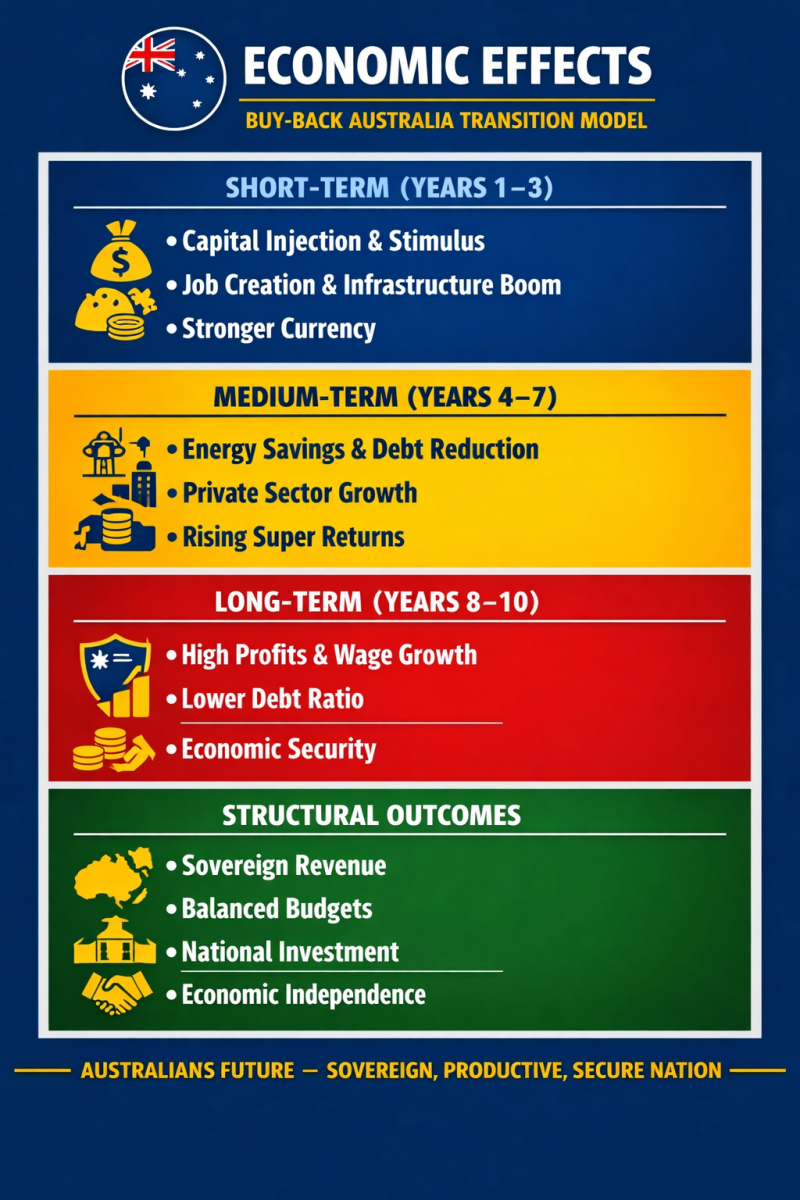
1️⃣ Short‑Term (Years 1–3) — Investment & Stabilisation
-
Capital injection: $392.5 B buy‑back financed through sovereign bonds and superannuation investment.
-
Immediate stimulus: Infrastructure, energy, and logistics sectors expand; GDP growth lifts by ~1.2 %.
-
Employment surge: Construction, engineering, and manufacturing absorb displaced admin labour.
-
Currency stability: Sovereign ownership reduces foreign profit outflows, strengthening the AUD.
2️⃣ Medium‑Term (Years 4–7) — Productivity & Paydown
-
Energy Super‑Grid cuts national power costs 20–30 %, lowering inflation.
-
Debt paydown: 60 % of profits redirected to reduce national debt ($411 B by Year 10).
-
Private‑sector expansion: Domestic firms reinvest in sovereign supply chains.
-
Superannuation returns: Members gain higher yields from productive, onshore assets.
3️⃣ Long‑Term (Years 8–10) — Sovereign Growth
-
Annual profit: $68.5 B from national enterprises; $26 B from the Super‑Grid alone.
-
Debt‑to‑GDP ratio: Falls from 38 % to 28 %.
-
Wages: Rise 22–28 % as productivity and domestic manufacturing strengthen.
-
National resilience: Australia becomes energy‑secure, export‑competitive, and fiscally independent.

4️⃣ Structural Outcomes
-
Foreign profit extraction replaced by sovereign dividends.
-
Public finance stabilised through predictable infrastructure returns.
-
Private investment aligned with national priorities.
-
Economic sovereignty restored — Australia owns its future.