🚨 National Emergency Management Agency (NEMA)
Gold Standard Portfolio Overview
Australians Unified | National Resilience, Disaster Readiness & Emergency Coordination
Primary Pillar: 🛡 Sovereignty
Supporting Pillars: 🤝 Unity • ⚖ Accountability • 🚀 Future Australia • 💰 Prosperity
📌 Executive Summary
✅ Australia's national disaster management agency. [emv.vic.gov.au], [nema.gov.au]
✅ Coordinates national preparedness, response, recovery and resilience. [homeaffairs.gov.au], [homeaffairs.gov.au]
✅ Operates the National Situation Room 24/7. [homeaffairs.gov.au], [homeaffairs.gov.au]
✅ Supports states and territories during major emergencies. [emv.vic.gov.au]
✅ Leads national disaster risk reduction initiatives. [emv.vic.gov.au], [homeaffairs.gov.au]
✅ Manages disaster funding and resilience programs. [homeaffairs.gov.au], [emv.vic.gov.au]
✅ Provides national situational awareness and crisis coordination. [homeaffairs.gov.au], [homeaffairs.gov.au]
🎯 National Mission
Protect Australia
✅ Save Lives
✅ Reduce Harm
✅ Improve Preparedness
✅ Strengthen Recovery
✅ Build National Resilience
✅ Support Communities Before, During and After Disasters
National Emergency Management Agency responsibilities
The National Emergency Management Agency (NEMA) coordinates Australia’s national approach to disaster risk reduction, emergency preparedness, crisis coordination, recovery, resilience programs and emergency management policy. Australians Unified supports NEMA becoming Australia’s National Resilience Authority, with clear responsibility for national crisis coordination, preparedness, community and infrastructure resilience, recovery and reconstruction, climate-adaptation readiness, risk reduction and emergency capability development.
Within the Home Affairs portfolio, Home Affairs retains responsibility for national security, borders, citizenship, national resilience and critical-infrastructure security. NEMA provides the dedicated emergency-management capability: preparedness, response support, recovery, risk reduction and community resilience.

Preparedness
Build national readiness before emergencies occur through the Disaster Ready Fund, community resilience programs, risk-reduction programs, emergency planning and national preparedness frameworks.

Response and coordination
Support nationally coordinated action through the National Situation Room, all-hazards monitoring, the National Coordination Mechanism, crisis coordination and Commonwealth disaster support.

Recovery and reconstruction
Help communities recover through disaster recovery funding, community recovery support, recovery coordination, long-term resilience planning and recovery policy development.

Risk reduction and resilience
Lead the National Disaster Risk Reduction Framework, resilience planning, community risk reduction, infrastructure resilience programs and disaster-mitigation investment to strengthen Australia’s climate-adaptation readiness.

OUR STRENGTHS
Emergency & Resilience Strengths
-
National coordination authority
-
Strong partnerships with states, Defence, and first responders
-
Proven disaster‑response capability
-
Established community‑recovery frameworks
AI‑Enhanced Strengths (New Model)
-
Predictive hazard modelling
-
Automated early‑warning systems
-
Real‑time disaster dashboards
-
AI‑driven resource allocation
-
Reduced manual workload

OUR WEAKNESSES (PRE‑AI)
-
Slow and inefficient information flow between different jurisdictions, leading to delays in decision-making and response times.
-
Manual resource coordination that often results in mismanagement and can hinder the overall efficiency of operations and resource allocation.
-
High and burdensome administrative overhead that consumes significant time and resources, detracting from core activities and priorities.
-
Fragmented data systems that operate in silos, making it challenging to achieve a comprehensive view of operations and complicating data analysis and reporting efforts.
-
Inconsistent levels of preparedness across various regions, leading to disparities in response capabilities and effectiveness when addressing challenges.

OUR THREATS
External Threats
-
Climate‑driven disasters (fires, floods, cyclones, heatwaves)
-
Infrastructure vulnerability
-
Supply‑chain disruptions
-
Increasing frequency and severity of emergencies
Internal Threats
-
Legacy systems
-
Workforce shortages in specialist roles
-
High operational costs
-
Inconsistent national standards
Federal, state, regional and local emergency resilience alignment
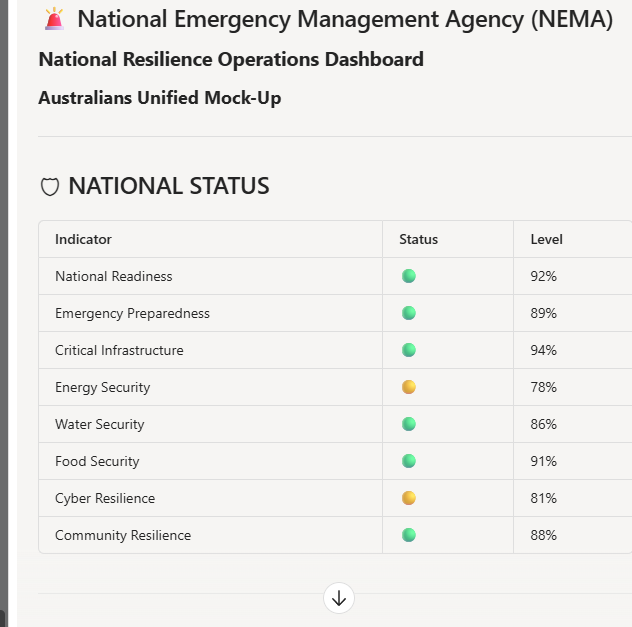
A coordinated Australian resilience system connects national leadership with state intelligence, regional networks and local action. Australians Unified proposes a National Resilience Operations Centre with an integrated national risk dashboard, real-time disaster monitoring, infrastructure monitoring, national recovery tracking, a state coordination platform and community resilience analytics.
National Resilience Dashboard
Preparedness: Emergency Preparedness Index; Community Readiness Index; Volunteer Capability Index.
Response: Emergency Response Time; National Coordination Capability; Crisis Management Readiness.
Recovery: Recovery Readiness Index; Recovery Delivery Performance; Community Recovery Outcomes.
Risk reduction: Disaster Risk Reduction Index; Infrastructure Resilience Index; Community Resilience Index.

🏛 Federal: National Emergency Management Agency
National role: set the national picture and coordinate support across jurisdictions.
- National coordination
- National preparedness
- National recovery programs
- Disaster funding
- National situational awareness
⬇️ Shares national priorities, intelligence and funding with states.

🏛 State: SIRCO
State Intelligence & Resilience Coordination Office: translate national priorities into state-wide readiness and coordinated operations.
- State risk monitoring
- Infrastructure resilience
- Emergency intelligence
- State preparedness
- Recovery coordination
⬇️ Connects state capability with regional resilience networks.

🌏 Regional: Resilience networks
Regional Resilience Networks: coordinate neighbouring communities, services and assets across shared hazards and recovery needs.
- Regional preparedness
- Recovery coordination
- Mutual aid planning
- Regional risk analysis
⬇️ Supports practical planning and mutual aid at the local level.

🏘 Local: LRRC
Local Resilience & Risk Committees: build prepared, connected communities with clear local plans before, during and after disasters.
- Community preparedness
- Local risk registers
- Community recovery planning
- Infrastructure resilience
- Volunteer coordination
Local insight and community capability inform every level of the national resilience system.
Opportunities and integrity safeguards
Our opportunities (AI-enabled)
By integrating cutting-edge machine learning across disaster management, we modernise readiness and response:
- Automate hazard forecasting and rapid early warnings
- Deploy AI-enabled resource and logistics modelling
- Reduce administrative overhead and accelerate operations
- Improve transparency, public communication, and reporting
- Strengthen institutional independence through tamper-proof systems
- Reinvest operational savings into community resilience and infrastructure hardening
Integrity and independence safeguards
Ensuring emergency management remains strictly non-political, evidence-based, and nationally consistent:
- AI-governed risk prioritisation: Emergency priorities set by transparent, auditable models rather than political preference.
- Immutable audit trails: All operational decisions systematically logged and independently reviewable.
- Independent appointment panels: Governed by proven leaders in emergency management, climate science, logistics, and resilience.
- Mandatory publication of ministerial contacts: Complete ministerial interactions logged and published transparently.
- Conflict-of-interest rules: Strict prohibition of political involvement for senior emergency leadership.
- Decentralised data architecture: Robust network designs ensure no single actor can override national emergency systems.
Strategic roadmap — National Emergency Management Agency
A 10-year phased transformation to modernise Australia's disaster readiness, streamline operations, and deliver a 20% reduction in operating costs offset by AI-enabled efficiency.
Phase 1 — Foundation (Years 1–2): Stabilise & modernise
- Reduce administrative staffing footprint
- Consolidate legacy systems across jurisdictions
- Deploy workflow automation to streamline coordination
- Begin AI pilots for predictive hazard forecasting
- Build unified national emergency data architecture
- Establish independent governance board
Phase 2 — Acceleration (Years 2–4): Automate & enhance
- Launch AI-enabled early-warning engine
- Deploy automated resource and logistics modelling
- Introduce digital self-service tools for communities
- Implement automated reporting and situational updates
- Deliver critical cyber-resilience uplift
Phase 3 — Expansion (Years 4–6): Strengthen national capability
- Establish integrated national emergency intelligence network
- Roll out real-time disaster dashboards across agencies
- Integrate advanced workforce augmentation tools
- Deliver enhanced operational transparency and public reporting
Phase 4 — Future-ready (Years 6–10): Transform & protect
- Deploy fully automated hazard-forecasting cycles
- Implement multi-scenario predictive climate-risk modelling
- Execute AI-enabled infrastructure vulnerability mapping
- Operate a seamless, integrated national emergency ecosystem
Investment framework and phase funding
A lean, AI-enabled, nationally coordinated emergency management agency that protects lives, strengthens resilience, and prepares Australia for a changing climate and increasing disaster risk.
Baseline funding and phase 1 modernisation
Baseline funding (reduced): $0.48B per year, reduced from $0.60B through a 20% efficiency gain delivered by smart systems.
Phase 1 (years 1–2): $0.60B – $0.82B to stabilise and modernise core operations, streamline administrative footprints, and build unified disaster data architecture.
Phase 2 automation and phase 3 capability
Phase 2 (years 2–4): $1.20B – $1.60B to automate and enhance services, deploying early-warning engines and real-time logistics modelling.
Phase 3 (years 4–6): $0.90B – $1.20B to strengthen national capability, integrating intelligence networks and advanced operational dashboards.
Phase 4 transformation and total investment
Phase 4 (years 6–10): $2.40B – $3.20B to transform and protect through multi-scenario climate modelling and automated forecasting.
Total investment:
- 6-year total: $3.10B – $4.42B
- 10-year total: $6.58B – $8.82B
People and community resilience
Focused on preparedness, resilience, and recovery across every Australian community:
- Community resilience programs and national preparedness education
- Dedicated volunteer and first-responder operational support
- Digital emergency-access tools and self-service portals
- Local infrastructure hardening and risk reduction
Frequently asked questions
Explore common inquiries regarding the role, operational model, and national coordination initiatives of the National Emergency Management Agency (NEMA).