DEFENCE PORTFOLIO
Australians Unified – Defence Portfolio
Australia’s security landscape is changing rapidly. From emerging regional tensions to cyber threats and technological disruption, the nation requires a Defence system that is modern, resilient, and strategically prepared. The Defence Portfolio is committed to safeguarding Australia’s sovereignty, protecting our people, and strengthening our national resilience. Australia unified believe we do not need uncertainty in its security — it needs clarity, capability, and readiness. Strong defence forces. Modern technology. Secure borders. Trusted intelligence. Resilient infrastructure. We are a nation with strategic responsibilities at home and in our region. Today, we affirm: our commitment to Australia’s defence is unwavering. It is time to strengthen the foundations of our national security.
Our services
We offer a range of specialized services tailored to meet your individual needs. Our approach is focused on understanding and responding to what you require, providing effective and practical solutions.

🟩 STRENGTHS
Department of Defence
-
Modernisation of maritime, air, land, space & cyber capabilities
-
Strong strategic planning and readiness frameworks
-
Deep alliances supporting regional stability
-
Sovereign manufacturing uplift through defence‑industry programs
-
Clear national‑security mandate and public trust
Australian Defence Force (ADF)
-
Multi‑domain operational capability (land, air, maritime, joint)
-
Rapid response capacity for crises & humanitarian missions
-
Strong international peacekeeping reputation
-
High‑readiness posture for domestic and regional operations
Australian Signals Directorate (ASD)
-
World‑class cyber defence and SIGINT capability
-
Offensive cyber operations supporting national security
-
Critical infrastructure protection at national scale
-
High‑value intelligence outputs for Defence & Government
Capability Acquisition & Sustainment Group (CASG)
-
Large‑scale procurement and sustainment expertise
-
Strong industry partnerships supporting sovereign capability
-
Lifecycle planning for ships, aircraft, vehicles & systems
-
Central role in reducing foreign dependency
Joint Operations Command (JOC)
-
Unified command & control for all ADF operations
-
Strategic logistics and deployment coordination
-
Strong international defence cooperation networks
-
Multi‑domain operational planning capability

🟧 WEAKNESSES
(Directly drawn from the weaknesses sections on your page)
ADF Headquarters (ADFHQ)
-
Complex decision layers slow crisis responsiveness
-
Heavy administrative burden reduces agility
-
Coordination gaps between strategic HQ and service‑level execution
-
Resource competition across services
-
Legacy systems limiting real‑time situational awareness
Joint Capabilities Group (JCG)
-
High demand for cyber/space/intelligence skills outpaces recruitment
-
Fragmented capability development creates duplication or gaps
-
Reliance on contractors reduces sovereign control
-
Rapid tech evolution makes systems hard to keep current
-
Interoperability challenges with partners and allies
Joint Operations Command (JOC)
-
High operational tempo strains personnel and resources
-
Logistics vulnerabilities, especially in remote/maritime operations
-
Limited surge capacity for simultaneous domestic + international ops
-
Ageing infrastructure at key operational hubs
-
Coalition coordination can slow decision cycles
CASG
-
Long procurement timelines
-
Cost overruns in major projects
-
Industry dependency for specialised components
-
Complex sustainment chains
ASD
-
Extreme competition for cyber talent
-
High operational secrecy limits public visibility and recruitment
-
Rapid threat evolution requires constant capability refresh

🟥
THREATS
Strategic Environment
-
Rapid military modernisation in the Indo‑Pacific
-
Cyber attacks targeting government, industry, and infrastructure
-
Supply‑chain fragility for fuel, components, and technology
-
Climate‑driven disasters increasing demand on ADF
-
Geopolitical instability affecting trade routes
Operational
-
Ageing infrastructure at key bases and logistics hubs
-
Over‑reliance on imported fuel and refined products
-
Recruitment and retention challenges in high‑skill areas
-
Increasing cost and complexity of defence platforms
Technological
-
Fast‑moving cyber and AI threats
-
Foreign control of critical technologies
-
Vulnerability of space‑based systems

🟨 OPPORTUNITIES
Whole Defence Portfolio
-
Integration with national infrastructure (fuel hubs, supergrid, transport corridors)
-
Sovereign manufacturing expansion (ships, drones, munitions, cyber systems)
-
AI‑enabled command, logistics, and workforce planning
-
Defence‑civil cooperation for disaster resilience (AISP model)
-
Strengthening Indo‑Pacific partnerships
ADF
-
Workforce reintegration pathways (civilian + reserve)
-
Expanded humanitarian and disaster‑response leadership
-
Modernisation of northern bases and dual‑use airfields
ASD
-
National cyber‑resilience uplift across government & industry
-
Expansion of offensive cyber capability
-
Integration with critical‑infrastructure protection
CASG
-
Growth of sovereign supply chains
-
Local production of fuel, munitions, drones, and components
-
Industry‑Defence co‑development programs
JOC
-
Enhanced joint logistics networks
-
Integration with national mobilisation planning
-
Multi‑domain training with regional partners
- drone and ship building
- nuclear energy plant construction
Cross-portfolio SWOT analysis
A consolidated strategic breakdown aligning Defence, Home Affairs, Energy, and Infrastructure into a resilient sovereign engine for Australia.
Strengths
Defence: Multi-domain capability across air, sea, land, and cyber, fortified by strong regional partnerships and high-readiness operational logistics.
Home Affairs: Established intelligence, national policing networks, secure border controls, and frontline crisis response mechanisms.
Energy: World-class renewable resources, major gas export capacity, and significant sovereign refining and synthetic fuels potential.
Infrastructure: Comprehensive national rail, port, and highway corridors with strategic northern gateways and ongoing major interstate upgrades.
Weaknesses
Defence: Heavy import dependency for refined fuel, ageing regional bases, and extended procurement cycles.
Home Affairs: Fragmented cross-jurisdiction emergency coordination, legacy IT systems, and persistent staffing shortages across cyber and border roles.
Energy: Limited domestic fuel refining, vulnerable distribution networks, and an unintegrated interstate power grid.
Infrastructure: Critical freight bottlenecks, congested ports, delayed project approval cycles, and minimal national transport redundancy.
Opportunities
Defence: Modernisation of northern defence bases, rapid expansion of sovereign munitions, autonomous drones, and naval shipbuilding.
Home Affairs: A unified national emergency command centre, advanced biometrics, cyber security uplifts, and streamlined community resilience frameworks.
Energy: Creation of a Northern Refinery, national strategic fuel reserves, and a dedicated Supergrid interconnecting defence corridors.
Infrastructure: Scaled hydrogen hubs, synthetic fuel logistics, and dual-use transport arteries facilitating total national mobilisation.
Threats
Defence: Indo-Pacific geopolitical instability, aggressive cyber warfare, space domain disruptions, and foreign component supply shocks.
Home Affairs: Escalating climate disasters, transnational organised crime, and mounting border pressures driven by overseas crises.
Energy: International oil price shocks, foreign leverage over critical minerals, and grid exposure to physical or digital sabotage.
Infrastructure: Severe weather damage against ageing installations, maritime chokepoint closures, and over-reliance on imported building materials.

CHALLENGES — KEY OVERVIEW
1. Strategic Environment & Regional Stability
-
Increasing geopolitical competition in the Indo‑Pacific.
-
Rising military modernization among regional powers.
-
Greater need for partnerships and alliances. Core problem: Australia must remain prepared in a rapidly shifting strategic environment.
2. Defence Capability & Modernisation
-
Ageing platforms and systems requiring renewal.
-
Need for advanced technologies (cyber, space, autonomous systems).
-
Long lead times for procurement and capability delivery. Core problem: Defense capability must evolve faster than emerging threats.
3. Workforce & Defense Personnel
-
Recruitment and retention challenges across the ADF and APS.
-
Increasing demand for specialized skills (cyber, engineering, intelligence).
-
Supporting veterans and families through transitions. Core problem: A strong defense force requires a strong, supported workforce.

Cybersecurity & Information Warfare
-
Growing frequency and sophistication of cyber attacks.
-
Threats to critical infrastructure and national systems.
-
Need for secure communication and intelligence networks. Core problem: Australia must defend itself in both physical and digital domains.
5. Defence Industry & Sovereign Capability
-
Reliance on international supply chains for critical equipment.
-
Need for domestic manufacturing and innovation.
-
Supporting small and medium defence businesses. Core problem: Australia must build sovereign capability to ensure long‑term security.
6. Infrastructure, Estate & Preparedness
-
Maintaining and upgrading bases, training areas, and defence estates.
-
Ensuring readiness for humanitarian, disaster, and regional support missions.
-
Strengthening logistics and supply resilience. Core problem: Defence infrastructure must be modern, resilient, and future‑ready.

DEFENCE PORTFOLIO — PROBLEM / SOLUTION STRATEGIES
1. STRATEGIC ENVIRONMENT & REGIONAL STABILITY
Challenge:
-
Rising tensions and uncertainty in the Indo‑Pacific.
-
Increased need for regional cooperation and deterrence.
Our Solution:
-
Strengthen alliances and partnerships, including regional defence cooperation.
-
Enhance Australia’s strategic presence and readiness.
-
Invest in intelligence, surveillance, and strategic planning.
2. DEFENCE CAPABILITY & MODERNISATION
Challenge:
-
Outdated systems and long procurement cycles.
-
Rapid technological change.
Our Solution:
-
Accelerate acquisition of modern platforms and technologies.
-
Invest in cyber, space, autonomous systems, and advanced defence science.
-
Strengthen Defence Science and Technology Group innovation pathways.
3. WORKFORCE & DEFENCE PERSONNEL
Challenge:
-
Skills shortages and retention pressures.
-
Increasing demands on personnel and families.
Our Solution:
-
Expand recruitment and specialist training programs.
-
Improve conditions, support services, and career pathways.
-
Strengthen veteran transition and wellbeing initiatives.
4. CYBERSECURITY & INFORMATION WARFARE
Challenge:
-
Escalating cyber threats targeting government, industry, and infrastructure.
Our Solution:
-
Enhance national cyber defence capabilities.
-
Strengthen the Australian Signals Directorate and cyber operations.
-
Improve whole‑of‑government cyber resilience and intelligence sharing.
5. DEFENCE INDUSTRY & SOVEREIGN CAPABILITY
Challenge:
-
Vulnerable supply chains and limited domestic production.
Our Solution:
-
Invest in sovereign manufacturing and defense industry growth.
-
Support Australian businesses through procurement reform.
-
Encourage innovation through defence‑industry partnerships.
6. INFRASTRUCTURE, ESTATE & PREPAREDNESS
Challenge:
-
Ageing infrastructure and increasing operational demands.
Our Solution:
-
Modernise bases, training facilities, and logistics networks.
-
Strengthen preparedness for humanitarian and regional missions.
-
Improve estate sustainability and resilience.
AUSTRALIANS UNIFIED — NATIONAL INTEGRATION ROLE
The system that connects energy, workforce, industry, and Defence into one sovereign engine.
🟥 5. Defence‑Enabled National Capability
-
Dual‑use infrastructure: ports, rail, airfields, fuel hubs, and Supergrid corridors
-
Defence logistics integrated with national supply chains
-
Cyber‑secure, AI‑enabled command systems supporting mobilisation and crisis response
-
Workforce pipelines feeding Defence trades, engineering, and intelligence roles

🟦 1. Supergrid Integration
-
Aligns energy corridors with rail, highways, Defence bases, and fuel hubs
-
Powers EV manufacturing, shipbuilding, AI centres, and regional industry
-
Creates a single national energy spine that lowers costs and boosts productivity

🟩 2. Employment & Workforce Pipelines
-
National skills pathways for engineering, trades, cyber, logistics, Defence support
-
Regional job creation through Supergrid zones, refinery construction, and manufacturing
-
AI‑driven workforce matching to fill shortages across Defence, Home Affairs, and industry

🟧 3. Reintegration Programs
-
Smooth transition for veterans, long‑term unemployed, and youth into skilled roles
-
Placement into energy, construction, Defence logistics, cyber, and manufacturing
-
Wrap‑around support: training, housing, transport, and community services

🟨 4. AI Business Operations System (GovOps)
-
One unified platform replacing fragmented government systems
-
Automates approvals, procurement, logistics, and workforce allocation
-
Real‑time national dashboard for energy, transport, Defence readiness, and supply chains
-
Cuts duplication across departments and accelerates national projects
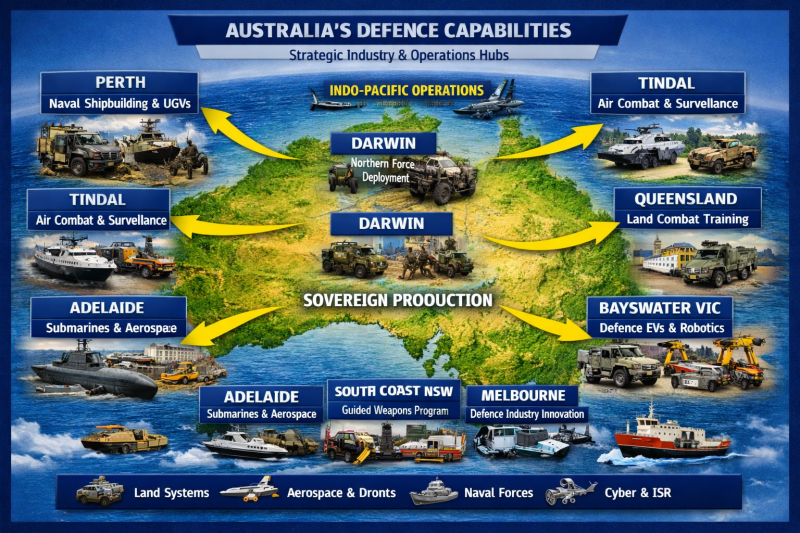
🛡️ Defence Capabilities Map Highlights
🟦 Strategic Defence Hubs
-
PERTH Naval Shipbuilding & UGVs
-
ADELAIDE Submarines & Aerospace
-
DARWIN Northern Force Deployment
-
TINDAL Air Combat & Surveillance
-
QUEENSLAND Land Combat Training
-
CANBERRA Defence HQ & Cyber
-
SOUTH COAST NSW Guided Weapons Program
-
BAYSWATER VIC Defence EVs & Robotics
-
MELBOURNE Defence Industry Innovation
🟨 Defence Deployment
-
INDO-PACIFIC OPERATIONS — Naval and air power to the north
-
ANTARCTIC MISSION — Operations below, with icebreaker
🛠️ Bottom Capabilities Icons
-
Land Systems
-
Aerospace
-
Naval Forces
-
Cyber & ISR
🟦 THE OUTCOME
A unified national system that powers jobs, energy, industry, and Defence readiness — all at once.
Australia becomes faster, stronger, sovereign, and economically resilient.
Defence portfolio frequently asked questions
Explore answers to common questions regarding Australia's defence readiness, sovereign industrial capabilities, and cross-portfolio national security integration.