Understanding Australia's governance matrix
Australia operates under a three-tier governance model comprising federal, state and territory, and local governments. Navigating who does what, why duties are divided, and where overlaps emerge is vital to civic clarity. Australians Unified maps this landscape across our five pillars—sovereignty, prosperity, accountability, unity, and future Australia—to foster complete community transparency.

Federal government: national leadership and strategic direction
The federal tier sets overarching national strategy and commands essential nationwide functions requiring constitutional consistency. Its key portfolios encompass defence, foreign affairs, border protection, immigration, national taxation, and tertiary education funding.
Because national frameworks rely heavily on lower tiers for practical execution, gaps frequently arise between grand strategy and tangible delivery. Australians Unified tracks these friction points to establish genuine nationwide accountability.

State and territory government: service delivery and regional coordination
State and territory administrations translate national policy priorities into tangible public services across broad regional networks. Their central responsibilities include managing public hospitals, primary and secondary schools, state policing, emergency services, regional planning, and public transport networks.
The primary hurdle at the state level remains balancing growing community service demands against rigid fiscal constraints and intergovernmental funding arrangements.

Local government: community delivery and place-based outcomes
Local councils form the frontline tier of civic representation, delivering immediate community infrastructure and maintaining neighborhood wellbeing. Everyday duties span local roads, town planning approvals, waste collection, parks, recreational facilities, and community health bylaws.
Operating at the community coalface, councils face increasing cost burdens and delegated statutory requirements. Bridging these three distinct layers is essential for grassroots empowerment and unified national prosperity.
Australia’s three governance layers
Australia’s governance matrix maps responsibility across federal, state and local government, while highlighting the shared functions where clear ownership matters most. Australians Unified assesses every responsibility through five pillars: sovereignty, prosperity, accountability, unity and future Australia.

Federal government
National leadership and strategic direction. Responsible for defence, foreign affairs, border protection, immigration, taxation, the national economy, Medicare funding, university funding and national infrastructure funding. Its purpose is to manage functions requiring national consistency; its key challenge is turning national strategy into delivery through state governments. Aligned to all five Australians Unified pillars.

State government
Service delivery and regional coordination. Responsible for public hospitals, schools, police, emergency services, public transport, state roads, planning systems, housing programs and justice systems. States turn national priorities into practical services while balancing growing demand, funding arrangements and complex responsibilities. Aligned to all five Australians Unified pillars.

Local government
Community delivery and local place management. Responsible for local roads, parks and open space, community centres, libraries, waste services, local planning, recreation facilities, community engagement and local economic development. Councils are closest to citizens, yet must meet rising expectations with limited funding and influence over wider decisions. Aligned to all five Australians Unified pillars.

Shared responsibility and accountability
Better outcomes require clear ownership. Housing, health and infrastructure cross all three layers: federal government funds and sets national frameworks; states regulate, plan and deliver major services; local government implements locally and connects community infrastructure. Australians Unified’s reform model maps responsibilities, identifies challenges, aligns them to the five pillars, develops amendments and implementation plans, and measures community outcomes.
The business operations mechanism
The Business Operations Mechanism is Australians Unified’s governance engine for connecting—not replacing—federal, state and local government. It aligns strategy with delivery, delivery with outcomes, outcomes with community needs, and performance with accountability. By measuring, coordinating, reporting, improving, aligning and governing, it supports one connected system focused on better outcomes for Australians.
Governance flow: community needs → national strategy → service coordination → community delivery → community outcomes → continuous reform.

Strategic alignment
Strategic alignment links federal priorities, state implementation and local delivery in one governance framework. Federal government provides national strategy, states coordinate and deliver major services, and local government delivers place-based community outcomes.
Key question: Are all levels working towards the same outcome?
This function strengthens sovereignty through national capability and resilience; prosperity through industry, infrastructure, employment and regional development; unity through health, education, housing and community services; and Future Australia through innovation, technology, skills and long-term planning.

Program coordination
Program coordination ensures that complex initiatives involving multiple agencies and levels of government have clear roles, connected plans and practical delivery pathways. It applies to housing, health, infrastructure, emergency management and regional development.
For shared responsibilities, the matrix clarifies how federal funding and national frameworks, state planning and major service delivery, and local implementation work together. Housing, transport and infrastructure require all three tiers; community services and parks are primarily delivered closer to communities.
Key question: Who is responsible for what?

Performance and accountability
Performance management tracks delivery against measurable objectives: delivery progress, service performance, budget performance and community outcomes. Accountability management then makes ownership visible for every major initiative.
Each initiative should identify a strategic owner who sets direction, funding owner who provides resources, delivery owner who delivers services, and accountability owner who is responsible for outcomes.
Key questions: Are we achieving results? Who owns the result? Outcome measurement, performance reporting, audits and governance frameworks make accountability practical.

Risk and continuous improvement
Risk management monitors what could prevent success across services, infrastructure, communities, budgets and national capability. Continuous improvement identifies inefficiencies, duplication, emerging opportunities and reform priorities so government can perform better over time.
The mechanism integrates every function with Australians Unified’s five pillars: sovereignty, prosperity, accountability, unity and Future Australia. It turns community needs into measurable outcomes, feeds results back into reform, and keeps responsibilities clear across the full system.
One Australia. Five Pillars. Better outcomes.
Advantages of the Australians Unified Governance Model
Australia’s federal, state and local governments each hold important constitutional, democratic and service-delivery responsibilities. Australians Unified does not replace these three levels of government. It adds a Business Operations Mechanism (BOM): a governance engine that continuously connects strategy, funding, delivery, performance, accountability and community outcomes.
Current model: federal → state → local → community outcomes. Australians Unified model: national strategy → state coordination → local community delivery → community outcomes, supported throughout by planning, coordination, accountability, performance, risk management, outcome measurement and continuous improvement.

Clear ownership and visibility
In the current system, a housing project may involve federal funding, state planning and local approvals, making responsibility difficult to trace when delays occur. The BOM assigns a defined strategic owner, funding owner, delivery owner and accountability owner to every initiative.
This reduces blame shifting, improves transparency and enables faster problem resolution. Citizens can see who planned, funded and delivered an initiative—and who owns the outcome—strengthening public trust and democratic participation.

One connected government system
Departments can currently plan housing, transport, education and infrastructure separately, using different reporting systems, planning frameworks and stakeholder processes. Shared responsibilities, duplicate administration and portfolio silos can limit whole-of-government coordination.
The BOM continuously aligns plans, budgets, priorities, delivery activities and expected benefits across federal, state and local government. It identifies overlap and inefficiency, supports earlier intervention on housing, health, infrastructure and disaster management, and delivers simpler governance with lower administrative cost.

Outcomes, performance and the five pillars
Current measures can focus on money spent, programs delivered or projects completed. Australians Unified measures whether people receive better results: housing access, health improvement, economic growth, community wellbeing and educational outcomes.
Performance is monitored continuously: are objectives being achieved, projects on target, outcomes improving, and adjustments required? Every initiative is also tested against sovereignty, prosperity, accountability, unity and Future Australia—supporting resilience, economic outcomes, clear responsibility, community wellbeing and long-term success.

Long-term planning and improvement
Rather than an election-cycle sequence of policy, budget and implementation, the Australians Unified model follows community need → national strategy → implementation → measurement → improvement. This creates greater stability, long-term thinking and less policy fragmentation.
Its permanent improvement cycle is plan → deliver → measure → review → improve → repeat. Risk management and continuous monitoring detect issues earlier, enable faster corrective action, improve use of public funds and help government evolve rather than react only to crises, elections, inquiries or public pressure.
Current Australian government expenses exceed $1.0 trillion annually across all levels of government, while public sector wages exceed $232 billion annually and government-delivered services consume hundreds of billions each year. [abs.gov.au], [ipa.org.au]
Australians Unified Governance Model
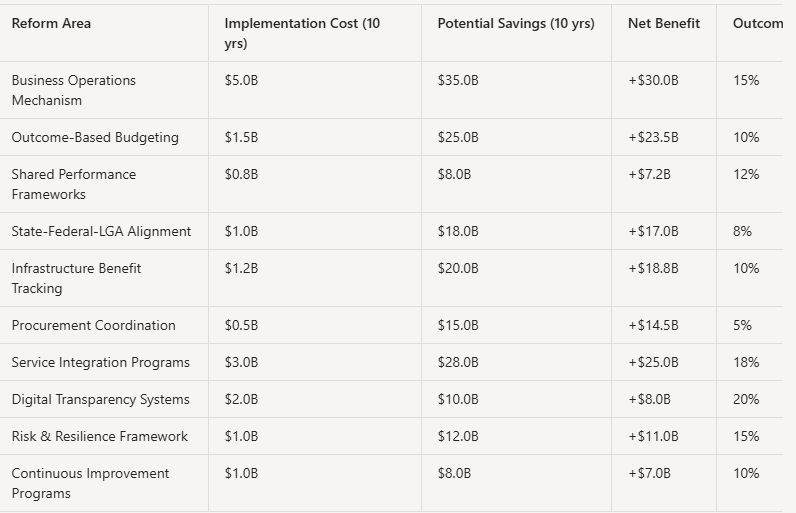
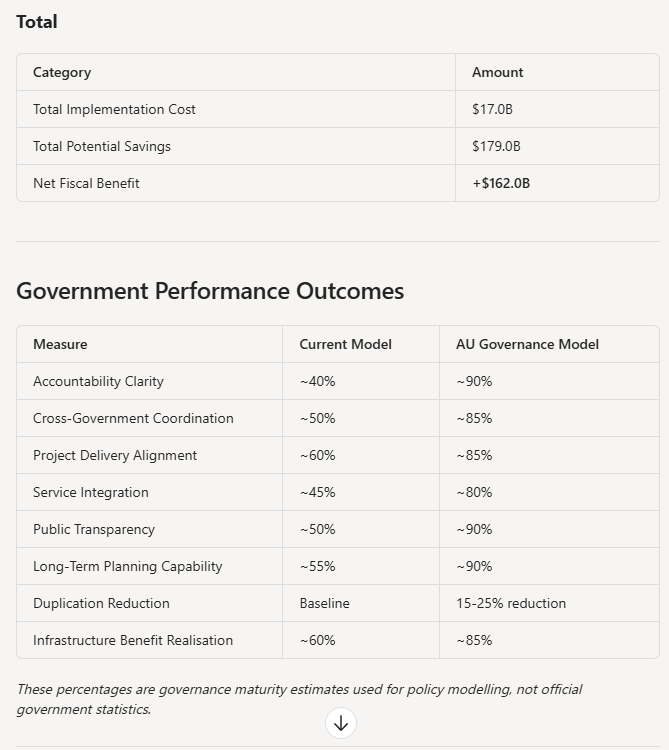
Indicative 10-Year Cost vs Savings Analysis
Assumptions
- Business Operations Mechanism implemented nationally.
- No reduction in frontline services.
- Savings primarily from duplication reduction, reporting consolidation, procurement coordination, project delivery improvements, and accountability reforms.
- Estimates based on modest efficiency gains of 1-3% across major expenditure categories.
- Figures shown in AUD billions.
Australians Unified Conclusion
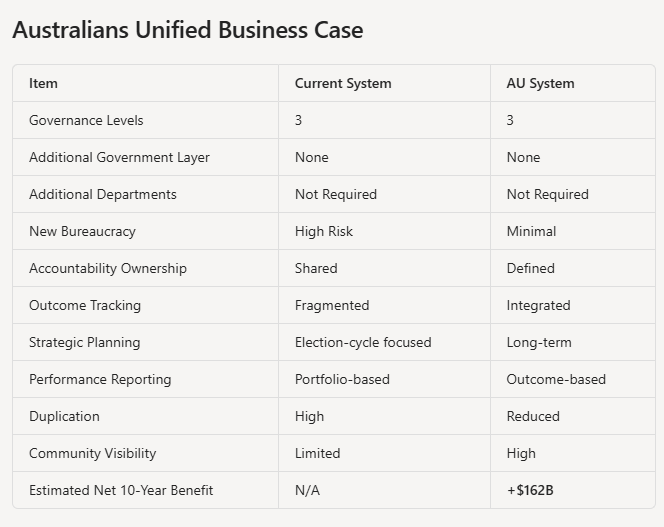
The Business Operations Mechanism is not designed to create more government.
It is designed to make the existing Federal-State-Local structure operate as a connected enterprise system.
If implemented conservatively and achieving only 1-2% efficiency gains across Australia's public expenditure, the model could reasonably generate $110B-$220B in cumulative savings over 10 years while improving accountability, coordination, transparency, and community outcomes. These savings figures are policy-model estimates based on total public expenditure levels, not audited forecasts.
Frequently asked questions about the governance matrix
Find clear answers on how Australia's three tiers of government connect, where shared responsibilities overlap, and how the Business Operations Mechanism drives accountability across our five core pillars.