Australian Taxation Office
A sovereign, simplified, and fair taxation system that puts Australians first. Under Australians Unified reforms, we champion transparency, protect national wealth, and support Australian families, workers, and local enterprises.

Fair revenue collection for national strength
Administering Australia's taxation system with precision ensures essential public infrastructure, vital healthcare, and national services are reliably funded. We advocate for simplified structures that eliminate loopholes favouring multinational and foreign interests over hardworking citizens.

National revenue protection and integrity
Protecting Commonwealth revenue requires stringent compliance mechanisms and robust audit frameworks. By restoring institutional accountability, our focus centres on defending economic sovereignty and safeguarding every dollar contributed by the Australian community.

Superannuation compliance and retirement security
Securing the future of Australian workers means ensuring employer obligations and Superannuation Guarantee contributions are transparently monitored. We hold compliance to the highest standards, safeguarding retirement savings and fostering long-term national prosperity.
Australian Taxation Department overview
The Australian Taxation Office (ATO) is Australia’s principal revenue collection agency and the nation’s Revenue & Tax Administration Authority. Its work supports a transparent, trusted and efficient taxation system that funds national prosperity while reducing complexity for individuals, families and businesses.

Vision, mission and purpose
Vision: Create the world’s most transparent, trusted and efficient taxation system, funding national prosperity while reducing complexity.
Mission: Administer Australia’s taxation and revenue systems fairly, efficiently and transparently; improve compliance, simplify taxation and support economic growth.
Purpose: Administer taxation, superannuation, business reporting and revenue compliance systems for Australia.

Current functions
The ATO administers core national revenue responsibilities, including:
- Income tax and company tax
- GST administration and PAYG systems
- Superannuation administration
- Business reporting and digital tax services
- Tax compliance and tax debt management
- Revenue collection

Agencies and governance
Australia’s revenue framework brings together the Australian Taxation Office, Treasury for tax policy, Administrative Review Tribunals, the Inspector-General of Taxation, the Commonwealth Ombudsman, the Australian Business Register and the Director Identification System.
Collectively, these bodies support revenue collection to fund government services, oversight, review and accountability.

Current government projects
Key programs and services include myTax, Single Touch Payroll, Business Activity Statements, Tax Time services, Director ID and Digital Identity integration.
Ongoing compliance and administration work includes the Tax Gap Program, GST compliance programs and superannuation administration.
Signature Future Australia ATO projects
Four connected digital reform projects for a simpler, fairer and more transparent Australian taxation system—supporting individuals, businesses and public accountability through secure national services.

Smart Tax Australia
A single national tax platform bringing tax returns, superannuation tracking, concessions eligibility, business reporting, retirement planning information and government payment integration into one clear digital experience.

National Tax Dashboard
Transparent public reporting on total tax revenue, GST collections, compliance performance, tax debt trends, processing times, service standards and revenue forecasts—so Australians can see how the national revenue system is performing.

One Business Reporting Platform
One digital interface for businesses to submit BAS, payroll reporting, super reporting, business updates and compliance reporting—reducing duplication and making essential obligations easier to manage.

AI Compliance Assistance
Practical, early support through compliance health checks, tax guidance, error detection, early intervention, fraud detection and small business support—helping resolve issues before enforcement action becomes necessary.
Gold standard tax principles
Our sovereign taxation blueprint is anchored in fair treatment, competitive rates, and national reinvestment to build enduring prosperity for all Australians.
Australian tax first
Profits generated in Australia should be assessed and taxed in Australia before being distributed offshore, protecting national revenue and ensuring multinationals contribute fairly.
Lower rates, broader base
Lower tax rates combined with fewer exemptions, stronger compliance, and simpler administration deliver a sustainable, growth-oriented tax environment.
Equal treatment
Australian and foreign investors operate under the exact same taxation framework when earning Australian income, eliminating unfair advantages and distortions.
Reward reinvestment and simplicity
Businesses reinvesting profits in Australian jobs, manufacturing, technology, and productivity receive lower effective taxation under a system easily understood by ordinary Australians.
Taxpayer support and Future Australia transformation
Australians Unified proposes a connected Australian taxation system that helps people and businesses recover, plan for retirement and meet obligations with confidence—using real-time reporting, responsible AI guidance and transparent public services.
Tax recovery and support network
A taxpayer-first support network offering flexible repayment plans, financial hardship assessments, financial counselling referrals, early intervention programs and business recovery support. The focus is on resolving issues early, protecting viability and making compliance achievable.

Retirement and super dashboard
A clear retirement and superannuation dashboard linked directly with the Australian Financial Retirement & Community Wealth Department, the superannuation system, retirement readiness reporting and the community wealth framework—supporting Australia 2037 Retirement Outcomes.
Future Australia tax model
From tax return, assessment, compliance and collection to taxpayer, Smart Tax Australia, real-time reporting, AI guidance, compliance support, financial wellbeing and retirement readiness. The result: a simpler tax system, lower compliance burden, better business reporting, greater transparency, stronger revenue integrity, improved taxpayer experience, better retirement outcomes and higher national prosperity.
Australian taxation SWOT analysis
A comprehensive assessment of current revenue system capabilities and challenges, paired with targeted Future Australia reform pathways to create a modern, simplified, and fair taxation architecture.

Strengths
Current examples: Mature tax administration system, digital lodgement systems, Single Touch Payroll, established compliance systems, and strong revenue collection capability.
Future Australia expansion: National Tax Dashboard, Taxpayer Portal 2.0, real-time reporting systems, and AI-assisted tax services.

Weaknesses
Current examples: Tax complexity, compliance burden, multiple reporting requirements, small business administration costs, and community misunderstanding of tax obligations.
Future Australia response: Tax simplification, One Business Reporting System, automated reporting, and proactive guidance.

Opportunities
Future Australia opportunities: Digital-first taxation, pre-filled business reporting, automated compliance assistance, family taxation reforms, small business simplification, and proactive tax education initiatives.

Threats
Current risks: Tax avoidance, shadow economy, cyber security risks, international profit shifting, and increasing system complexity.
Future Australia response: Enhanced analytics, digital compliance systems, AI monitoring, and strengthened international cooperation.
Taxation system gap analysis
A side-by-side assessment of Australia's current taxation administration against the strategic objectives of the Future Australia 2037 transformation framework.
| Area and current status | Future Australia 2037 outcome |
|---|---|
| Revenue collection (strong) | Enhanced national revenue integrity |
| Tax administration (strong) | Simplified modern administration |
| Taxpayer support (moderate) | Enhanced proactive assistance |
| Real-time reporting (limited) | Integrated real-time digital architecture |
| Business compliance (complex) | Streamlined single-portal reporting |
| Tax transparency (moderate) | Public dashboard-driven oversight |
| Australia 2037 reporting (not integrated) | Embedded national metrics and insights |
Current baseline
Current strengths
- High voluntary compliance: Consistent engagement from taxpayers across the community.
- Strong digital capability: Modern lodgement tools and online service infrastructure.
- Established legislative framework: Robust national foundations for revenue collection.
- Effective revenue collection: Sustained delivery of vital funding for national services.
- National systems coverage: Comprehensive reach across individuals and businesses.
Current challenges
- Complexity: Burdensome rules that make navigation difficult for taxpayers.
- Business compliance burden: Heavy administrative overhead for local enterprises.
- Reporting duplication: Inefficient and overlapping data lodgement processes.
- GST leakage: Uncollected revenue impacting national economic capacity.
- Tax debt pressures: Mounting debt books demanding smarter early intervention.
Future Australia tax structure
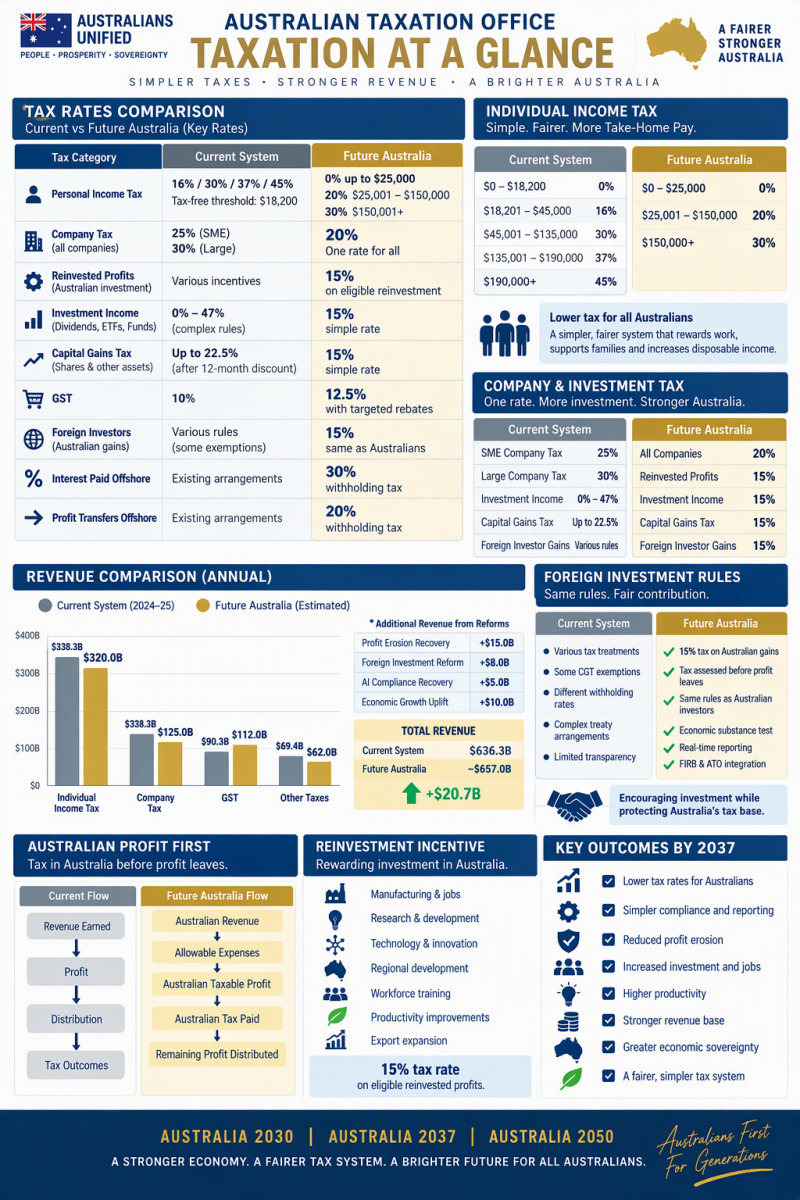
A side-by-side comparison illustrating current revenue policies against the simplified, sovereign tax architecture proposed under Australians Unified.
| Personal and income tax category (current vs future) | Structure and rates |
|---|---|
| Personal income tax — current system | Multiple rates to 45% |
| Personal income tax — Future Australia | 0%, 20%, 30% |
| Tax-free threshold — current system | $18,200 |
| Tax-free threshold — Future Australia | $25,000 |
| Company tax and investment category (current vs future) | Structure and rates |
|---|---|
| Company tax (SME) — current system vs Future Australia | 25% vs 20% |
| Company tax (large) — current system vs Future Australia | 30% vs 20% |
| Reinvested Australian profits — current system vs Future Australia | Various concessions vs 15% |
| Capital gains — current system vs Future Australia | Complex CGT system vs 15% |
| Returns, investment and consumption category (current vs future) | Structure and rates |
|---|---|
| Dividend income — current system vs Future Australia | Complex franking system vs 15% |
| Managed funds — current system vs Future Australia | Multiple tax treatments vs 15% |
| Foreign investors — current system vs Future Australia | Multiple rules vs same rates as Australians |
| GST — current system vs Future Australia | 10% vs 12.5% |
Investment, reinvestment and tax integrity framework
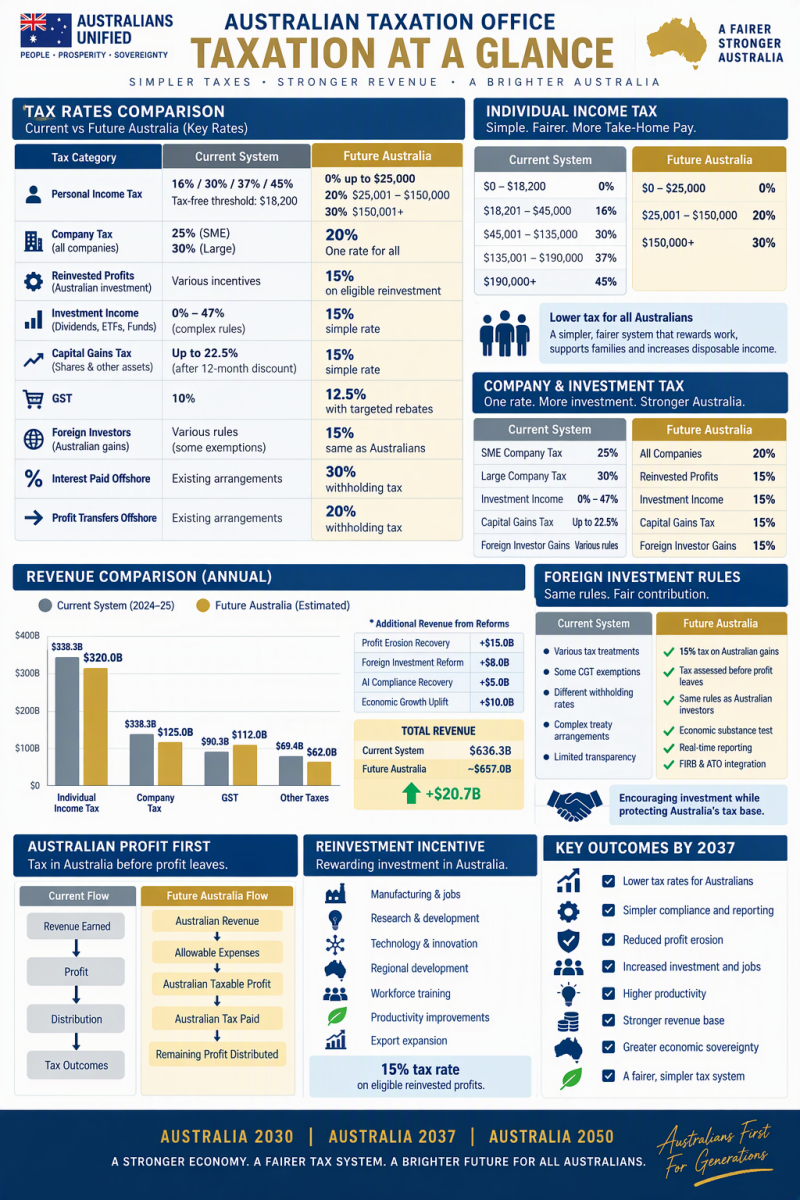
A proposed national taxation framework that applies a simple 15% investment tax, rewards Australian reinvestment, protects revenue from offshore profit shifting, and connects taxpayers through Smart Tax Australia.

Equal investment tax rules
A simple 15% national investment tax would apply to dividends, capital gains, managed funds, ETFs and trust distributions. Australian investors and foreign investors earning Australian investment profits would face the same 15% rate—supporting equal treatment, fewer preferential loopholes, simpler administration and greater investment certainty.

Australian reinvestment incentive
The standard corporate rate would be 20%, reducing to 15% when profits are reinvested in Australian jobs, manufacturing, technology, research and development, export capability, regional development, workforce training or productivity improvements. Reinvesting in Australia lowers tax, creates jobs and supports growth.

National tax sovereignty
Revenue protection would combine economic substance and operating profit ratio tests, transfer-pricing monitoring, multinational reporting, offshore profit-transfer monitoring, a National Revenue Intelligence Network, AI fraud detection and a Tax Integrity Dashboard. The goal is to reduce profit erosion, artificial avoidance, offshore shifting and tax fraud.
Smart Tax Australia
One secure taxpayer account would bring together income and company tax, GST, BAS, payroll, superannuation, investment taxation, payment plans and AI tax assistance. A single digital service is designed to make obligations easier to manage for individuals and Australian businesses.
Tax policy changes and legislative reform
Australians Unified proposes a lower-rate, broader-based Future Australia taxation framework: simpler rules, lower compliance costs, fair treatment for Australian and foreign investors, and stronger protection of revenue generated in Australia. Lower rates + simpler rules + broader participation + stronger revenue protection = national prosperity.

Simple, lower-rate taxation
A clear personal income tax framework: 0% to $25,000, 20% from $25,001 to $150,000, and 30% above $150,000. A universal 20% company tax rate and a simple 15% investment tax would apply to dividends, capital gains, managed funds, ETFs and trust distributions. Fewer duplicate reports, simpler deductions, pre-filled assessments and improved taxpayer guidance make tax easier to understand and cheaper to comply with.
Reward Australian reinvestment
Eligible company profits reinvested in Australia would receive a reduced 15% tax rate. Qualifying activity includes Australian jobs, manufacturing, research and development, technology upgrades, export growth, workforce training, regional development and productivity improvements. The objective is simple: reinvest locally, lower tax, create more jobs and lift national productivity.
Protect Australian tax sovereignty
The Australian Tax First Principle requires profits generated through Australian economic activity to be assessed for Australian tax before offshore distribution. Economic substance tests, operating profit ratio tests, transfer-pricing monitoring, related-party transparency, stronger multinational reporting and a National Revenue Intelligence Network would reduce profit erosion, offshore shifting, fraud and unfair avoidance.

Digital transparency and oversight
Smart Tax Australia and the One Business Reporting Platform would integrate income and company tax, GST, BAS, payroll, superannuation, investment tax, payment plans and support in one account. Legislative reform of tax administration, income tax and GST rules would enable real-time reporting and a public National Tax Dashboard. Annual compliance, tax-gap, revenue, service and taxpayer-satisfaction reporting would be subject to parliamentary, Inspector-General, Ombudsman, audit and privacy safeguards.
Current budget and Future Australia investment
The Australian Taxation Office (ATO) currently administers approximately $636.3 billion in annual revenue. The Future Australia Gold Standard Framework proposes a $3.5 billion investment to 2037 to evolve the ATO into a Tax Sovereignty, Revenue Integrity and Prosperity Authority—simplifying tax, strengthening compliance, attracting investment and protecting Australia’s revenue base.
Current ATO revenue and operations
The current ATO collects $338.3B in individual income tax, $138.3B in company tax, $90.3B in GST and $69.4B in other taxes and revenue. Core functions include revenue collection, compliance and enforcement, superannuation, GST, BAS, payroll and PAYG administration, myTax digital services, taxpayer support and revenue forecasting.
$3.5B digital tax investment
Investment to 2037 includes Smart Tax Australia ($1.0B), One Business Reporting Platform ($500M), National Revenue Intelligence Network ($500M), AI compliance and fraud detection ($500M), plus $250M each for the National Tax Dashboard, Tax Operations Centre, digital GST integration and Australian Tax Sovereignty Framework.

Three-phase delivery roadmap
2027–2030: $1.25B for Smart Tax Australia, the National Tax Dashboard, modern lodgement and real-time accounts. 2030–2034: $1.25B for one business reporting, Australian Tax First, AI assistance and investment-tax reform. 2034–2037: $1.0B for revenue intelligence, Australia 2050 forecasting, integrated Treasury reporting and the Tax Operations Centre.

Gold standard outcomes by 2037
The proposed model sets personal rates of 0% to $25,000, 20% to $150,000 and 30% above; a universal 20% company rate; 15% for Australian reinvestment and investment income; and Australian Tax First protections. Indicative modelling estimates sustainable revenue of about $657B, $25B–$80B in benefits, a 7:1–22:1 benefit-cost ratio and a 50% reduction in SME compliance burden. Figures require formal Treasury, Parliamentary Budget Office and ATO costing.
Delivery accountability matrix
Strategic initiative roadmap detailing key reform projects, lead operational divisions, and target milestones through to 2037.
| 2030 foundation initiatives | Lead division |
|---|---|
| National Tax Dashboard | Operations Centre |
| Smart Tax Australia | Digital Systems |
| 2034 integration initiatives | Lead division |
|---|---|
| One Business Reporting Platform | Business Tax Division |
| Tax Simplification Framework | Taxpayer Services |
| 2037 future horizon initiatives | Lead division |
|---|---|
| Australia 2050 Tax Forecasting | Operations Centre |
Revenue protection and growth
Future Australia’s taxation roadmap protects a strong sovereign revenue base while lowering rates, simplifying compliance and creating the conditions for higher investment, productivity and long-term national prosperity.

Current revenue protection
Current tax collections: approximately $636 billion.
Revenue is protected through a broader tax base, consistent taxation for foreign investors, reduced profit erosion, real-time compliance, economic growth and higher investment.
Objective: maintain strong revenue while lowering rates.

Australia 2030 targets
- Smart Tax Australia operational
- One Business Reporting Platform operational
- Real-time taxpayer accounts
- 50% reduction in SME compliance burden
- National Tax Dashboard operational
Australia 2037 targets
- Universal 20% company tax
- Universal 15% investment tax
- Reduced multinational profit erosion
- Higher business investment
- Increased productivity
- Stronger sovereign revenue base

Australia 2050 targets
- World’s leading digital taxation system
- Real-time tax administration
- Fully integrated revenue intelligence
- Highly competitive investment environment
- Sustainable long-term public finances
- Strong national prosperity
Australia taxation targets
Our strategic roadmap establishes clear, accountable milestones to build a world-leading, transparent, and trusted national revenue system for all Australians.
Australia 2030
National Tax Dashboard operational
Smart Tax Australia Portal operational
Digital taxpayer services expanded
Compliance burden reduced
Australia 2037
Simplified taxation system
Higher voluntary compliance
Faster business reporting
Improved taxpayer satisfaction
Stronger revenue collection
Australia 2050
World-leading digital tax system
Highly efficient compliance model
Low administration burden
Strong national revenue base
Transparent and trusted taxation system
Frequently asked questions about taxation reform
Clear answers regarding proposed changes to personal income tax, company tax, reinvestment incentives, and sovereign revenue integrity under Australians Unified.