National Transport Commission
Operating within the Infrastructure, Transport & Regional Development portfolio, the National Transport Commission champions national reform across road, rail, and intermodal transport systems to create unified, safe, and productive networks for all Australians.
NTSISA decides how Australia's transport system should operate. DATHRR builds and maintains the infrastructure that allows it to operate. 🇦🇺

Current responsibilities and legislative scope
The commission develops and maintains comprehensive national road, rail, and intermodal transport legislation. Through active stewardship, it leads essential safety and regulatory reforms while coordinating uniform laws across every state and territory. Dedicated teams oversee operational policies for heavy vehicles, emerging rail technologies, and automated vehicles, underpinned by national transport modelling and strategic impact analysis.

Stakeholder coordination and public transport
Serving state and territory transport departments, key regulators like the NHVR and ONRSR, peak industry associations, and operators, the commission acts as an essential bridge. It ensures public transport frameworks deliver reliable, safe, and accessible community mobility, fostering economic participation and social cohesion across metropolitan and regional areas.

Road transport services and future mobility
Through cohesive road transport standardisation and proactive regulatory oversight, the commission supports regional connectivity and national supply chain resilience. Its forward-looking agenda sets rigorous safety baselines, assists domestic commercial operators, and prepares national infrastructure for the secure integration of next-generation automated transport.
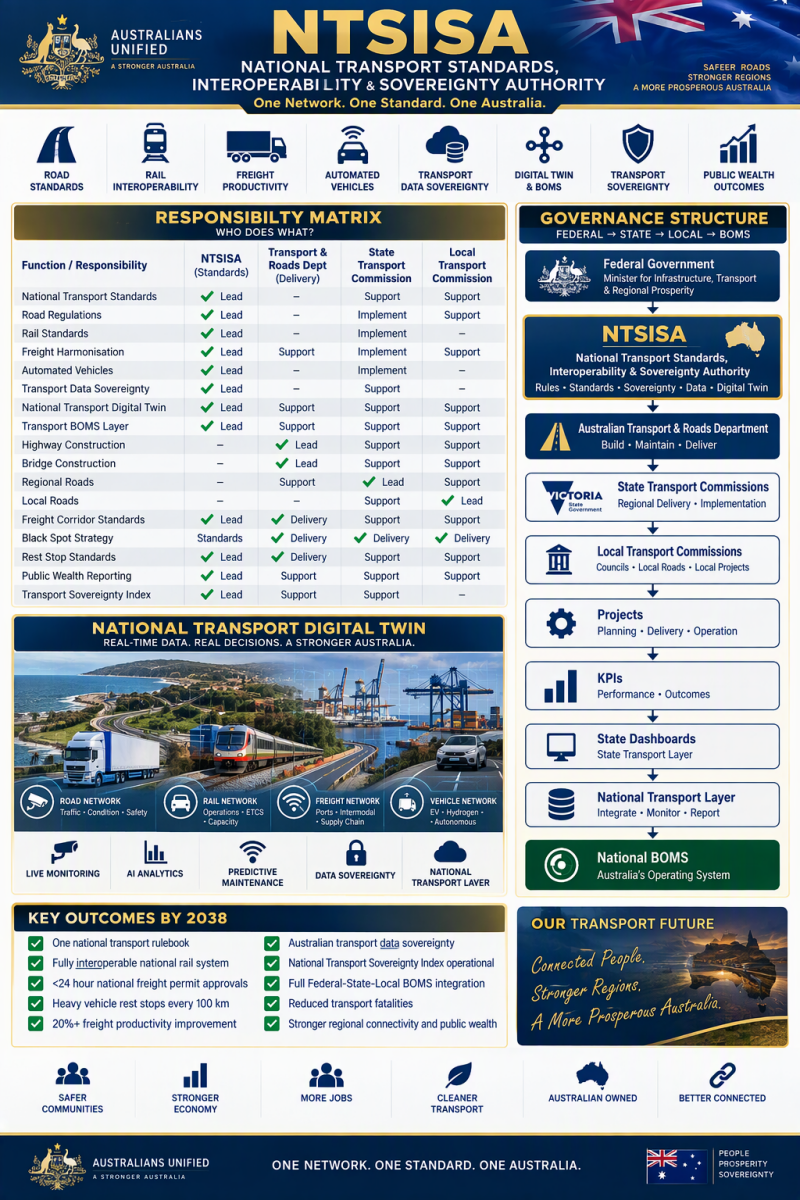
Transforming into the National Transport Standards & Interoperability Authority
Under the Australians Unified framework, the National Transport Commission evolves from an advisory body into Australia's primary transport harmonisation, interoperability, and freight productivity authority.
Australians Unified evolution & mission
While the current NTC primarily drafts model laws and advisory policy, the newly established NTSIA holds an expanded mandate: "To create one nationally integrated transport system by harmonising road, rail, freight, automated vehicles and transport technologies across Australia."
Vision 2050 transport pillars
Delivering a unified future powered by one national transport rulebook, seamless interstate freight logistics, comprehensive national rail interoperability, fully integrated supply chain corridors, and cohesive Federal-State-Local transport alignment.
Core regulatory purpose
The Authority serves as Australia's statutory National Transport Regulator, National Freight Harmonisation Agency, Automated Vehicle Certification Authority, and National Rail Interoperability Authority, ensuring safety across all state borders.
Digital twin & portfolio structure
Positioned within the Department of Infrastructure, Transport & Regional Prosperity alongside Airservices Australia and AMSA, the authority coordinates the real-time national transport digital twin and sovereign transport data networks connecting state and local transport commissions.
🏛 Transport Sovereignty Framework
National Objective
Ensure Australia's road, rail, freight, logistics and transport data systems remain secure, interoperable, productive and sovereign.
Sovereignty Pillars
✅ Infrastructure Sovereignty
✅ Rail Sovereignty
✅ Freight Sovereignty
✅ Transport Data Sovereignty
✅ Vehicle Technology Sovereignty
✅ Logistics Sovereignty
✅ Workforce Sovereignty
✅ Digital Sovereignty
Federal government projects overview
Key regulatory, safety, and interoperability initiatives managed directly by the National Transport Commission (NTC) and Commonwealth statutory partners, upgraded through Australians Unified (AU) and Department of Business Operations (DBO) frameworks.
| Core federal project & statutory partners | Scope & AU / DBO upgrade |
|---|---|
| Heavy Vehicle National Law (HVNL) Reform & National Access Harmonisation (NTC & NHVR) | ~$14M+/yr baseline updating mass, dimension, and access rules; upgraded with Fair Go reform and 1-click national access portal |
| National Rail Interoperability & ETCS Signalling Standards (NTC & ONRSR) | $25M+ multi-year program unifying ETCS Level 2 signalling and crew qualifications with binding national mandates |
| Automated Vehicle Safety Law (AVSL) & Freight Regulation (NTC, DITRDCA & Austroads) | $18M+ rollout establishing national safety laws with mandatory onshore server storage for mapping and telemetry |
| Next-generation standards & digital infrastructure | Scope & AU / DBO upgrade |
|---|---|
| Australian Dangerous Goods (ADG) Code & Zero-Emission Standards (NTC) | Maintains core safety codes for lithium-ion and hydrogen, introducing open-access heavy-freight charging/refuelling standards |
| National Freight Data Hub & Transport Digital Twin Integration (DITRDCA, BITRE & NTC) | $30M+ digital spine streaming real-time corridor data into BOMS under Australian sovereign data laws |
| Summary scorecard: NTC → NTSISA reform metric | Target & return (2026–27 to 2038) |
|---|---|
| Current advisory baseline (NTC) | ~$14M / yr (voluntary state model-law adoption) |
| Proposed AU authority (NTSISA) | $185M / yr (binding national rules & digital twin) |
| 10-year investment vs. economic return | $1.85B out — $11.8B return (BCR of 6.4 : 1, or 540% net economic return by 2038) |
| 2038 strategic targets | 1 national rulebook, 100% onshore transport data, zero cross-border rail delays |
Federal government-incentivised transport standards and digital programs
Co-funded Commonwealth grants, digital telematics initiatives, zero-emission freight corridors, and rail interoperability trials delivering enhanced sovereign capability alongside Australians Unified and proposed NTSISA upgrades.
| Program & baseline investment | Delivery split & AU / NTSISA upgrade |
|---|---|
| NHVR Heavy Vehicle Safety Initiative (HVSI) — $5.5M+/year matched grants ($50K–$500K) targeting rollover prevention, fatigue, and blind-spot technology | 80% Australian trucking groups and SMEs vs. 20% foreign safety-tech vendors. Upgrades into a $35M/year direct 50% equipment rebate for domestic owner-drivers. |
| Zero-Emission Heavy Vehicle (ZEHV) & Freight Corridor Trials — $70M+ multi-year pool co-funded via ARENA for electric and hydrogen freight trials | 50% Australian logistics and charging builders vs. 50% foreign truck OEMs (Volvo, Daimler, Scania, BYD). Upgrades to require universal open-access chargers and 50%+ local assembly. |
| National Telematics & Intelligent Access Program (IAP) — industry-funded regulatory compliance and route monitoring scheme supporting 20,000+ heavy vehicles | 65% Australian telematics providers (MTData, Netcorp, Transtech) vs. 35% foreign SaaS platforms (Geotab, Samsara). Upgrades eliminate duplicate state fees and mandate a ban on offshore data storage. |
| Digital rail & intelligent transport program | Delivery split & AU / NTSISA upgrade |
|---|---|
| National Rail Interoperability & ETCS Testing Program — $40M+ pool validating European Train Control Systems across interstate lines | 75% Australian universities, CSIRO, and local engineers vs. 25% multinational signalling OEMs (Siemens, Alstom, Hitachi). Upgrades establish an open-architecture Australian rail signalling standard. |
| Cooperative Intelligent Transport Systems (C-ITS) & Smart Corridors — $25M+ grant initiative testing vehicle-to-everything (V2X) connectivity | 60% Australian road authorities and sensor firms vs. 40% foreign automotive and telecom vendors. Upgrades mandate ASD cyber-hardening and 100% onshore sovereign data storage. |
| Summary scorecard: who delivers incentivised programs? (2026–27) | Sovereignty target & operational reform |
|---|---|
| Heavy-vehicle safety equipment rebates | Shift from discretionary grant rounds to a $35M/year direct rebate supporting Australian owner-drivers |
| Freight corridor charging infrastructure | Mandatory non-proprietary open-access hardware with at least 50% domestic manufacturing and assembly |
| Regulatory telematics and data governance | Single national access scheme with 100% onshore telemetry hosting under Australian statutory privacy laws |
| Rail signalling and communications architecture | Binding open-source signalling protocols eliminating multi-vendor lock-in across interstate networks |
╔═══════════════════════════════════════════════════════════════════════════════════════════════╗
║ INCENTIVISED TRANSPORT STANDARDS & DIGITAL GRANTS (~$140M+ Active Commonwealth Pool) ║
╠═══════════════════════════════════════════════════════════════════════════════════════════════╣
║ Overall Contractor & Recipient Split: 🇦🇺 66% Australian-Owned [█████████████░░░░░░░] 34% 🌐 Foreign ║
║ Owner-Driver Safety & Rail Skills: 🇦🇺 78% Australian-Owned [████████████████░░░░] 22% 🌐 Foreign ║
║ Zero-Emission Trucks & Smart V2X: 🇦🇺 55% Australian-Owned [███████████░░░░░░░░░] 45% 🌐 Foreign ║
╚═══════════════════════════════════════════════════════════════════════════════════════════════╝
AU + NTSISA 2037 TARGET: 🇦🇺 90%+ Australian Transport Tech, Onshore Data & Local Fleet Assembly
Federal private sector transport tech, telematics and freight ownership breakdown
Mapping private road freight carriers, interstate rail operators, vehicle OEMs, fleet telematics platforms, and automated vehicle developers across Australian-owned versus foreign-controlled entities in 2026–27, alongside Australians Unified (AU) and NTSISA sovereign reforms.
| Sector and enterprise footprint | Ownership split and sovereign reform |
|---|---|
|
1. Interstate road freight & cold-chain logistics • 🇦🇺 AU: Linfox, Lindsay Australia (ASX), Centurion, Followmont, family owner-drivers • 🌐 Foreign: Toll Group (Japan Post), DHL Supply Chain (Germany), DSV (Denmark), Amazon Freight (US) |
🇦🇺 ~45% / 🌐 ~55% ($95B+ market) Risk: Multinational conglomerates squeeze contract rates and shift fatigue onto owner-drivers. AU + NTSISA reform: Enforceable Chain of Responsibility and Fair-Rate transport floor holding consignors liable. |
|
2. Interstate bulk & intermodal rail-freight operators • 🇦🇺 AU: Aurizon (ASX), Qube Holdings (ASX intermodal terminals), SCT Logistics • 🌐 Foreign: Pacific National (GIP/BlackRock, CPPIB), Genesee & Wyoming / One Rail (Brookfield) |
🇦🇺 ~40% / 🌐 ~60% ($12B+ sector) Risk: Fragmented state signalling and unequal access restrict rail share, keeping heavy trucks on highways. AU + NTSISA reform: Binding national rail interoperability rulebook mandating ETCS Level 2 signalling. |
| Technology and fleet manufacturing sector | Ownership split and sovereign reform |
|---|---|
|
3. Heavy-vehicle trucks, buses & rolling-stock OEMs • 🇦🇺 AU: SEA Electric (EV trucks), Volgren, Custom Denning, local trailer builders (MaxiTRANS, Krueger) • 🌐 Foreign: PACCAR/Kenworth (US), Volvo/Mack (Sweden), Daimler (Germany), Scania, CRRC/Alstom/Siemens |
🇦🇺 ~15% / 🌐 ~85% ($18B+ market) Risk: Extreme reliance on imported prime movers leaves fleet transition exposed to offshore bottlenecks. AU + NTSISA reform: 50%+ Australian local content mandate and sovereign fleet assembly on public contracts. |
|
4. Transport telematics, GPS & fleet AI platforms • 🇦🇺 AU: MTData (Telstra), Netcorp GPS, Transtech, domestic fleet-management SMEs • 🌐 Foreign: Geotab (Canada), Samsara (US), Teletrac Navman (Vontier — US), Motive (US) |
🇦🇺 ~30% / 🌐 ~70% ($2.2B+ tech market) Risk: Foreign platforms harvest corridor movement, mass, and telemetry data onto offshore cloud servers. AU + NTSISA reform: Transport Data Sovereignty Act enforcing onshore data hosting and open-standard protocols. |
| Future autonomy and robotics sector | Ownership split and sovereign reform |
|---|---|
|
5. Automated vehicles (AVs), autonomous freight & LiDAR mapping • 🇦🇺 AU: CSIRO Data61, Australian university robotics labs, mining and agricultural autonomy innovators • 🌐 Foreign: Tesla (US), BYD (China), Waymo / Alphabet (US), Aurora (US), Mobileye (Israel/US) |
🇦🇺 ~10% / 🌐 ~90% (rapidly emerging) Risk: Offshore entities harvest road-level camera, LiDAR, and driver biometrics without statutory oversight. AU + NTSISA reform: Mandatory pre-market AV safety certification and strict bans on exporting raw mapping telemetry. |
|
Summary strategic targets for transport sovereignty • Benchmark transition targets from 2026–27 to 2038 • Australians Unified and NTSISA long-range economic security objectives |
🇦🇺 90%+ target across data, tech & freight assembly Milestones: 100% onshore hosting for transport telemetry, universal non-proprietary charging standards, and fair cost-recovery for Australian drivers. |
╔═══════════════════════════════════════════════════════════════════════════════════════════════╗
║ AUSTRALIAN PRIVATE TRANSPORT TECH, OEM & FREIGHT LOGISTICS FOOTPRINT (2026–27) ║
╠═══════════════════════════════════════════════════════════════════════════════════════════════╣
║ Automated Vehicles & Road Mapping: 🇦🇺 10% Australian-Owned [██░░░░░░░░░░░░░░░░░░] 90% 🌐 Foreign ║
║ Heavy Trucks, Buses & Rail OEMs: 🇦🇺 15% Australian-Owned [███░░░░░░░░░░░░░░░░░] 85% 🌐 Foreign ║
║ Fleet Telematics & AI Platforms: 🇦🇺 30% Australian-Owned [██████░░░░░░░░░░░░░░] 70% 🌐 Foreign ║
║ Interstate Rail-Freight Operators: 🇦🇺 40% Australian-Owned [████████░░░░░░░░░░░░] 60% 🌐 Foreign ║
║ Interstate Road & Cold-Chain Freight: 🇦🇺 45% Australian-Owned [█████████░░░░░░░░░░░] 55% 🌐 Foreign ║
╚═══════════════════════════════════════════════════════════════════════════════════════════════╝
AU + NTSISA 2037 TARGET: 🇦🇺 100% Onshore Transport Data Sovereignty & 55%+ Domestic Fleet/Tech Control
Sector-by-sector 10-year transport breakdown (2016–17 vs. 2026–27)
Over the past decade, Australia's transport, freight, and logistics networks have undergone an unprecedented foreign takeover. Total annual sector activity expanded by 65.3% from ~$98.0B to ~$162.0B, yet local Australian ownership grew by just +18.5% while foreign-controlled balance sheets surged by +117.8% (from ~$46.1B to ~$100.4B).
Aviation dropped from 56% to 46% domestic control following the buyout of Virgin Australia by US private equity and foreign airlines, while aerospace systems became dominated by Thales, Boeing, and Airbus. Maritime and shipping collapsed from 38% to 26% Australian ownership due to 50-year private port leases to offshore sovereign funds and the reduction of the Australian-flagged coastal fleet. In freight logistics and transport tech, domestic share slid from 52% to 39% as giants like Pacific National and Toll were consolidated overseas, local truck assembly vanished, and offshore SaaS telematics captured 70% to 90% of vehicle telemetry.
Under the Australians Unified (AU) and DBO 10-year reversal framework (2027–2037), this erosion is halted at 38%. By leveraging the National Public Bank, Sovereign Super, a dedicated 30-ship strategic coastal fleet, 50%+ domestic assembly mandates, and statutory onshore data locks, Australian-owned control will rebuild back to 65%+ by 2037.
SWOT analysis for national transport reform
An overview of the National Transport Commission’s strategic position: the foundations it can build on, barriers to national consistency, emerging opportunities for safer freight and mobility, and risks that require coordinated action.

Strengths
Australia has a strong base for reform: an existing national transport framework, the Heavy Vehicle National Law, established National Transport Commission expertise, and nationally significant freight networks connecting communities, ports, producers and markets.

Weaknesses
State-by-state implementation can create interstate inconsistencies, regulatory duplication and fragmented data systems. These gaps add complexity for operators and make it harder to deliver seamless national transport outcomes.

Opportunities
Automated vehicles, digital transport systems, national freight harmonisation, interoperable rail networks and AI-enabled freight logistics offer practical pathways to safer, more productive and better-connected transport across Australia.

Threats
Cyber attacks, data sovereignty risks, freight disruptions and continuing interstate regulatory fragmentation could undermine transport resilience. National safeguards, secure data governance and coordinated contingency planning are essential.
National transport strategy pathways
Four coordinated strategies turn the National Transport Commission’s strengths, risks and opportunities into practical national reform—building freight productivity, transport sovereignty, technology-led modernisation and enduring regulatory harmonisation.

National freight productivity strategy
SO strategy: use Australia’s established transport networks to create the world’s most efficient freight system. Actions include national interoperability, a freight digital twin, national corridor optimisation and automated freight systems.

Transport sovereignty strategy
ST strategy: protect Australia’s transport systems from cyber, data and infrastructure vulnerabilities through sovereign transport data hosting, national cyber security standards and a transport resilience framework.

Transport modernisation strategy
WO strategy: use new technology to eliminate transport inefficiencies. Priority actions are AI traffic management, automated vehicle certification and national transport platforms.

National harmonisation strategy
WT strategy: reduce long-term regulatory complexity with one national rule book, one permit framework and one interoperability framework for seamless movement across Australia.
Four national transport reforms
Australians Unified proposes four practical reforms to make transport safer, faster and more consistent across Australia: binding interoperability standards, sovereign transport data protections, a fairer Heavy Vehicle National Law, and a one-click national access portal for freight permits.

National interoperability mandate
Problem: fragmented state transport standards delay interstate movement. Create binding national standards for rail signalling, rail operations, heavy vehicle access and freight regulation—reducing transport delays and lowering logistics costs.

Vehicle safety and sovereign data act
Problem: overseas technology providers increasingly control vehicle and logistics data. Require Australian-based data storage, transport telemetry sovereignty and autonomous vehicle certification for stronger sovereignty and enhanced cyber security.

HVNL fair go reform
Problem: the Heavy Vehicle National Law can penalise minor paperwork breaches while systemic freight issues remain unresolved. Separate safety breaches from administrative errors and strengthen Chain of Responsibility enforcement for safer freight and better driver outcomes.

One-click national transport access portal
Problem: oversize and freight permits remain fragmented. Establish one national permit system with digital route approvals and automated transport access approvals—delivering faster freight approvals and less administrative burden.
Public wealth transport model
Moving beyond legacy systems fixated only on compliance, fines, and penalties. Australians Unified introduces a national transport public wealth model driven by productivity, regional vitality, and shared prosperity.
From punitive tracking to national wealth creation
Current systems measure transport through negatives: compliance breaches, fines, accidents, and red tape. Our framework refocuses measurement on national asset performance: Transport Investment > Productivity > Industry Growth > Jobs > Regional Growth > Public Wealth.
Freight productivity
Establishing core productivity indicators focused on lowering the net cost per tonne-kilometre, shortening transit times across interstate freight routes, and removing systemic supply chain bottlenecks through integrated rail and road freight networks.
Regional prosperity
Unlocking the full productive capacity of regional communities. Measurable targets include expanding regional freight throughput, creating quality transport and maintenance jobs, and boosting long-term domestic and foreign investment attraction.
Economic growth and logistics competitiveness
Directly tracking transport's overall contribution to national GDP, enhancing port and air export efficiency, and cementing Australia's international logistics competitiveness through dependable, sovereign infrastructure and digital networks.
National transport digital twin
Creating a live national transport operating environment across Australia. One integrated digital twin directly feeding operational data into BOMS for superior coordination, productivity, and resilience.
Road layer
Monitors critical national highway corridors, dynamic traffic volumes, oversize and over-mass vehicle transit paths, and real-time infrastructure conditions to prevent bottlenecks and ensure long-term road safety.
Rail layer
Provides live oversight of the National Rail Grid, tracking live train movements, line network capacity, and progressive ETCS deployment to unify interstate signaling and boost rail transport throughput.
Freight layer
Connects national intermodal terminals, complex supply chain links, identified freight choke points, and seamless maritime port integration to deliver smooth multimodal logistical transfers nationwide.
Vehicle layer
Supervises automated vehicle operations, commercial electric freight fleets, designated hydrogen trucking corridors, and sovereign telematics data systems to establish Australia's next-generation transport network.
Three national transport reforms
Australians Unified proposes three connected reforms to accelerate future transport, improve national freight performance and protect Australia’s strategic transport systems.

National EV and hydrogen interoperability standard
Establish open charging standards, national hydrogen standards and a freight-corridor refuelling framework so vehicles and freight operators can transition confidently to future transport systems.

National freight digital twin
Create real-time monitoring across road freight, rail freight, intermodal hubs, ports and airports—improving network efficiency and supporting better infrastructure investment decisions.

Transport sovereignty framework
Protect national transport data, autonomous vehicle systems, freight platform infrastructure and strategic transport assets to strengthen Australia’s transport resilience.
National transport strategy priorities
Australians Unified advances three connected priorities for a secure, modern and nationally consistent transport system: protect critical transport assets and data, use technology to remove inefficiency, and simplify rules for safe movement across Australia.
Transport sovereignty strategy
ST strategy: protect Australia’s transport systems from cyber, data and infrastructure vulnerabilities through sovereign transport data hosting, national cyber security standards and a transport resilience framework.
Transport modernisation strategy
WO strategy: use new technology to eliminate transport inefficiencies through AI traffic management, automated vehicle certification and connected national transport platforms.
National harmonisation strategy
WT strategy: reduce long-term regulatory complexity with one national rule book, one permit framework and one interoperability framework for seamless transport across Australia.
BOMS transport layer architecture and governance
BOMS layer structure
The Authority functions as the dedicated Transport Layer Manager for Australia's National BOMS architecture, harmonising mission-critical operating environments across seven key structural tiers:
- National BOMS: Sovereign core systems architecture
- National Transport Layer: Centralised operational oversight
- Road Layer: Highway monitoring and automated route access
- Rail Layer: ETCS deployment and network capacity tracking
- Freight Layer: Multimodal logistics and freight corridor flows
- Vehicle Layer: EV, autonomous, and fleet telematics
- Safety Layer & Infrastructure Layer: Asset integrity, resilience baselines, and standards enforcement
Transport reporting chain
Ensuring end-to-end operational visibility, accountability flows systematically from local ground assets up to the national leadership core:
- Project: Field delivery and local infrastructure initiatives
- Program: Coordinated regional implementations
- Local Transport Commission: Municipal integration
- State Transport Commission: State network operations
- Federal NTSISA: National transport safety and interoperability standards
- National Transport Layer: Unified sovereign telemetry and operational logic
- National BOMS: Whole-of-government digital operational baseline
National transport strategic frameworks
Driving national workforce support, technical rail harmonisation, sovereign data control, and regional economic prosperity across Australian transport networks.
National driver wellbeing program
Purpose: Support Australia's essential road transport workforce through binding national standards for secure truck parking, quality shower facilities, dedicated rest stops, fatigue management infrastructure, and responsive health services.
Outcome: Measurably reduced driver fatigue, enhanced road safety for all road users, and sustainable long-term workforce retention.
National rail interoperability framework
Objective: Unify fragmented state systems into one cohesive national rail system.
Deliverables: Consistent ETCS Level 2 standards, harmonised signaling networks, common train communications protocols, and uniform operating rules across state borders.
Outcome: Seamless interstate rail freight and passenger operations without cross-border technical barriers.
Transport data sovereignty framework
National principle: Australian transport data remains under sovereign domestic law.
Scope: Covers autonomous vehicles, vehicle telemetry, freight tracking, artificial intelligence transport systems, and mapping platforms.
Mandatory requirements: Sovereign Australian hosting, domestic governance and oversight, and compliance with national cyber resilience standards.
Regional prosperity framework
Core mission: Transforming regional transport routes into vital wealth generation engines.
Economic pathway: Modern Roads → Efficient Freight → Competitive Industry → Thriving Local Business → Regional Jobs → Sustained Regional Growth → Enduring Public Wealth across regional Australian communities.
50-year nation building framework (2028–2078)
A generational strategy guiding the transition of transport policy into an engine of sovereign industrial strength, automated logistics, and shared Australian prosperity.
Phase 1 (2028–2038): Harmonisation
Establishing the groundwork of full national cohesion. Priority reforms deliver seamless interstate interoperability, universal national heavy vehicle and freight permit systems, and widespread digital twin deployment across all jurisdictions.
Phase 2 (2038–2048): Automation
Accelerating supply chain performance through technology. Dedicated autonomous freight corridors, artificial intelligence logistics optimisation, and smart freight networks unlock unprecedented efficiency and transport safety.
Phase 3 (2048–2058): Sovereignty
Securing Australia's logistical destiny. Developing sovereign domestic transport technology capabilities, creating an Australian transport cloud, and establishing a dedicated transport cyber command protect our national connectivity.
Phase 4 (2058–2078): Prosperity
Realising the world's most integrated freight and transport ecosystem. Operating with near-zero regulatory fragmentation, this unified network generates sustainable public wealth and guarantees lasting regional productivity.
National transport standards, interoperability and sovereignty package 2028
Australians Unified’s Gold Standard National Transport Framework delivers one connected, safe and sovereign transport system. The proposed National Transport Standards, Interoperability & Sovereignty Act 2028 establishes national rules, digital capability and public-wealth outcomes across road, rail, freight and future transport.
One national network
End state-by-state fragmentation through national rail interoperability, ETCS Level 2 implementation, uniform heavy-vehicle access, freight-corridor standards and harmonised interstate permits. The National Rail Harmonisation Program supports seamless operations, consistent signalling, communications and driver credentials.
Digital freight visibility is also essential to a truly integrated national network. Shared real-time data platforms can connect rail operators, road carriers, ports, terminals and customers, improving asset utilisation, reducing delays and giving businesses clearer information about shipment status. Common data standards and secure information-sharing arrangements will help coordinate freight movements across jurisdictions, strengthen supply-chain resilience and support faster, more reliable interstate trade.
Safe and sovereign technology
Establish autonomous vehicle certification, national telematics and AI safety requirements, Australian-hosted transport data and a transport cyber security framework. Open EV charging, hydrogen and heavy-vehicle refuelling standards reduce barriers to investment in future freight corridors.
Build a nationally coordinated skills and workforce program to prepare drivers, technicians, engineers and emergency services for emerging transport technologies. Targeted training, recognised qualifications and industry partnerships will help regional communities and freight operators adopt new systems safely, creating skilled jobs while ensuring the benefits of cleaner, more connected transport are shared across Australia.

Fairer freight access
Modernise the Heavy Vehicle National Law by separating clerical from safety breaches, strengthening Chain of Responsibility enforcement, improving national fatigue management and simplifying compliance. A one-click freight access portal delivers automated route approvals, council integration and real-time route management, alongside safer rest stops and driver health facilities.
Invest in a nationally coordinated heavy vehicle workforce by expanding accredited training, apprenticeships and skills recognition for drivers, mechanics and logistics professionals. Clear career pathways, targeted regional incentives and better access to mental health support will help address workforce shortages, improve retention and ensure the freight industry has the skilled people needed to keep Australia moving safely and efficiently.
Data, resilience and public wealth
CCreate a National Freight Digital Twin within BOMS for live road, rail, corridor, intermodal and supply-chain intelligence. The proposed National Transport Standards, Interoperability & Sovereignty Authority will publish sovereignty, freight productivity, rail interoperability and public wealth reporting to guide resilient investment and regional prosperity.
Cybersecurity and trusted data governance will be central to this capability, ensuring that freight operators, governments and regional partners can share timely information without compromising commercial confidence, critical infrastructure or national interests. Common data standards, secure access controls and transparent performance benchmarks will support faster disruption response, better asset utilisation and coordinated decision-making across the national freight network.
NTSISA 10-year implementation timeline and KPI schedule (2028–2038)
A comprehensive breakdown detailing the phased transformation of the National Transport Commission into Australia's primary transport harmonisation, interoperability, freight productivity, sovereignty, and digital twin authority under the Australians Unified Gold Standard Roadmap.
National benefits for all Australians
Reviewing the lasting social and economic gains of unifying Australia's transport system into a single sovereign network. From lower freight costs to enhanced driver wellbeing and data protection, these core advantages support our nation's prosperity.
Seamless supply chains and lower costs
Eliminating cross-border friction, state permit backlogs, and mismatched rail signalling directly reduces the cost per tonne-kilometre, keeping everyday groceries and domestic goods affordable for Australian families.
Protected transport data and sovereignty
Mandating 100% onshore hosting for freight telemetry, mapping, and vehicle sensors ensures Australia's critical transport infrastructure remains secure against offshore cyber threats and foreign data exploitation.
Safer conditions for transport workers
Fair Go reform of heavy vehicle laws removes punitive fines for minor paperwork errors while funding dedicated rest stops, better facilities, and mental health support for essential Australian drivers.
Frequently asked questions
Key answers detailing the transition of the National Transport Commission into the National Transport Standards & Interoperability Authority (NTSISA), national freight harmonisation, and transport data sovereignty.