Department of National Business & Industry Systems (NBIS)
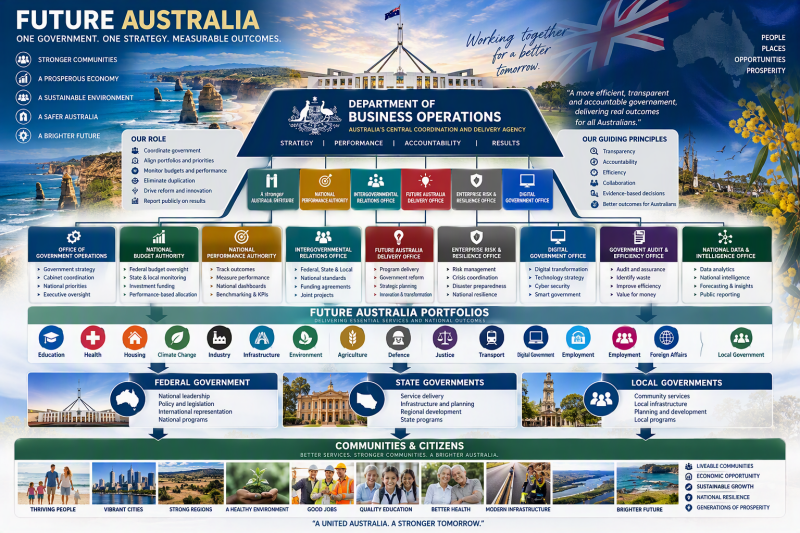
A whole-of-economy department linking all business functions together: AI-enabled, leaner, faster, more integrated, and future-ready.
The Department of National Business & Industry Systems serves as the central nervous system for Australia’s business ecosystem. By creating a single front door for Australian commerce, it consolidates fragmented operations across government to build national resilience and sovereign industry strength.
Our core role and mandate
- Unified business functions: Connects trade, industry, workforce skills, digital technology, regulation, and innovation into a cohesive operational framework.
- Single front door: Delivers streamlined access for enterprises of all sizes, eliminating bureaucracy and conflicting agency touchpoints.
- Strengthened productivity: Drives national competitiveness and commercial performance through synchronized industry policies.
- Transparent policy execution: Delivers consistent, evidence-based business regulation while removing costly duplication across public agencies.
- Sovereign capability: Protects domestic supply chain independence and reinforces long-term economic resilience.
Business operations portfolio breakdown
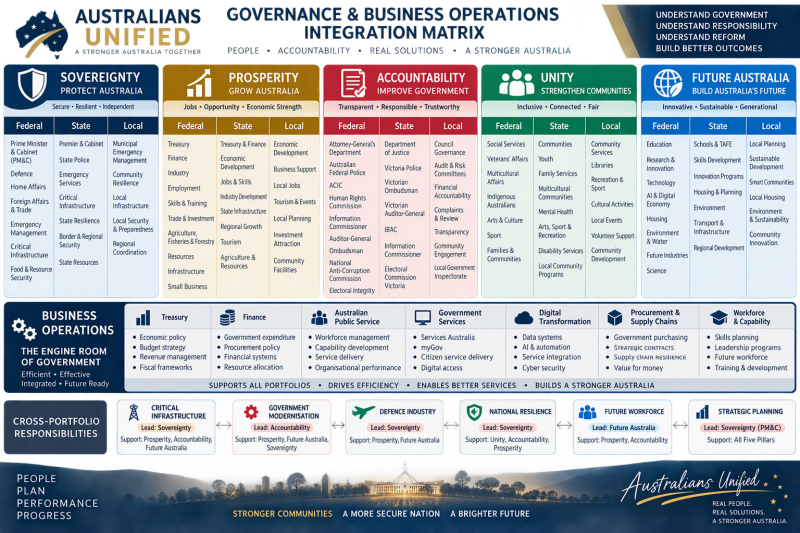
The operational engine of government
The Business Operations Portfolio supports whole-of-government administration, public sector capability, corporate operations, workforce planning, strategic procurement, digital transformation, service delivery, resource management, and organisational performance.
Primary pillar: Prosperity
Supporting pillars: Accountability, Future Australia, and Sovereignty
Federal business operations
- Treasury: Manages Australia's economic framework, revenue management, budget planning, national productivity, fiscal policy, and taxation frameworks. Key agencies include the Australian Bureau of Statistics, Productivity Commission, and AOFM.
- Department of Finance: Oversees government expenditure, resource allocation, procurement policy, financial systems, and operational efficiency through entities like the Future Fund and Comcover.
- Australian Public Service: Delivers government services, workforce capability, leadership development, and operational performance standards.
- Government services: Powers Services Australia (Medicare, Centrelink, Child Support) and myGov for modern citizen digital access.
- Digital, AI & procurement: Drives digital transformation programs, workflow automation, cyber security, vendor management, and supply chain resilience.
State and local business operations
- Department of Premier & Cabinet: Leads whole-of-government coordination, state priorities, cabinet governance, strategic planning, and intergovernmental relations.
- Treasury & Finance: Steers state budgets, revenue frameworks, procurement Victoria protocols, expenditure controls, and financial strategies.
- Public sector & Digital Victoria: Directs public sector reform, digital government integration, cyber security, and statewide workforce capability programs.
- Local government administration: Coordinates executive council operations, strategic planning, corporate services, administration, and transparent municipal leadership.
- Council finance & assets: Administers local rates collection, budget management, asset maintenance, infrastructure planning, and public contract delivery.
Cross-portfolio responsibility map
- PM&C: Lead: Sovereignty | Supports: Prosperity, Accountability, Unity, Future Australia
- Defence: Lead: Sovereignty | Supports: Prosperity, Future Australia, Unity
- Treasury & Finance: Lead: Prosperity | Supports: Sovereignty, Accountability, Future Australia
- Digital transformation: Lead: Future Australia | Supports: Prosperity, Accountability
- Government modernisation: Lead: Accountability | Supports: Prosperity, Future Australia, Sovereignty

🛡 Federal sovereignty
Portfolio overview
- Purpose: Safeguard national independence, defense capabilities, economic self-reliance, and democratic integrity across all commonwealth jurisdictions.
- Why it matters: Ensures Australia retains ultimate authority over its borders, institutions, strategic supply lines, and democratic self-determination without foreign vulnerability.
- Related five pillars: Anchors sovereignty while actively interfacing with prosperity, accountability, unity, and future Australia.
- Strategic importance: Establishes cohesive national resilience amid changing geopolitical landscapes, evolving cyber threats, and global supply chain pressures.
Prime Minister & Cabinet (PM&C)
Purpose
Provides central leadership, coordination, and strategic direction across the whole of the federal government.
Key responsibilities
- National leadership
- Cabinet government
- National priorities
- Whole-of-government coordination
- National security coordination
- Crisis & emergency coordination
- Strategic policy
Key agencies and functions
- National Security Committee support
- Cabinet Secretariat
- Office for Women
- Indigenous Affairs coordination
- Intergovernmental relations
Cross-portfolio responsibilities
- Prosperity: Economic strategic alignment
- Accountability: Executive transparency and ministerial standards
- Unity: National cohesion and federation coordination
- Future Australia: Long-range sovereign policy planning
Policy issues & amendments
- Addressing ministerial overreach and streamlining national cabinet policy outputs.
- Codifying rapid response frameworks for emergency federal intervention.
Governance issues & reforms
- Establishing statutory transparency for National Security Committee processes.
- De-politicising senior public service appointments through independent oversight.
Defence
Purpose
Protects Australia’s territory, citizens, borders, and national strategic interests through decisive military capability.
Key responsibilities
- Military defence
- Defence capability
- National security
- Defence industry
- Strategic intelligence
- Military operations
Key agencies
- Australian Defence Force
- Australian Army
- Royal Australian Navy
- Royal Australian Air Force
- Defence Intelligence
- Defence Science and Technology
Cross-portfolio responsibilities
- Prosperity: Domestic manufacturing, naval shipbuilding, and sovereign defence industrial base
- Accountability: Procurement transparency and expenditure auditing
- Unity: Veteran community welfare and national service pride
- Future Australia: Advanced technological readiness and quantum/AI defence applications
Policy issues & amendments
- Addressing chronic delays and cost blowouts in major acquisition programs.
- Re-evaluating sovereign domestic manufacturing mandates for munitions and fuels.
Governance issues & reforms
- Reforming defence capability and sustainment group management structures.
- Implementing independent procurement oversight and strict delivery milestones.
Home Affairs
Purpose
Coordinates domestic safety, border integrity, law enforcement, and federal resilience against domestic and transnational threats.
Key responsibilities
- Border security
- Immigration security
- Counter-terrorism
- Cyber security
- Protective security
- Critical infrastructure security
Key agencies
- Australian Border Force
- National Emergency Management Agency
- Australian Cyber Security Centre
Cross-portfolio responsibilities
- Accountability: Oversight of surveillance, detention integrity, and civil liberties protections
- Unity: Social cohesion and respectful border administration
Policy issues & amendments
- Resolving persistent immigration backlog bottlenecks and visa processing integrity.
- Clarifying national cyber security standards across private and public sectors.
Governance issues & reforms
- Restructuring internal operational reporting lines to prevent inter-agency silo culture.
- Strengthening public reporting of counter-espionage and counter-interference measures.
Foreign Affairs & Trade
Purpose
Advances Australia’s international interests, global diplomatic relationships, security alliances, and economic opportunities.
Key responsibilities
- Diplomacy
- International relations
- Trade agreements
- Strategic partnerships
- Consular services
Key agencies
- Department of Foreign Affairs and Trade
- Austrade
- Overseas missions
Cross-portfolio responsibilities
- Prosperity: Bilateral trade deals, foreign direct investment, and export markets
- Unity: Cultural diplomacy and international educational integration
- Future Australia: Regional climate stability agreements and international technology partnerships
Policy issues & amendments
- Modernising trade diversification initiatives away from single-market dependencies.
- Strengthening strategic bilateral ties across the Pacific and Indian Ocean rim.
Governance issues & reforms
- Rationalising diplomatic post expenditure with verified bilateral impact metrics.
- Integrating geopolitical intelligence directly into multi-agency trade policy development.
Emergency Management
Purpose
Prepares the Commonwealth for, responds to, and recovers from national disasters and emergencies.
Key responsibilities
- Disaster response
- National resilience
- Emergency coordination
- Crisis recovery
Key agencies
- National Emergency Management Agency
Cross-portfolio responsibilities
- Unity: Local council alignment and unified community relief networks
- Accountability: Fair and timely disaster relief funding distribution
- Prosperity: Mitigating economic shocks and infrastructure rebuild operations
Policy issues & amendments
- Streamlining commonwealth-state disaster relief activation triggers.
- Improving public access to immediate relief payments with zero red tape.
Governance issues & reforms
- Centralising all cross-jurisdictional emergency disaster data under single unified command systems.
- Establishing public audit trails for relief funding allocations.
Critical Infrastructure
Purpose
Safeguards vital energy, water, telecommunications, and transport networks underpinning civil stability.
Key responsibilities
- Energy security
- Water security
- Communications security
- Transport networks
- Strategic assets
Cross-portfolio responsibilities
- Prosperity: Continuous industry operability and productivity
- Accountability: Transparent foreign asset ownership compliance
- Future Australia: Grid decarbonisation and modern automated transit infrastructure
Policy issues & amendments
- Preventing foreign state monopolisation of domestic energy grids and water resources.
- Mandating real-time cyber protection standard compliance across critical operators.
Governance issues & reforms
- Establishing proactive audits for foreign investment in critical physical infrastructure.
- Enforcing cross-jurisdictional resilience protocols for communication utilities.
Food & Resource Security
Purpose
Ensures sustainable, independent national access to agriculture, fisheries, energy resources, and clean water.
Key responsibilities
- Agriculture
- Fisheries
- Forestry
- Supply chains
- Resource stewardship
Cross-portfolio responsibilities
- Prosperity: High-yield domestic output and value-added primary product exports
- Future Australia: Sustainable regenerative farming practices and ecosystem conservation
Policy issues & amendments
- Restricting overseas water licence holding and speculative rural land acquisitions.
- Securing national fertiliser, seed, and grain storage reserves.
Governance issues & reforms
- Establishing sovereign agricultural supply board transparency standards.
- Auditing compliance within forestry, biosecurity, and coastal fishing reserves.
Cross-portfolio responsibility map
Framework: The Lead Portfolio owns responsibility; Supporting Portfolios contribute, regulate, fund, coordinate, or deliver auxiliary functions.
- Critical infrastructure: Lead: Sovereignty | Supporting: Prosperity, Accountability, Future Australia
- Defence industry: Lead: Sovereignty | Supporting: Prosperity, Future Australia
- National resilience: Lead: Sovereignty | Supporting: Unity, Accountability, Prosperity
- Strategic planning: Lead: Prime Minister & Cabinet | Supporting: All Pillars
Related learning links
Why this department is needed
The problem of departmental fragmentation
Currently, business-related responsibilities are scattered across multiple disparate agencies: Treasury, Industry, Austrade, Skills & Training, the Digital Transformation Agency, ACCC, ASIC, Fair Work, Agriculture, and Climate & Energy.
This ongoing division produces overlapping, duplicated programs, inconsistent regulatory interpretations, and substantial administrative expenses that strain public finances and stifle commercial momentum.
The unified NBIS solution
Operating across disconnected silos leads to slow decision-making, poor data sharing, and chronic confusion for Australian enterprises trying to navigate compliance and trade pathways.
The Department of National Business & Industry Systems (NBIS) directly solves this by linking all business operations, trade portfolios, and regulatory mechanisms together into one integrated, automated, and streamlined ecosystem.

OUR STRENGTHS
Economic & Business Operations Strengths
-
Whole‑of‑economy oversight
-
Unified business policy and regulation
-
Stronger national competitiveness
-
Streamlined business support
AI‑Enhanced Strengths (New Model)
-
Automated regulatory compliance
-
AI‑driven industry forecasting
-
Predictive economic modelling
-
Real‑time business intelligence dashboards
-
Integrated national business data platform

.OUR WEAKNESSES (PRE‑AI, PRE‑UNIFICATION)
-
Fragmented business functions
-
Slow regulatory processes
-
High administrative overhead
-
Conflicting policy directions
-
Limited cross‑agency coordination

OUR THREATS
External Threats
-
Global economic volatility
-
International competition
-
Supply chain disruptions
-
Technological disruption
Internal Threats
-
Political appointments influencing priorities
-
Legacy systems
-
High program duplication
-
Workforce shortages in specialist roles
Strategic opportunities and anti-capture safeguards
Our opportunities (AI-enabled)
By modernising the department through intelligent systems, we eliminate unnecessary friction and reinforce our national economy:
- Automated regulation: Seamlessly automate business regulation and compliance workflows.
- Industry forecasting: Deploy AI-enabled forecasting to identify market trends and supply disruptions early.
- Administrative efficiency: Significantly reduce operational overhead and redundant bureaucracy.
- Reporting and transparency: Improve transparency with immediate public metrics and live dashboards.
- Tamper-proof systems: Strengthen institutional independence through immutable records.
- Sovereign reinvestment: Reinvest public savings directly into Australian innovation, skills, and sovereign capability.
Anti-capture safeguards
Strict governance protocols prevent external political influence or partisan redirection of core department operations:
- 1. AI-governed policy prioritisation: Business programs and regulatory priorities are determined by transparent algorithms rather than political preferences.
- 2. Immutable audit trails: All operational decisions, system adjustments, and approvals are automatically logged and publicly visible.
- 3. Independent appointment panels: Leadership is appointed solely by non-political experts across industry, academia, and civil society.
- 4. Mandatory publication of ministerial contacts: Every formal or informal engagement with elected officials is automatically registered and publicised.
- 5. Strict conflict-of-interest rules: Department executives and senior staff are prohibited from political memberships, donations, or campaign work.
- 6. Decentralised data architecture: Robust distributed frameworks prevent any individual minister or agency from overriding core systems.
Investment roadmap and structural phases
A lean, AI-enabled, and politically independent transformation architecture designed to unify public operations, reduce waste, and build sovereign national capability.
Baseline funding and initial foundation
Baseline funding (reduced): $0.62B per year
Reduced from $0.88B — delivering an immediate 30% efficiency gain.
- Reduced program duplication and lower administrative overhead
- Reduced consultant reliance with AI handling repetitive processing
Phase 1 (years 1–2): $0.48B – $0.66B
Foundation: Unify & stabilise
- AI pilots for predictive forecasting and automated compliance
- Workflow automation and legacy system consolidation
- Establishment of an independent governance board and unified data architecture
Modernisation, expansion, and national scale
Phase 2 (years 2–4): $1.00B – $1.40B
Acceleration: Modernise & automate
- AI-enabled business intelligence platforms and automated compliance tools
- Digital business self-service systems, automated grants, and approvals
- Essential cyber-resilience infrastructure upgrades
Phase 3 (years 4–6): $0.80B – $1.10B
Expansion: Strengthen capability
- National business intelligence network and live industry dashboards
- Workforce augmentation systems and comprehensive public audit upgrades
Future-ready transformation (years 6–10)
Phase 4 (years 6–10): $2.20B – $2.80B
Future-ready: Transform & protect
- Fully automated regulatory review cycles
- Predictive economic modelling for national policy execution
- AI-enabled industry transformation planning
- Integrated whole-of-economy business ecosystem
People, community, and total investment
Integrity, independence, and capability:
- Strict conflict-of-interest rules with no political memberships or donations
- Mandatory publication of ministerial contacts
- AI-supported accessibility for all Australian enterprises and digital literacy uplift
Total national investment:
- 6-year total: $2.28B – $3.16B
- 10-year total: $4.58B – $5.96B
- Outcome: A lean, automated, politically independent department driving economic growth.
Frequently asked questions
Key details on how the Department of National Business & Industry Systems (NBIS) unifies public operations, implements AI-assisted workflows, and protects economic independence.