Australian federal sovereignty FAQs

Australians Unified believes national sovereignty means Australians retain the democratic capacity to make decisions about our country’s laws, security, resources, economy and future. This page answers common questions about the Federal Government’s role, national self-reliance and how everyday Australians can engage with these ideas respectfully and constructively.

Frequently asked questions

Explore clear, practical answers about Australian federal sovereignty. Australians Unified supports informed discussion, democratic participation and common ground for Australians from every background.

What is national sovereignty?

National sovereignty is Australia’s ability to govern itself through its democratic institutions, Constitution and laws. It means Australians can make decisions in the national interest while respecting the rights, responsibilities and diversity of people across the country.

How does the Federal Government protect Australia’s sovereignty?

The Federal Government has key responsibilities for matters of national importance, including defence, foreign affairs, immigration, trade, national security and elements of economic policy. It protects sovereignty by making accountable decisions, upholding the rule of law and representing Australia’s interests at home and abroad.

What role do Defence and border security play?

Defence and border security help safeguard Australia’s people, territory, critical infrastructure and national interests. Effective arrangements should be lawful, properly resourced, subject to democratic oversight and balanced with Australia’s humanitarian and international obligations.

How can foreign investment affect sovereignty?

Foreign investment can bring capital, skills, jobs and new opportunities. Sovereignty questions arise when investment involves strategic assets, essential services, land, resources or sensitive technology. Transparent rules, careful national-interest assessment and strong regulation help Australia retain appropriate control and resilience.

What is Australia’s role in international agreements?

Australia enters international agreements to cooperate on trade, security, climate, human rights and other shared challenges. These agreements should be considered openly through Australia’s democratic processes, with a clear understanding of their benefits, commitments and effect on Australia’s ability to make independent decisions.

How can Australia increase self-reliance?

Self-reliance can be strengthened by building local capability in essential industries, skills, energy, food, manufacturing, technology, supply chains and emergency preparedness. It does not mean isolation; it means being better prepared to support Australians and make confident choices during disruption or change.

How do Australians Unified shop items connect to unity and sovereignty?

Australians Unified products are designed to help supporters express a shared commitment to informed participation, national resilience and constructive unity. Purchasing from the online shop is a voluntary way to show support for the message and help build awareness around common-ground conversations.

How can I get involved with Australians Unified?

Start by exploring the Sovereignty Portfolio and reform information, sharing ideas respectfully and joining Australians Unified as a free member. You can also browse the online shop to find products that reflect your support for unity, participation and Australia’s future.


What is national sovereignty?

National sovereignty is Australia's ability to govern itself, make its own laws, protect its borders, manage its resources, and make decisions in the national interest without undue influence from external governments, organisations, or interests.

Sovereignty includes political independence, economic resilience, border security, national defence, food security, energy security, and the ability to maintain control over critical infrastructure and strategic assets.

A sovereign nation has the capacity to protect its citizens, uphold its democratic institutions, and respond to national challenges while preserving Australia's identity, freedoms, and interests.


What Sovereignty reforms does Australians Unified support?

Australians Unified supports strengthening Australia's ability to make independent decisions in the national interest through improved national resilience, strategic planning, critical infrastructure protection, and long-term capability development. Sovereignty is strengthened when Australia can provide essential services, protect strategic assets, and respond effectively to future challenges.


How can Australia strengthen strategic self-reliance?

Australia can improve self-reliance by supporting domestic manufacturing, strengthening supply chains, investing in critical industries, developing workforce skills, and encouraging innovation. The goal is to maintain the ability to meet national needs during global disruptions while remaining connected to international markets.


How can critical infrastructure be better protected?

Critical infrastructure such as energy networks, water systems, communications, transport corridors, and digital systems can be protected through long-term planning, maintenance programs, cybersecurity measures, resilience strategies, and coordinated oversight between governments.


Be part of Australia’s conversation

Sovereignty is strengthened when Australians are informed, engaged and willing to find common ground. Join Australians Unified for free to follow the conversation, explore federal reform ideas and stand with a community focused on Australia’s future.

Defence Force

A–Z Reforms

  • ADF Infrastructure Support Partnership (AISP)

  • ADFHQ Modernisation

  • Base & Logistics Hardening

  • Civil–Defence Joint Mobilisation Model

  • Cyber Defence Expansion (ASD)

  • Disaster Response Integration

  • Engineering & Technical Workforce Expansion

  • Infrastructure Resilience (Dual‑Use Assets)

  • Intelligence Interoperability Upgrade

  • Joint Operations Command Modernisation

  • Joint Capabilities Group Reform

  • Northern Defence Network Strengthening

  • Sovereign Defence Industry Expansion

  • Space & Multi‑Domain Capability Growth


EDUCATION PORTFOLIO

A–Z Reforms

  • Adaptation of National Curriculum (Faster Cycles)

  • Community‑Led First Nations Education

  • Digital Learning Infrastructure Modernisation

  • Early Childhood Expansion & Affordability

  • Equity Programs for Vulnerable Learners

  • Integrated Data‑Sharing Platform (National)

  • International Education Strengthening

  • Lifelong Learning Pathways

  • National Education Data Spine

  • National Teacher Workforce Strategy

  • Outcome‑Linked Funding Models

  • Regional & Remote Education Access

  • Skills & Workforce Transition Pipelines

  • Teacher Wellbeing & Retention Programs


EMPLOYMENT & WORKPLACE RELATIONS

A–Z Reforms

  • Apprenticeship & Trades Expansion

  • Behaviour‑Change & Reintegration Programs

  • Digital Workplace‑Compliance Tools

  • Dispute Resolution Acceleration

  • Employer Incentives for Structured Placements

  • Fair Work Modernisation

  • First Nations Employment Pathways

  • Gig‑Economy Worker Protections

  • Justice → Employment Pipelines

  • Labour‑Market Forecasting Platform

  • National Workforce Capability Board

  • Regional Workforce Development Programs

  • Safety Standards Strengthening

  • Skills Transition & Reskilling Programs

  • Workplace Relations System Modernisation


FOREIGN AFFAIRS & TRADE

A–Z Reforms

  • Aid & Development Modernisation

  • Consular Crisis‑Response Strengthening

  • Diplomatic Capability Expansion

  • Economic Diversification (Indo‑Pacific)

  • Export & Investment Support Expansion

  • Global Partnerships Strengthening

  • International Legal & Treaty Reform

  • Regional Stability & Security Programs

  • Trade Agreement Modernisation

  • Workforce Capability for Overseas Posts


HOME AFFAIRS

A–Z Reforms

  • Autonomous Border Surveillance

  • Biometric & AI‑Enabled Screening

  • Border Fleet Renewal

  • Counter‑Foreign Interference Expansion

  • Cyber Security Skills Pipeline

  • Emergency Management Interoperability

  • Immigration Digital Transformation

  • Integrity & Anti‑Corruption Systems (ABF)

  • Maritime & Aviation Security Modernisation

  • Multicultural Cohesion Programs

  • National Resilience Grid (NEMA)

  • Smart Borders (AI + Biometrics)

  • Visa Backlog Reduction & System Reform


INFRASTRUCTURE, TRANSPORT & REGIONAL DEVELOPMENT

(From your integrated reforms across portfolios)

A–Z Reforms

  • Airfield & Remote Access Upgrades

  • Critical Infrastructure Hardening

  • Disaster‑Resilient Transport Corridors

  • National Infrastructure Priority List

  • Northern Development Corridors

  • Regional Connectivity Upgrades

  • Strategic Fuel & Logistics Hubs


PRIME MINISTER & CABINET (PM&C)

A–Z Reforms (Condensed, Bullet‑Pointed, Matching Your Model)

  • AI‑Enabled Cabinet Automation

  • AI‑Enabled National Forecasting & Risk Modelling

  • AI‑Supported Policy Modelling

  • Business Operations Reform (Central Agency Efficiency)

  • Cabinet Secretariat Modernisation

  • Central Agency Consolidation

  • Crisis Coordination Centre Strengthening

  • Cyber‑Resilience Upgrades for Governance Systems

  • Digital Self‑Service Tools for Ministers & Departments

  • Governance & Integrity System Reform

  • Independent National Governance Board

  • Intergovernmental Relations Modernisation

  • National Governance Data Architecture (Unified)

  • National Governance Intelligence Network

  • National Performance Visibility (Real‑Time)

  • Predictive National Risk, Economic & Security Forecasting

  • Public Transparency & Audit Upgrades

  • Reduction of Consultant Reliance

  • Streamlined National Governance Architecture

  • Unified National Crisis, Resilience & Security Platform

  • Workflow Automation Across Cabinet & Central Agencies

SOCIAL SERVICES (DSS)

A–Z Reforms (Condensed, Bullet‑Pointed, Matching Your Model)

(All facts sourced from your open tab )

  • AI‑Enabled Service Delivery

  • Automated Eligibility & Real‑Time Case Management

  • Community & Crisis Support Network Expansion

  • Community‑Led Prevention Programs

  • Disability, Aged Care & Carer Integration

  • Domestic & Family Violence Prevention System (Integrated)

  • Early‑Intervention & Prevention Systems

  • Homelessness & Housing Response Network (National)

  • National Social Data Architecture (Unified)

  • National Social Outcomes Intelligence Network

  • NDIS, Aged Care & DSS System Integration

  • Predictive Modelling for Hardship, Risk & Service Needs

  • Prevention‑Led Social Policy Framework

  • Real‑Time Social Wellbeing Dashboards

  • Shared Workforce & Training Systems (Care Sectors)

  • Single Digital Platform for All Payments & Services

  • Unified Customer Experience Across DSS, NDIA, Aged Care & Services Australia

  • Workflow Automation Across All Social Programs


Explain the Sovereign Energy Triangle is best for Australia

Hero Speech — The Sovereign Energy Triangle

Australia is building a new era of national strength through the Sovereign Energy Triangle — a unified system linking the North West Shelf, the Port Augusta–Whyalla Refinery Corridor, and the Portland Manufacturing & Export Hub. Together, these three nodes form the backbone of a fully sovereign fuel and energy system: one that refines Australian light crude, moves it through a national pipeline spine, and distributes it through the National Energy Grid to every state and territory. This is a Defence‑aligned, low‑emissions, high‑capacity network designed to secure our nation against global shocks, restore industrial capability, and power the next generation of Australian manufacturing.

At the northern apex, the North West Shelf provides the nation’s most stable, high‑volume supply of light crude and condensate. At the centre, the Port Augusta–Whyalla Corridor becomes Australia’s sovereign refinery heart — a Joint‑Force build powered by ADF mobilisation, green‑factory innovation, and direct grid integration. And in the south, Portland anchors the system with deep‑water export capacity, renewable‑powered industry, and a strategic distribution hub for Victoria and the eastern states. Together, these three locations form a single, unified national system — the Sovereign Energy Triangle — delivering security, resilience, and prosperity for generations to come.


🌍 What are Best Oil Trade Partners for Petrol Production

Australia needs light, sweet crude to produce petrol efficiently and effectively to meet its energy demands. Below are the top countries with compatible oil grades that offer robust strategic trade potential for Australia:

Why These Countries Work for Australia

  • Refinery Compatibility: Australia’s planned sovereign refinery, such as the upcoming facilities at Port Augusta or Whyalla, is specifically optimized for light crude, making it a suitable choice for local production.

  • Petrol Yield Efficiency: Light, sweet crudes are known to produce more gasoline per barrel, thereby offering a better yield with significantly lower refining costs associated with the process.

  • Strategic Access: Many of these countries are part of the Commonwealth, OPEC+, or have established and existing trade frameworks with Australia that facilitate smoother transactions and partnerships.

  • Diversification: Aligning with multiple suppliers from different regions reduces exposure to geopolitical shocks, ensuring a more stable supply chain and better pricing in the global market.


🟩 Why Are These are The Next Steps for Australia’s Sovereign Refinery Strategy

  • Secure long-term contracts with Nigeria, UAE, and Libya for Bonny Light, Murban, and Es Sider, ensuring a consistent and reliable supply of essential crude oil. This strategy aims to stabilize our resources and fortify the reliability of our energy sector.

  • Blend domestic condensate with imported light crude for optimal refinery input, enhancing the overall quality and efficiency of our refining processes while minimizing waste and maximizing output.

  • Use the Sovereign Fuel Pipeline to effectively move refined petrol to Portland and eastern states, thereby facilitating smoother distribution and ensuring that vital fuels reach areas where they are most needed without unnecessary delays.

  • Integrate with the National Energy Grid for low-emissions, electrified refining, aiming to create a sustainable framework that supports Australia’s commitment to reducing its carbon footprint and promoting renewable energy sources.

  •  

National Super Grid — Australia’s Unified Backbone

Hero paragraph: Australia is currently in the process of building an ambitious and transformative National Super Grid that expertly unifies essential services such as electricity, fuel, water, and data into a comprehensive and single sovereign backbone. This innovative grid seamlessly connects every state and territory through robust high‑capacity transmission networks, efficient pipeline systems, and well-planned logistics corridors, effectively transforming fragmented infrastructure into one coordinated and cohesive national system. It is truly the vital spine that supports Defence mobilization, promotes clean industry initiatives, and ensures long‑term economic resilience and sustainability for the country as a whole, paving the way for a brighter and more interconnected future.


if Australia invested in and ev car manufacturing, solid state batteries ship building and defence contractors with private contractors he a great way to rebuild our economy combined with an ai businees operations system for government and a national buy back system, a federal bank, insurance and super company ?

FULL PORTFOLIO INTEGRATION MAP

(Superguide + EV + Batteries + Defence + AI + Shipbuilding + Infrastructure Buy‑Back)


1. NATIONAL SUPERGRID — THE CENTRAL SPINE

What it enables:

  • Powers EV factories, battery plants, shipyards, and Defence bases

  • Reduces energy costs → lowers inflation

  • Connects renewable sources into a national backbone

  • Supports AI-driven automation

  • Enables electrified logistics and ports

Key Outputs:

  • Cheap, stable energy

  • National electrification

  • Industrial competitiveness

  • Sovereign energy security


2. EV MANUFACTURING (HONDA PARTNERSHIP) — NATIONAL AUTOMOTIVE REBIRTH

Why Honda:

  • Leads in solid-state battery commercialisation

  • Offers logistics networks in Asia-Pacific

  • Manufacturing discipline for Australia

  • Aligns with Australia’s mineral advantage

What Australia gains:

  • A sovereign EV industry

  • Export to ASEAN, India, Pacific

  • Resilient domestic supply chain

  • High-skill manufacturing jobs

Integration Points:

  • Powered by the Supergrid

  • Batteries from domestic solid-state plants

  • AI-optimised production lines

  • Defence logistics for national distribution


3. SOLID-STATE BATTERY MANUFACTURING — THE VALUE ENGINE

Why it’s essential:

  • Batteries are the highest-value component of EVs

  • Australia has lithium, nickel, cobalt, manganese

  • Solid-state tech is safer and faster-charging

Integration Points:

  • Powered by the Supergrid

  • Supplies Honda EV factories

  • Supports Defence electrified vehicles

  • Supplies shipbuilding (electric tugs, port vehicles)

  • AI-optimised mineral processing


4. DEFENCE + SHIPBUILDING — NATIONAL MOBILISATION ENGINE

Defence provides:

  • Workforce mobilisation

  • Engineering capability

  • Logistics and supply chain discipline

  • Cybersecurity for AI systems

  • National resilience

Shipbuilding provides:

  • Industrial base for large-scale manufacturing

  • Skilled trades pipeline

  • Export capability (patrol boats, support vessels)

Integration Points:

  • Electrified shipyards powered by Supergrid

  • Solid-state batteries for naval crafts

  • AI-driven shipyard operations

  • Defence workforce for EV and battery plants


5. AI BUSINESS OPERATIONS SYSTEM — THE NATIONAL BRAIN

What AI does:

  • Removes duplication in government

  • Optimises workforce allocation

  • Automates procurement, logistics, approvals

  • Reduces admin staff → frees labour for manufacturing

  • Boosts productivity (Australia’s key weakness)

Integration Points:

  • AI-optimised EV factories

  • AI-driven battery production

  • AI-managed Supergrid load balancing

  • AI-enhanced Defence logistics

  • AI-coordinated shipbuilding


6. BUYING BACK INFRASTRUCTURE — THE SOVEREIGN FOUNDATION

What it enables:

  • Control of ports, rail, energy, water, telecoms

  • National coordination of supply chains

  • Lower prices (public control reduces inflation)

  • Integration with Supergrid and manufacturing.

Integration Points:

  • Ports as EV export hub

AUSTRALIA’S SOVEREIGN ECONOMY INTEGRATION MAP

Supergrid • EV Manufacturing (Honda) • Solid‑State Batteries • Defence & Shipbuilding • AI Operations • Infrastructure Buy‑Back • Federal/State Bank • Super Company • Insurance Company

🔵 1. NATIONAL SUPERGRID — THE ENERGY BACKBONE

Role:

  • Powers EV plants, battery factories, shipyards, Defence bases, AI data centres

  • Reduces energy costs → lowers inflation

  • Enables national electrification

Economic Effect:

  • Cheaper energy = lower production costs

  • Attracts manufacturing and export industries

🔵 2. HONDA EV MANUFACTURING — SOVEREIGN AUTOMOTIVE INDUSTRY

Role:

  • Domestic EV production

  • Export capability to Asia & Pacific

  • High‑skill manufacturing jobs

Economic Effect:

  • Reduces import dependence

  • Keeps value‑add in Australia

🔵 3. SOLID‑STATE BATTERY INDUSTRY — THE VALUE ENGINE

Role:

  • Uses Australian minerals

  • Supplies EVs, Defence vehicles, shipyards

  • Supports grid‑scale storage

Economic Effect:

  • High‑value exports

  • Strengthens supply chain sovereignty

🔵 4. DEFENCE + SHIPBUILDING — NATIONAL MOBILISATION

Role:

  • Workforce mobilisation

  • Engineering capability

  • Cyber + logistics backbone

Economic Effect:

  • Accelerates national projects

  • Builds sovereign industrial capability

🔵 5. AI BUSINESS OPERATIONS SYSTEM — THE NATIONAL BRAIN

Role:

  • Removes duplication across government

  • Optimises workforce allocation

  • Automates logistics, procurement, approvals

Economic Effect:

  • Major productivity uplift

  • Lower operating costs across all sectors

🔵 6. INFRASTRUCTURE BUY‑BACK — SOVEREIGN CONTROL

Role:

  • Public ownership of ports, rail, water, energy, telecoms

  • Aligns infrastructure with national priorities

Economic Effect:

  • Lower long‑term prices

  • Stops profit leakage overseas

🟣 FINANCIAL SOVEREIGNTY LAYER

These three institutions stabilise, fund, and de‑risk the entire system.

🟣 7. FEDERAL OR STATE BANK — NATIONAL CAPITAL ENGINE

Role:

  • Provides long‑term, low‑cost loans for national projects

  • Counter‑cyclical lending during downturns

  • Funds Supergrid, EV plants, shipyards, housing

Economic Effect:

  • Stabilises credit cycles

  • Reduces reliance on foreign capital

  • Lowers project financing costs → reduces inflation

🟣 8. NATIONAL SUPER COMPANY — $3 TRILLION OF PATIENT CAPITAL

Role:

  • Redirects a portion of Australia’s super pool into:

    • Energy

    • Manufacturing

    • Infrastructure

    • Housing

  • Aligns retirement savings with national productivity

Economic Effect:

  • Keeps investment returns onshore

  • Funds long‑duration nation‑building assets

  • Strengthens national wealth

🟣 9. SOVEREIGN INSURANCE COMPANY — RISK STABILISER

Role:

  • Insures critical infrastructure

  • Covers climate risk

  • Supports Defence, EV, battery, and shipbuilding sectors

Economic Effect:

  • Stabilises premiums

  • Prevents insurance withdrawal from high‑risk regions

  • Reduces fiscal shocks from disasters

🟩 THE UNIFIED OUTCOME — A PRODUCTIVE, LOW‑INFLATION, SOVEREIGN ECONOMY

This integrated system delivers:

  • Lower inflation (cheap energy, domestic manufacturing, sovereign finance)

  • Higher wages (high‑skill industrial jobs)

  • Higher productivity (AI + integrated planning)

  • Stronger sovereignty (infrastructure, energy, defence, finance)

  • Export capability (EVs, batteries, ships, energy tech)

  • National resilience (Defence workforce + sovereign insurance)

INFLATION REFORM

.

Inflation in Australia is not just a number — it’s a symptom of structural weakness. High energy costs, housing shortages, supply chain dependency, and government waste have driven up prices and eroded national confidence. Australians Unified rejects the idea that interest rates alone can fix this. We offer a sovereign solution.

Through cross‑portfolio reform, we reduce the real cost of doing business, increase supply, and restore capability. We simplify taxation, build housing faster, secure energy inputs, revive manufacturing, and align migration with capacity. We cut duplication, strengthen infrastructure, and deliver cost‑of‑living relief where it matters most — to families, workers, and small businesses.

This is not inflation management. This is inflation elimination — through national planning, sovereign investment, and economic clarity. Over 10 years, we return $6.01T to the economy, restore wage–price stability, and rebuild Australia’s productive base.

We don’t wait for global markets to fix our problems. We fix them ourselves. That is the Australians Unified model — strong, secure, sovereign.


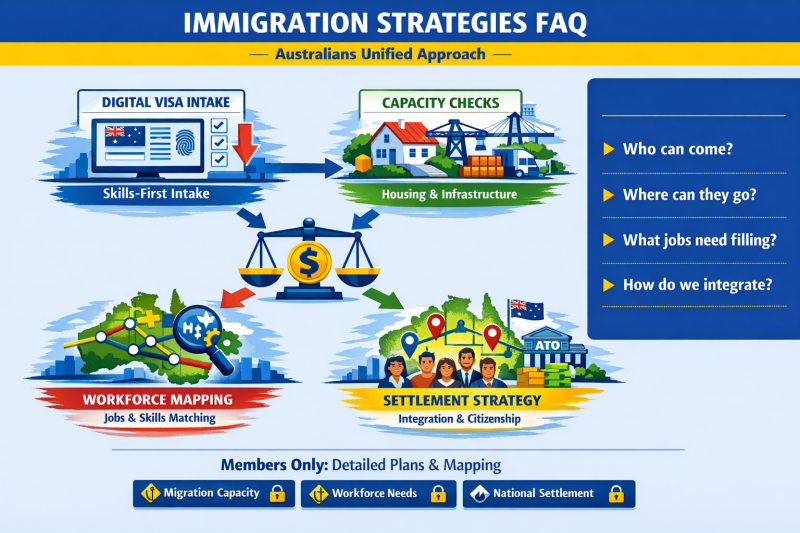
🟩 IMMIGRATION STRATEGIES — FAQ

Q1. What is the goal of Australia’s immigration reform?

A: To build a fair, secure, and sustainable system that aligns migration with national capacity. Australians Unified replaces fragmented visa systems with one digital portal, linking workforce mapping, housing capacity, and values alignment. 🔗 Immigration Reform


Q2. How does the new system balance skilled and unskilled migration?

A: Through a skills‑first intake model. Migration is capped and prioritised for sectors with genuine shortages — energy, defence, health, agriculture, and infrastructure — while low‑skill and non‑essential streams are reduced. 🔗 Immigration Reform


Q3. How will migration align with housing and infrastructure capacity?

A: The system uses capacity‑linked intake. Before visas are issued, regional housing and infrastructure data are checked to ensure communities can absorb new arrivals without increasing cost‑of‑living pressure. 🔗 Housing Reform


Q4. What is workforce mapping and how does it work?

A: Workforce mapping connects migration directly to labour demand. AI‑enabled modelling identifies real gaps in the workforce and matches migrants to those roles — not to arbitrary quotas. 🔒 Members: /members/project-workspaces/workforce-migration
Q5. How does it connect to other reforms?

A: Immigration reform is part of a unified national model that links:

  • Housing Reform — capacity‑linked intake

  • Workforce Reform — skills‑first mapping

  • Treasury Reform — fiscal sustainability

  • Energy & Infrastructure Reform — regional development corridors 🔗 Housing Reform 🔗 Treasury Reform 🔗 Infrastructure Reform

Q6. How does the reform strengthen border integrity and citizenship?

A: By integrating border, visa, and citizenship systems into one secure digital platform. It includes biometric verification, agent regulation, and a national values test before permanent residency. 🔗 Immigration Reform

Q7. What is the National Settlement Strategy?

A: A coordinated plan showing where people go, why, and how capacity determines intake. It aligns migration with regional workforce needs, housing supply, and infrastructure readiness. 🔒 Members: /members/project-workspaces/national-settlement-strategy

Q8. How does this reform support Australia’s long‑term sustainability?

A: By reducing population pressure, protecting wages, and strengthening national cohesion. Migration becomes a strategic tool — not a volume target — supporting sovereign capability and balanced growth. 🔗 Immigration Reform


Q9. What are the benefits for Australians?

  • Lower housing and cost‑of‑living pressure

  • Stronger job protection and wage growth

  • Faster, fairer visa processing

  • Clearer citizenship pathways

  • Restored integrity and national cohesion


Agriculture, Fisheries & Forestry — Food Security FAQ

FAQ 1 — What is the biggest threat to Australia’s food security right now?

Answer: Climate extremes — droughts, floods, heatwaves and bushfires — are the most immediate threat to stable food production. These events reduce yields, damage soil, strain water systems and disrupt supply chains.

Operational Response:

  • Climate‑resilient farming systems

  • Regenerative agriculture

  • Water‑security and drought‑ready planning

Policy Reform Path:

  • Amend the Water Act to modernise water governance

  • Embed climate‑risk standards in agricultural policy

  • Modernise land‑management legislation to prioritise soil and water sustainability


How is Australia protecting itself from pests and diseases?

Answer: Australia relies on strong biosecurity systems, but rising global movement increases the risk of exotic pests and diseases entering the country.

Operational Response:

  • Digital surveillance and national traceability

  • Rapid response capability

  • Strong border biosecurity

Policy Reform Path:

  • Amend the Biosecurity Act to mandate digital monitoring and emergency powers

  • Update the Export Control Act for streamlined certification

  • Modernise the Fisheries Management Act to address climate impacts

Why is agricultural innovation so important?

Answer: Food security depends on farmers having access to modern tools — precision agriculture, advanced crop genetics, digital monitoring and climate‑ready technologies.

Operational Response:

  • Strategic R&D hubs

  • Technology‑transfer programs

  • Digital literacy and rural connectivity

Policy Reform Path:

  • Create a National Agri‑Innovation Framework

  • Modernise R&D funding rules to prioritise on‑farm adoption

  • Embed digital‑inclusion targets for rural communities

Why is there a workforce shortage in agriculture?

Answer: Agriculture faces labour shortages due to an ageing workforce, limited regional services, and competition from other industries.

Operational Response:

  • Targeted training and apprenticeships

  • Rural infrastructure investment

  • Support for 2,800 skilled roles in biosecurity, water systems and digital monitoring

Policy Reform Path:

  • Establish a National Agricultural Workforce Strategy

  • Align education policy to priority skill areas

  • Integrate regional‑development funding with food‑security outcomes

Why are agricultural regulations so complex?

Answer: Producers navigate overlapping rules across agriculture, environment, trade and biosecurity — slowing approvals and increasing costs.

Operational Response:

  • Streamlined regulations

  • Digital‑first approvals

  • Unified data systems

Policy Reform Path:

  • Modernise core agricultural legislation

  • Create unified data standards across DAFF, Trade, Environment and Home Affairs

  • Annual regulatory impact review

What is being done to strengthen Australia’s food supply chains?

Answer: Australia’s long supply chains are vulnerable to disruption and lack domestic processing capacity.

Operational Response:

  • Investment in cold‑chain logistics

  • Regional processing hubs

  • Value‑adding incentives

Policy Reform Path:

  • Embed supply‑chain resilience in national infrastructure planning

  • Create value‑adding incentives for domestic manufacturing

  • Develop a National Food Supply Chain Resilience Plan


How are First Nations communities involved in food security?

Answer: First Nations land management, cultural knowledge and economic participation are essential to sustainable agriculture and natural resource protection.

Operational Response:

  • Co‑management of land and water

  • Cultural‑heritage protection

  • Economic participation in agriculture and carbon farming

Policy Reform Path:

  • Amend land‑management frameworks to strengthen co‑management

  • Establish a First Nations Land & Resource Partnership Framework

  • Integrate First Nations knowledge into climate and biodiversity programs

What is the overall path forward for Australia’s food security?

Answer: A modern, resilient food system built on strong biosecurity, climate‑ready agriculture, innovation, skilled workers, efficient supply chains and First Nations partnerships.

Policy Reform Path (Full):

  • Modernise the Biosecurity Act, Export Control Act, Water Act, Fisheries Management Act

  • Build climate‑resilient agriculture and water systems

  • Strengthen national biosecurity and digital traceability

  • Drive innovation and technology adoption

  • Develop a skilled agricultural workforce

  • Secure supply chains and expand domestic value‑adding

  • Embed First Nations co‑management and cultural protection

Frequently asked questions about PM&C reform

Explore answers to common questions regarding our strategic roadmap for the Department of the Prime Minister and Cabinet, national coordination, and phased capability upgrades.

What is the primary role of the reformed Prime Minister and Cabinet?

The reformed PM&C acts as the central national coordination and strategic governance engine. It provides independent, transparent policy advice to the Prime Minister and Cabinet, eliminates agency duplication, and coordinates cross-portfolio delivery across all Australian states and territories.

How does the costing model achieve a 30% baseline efficiency gain?

Baseline funding is reduced from $1.57B to $1.10B annually through automated reporting, consolidation of legacy systems across central agencies, reduced reliance on external consultants, and streamlined intergovernmental workflows.

How is political and commercial independence maintained?

Reform includes the creation of an independent national governance oversight board and public-facing performance dashboards, protecting critical policy, intelligence, and national risk modelling from external political or commercial interference.

What role does AI and digital automation play across the phased roadmap?

Modern digital tools automate manual Cabinet submissions, minutes, and compliance tracking, while AI-supported modelling assists in real-time predictive analysis for economic stability, national security risks, and misinformation threats.

How are First Nations leadership and communities integrated into the model?

Programs are co-designed directly with First Nations communities, ensuring data sovereignty, local control, Elder-led justice reintegration hubs, and structured on-Country employment pathways with cultural safety.

Frequently asked questions

Learn how the Australian Criminal Intelligence Commission (ACIC) safeguards Australia through intelligence sharing, national database modernisations, and targeted criminal disruption.

What is the primary role of the ACIC in Australia's security architecture?

The Australian Criminal Intelligence Commission (ACIC) is Australia's national criminal intelligence agency. Operating within the Attorney-General's portfolio, it collects, analyses, and shares intelligence to identify and disrupt serious and organised crime across federal, state, territory, and international jurisdictions.

How does the ACIC collaborate with state and territory police?

The ACIC operates essential national policing databases and leads joint operational taskforces. Through real-time data exchange, forensic analysis, and shared intelligence platforms, it equips state and territory police with strategic insights to dismantle cross-border criminal networks.

What are the priority focus areas of the Future-Ready ACIC roadmap?

The strategic roadmap prioritises five key pillars: deploying modern integrated intelligence platforms, expanding sovereign data and forensic capabilities, building a resilient specialist workforce, enhancing inter-agency integration, and establishing robust defenses against cyber-enabled financial crime.

How is the ACIC transition and modern database capability funded?

Baseline operations rely on recurring federal budget appropriations. The multi-phase reform model proposes structured funding uplifts across Foundation, Acceleration, and Expansion phases to overhaul legacy IT infrastructure, expand digital forensics, and modernise national data ecosystems.

How does the agency combat emerging cyber and financial crime?

The ACIC invests heavily in advanced AI-driven analytics, digital forensic capabilities, and sovereign cyber intelligence tools, partnering directly with financial institutions and global law enforcement to intercept illicit wealth and dismantle illicit digital syndicates.

Frequently asked questions

Key questions and answers regarding the role, statutory authority, and proposed modernisation of the Office of National Intelligence under the Australians Unified framework.

What is the primary role of the Office of National Intelligence?

The Office of National Intelligence (ONI) serves as Australia's central agency for intelligence coordination and strategic assessment. Situated independently within the Prime Minister and Cabinet portfolio, ONI leads the National Intelligence Community (NIC), provides integrated geopolitical and security assessments, and advises senior government leadership to safeguard national sovereignty.

Under what statutory legislation does ONI operate?

ONI derives its statutory mandate from the Office of National Intelligence Act 2018, supported by established National Intelligence Community coordination structures, National Security Committee arrangements, and strict parliamentary and independent oversight bodies.

Why should ONI remain independent within Prime Minister and Cabinet?

Centring ONI independently within Prime Minister and Cabinet guarantees that intelligence advice remains objective and uncompromised by departmental boundaries. It allows ONI to provide whole-of-nation assessments spanning national defence, economic security, supply chains, infrastructure resilience, and emerging global risks.

What is the National Intelligence Fusion Platform proposal?

As part of the Australians Unified reform proposal (not current law), the National Intelligence Fusion Platform is designed to unite fragmented intelligence systems into a secure, interoperable data architecture. This multi-phase initiative aims to integrate real-time cyber intelligence, critical infrastructure monitoring, and predictive AI decision tools while strengthening human accountability.

How does the proposed phased reform and costing model work?

The reform roadmap outlines a four-phase rollout from 2028 through 2037, shifting from core data integration to autonomous forecasting. The financial model targets an ongoing 30% operational efficiency gain—reducing baseline community costs from $0.88B to $0.62B annually—while redirecting capital into sovereign analytical capabilities and AI-assisted tools.

Frequently asked questions

Key questions and answers regarding the AI-enabled transition, reduced-budget model, and sovereign research independence of the Australian Institute of Criminology.

What is the AI-enabled model for the Australian Institute of Criminology?

The model transforms the Australian Institute of Criminology (AIC) into a lean, data-driven research institute. By implementing automated crime-trend detection and predictive modeling, the agency cuts administrative overhead, accelerates research cycles, and enhances national intelligence capabilities.

How does this model achieve a 20% budget reduction?

Baseline funding is streamlined from $0.015B to $0.012B per year through a leaner operational structure. Repetitive manual analysis and routine data processing are replaced by automation tools, cutting labor-intensive overhead while delivering higher overall capacity.

How is political and ministerial independence safeguarded?

Independence is protected by strict safeguards: transparent algorithmic research prioritization, immutable audit trails for every dataset change, independent non-political appointment panels, decentralized data architecture, and mandatory real-time publication of all ministerial contacts.

What are the primary focus areas across the strategic roadmap?

The multi-phase roadmap progresses from initial legacy system consolidation and workflow pilots (Phase 1) to deploying full AI analysis engines (Phase 2), establishing a unified national crime intelligence network (Phase 3), and achieving automated, predictive national justice research cycles (Phase 4).

How will the Australian public and justice agencies benefit?

Policing authorities, community groups, and policy makers gain faster access to high-accuracy crime analytics and public dashboards. Efficiency savings are systematically reinvested into victim support, community safety, and national crime prevention initiatives.

Frequently asked questions

Clear answers on how the Australian Federal Police operates, protects national sovereignty, and coordinates across Commonwealth law enforcement.

What is the primary role of the Australian Federal Police?

The Australian Federal Police (AFP) serves as Australia's primary national law enforcement agency. It investigates complex transnational crime, enforces Commonwealth legislation, combats cybercrime, and ensures protective security across critical sovereign assets.

How does the AFP collaborate with state and territory police forces?

The AFP partners closely through joint taskforces, shared intelligence databases, and coordinated national operations. While state police manage domestic criminal matters within their respective jurisdictions, the AFP leads on federal matters, national security inquiries, and cross-border operations.

What capabilities are being expanded under the AFP strategic roadmap?

Key focus areas include sovereign digital forensics, advanced intelligence ecosystems, counter-terrorism operations, modernised front-line infrastructure, and enhanced officer wellbeing initiatives to stay ahead of evolving global threats.

Where can I report federal or cyber offenses?

Suspected federal offenses, including major cybercrime, child safety threats, and border-related crimes, can be reported directly via ReportCyber or by contacting official Commonwealth crime reporting portals. In any immediate emergency, always dial 000.

Foreign affairs and trade portfolio FAQ

Find clear answers regarding Australia's international engagement, diplomatic priorities, trade networks, and sovereign security frameworks.

What is the primary role of the Department of Foreign Affairs and Trade?

The Department of Foreign Affairs and Trade (DFAT) leads Australia's foreign policy, manages diplomatic relationships, and champions international trade agreements. It safeguards national sovereignty, supports regional stability across the Indo-Pacific, and protects Australian interests globally.

How does DFAT assist Australian citizens abroad?

Through its Consular and Crisis Management Division and global network of embassies and high commissions, DFAT provides 24/7 emergency consular assistance, crisis response, travel advisories, and emergency passport support to Australians overseas.

What portfolio agencies operate alongside DFAT?

Key agencies within the portfolio include Austrade (expanding Australian exports and attracting foreign investment), Tourism Australia (international visitor marketing), the Australian Centre for International Agricultural Research (ACIAR), and Export Finance Australia (EFA).

How does international trade policy protect national sovereignty?

Strategic trade policies diversify supply chains, counter economic coercion, negotiate equitable rules-based trade agreements, and ensure Australia maintains self-reliance while opening high-growth export markets worldwide.

How are international partnerships and humanitarian aid managed?

The Development, Humanitarian & Partnerships Division coordinates regional aid programs, delivers rapid disaster relief, and collaborates with multilateral partners and NGOs to build economic resilience across neighbouring Pacific and Southeast Asian nations.

Frequently asked questions about policy reforms

Find clear answers regarding the proposed amendments, sovereignty safeguards, and modern foreign affairs oversight frameworks designed to protect Australia's long-term national interest.

What is the primary purpose of the proposed National Interest Test?

The National Interest Test ensures that all international treaties, foreign investment agreements, and strategic partnerships are systematically evaluated to safeguard Australia's sovereign capabilities, local workforce, and essential infrastructure before commitments are signed.

How do these amendments address supply chain vulnerabilities?

The proposed policies introduce a dedicated Sovereign Supply Chain Strategy that monitors geopolitical and economic risks. It encourages the domestic production of critical goods, safeguards essential technology, and eliminates dangerous dependencies on single foreign markets.

What oversight improvements are being introduced for foreign aid and treaties?

We propose a transparent Aid & Treaty Portal alongside enhanced parliamentary scrutiny. This gives the public and elected officials real-time visibility into international expenditure, measurable outcomes, and potential foreign influence risks.

How will digital systems within foreign affairs be protected?

A unified, secure digital platform will replace outdated legacy ICT systems. This upgrade strengthens cyber resilience across diplomatic networks, unifies consular and trade operations, and ensures critical Australian communications remain secure.

How do these foreign affairs reforms support everyday Australians?

By protecting local industries from unfair trade practices, strengthening consular response capabilities for citizens travelling overseas, and ensuring our foreign policy serves national sovereignty, these reforms establish a resilient foundation for long-term Australian prosperity.

Frequently asked questions

Find answers regarding the AI-enabled, reduced-budget operating model for the Australian Centre for International Agricultural Research (ACIAR), our anti-capture safeguards, and national food security goals.

What is the primary role of ACIAR under this model?

ACIAR funds and manages international agricultural research partnerships, strengthens food security and climate resilience in partner countries, and supports Australian agricultural innovation while building global capability at a lower cost footprint.

How does AI technology reduce operating costs by 25%?

By replacing manual research evaluations, legacy processes, and administrative bloat with automated project monitoring, predictive crop analytics, and AI-governed prioritisation, ACIAR reduces annual baseline funding needs from $0.12B down to $0.09B per year.

How are research priorities protected from political interference?

Our anti-capture safeguards mandate AI-governed research prioritisation based on transparent algorithms rather than ministerial preferences, backed by immutable public audit logs, independent scientific appointment panels, and strict conflict-of-interest bans.

What are the four phases of the strategic transition roadmap?

The roadmap spans 10 years across four progressive stages: Phase 1 focuses on lean stabilization and data consolidation; Phase 2 introduces accelerated modelling engines and automated portals; Phase 3 establishes a national agricultural intelligence network; and Phase 4 deploys autonomous research lifecycles.

How does ACIAR's international research benefit Australian farmers?

Global agricultural partnerships provide critical insights into emerging biosecurity threats, crop diseases, and climate challenges. Discoveries in soil health, drought resistance, and yield optimisation are directly reinvested into Australian agricultural resilience and market competitiveness.

Frequently asked questions

Explore common questions regarding the modernization, budget restructuring, and AI integration for Austrade under Australians Unified.

How does the AI model reduce Austrade's operating costs?

By automating routine market intelligence, market access assessments, and predictive targeting, Austrade replaces costly manual consultant workflows and oversized physical posts abroad, achieving a planned 25% baseline operational efficiency.

What are the anti-capture safeguards protecting Austrade?

Austrade incorporates tamper-proof systems including AI-governed project prioritisation, immutable public audit logs, independent merit-based appointment panels, and mandatory disclosure of all ministerial and lobbyist contacts.

Will reduced overseas posts affect Australian exporters?

No. Digital self-service systems, predictive trade matching, and global data networks expand reach to Australian businesses regardless of size or location, rather than relying on legacy physical delegations.

How are efficiency savings reinvested?

Every dollar recouped from administrative overhead, consultant fees, and physical consolidation is returned directly into domestic sovereign capabilities, advanced industries, and export innovation across Australia.

Frequently asked questions

Learn more about the role, ongoing initiatives, and conservation funding model for the Sydney Harbour Federation Trust within our national environmental framework.

What is the primary role of the Sydney Harbour Federation Trust?

The Harbour Trust manages, rehabilitates, and protects prominent former defence and Commonwealth sites situated along Sydney Harbour. Its mission is to conserve natural and cultural heritage, honour First Nations connections, and provide welcoming, accessible public parklands and community spaces for future generations.

Which key sites are preserved and managed by the Harbour Trust?

The Trust oversees historically significant locations around the harbour, including Cockatoo Island (Wareamah), Headland Park in Mosman, North Head Sanctuary in Manly, Sub Base Platypus in Neutral Bay, and Woolwich Dock. Each location offers public walking trails, restored foreshore access, and rich heritage interpretation.

How does the Trust partner with Traditional Owners and First Nations communities?

The Trust prioritises genuine collaboration with Traditional Owners and First Nations communities across cultural interpretation, environmental stewardship, and dual naming initiatives. Ongoing co-management planning ensures that ancient cultural connections and living heritage remain central to all site transformations.

How is the Harbour Trust funded across baseline and future uplift phases?

Core site operations, remediation, and park maintenance are supported by annual baseline funding of approximately $0.20B. Under our phased investment framework, targeted capital uplifts across a ten-year horizon will address deferred infrastructure maintenance, coastal erosion management, and modern digital visitor infrastructure.

How can community members and volunteers get involved?

Community involvement is vital to long-term success. Members of the public can participate through hands-on bush regeneration programs, volunteer tour guiding, citizen science projects, and community consultative committees. You can also join Australians Unified to support national conservation policy reforms.

Frequently asked questions about reef management

Find clear answers regarding the governance, statutory mandates, scientific monitoring, and long-term investment framework of the Great Barrier Reef Marine Park Authority.

What is the primary role of the Great Barrier Reef Marine Park Authority?

The Great Barrier Reef Marine Park Authority (GBRMPA) is Australia’s lead statutory agency dedicated to safeguarding the marine park. It delivers science-based marine conservation, zoning enforcement, environmental permitting, and climate resilience initiatives to ensure the Reef remains protected for future generations.

Which acts govern activities and zoning within the marine park?

GBRMPA operates primarily under the Great Barrier Reef Marine Park Act 1975 and works in concert with the Environment Protection and Biodiversity Conservation Act 1999. Together, these frameworks govern marine park zoning, sustainable use permits, biodiversity conservation, and strict compliance enforcement.

How does GBRMPA partner with Traditional Owners?

GBRMPA partners with Traditional Owners through formal Sea Country agreements, Indigenous ranger initiatives, and joint management programs. This collaboration respects enduring cultural stewardship, protects maritime cultural heritage, and integrates Indigenous ecological knowledge into everyday marine management.

What does the phased baseline and uplift costing model achieve?

The funding framework combines an ongoing operational baseline of $0.46B annually with a four-phase uplift strategy. This phased capital program modernises digital monitoring tools, restores remote vessel infrastructure, accelerates climate response, and bolsters sovereign marine science capabilities across Australia.

How can the public and regional operators engage with conservation programs?

Commercial operators, scientists, and regional community members can actively engage through collaborative monitoring networks, consultation panels, and public transparency initiatives. Regular reporting and open ecosystem datasets provide transparent updates on Reef resilience and health.

Frequently asked questions

Key details on the National Indigenous Australians Agency (NIAA), current operations, and proposed Australians Unified structural reforms.

What is the role of the National Indigenous Australians Agency?

The National Indigenous Australians Agency (NIAA) is an executive agency within the Prime Minister and Cabinet portfolio. It leads whole-of-government policy coordination, implements Closing the Gap priorities, administers community programs, and collaborates with First Nations communities across Australia.

How does Australians Unified propose reforming the NIAA?

The Australians Unified reform framework proposes streamlining fragmented administrative programs, adopting an Indigenous data sovereignty model, automating grant cycles, and transitioning to direct, community-led governance through a representative House of First Nations structure.

What is the proposed House of First Nations?

The House of First Nations is a reform proposal outlining an elected national leadership chamber representing distinct Nations, clans, and cultural regions. It is designed to work as an equal legislative partner with Parliament on matters directly impacting Aboriginal and Torres Strait Islander communities.

Are these reform proposals part of current legislation?

No. These proposals, including the House of First Nations and the National First Nations Outcomes Authority, are reform concepts put forward by Australians Unified. They reflect a structural policy framework rather than enacted Commonwealth legislation.

How will community data sovereignty and outcomes tracking work?

Under the proposed model, the National Indigenous Data and Intelligence Network establishes community-owned data registries, public KPI outcome dashboards, and predictive wellbeing indicators that keep governance accountable to local Traditional Owners and communities.

Frequently asked questions

Key questions and answers regarding ASIO's statutory role, accountability oversight, sovereign capabilities, and our proposed governance reforms.

What is ASIO's primary statutory role in Australia?

The Australian Security Intelligence Organisation (ASIO) operates under the Australian Security Intelligence Organisation Act 1979. Its primary responsibility is to protect Australia and its citizens against national security threats including espionage, foreign interference, politically motivated violence, attacks on defence systems, and terrorism.

Does ASIO hold law enforcement or military powers?

No. ASIO is strictly an intelligence service, not a police or military force. It does not carry out arrests, file legal prosecutions, or enforce civil laws. Its mandate is restricted to gathering intelligence, assessing threats, and providing security advice to government agencies and operational law enforcement partners like the Australian Federal Police.

Who oversees ASIO to ensure compliance with the law?

ASIO is subject to rigorous democratic oversight. Key bodies include the Inspector-General of Intelligence and Security (IGIS), which has ongoing inquiry and audit powers, the Parliamentary Joint Committee on Intelligence and Security (PJCIS), ministerial direction, and regular reviews conducted by the Auditor-General.

How does Australians Unified propose modernising ASIO with AI?

Our reform roadmap integrates sovereign AI tools to automate intelligence triage, synthesise incoming threat indicators in real time, and eliminate manual backlogs. By deploying smart data analytics and immutable audit trails, we aim to cut baseline operational overhead by 20% while elevating threat response capabilities and institutional transparency.

How do national intelligence assessments reach state and local levels?

We propose a coordinated multi-tier security framework. Strategic assessments developed by ASIO connect with state entities such as the State Security and Protective Resilience Office (SSPRO) and local Community Security and Resilience Partnerships, ensuring consistent critical infrastructure defence and public preparedness nationwide.

Frequently asked questions about ANSTO reform

Clear answers regarding Australia's sovereign nuclear science mandate, medical isotope supplies, battery technology research, and the proposed modernisation roadmap.

What is ANSTO's primary role within the sovereign capability framework?

The Australian Nuclear Science and Technology Organisation (ANSTO) serves as the nation's sovereign nuclear authority and national centre for scientific excellence. Under the Australians Unified framework, ANSTO leads research across landmark facilities including the OPAL Reactor and Australian Synchrotron, securing medical isotopes, advanced manufacturing, and strategic nuclear stewardship.

How does ANSTO safeguard Australia's nuclear medicine supply?

ANSTO produces vital diagnostic and therapeutic radioisotopes used in cancer treatments and health screenings across Australia and regional facilities. The strategic capability plan expands domestic production resilience, protecting healthcare providers from global supply chain disruptions and enabling rapid access to cutting-edge diagnostics.

Why is battery research integrated into the nuclear science portfolio?

Advanced neutron-scattering and synchrotron beamline facilities allow scientists to analyse battery chemistries at atomic resolution. By leveraging advanced materials testing, AI-driven molecular modelling, and critical minerals refining, ANSTO accelerates the development of next-generation lithium, sodium, and solid-state energy storage for domestic industries.

How does the proposed 10-year investment plan deliver efficiency?

The strategic investment framework balances baseline operational savings—targeting a 20% efficiency dividend through AI-enabled systems and workflow automation—with phased investments across four distinct stages. This transforms legacy monitoring into automated, predictive operations while significantly upgrading cyber-resilience and workforce training.

How does ANSTO interface with state agencies and local innovation hubs?

ANSTO operates under a transparent accountability hierarchy from federal oversight through to state research entities—such as the Nuclear Science and Advanced Technology Office (NSATO)—and regional tech precincts. This ensures scientific breakthroughs directly supply commercial manufacturing partnerships, clinical health centres, and high-tech STEM job networks nationwide.

Frequently asked questions about Home Affairs services

Find clear answers regarding Australia's civil security portfolio, border integrity, immigration modernisations, and the long-term national reform roadmap.

What core responsibilities sit under the Department of Home Affairs?

The Department of Home Affairs coordinates Australia's national security, civil defence, and border architecture. Its service portfolio brings together the Australian Border Force (ABF), lawful migration and visa processing, citizenship administration, cyber security resilience, counter-foreign interference, and disaster response via the National Emergency Management Agency (NEMA).

How does the proposed reform roadmap strengthen national border integrity?

The Australians Unified roadmap addresses frontline fleet and equipment deficits through multi-year capital envelopes, fleet renewals, autonomous maritime surveillance, and integrated data analytics. These upgrades close operational blind spots, streamline lawful crossings via SmartGate enhancements, and deter transnational organised crime.

What changes are proposed for immigration and visa processing?

The strategy introduces AI-assisted digital triage rules to resolve visa backlogs, accompanied by strict legislative safeguards and independent oversight. This ensures transparent, predictable processing times while aligning migration targets with cultural cohesion, national skill priorities, and human rights standards.

How do Home Affairs and the Department of Defence collaborate?

Defence and Home Affairs collaborate directly on maritime domain awareness, threat deterrence, and critical infrastructure defense. The framework establishes shared cyber intelligence pipelines, quantum-safe networks, and transitional employment pathways through initiatives like the Sovereign Cyber Plan.

What is the implementation timeline for these reforms?

The national roadmap spans four distinct phases between 2028 and 2037. Early phases focus on operational stabilization, platform integration, and governance oversight, progressing to full deployment of autonomous patrol systems, quantum-resistant cyber architectures, and unified civil security platforms by 2037.

Frequently asked questions about Home Affairs reform

Find answers to common questions regarding Australia's national security, border integrity, visa enforcement, and our unified reform roadmap.

What is the primary role of the Department of Home Affairs?

Home Affairs serves as Australia's central civilian security agency. It oversees border security, immigration integrity, counter-terrorism, domestic resilience, cyber policy, and critical infrastructure protection, collaborating closely with ASIO and the Australian Federal Police.

Why does the migration system need urgent reform?

The current system suffers from disjointed visa portals, prolonged processing delays, and widespread exploitation in international student and non-essential visa pathways. These pressures strain local housing, essential infrastructure, and community services while diluting border integrity.

How does the proposed single national migration portal work?

The reform replaces multiple legacy databases with a single streamlined digital portal. This consolidates visa applications, skilled pathway tracking, biometric identity verification, and national values testing into a cohesive and secure entry system.

What is the purpose of the mandatory national values test?

The values test ensures that individuals seeking permanent residency and citizenship demonstrate a firm commitment to parliamentary democracy, the rule of law, Australian civic responsibilities, and mutual community respect.

How will workforce shortages in national security be addressed?

Through targeted APS redeployment and dedicated training pipelines, surplus public service personnel will transition into critical shortage roles across cybersecurity fundamentals, border technology, and compliance enforcement.

Frequently asked questions about passport services

Key answers concerning Australian passport processing times, document integrity, urgent lodgements, and the modernised digital service framework.

How long does standard passport processing take?

Ordinary passport applications are processed within 10 working days once all necessary identity documentation, guarantor details, and compliant photographs have been received and verified. Applicants are advised to allow additional time for postal delivery.

What is the priority processing timeframe?

Priority processing ensures complete applications are finalised within 2 working days. This service incurs an additional statutory fee and applies once all identity verification and eligibility checks are cleared.

How are Australian passports safeguarded against fraud?

The Australian Passport Office uses multi-layered identity validation, advanced biometric matching, and automated security verification integrated with state and territory birth, marriage, and citizenship registries to safeguard document integrity.

What happens if I lose my passport overseas?

Australians abroad can contact the nearest Australian diplomatic mission or consular post. Staff can issue emergency travel documents, supporting over 9,000 urgent credential requests each year for stranded or affected citizens.

How does the modernization roadmap improve passport issuance?

The staged modernization roadmap introduces AI-enabled fraud detection, streamlined digital renewal workflows, and real-time tracking, reducing manual bottlenecks while upholding international identity and cybersecurity benchmarks.

Detailed immigration policy reforms

Explore the complete breakdown of current challenges, the Australians Unified policy plan, and key legislative changes across our ten core immigration pillars.

1. Intake and population sustainability

Current: Migration targets are set largely on economic growth assumptions with weak linkages to housing supply, infrastructure capacity, or wage growth.

Australians Unified plan: Implement a hard statutory cap of 100,000 to 130,000 permanent visas per year with the explicit objective of relieving pressure on housing, essential services, and wages.

Legislative changes: Amend the Migration Act to set an annual statutory cap on permanent visas and require a formal annual Capacity Statement evaluating housing, infrastructure, and the domestic labour market before adjusting intake levels.

2. Illegal migrants and criminal visa holders

Current: Complex removal pathways and protracted appeal layers result in delayed, contested deportations of non-citizens who have committed offences or overstayed visas.

Australians Unified plan: Immediate deportation of illegal migrants and automatic deportation for serious or violent offenders.

Legislative changes: Amend the Migration Act to create a mandatory removal category for unlawful non-citizens, legally define serious and violent offences triggering automatic cancellation and removal, and mandate strict statutory timeframes for immediate removal.

3. Skilled visa integrity and workforce training

Current: Employer sponsorship permits superficial labour-market testing, provides weak penalties for abuse, and lacks rigorous enforcement of qualifications.

Australians Unified plan: Tighten labour-market testing, permanently ban repeat-offender employers, mandate immediate deportation for immigrants presenting fraudulent degrees, and prioritise local training and apprenticeships to domestic Australian standards.

Legislative changes: Amend Migration Regulations to raise wage floors, extend advertising duration rules, and establish a public Prohibited Sponsor Register. Enact the Workforce Sovereignty & Skills Act to formally link skilled visa quotas to domestic training benchmarks.

4. Student visas and education integrity

Current: High international student volumes, the widespread use of education as a backdoor migration pathway, and poor enforcement around attendance and provider quality.

Australians Unified plan: Cap foreign student enrolments at 1% of the national population, shut down fraudulent providers, mandate the return home of students with poor attendance, and introduce visa levies to cover regional infrastructure costs.

Legislative changes: Amend the Education Services for Overseas Students (ESOS) Act to enforce a statutory national cap and fast-track closure powers for fraudulent providers. Amend Migration Regulations to condition visas on strict academic attendance, require offshore continuation upon breach, and enact a new Student Infrastructure Levy.

5. Appeals and the Administrative Review Tribunal

Current: Multiple appeal layers from the Department through tribunals and courts lead to prolonged delays, continuous bridging visa extensions, and system congestion.

Australians Unified plan: Abolish Administrative Review Tribunal (ART/AAT) jurisdiction over migration matters and require bridging-visa holders to depart Australia before reapplying.

Legislative changes: Repeal migration jurisdiction in the Administrative Appeals Tribunal legislation, amend the Migration Act to replace merits review with a streamlined internal review process, narrow judicial review strictly to points of legal error, and mandate offshore re-application for bridging visa holders.

6. Border protection, TPVs, and sovereign refugee policy

Current: Absence of Temporary Protection Visas (TPVs) and legal subservience to international United Nations Refugee Convention mandates.

Australians Unified plan: Reintroduce TPVs, withdraw from the UN Refugee Convention, and maintain resolute maritime border security.

Legislative changes: Amend the Migration Act to restore Temporary Protection Visa and Safe Haven Enterprise Visa classes. Pass the Sovereign Refugee Policy Act to formalise autonomous humanitarian criteria and withdraw from international convention obligations in favour of domestic statutory law.

7. National security and extremist risk exclusion

Current: Standard security checks without an explicit exclusion framework for jurisdictions known to harbor extremist ideologies.

Australians Unified plan: Deny entry to applicants from nations known to foster extremist ideologies and mandate rapid deportation for any individuals involved in extremist activity.

Legislative changes: Amend the Migration Act to establish a statutory High-Risk Country List with presumptive visa refusal and define extremist activity as grounds for mandatory cancellation and removal. Update intelligence legislation to embed binding security risk assessments into all visa determinations.

8. Citizenship criteria, self-reliance, and welfare access

Current: Short residency thresholds for Australian citizenship alongside premature access to public welfare and pension systems.

Australians Unified plan: Institute an eight-year waiting period for citizenship, a ten-year contribution requirement before accessing welfare, mandatory private health and income protection for new arrivals, and pro-rated pensions based on domestic working years.

Legislative changes: Amend the Australian Citizenship Act to extend residency requirements to 8 years. Amend the Social Security Act to impose a 10-year waiting period and pro-rate the age pension to working life in Australia. Pass the Immigrant Self-Reliance Act requiring comprehensive private insurance coverage.

9. Migration agreements and bilateral treaties

Current: Bilateral trade and mobility deals expand temporary worker and student flows without adequate population, wage, or infrastructure safeguards.

Australians Unified plan: Repeal international agreements that inflate migration pressure and renegotiate bilateral deals under binding national interest tests.

Legislative changes: Mandate affirmative Parliamentary approval for any international agreement or treaty impacting migration numbers. Introduce a statutory requirement for a Population Impact Assessment prior to ratifying any pact that materially affects inward migration.

10. Regional settlement, domestic apprenticeships, and credit reform

Current: Regional visa conditions are poorly monitored and enforced, driving continued over-reliance on overseas labour rather than developing domestic skills.

Australians Unified plan: Enforce strict regional settlement conditions, launch a military apprenticeship pathway for young Australians, reform credit settings to lower household debt, and introduce culturally aligned means testing.

Legislative changes: Amend Migration Regulations to tighten regional stay compliance and tracking. Pass the National Apprenticeship & Defence Trades Act to fund vocational defense careers, and amend financial credit legislation to enact macro-prudential tools that ease family household debt.

Frequently asked questions

Explore common inquiries regarding the role, operational model, and national coordination initiatives of the National Emergency Management Agency (NEMA).

What is the primary role of NEMA in Australian disaster management?

NEMA leads Australia’s national efforts in disaster risk reduction, emergency preparedness, response coordination, and community recovery. Working alongside federal, state, and territorial bodies, it provides cohesive national leadership and operates the National Situation Room 24/7 to maintain continuous situational awareness across all hazard types.

How does NEMA collaborate with state and territory emergency services?

While state and territory agencies retain constitutional authority for operational response within their borders, NEMA coordinates Commonwealth assistance, provides national asset deployment, and delivers strategic data. Through integrated structures like the State Intelligence & Resilience Coordination Office (SIRCO) and Regional Resilience Networks, priorities and relief resources remain aligned from national to local tiers.

How are modern AI and automated tools utilized in emergency management?

The modernization roadmap integrates AI-driven predictive hazard forecasting, automated early-warning distribution, and intelligent logistics modelling. These innovations streamline administrative overhead, accelerate response readiness, and enable real-time situational dashboards while adhering to strict governance and auditable decision frameworks.

What programs support community recovery and long-term resilience?

NEMA oversees national funding initiatives including the Disaster Ready Fund and coordinates recovery support packages for affected regions. Beyond immediate relief, programs support local infrastructure hardening, risk-mitigation projects, volunteer coordination, and climate-adaptation planning to safeguard communities ahead of future events.

Frequently asked questions about cultural inclusion and development

Learn how the Cultural Development Australia (CDA) framework unifies communities, preserves First Nations heritage, and builds national cohesion through lean, AI-enabled governance.

What is Cultural Development Australia (CDA)?

Cultural Development Australia (CDA) serves as the national steward of cultural richness, shared identity, and Australian values under the Australians Unified framework. It focuses on uniting fragmented cultural programs, protecting heritage, and strengthening social cohesion across all communities.

How does AI technology support cultural inclusion?

CDA integrates AI-driven cultural intelligence to automate research cycles, assess social cohesion, and monitor community sentiment in real time. This modern model cuts administrative overhead by 20%, allowing resources to be redirected straight into local arts, community projects, and First Nations initiatives.

How are First Nations leadership and heritage embedded?

First Nations cultural governance is safeguarded through statutory leadership frameworks, enhanced heritage protection acts, and the legislated protection of Indigenous Cultural and Intellectual Property (ICIP). It ensures Indigenous communities lead decision-making across national cultural policies.

What are the core Australian values guiding this portfolio?

Our non-political values form the foundation of national unity: fairness (a fair go for all), respect for people and country, integrity, community and mateship, freedom of belief, individual responsibility, multicultural diversity, and careful stewardship of heritage for future generations.

How does the 10-year cultural development roadmap unfold?

The roadmap progresses across four distinct phases: Phase 1 consolidates fragmented agency programs and stabilizes digital governance; Phase 2 introduces the AI-enabled intelligence engine; Phase 3 expands national community capability; and Phase 4 secures an enduring, future-ready cultural ecosystem.

Defence portfolio questions and answers

Find clear answers regarding Australia's defence strategy, sovereign manufacturing targets, force readiness, and collaborative civil infrastructure partnerships.

What is the primary objective of the Defence Portfolio roadmap?

The core objective of the Defence Portfolio is to secure Australian national sovereignty, bolster military readiness, and foster domestic industrial independence. Through targeted phases leading to 2037, the roadmap aims to decrease overseas reliance and deliver advanced sovereign technologies across land, maritime, air, cyber, and space domains.

How does the ADF Infrastructure Support Partnership (AISP) work with civilian industry?

The AISP operates on a strict non-commercial, non-competitive basis. The Australian Defence Force provides engineering, logistics, and planning advice primarily for strategic assets, remote indigenous communities, and rapid disaster relief. Civilian contractors and local industry remain the primary builders, ensuring market integrity while accelerating vital national resilience projects.

What role does the Australian Signals Directorate (ASD) play in national resilience?

ASD is responsible for signals intelligence (SIGINT), offensive cyber capabilities, and cyber defence operations. It safeguards critical national infrastructure, shields government and commercial networks against foreign interference, and provides actionable threat intelligence to protect Australia's digital sovereignty.

How are sovereign manufacturing capabilities being expanded?

Through coordinated efforts with the Capability Acquisition and Sustainment Group (CASG), the portfolio prioritises domestic procurement of guided weapons, naval vessels, and autonomous systems. Measurable targets include expanding Australian defence contracts for domestic SMEs, increasing sovereign defence production by 50% by 2035, and reducing supply chain vulnerabilities.

How does the Defence Portfolio support domestic disaster recovery?

Under Defence Assistance to the Civil Community (DACC) protocols, ADF units provide surge capacity when civil resources are stretched during crises. Key support includes temporary bridge installations, clearing vital road links, repairing cyclone-affected airstrips, and restoring basic water and communications services.

Defence portfolio frequently asked questions

Explore answers to common questions regarding Australia's defence readiness, sovereign industrial capabilities, and cross-portfolio national security integration.

What is the core mission of the defence portfolio under Australians Unified?

Our mission is to establish a modern, sovereign, and resilient defence apparatus that safeguards Australia's borders, protects our national interests, and integrates seamlessly with critical energy, logistics, and digital infrastructure across the country.

How does the defence strategy integrate with national industry and infrastructure?

We champion a whole-of-nation framework where defence capabilities align directly with domestic manufacturing, the renewable supergrid, strategic fuel reserves, and dual-use transport arteries. This reduces reliance on overseas supply lines and ensures uninterrupted sovereign support during crises.

What role do the ADF, ASD, and CASG play in this integrated model?

The Australian Defence Force (ADF) delivers multi-domain readiness across land, sea, air, and space. The Australian Signals Directorate (ASD) guarantees world-class cyber defence and offensive capabilities, while the Capability Acquisition and Sustainment Group (CASG) partners with Australian industry to fast-track essential equipment and systems procurement.

How are recruitment shortages and workforce transitions addressed?

Our policy establishes clear vocational pipelines connecting technical trades, cyber disciplines, and engineering directly into defence roles. Additionally, comprehensive transition and reintegration programs ensure veterans retain meaningful career pathways in high-growth civilian and sovereign industry sectors.

How can citizens and industry partners get involved in defence reforms?

Australians Unified encourages community members, veterans, and local enterprise leaders to contribute to policy formulation, volunteer initiatives, and defence-civil resilience programs designed to protect our national sovereignty.

Defence reform and policy amendments FAQ

Find answers regarding Australians Unified's policy amendments for Defence base modernisation, sovereign supply chain capability, and integration with national energy infrastructure.

Why must Defence bases connect to the National Energy Super-Grid?

Defence bases currently face major vulnerabilities due to heavy reliance on aged diesel-only systems and fragile distribution networks. Connecting bases to the National Energy Super-Grid and backing them with renewable microgrids and hardened local storage ensures mission readiness and operational resilience during severe weather events or national emergencies.

What role does the ADF play in remote civil infrastructure?

Under proposed legislative reforms, a Joint Civilian–ADF Infrastructure Taskforce will facilitate dual-use construction across remote national corridors like the inland spine and the Pilbara–NT region. ADF logistics, planning, and engineering capabilities will help rapidly deliver sovereign infrastructure while reinforcing national resilience.

How does the policy protect critical infrastructure from cyber threats?

The agenda establishes a dedicated National Critical Infrastructure Cyber Command within Defence. This body will monitor national power grids, water networks, and telecommunications around the clock, removing bureaucratic silos and providing direct ADF protection to critical utilities.

How will sovereign defence manufacturing and supply chains be strengthened?

The Sovereign Capability Act and National Defence Act Amendments will legislatively mandate strategic domestic stockpiles of munitions, processed critical minerals, and fuel. Defence procurement will actively prioritize sovereign Australian manufacturers over vulnerable offshore suppliers, ensuring supply continuity in times of crisis.

What changes are proposed for ADF staffing, housing, and veteran pathways?

The reforms introduce a National Defence Housing Code with enforceable maintenance cycles, modernise regional medical facilities, and create continuous education pipelines linking secondary schools, TAFEs, and universities directly to technical Defence trades. In addition, a Veterans Skills Translation Framework will officially validate military qualifications for seamless civilian careers in energy, cyber, and infrastructure.

Frequently asked questions about Australian defence and sovereign capability

Find answers to key questions regarding the Australian Defence Force governance structure, sovereign industry capability, and the Australians Unified 2037 transformation roadmap.

What is the primary role of the Australian Defence Force under this framework?

The core mission is to defend Australian sovereignty, safeguard national interests, reinforce domestic resilience, and maintain an integrated Joint Force across the maritime, land, air, cyber, and space domains.

How does Australians Unified propose reforming Defence accountability?

Key proposals include establishing the Joint Force Accountability & Performance Office, launching a real-time National Defence Dashboard, and publishing regular capability scorecards to ensure transparency directly to Parliament and the public.

What does sovereign industrial capability mean for Australian defence?

It means designing, manufacturing, and sustaining critical systems, munitions, and defence platforms domestically. This reduces critical foreign supply chain dependency and ensures strategic self-reliance during prolonged global disruption.

How are emerging domains like cyber and space integrated into the Joint Force?

Through dedicated commands such as Defence Cyber Command and Defence Space Command, in coordination with the Defence Science and Technology Group (DSTG), enabling autonomous systems, sovereign satellite awareness, and resilient digital communications.

What is the proposed National Defence Resilience Command?

The National Defence Resilience Command is an Australians Unified reform designed to coordinate military logistics, critical infrastructure protection, and disaster response directly with emergency management agencies and local councils.

Frequently asked questions about air power reform

Find answers regarding Australians Unified plans for the Royal Australian Air Force, sovereign aerospace manufacturing, space integration, and workforce expansion.

What is the primary focus of the Australians Unified air power strategy?

The strategy focuses on building sovereign depth, expanding operational reach, and accelerating air and space capability integration. It ensures the Royal Australian Air Force can operate across northern bases, sustain frontline platforms domestically, and maintain regional deterrence across the Indo-Pacific.

How does the plan address sovereign aerospace sustainment and supply chains?

Through our Sovereign Aerospace Network program, we prioritise domestic manufacturing, local maintenance facilities, and secure component supply lines. This reduces foreign dependencies for critical avionics, software updates, and maintenance for fleets like the F-35A and KC-30A.

Why is northern Australia receiving dedicated airbase infrastructure investment?

Northern airfields such as RAAF Base Tindal, Curtin, and Scherger serve as essential operational hubs for force projection and territorial defence. Strengthening runways, fuel reserves, and logistics networks in the north ensures rapid deployment and resilient dispersed basing.

How will autonomous aircraft like the MQ-28 Ghost Bat be integrated?

Autonomous air systems will work alongside crewed strike and surveillance aircraft using sovereign artificial intelligence. This force multiplier approach expands combat mass, enhances sensor coverage, and safeguards personnel in high-threat environments.

What initiatives are proposed to overcome pilot and technical workforce shortages?

Our $5 billion Aerospace Workforce Program introduces dedicated pilot pathway schemes, STEM apprenticeships, university aerospace partnerships, and improved retention frameworks for service members and transitioning veterans.

Frequently asked questions

Common questions regarding the Defence Science and Technology Group (DSTG), sovereign research priorities, and ADF capability enhancements under the Australians Unified blueprint.

What is the primary role of the Defence Science and Technology Group?

DSTG serves as Australia's primary national research organisation dedicated to defence. It provides high-level scientific advice, advanced research, and technology acceleration to equip the Australian Defence Force (ADF) with decisive operational advantages across land, sea, air, cyber, and space domains.

How does Australians Unified propose reforming DSTG?

The Australians Unified framework introduces a 10-year, $40.5 billion strategic investment plan. This program establishes DSTG as the central Sovereign Technology Authority, slashes procurement transition times via the Rapid Defence Innovation Pathway, and establishes dedicated frontier hubs like the Defence AI and Defence Quantum Centres.

How will the transition of prototypes into active military service be accelerated?

By establishing mission-focused innovation cells and embedding scientists directly into front-line ADF units, DSTG removes traditional bureaucratic bottlenecks. Combined with advanced digital-twin simulation environments, rapid experimentation ensures field-tested technologies reach operators significantly faster.

How does DSTG collaborate with industry, academia, and external agencies?

DSTG operates at the centre of the National Defence Research Network, working alongside universities, CSIRO, ANSTO, and domestic industry leaders. This whole-of-nation framework builds a resilient STEM workforce pipeline, secures sovereign microelectronics, and fosters Australian-owned intellectual property.

How does DSTG support regional stability in the Indo-Pacific?

By maintaining superior sovereign technology in artificial intelligence, autonomous platforms, and electronic warfare, DSTG ensures the ADF retains a decisive edge in an increasingly contested strategic environment, while deepening interoperability with trusted international partners.

Frequently asked questions

Key details regarding the Australian Signals Directorate's legislative mandate, offensive cyber capabilities, REDSPICE expansion, and national digital resilience.

What is the Australian Signals Directorate's core mandate?

Under the Intelligence Services Act 2001, the Australian Signals Directorate (ASD) is Australia's national authority for foreign signals intelligence, cyber security, and offensive cyber operations. ASD protects Australia's sovereign interests by gathering foreign intelligence, securing critical infrastructure, disrupting offshore cyber criminals, and supporting Australian Defence Force (ADF) military operations.

How does the REDSPICE program enhance Australia's cyber posture?

REDSPICE (Resilience, Effects, Defence, Space, Intelligence, Cyber, Enablers) represents the largest investment in ASD history. It triples offensive cyber capabilities, doubles persistent cyber hunt capacity, integrates advanced artificial intelligence and machine learning, recruits 1,900 additional specialist personnel, and establishes a decentralised operational footprint with 40% of staff outside Canberra.

What role does the Australian Cyber Security Centre (ACSC) play?

The ACSC serves as the frontline national cyber defence hub within ASD. It provides round-the-clock cyber threat monitoring, delivers rapid incident response support, produces actionable security advice for Australian businesses and households, and partners with critical infrastructure operators to strengthen whole-of-nation digital resilience.

What statutory safeguards and oversight govern ASD operations?

ASD operates strictly under Australian legislation with robust independent oversight. This includes statutory accountability through the Inspector-General of Intelligence and Security (IGIS), parliamentary scrutiny by the Parliamentary Joint Committee on Intelligence and Security (PJCIS), and direct executive oversight from the Minister for Defence. By law, ASD cannot conduct domestic policing or exercise judicial powers.

How does ASD collaborate with state governments and critical infrastructure?

Under the national sovereignty framework, ASD coordinates closely with state Cyber Security & Digital Resilience Authorities, regional innovation hubs, and industry partners across vital sectors including energy, telecommunications, water, finance, and transport to deliver integrated threat intelligence and continuous incident response readiness.

Defence housing questions and answers

Explore how Defence Housing Australia (DHA) coordinates with state authorities and local communities to deliver operational readiness, family wellbeing, and sovereign infrastructure.

What is the primary role of Defence Housing Australia?

Defence Housing Australia (DHA) delivers high-standard housing and relocation services for Australian Defence Force (ADF) members and their families. Under the Australians Unified framework, DHA acts as a sovereign capability partner, ensuring accommodation availability directly supports recruitment, operational deployments, and ADF workforce retention nationwide.

How does DHA collaborate with state and local government?

DHA integrates delivery via the Defence Housing & Community Development Authority (DHCDA) at the state tier and Defence Community Housing Networks (DCHN) across local councils. This multi-tiered alliance coordinates trunk utilities, civic precincts, local schooling access, and regional master planning around key defence bases.

What is the 10-year investment plan for defence housing?

The comprehensive 10-year framework outlines a $23 billion sovereign investment pipeline across Australia. This includes $8B for housing modernisation, $5B for defence community precincts, $3B for Northern Australia base housing, $2B for veteran transition accommodation, and dedicated funds for smart, climate-resilient construction and strategic land acquisition.

How does modern defence housing support ADF family wellbeing?

Quality housing reduces posting turbulence and domestic disruption. Through faster allocation platforms, rapid maintenance response times, community hubs near bases, and integrated healthcare and educational access, ADF families receive enduring stability throughout every posting cycle.

How are veteran housing transitions supported under this model?

Through dedicated allocations in the National Veteran Housing Program and partnerships with local community housing networks, DHA supports transitioning personnel and veteran families with secure, accessible housing options and regional community support networks.

Frequently asked questions about ADF Cadets

Find key answers regarding the ADF Cadets youth development framework, membership pathways, volunteer leadership, and national modernisation initiatives.

Who can join ADF Cadets in Australia?

Young Australians aged 13 to 18 can enrol in the Australian Navy Cadets, Australian Army Cadets, or Australian Air Force Cadets. Programs are open to participants from all backgrounds and focus on leadership development, practical outdoor skills, teamwork, and civic responsibility without any military service obligation.

What career pathways do ADF Cadets provide?

While cadets are not enlisted Defence members, the framework provides direct pathways and recognised training into Australian Defence Force careers, emergency response organisations (such as SES, CFA, and Surf Life Saving), higher education, and rapidly expanding STEM streams including aviation, maritime tech, cyber, and robotics.

How is cadet safety and governance managed?

Child safety, wellbeing, and duty of care represent the core priorities across all units. ADF Cadets operates under rigorous child protection policies, adult instructor screening, regular independent audits, and a unified command and accountability structure overseen directly by Defence Australia and the National Cadet Advisory Council.

How can adults volunteer or become cadet instructors?

Adults from local communities, including parents, veterans, and youth mentors, can apply to become cadet staff. The Australians Unified framework establishes the National Volunteer Instructor Academy to offer comprehensive accreditation, digital training modules, leadership certifications, and ongoing support for adult instructors.

What is the 10-year modernisation roadmap for ADF Cadets?

The long-term transformation strategy targets 120,000 active cadets nationwide by 2037 through a targeted $2.0 billion investment program. Key milestones include nationwide facility upgrades, digital training access, regional and remote unit expansion, and dedicated STEM leadership academies.

Defence Estate & Infrastructure FAQ

Find answers to common questions regarding Australia's defence estate modernisation, sovereign construction programs, northern base development, and the 10-year infrastructure roadmap.

What is the primary role of Defence Estate & Infrastructure Australia (DEIA)?

Defence Estate & Infrastructure Australia (DEIA) oversees the planning, construction, maintenance, and security of Australia's critical defence land and base facilities. Operating as the strategic successor model to the current Security and Estate Group, it manages more than 3.8 million hectares of Commonwealth land and over 70 major defence bases, ensuring base readiness, mobility corridors, and energy security across the continent.

How does DEIA coordinate with state and local governments?

Under the Australians Unified framework, federal defence planning connects directly with state and municipal entities. The proposed Defence Infrastructure & Strategic Development Authority (DISDA) coordinates state delivery across agencies such as Defence Victoria, Defence SA, Defence Queensland, and Defence West. At the community level, the Defence Infrastructure Partnership Network (DIPN) liaises with local councils, TAFEs, regional utilities, and community groups to align local zoning, roads, housing, and emergency readiness.

What is the 10-year strategic investment roadmap?

The $80 billion strategic investment framework spans four phases between 2028 and 2037. Phase 1 (Foundation) establishes estate audits and fuel security baselines. Phase 2 (Acceleration) scales northern corridors and smart clean-energy bases. Phase 3 (Resilience) builds out sovereign logistics and disaster-hardened infrastructure. Phase 4 (Future-ready) completes an integrated whole-of-nation mobilisation system across transport, ports, airfields, and sovereign supply networks.

How does defence infrastructure support civilian communities and disaster response?

Defence bases and logistics networks are built to dual-use standards to reinforce community resilience. Hardened airfields, deep-water ports, fuel reserves, and communications grids developed by DEIA provide critical supply chains and staging grounds for civilian emergency services during natural disasters, bushfire crises, and regional humanitarian operations.

What are Defence smart bases and how do they achieve sustainability?

The Defence smart bases program integrates microgrids, on-site renewable energy generation, resilient water recycling systems, autonomous logistics, and digital AI estate tracking. These upgrades cut running costs, lower greenhouse emissions, and guarantee that strategic bases can operate completely off-grid during power disruptions or extreme weather events.