Department of Australian Transport, Highways & Regional Roads (DATHRR)
To design, build, maintain and modernise Australia's highway, bridge and regional road network while reducing project waste, improving freight productivity and strengthening national connectivity.
NTSISA decides how Australia's transport system should operate. DATHRR builds and maintains the infrastructure that allows it to operate
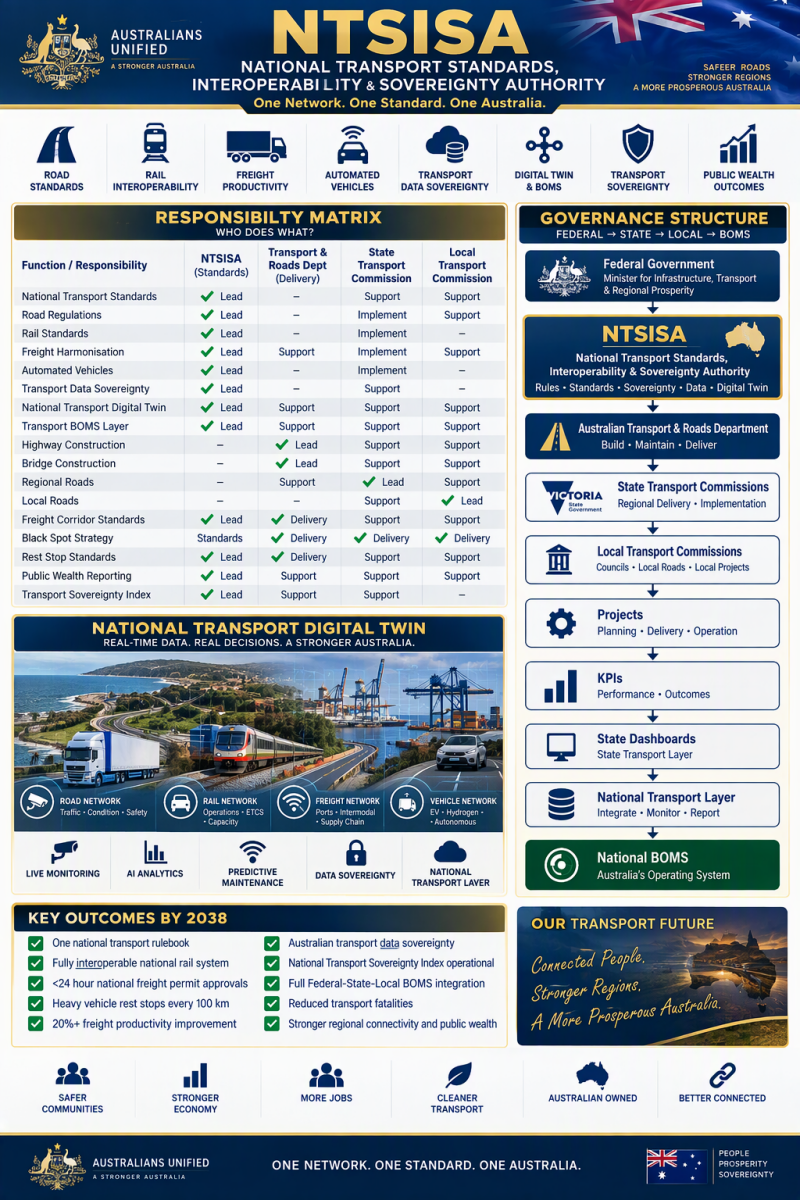
Core national transport authorities
Australians Unified proposes a coordinated national transport architecture to protect the movement of people, goods and information. The Transport Sovereignty Framework is built on six pillars: infrastructure sovereignty through Australian ownership and control of strategic transport assets; freight sovereignty through national capability and resilience; rail sovereignty through interoperable Australian rail systems; data sovereignty through transport data stored under Australian law; logistics sovereignty through freight continuity and emergency logistics capability; and digital sovereignty through protected transport platforms, AI systems and digital infrastructure.

National Road Transport Authority
Responsible for the Heavy Vehicle National Law, interstate road harmonisation, driver wellbeing, national permit systems and consistent national road freight standards.

National Rail Interoperability Authority
Leads ETCS implementation, rail signalling standards, interstate rail interoperability and secure national rail communications for a connected Australian network.

National Freight Productivity Authority
Improves national freight efficiency through strategic freight corridors, intermodal terminals and supply-chain performance. It works alongside the National Transport Data Authority on freight intelligence, transport digital twins, data sovereignty and cyber security.

Automated Vehicle Authority
Sets national direction for automated vehicles, autonomous freight, AI transport systems and vehicle safety certification—supporting safer innovation while protecting Australia’s digital transport sovereignty.
Core national road authorities
Australians Unified proposes four dedicated authorities within the Australian Transport & Roads Department to strengthen national highways, bridge safety, freight productivity, driver wellbeing and real-time road network intelligence.

National Highways Authority
Responsible for the Bruce Highway, Hume Highway, Pacific Highway, Newell Highway, Stuart Highway, Great Eastern Highway and the National Land Transport Network.

National Bridges Authority
Responsible for bridge audits, load limit management, regional bridge replacement, a modular bridge program and freight corridor bridges.

National Freight Corridor Authority
Responsible for road freight corridors, strategic freight routes, road freight productivity and heavy vehicle infrastructure.

Driver wellbeing and roads digital twin authorities
The Driver Wellbeing & Rest Stop Authority delivers the national truck stop program, fatigue management infrastructure, safety rest areas and freight driver facilities. The National Roads Digital Twin Authority monitors road and bridge conditions, potholes and real-time network performance.
Australian roads reform package
Australians Unified’s four-part roads reform package rebuilds essential freight infrastructure, strengthens national bridge capability, improves infrastructure delivery discipline and supports the wellbeing of Australia’s truck drivers.

National Highway Renewal Program
Reform 1: Reconstruct and modernise Australia’s major freight corridors to improve reliability, safety and national connectivity for communities, producers and freight operators.
National Bridge Sovereignty Program
Reform 2: Replace ageing bridges and remove freight bottlenecks, securing stronger heavy-vehicle access and resilient transport links across regional Australia.

Zero-Blowout Infrastructure Framework
Reform 3: Establish a plain-text design-build-operate (DBO) standard requiring a minimum 80% design completion before tender release—reducing scope creep and contract variations while improving cost certainty.

National Truck Driver Wellbeing Program
Reform 4: Deliver safer freight journeys with rest stops every 100 km, shower facilities, safe overnight parking, and reliable food and fuel facilities for truck drivers.
Reforms 6 and 7: digital twin intelligence and black spot zero strategy
Reform 6: National Roads Digital Twin. Leveraging the integrated BOMS architecture, this initiative deploys real-time spatial intelligence to continuously monitor critical road infrastructure. Key operational priorities track potholes, pavement condition, bridge health, freight corridor performance, and emerging accident hotspots before failures occur, ensuring timely preventative maintenance across regional and national highway networks.
Reform 7: Black Spot Zero Strategy. With a targeted objective to decisively reduce road fatalities nationwide, this program applies proactive engineering interventions directly to high-risk zones. Immediate focus is directed toward transforming dangerous intersections, constructing dedicated overtaking lanes, modernising rural highways, and fortifying heavy freight routes to protect all Australian motorists.
Treasury and public wealth assessment
Replacing duplicate administrative overhead with dedicated national road authorities delivers an estimated annual saving of $800M ($8B over 10 years), unlocking multi-billion dollar returns across Australia's transport network.
| Current fragmented system | Annual cost |
|---|---|
| Commonwealth road administration | $2.70B |
| Duplication and compliance overhead | High |
| Multiple delivery agencies | Yes |
| Current baseline expenditure | $2.70B |
| AU model division | Annual budget |
|---|---|
| National Highways Authority | $900M |
| National Bridges Authority | $350M |
| Freight Corridors Authority | $250M |
| Driver Wellbeing Authority | $150M |
| Roads Digital Twin | $100M |
| Administration | $150M |
| AU model total budget | $1.90B |
| Net annual saving (10-year saving: $8B) | $800M |
| 10-year benefits scenario | Benefit (BCR) |
|---|---|
| Conservative scenario | $25B (3.1 : 1) |
| Moderate scenario | $42B (5.2 : 1) |
| Strong scenario | $68B (8.5 : 1) |
| 50-year conservative scenario | $180B (3.6 : 1) |
| 50-year moderate scenario | $320B (6.4 : 1) |
| 50-year strong scenario | $580B (11.6 : 1) |
National transport standards, interoperability and sovereignty reform package 2028
National road standards
Reforms 1 and 2 establish national transport standards, heavy-vehicle access, freight-corridor rules, a National Road Transport Authority, HVNL Fair Go reform, driver wellbeing measures and a national freight access portal. The result: consistent cross-border rules, faster permits, safer operations and fewer freight bottlenecks.
Interoperable rail and freight
Reforms 3 and 4 create a National Rail Interoperability Authority and National Freight Productivity Authority to deliver ETCS and rail communications standards, harmonised rail operations, strategic freight corridors, intermodal integration and freight-efficiency standards—lifting capacity, productivity, supply-chain resilience and export competitiveness.

Safe automation and sovereign data
Reforms 5 and 6 establish an Automated Vehicle Authority, certification scheme and transport AI safety standards, alongside sovereign transport data governance and national freight, road and rail digital twins. A live analytics platform supports real-time network intelligence, infrastructure planning and sound investment decisions.

Sovereignty, public wealth and BOMS
Reforms 7 to 9 protect strategic assets through a Transport Sovereignty Index, ownership reviews and resilience framework; measure productivity and regional prosperity through public wealth reporting; and connect federal, state and local layers through the National BOMS Transport Layer, common KPIs and dashboard network.
Build better transport outcomes together
Explore the broader infrastructure, transport and regional development framework and help shape practical reform that delivers clearer accountability, smarter investment and reliable connections for communities across Australia.
Real benefits for Australia's transport future
The Australians Unified national transport reform transitions Australia from disjointed state advisory bodies into modern, interoperable national authorities. This approach delivers massive public value, lower bureaucratic costs, and safer, sovereign supply chains for all Australians.
Economic efficiency and high returns
Streamlining federal baseline expenditure yields an estimated 30% reduction in waste, achieving a projected 10-year moderate benefit-cost ratio of 6.4:1 and up to $125 billion in long-term public wealth gains.
National sovereignty and resilience
Protect vital supply corridors, digital infrastructure, and road freight data under sovereign Australian law to ensure domestic supply continuity during emergencies and international disruption.
Connected regional communities
Harmonised rail interoperability, faster heavy-vehicle permitting, and national digital twins eliminate cross-border friction, directly lowering freight costs for regional producers and everyday consumers.
Strategic Outcome by 2038
✅ One National Transport Rulebook
✅ One National Freight Network
✅ One National Rail Interoperability Standard
✅ National Freight Digital Twin operational
✅ National Transport Sovereignty Index published annually
✅ National Public Wealth Transport Framework operational
✅ National BOMS Transport Layer fully integrated
✅ Full Federal-State-Local transport alignment
References & legislative foundation
The statutory architecture and official Commonwealth benchmarks governing road funding allocations, national land transport networks, and freight productivity standards across Australia.