Victoria’s prosperity, built together
Australians Unified’s Victorian Prosperity Portfolio brings people together around practical economic renewal: stronger jobs, productive infrastructure, confident investment and thriving communities. Explore a community-led vision connecting government investment, private enterprise and local capability to strengthen regional economies and living standards through to Victoria 2055.
Prosperity priorities for Victoria
Our portfolio is a clear framework for Victorians, businesses and communities to discuss and support the economic foundations Victoria needs. It connects federal, state and local responsibilities so ideas can be considered at the level where they can make the greatest difference.

Treasury and economic strategy
Support responsible state budget management, revenue collection, economic strategy, forecasting, fiscal sustainability and financial resilience. This priority connects Victorian decision-making with national economic settings.

Industry, investment and jobs
Champion productive enterprise, investment confidence, innovation, workforce capability and secure, meaningful jobs across Melbourne and regional Victoria.

Infrastructure and regional growth
Advance practical infrastructure and local capability that improve access, support resilient regional economies and create lasting opportunities for Victorian communities.
A practical pathway to Victoria 2055
Prosperity is more than a headline figure. It is the ability of people, families, businesses and regions to plan with confidence, contribute locally and share in better living standards. Get involved to help shape priorities that are grounded in evidence, open discussion and common ground.

Connect investment with community capability
Australians Unified encourages a joined-up view of prosperity: public finance and investment, industry development, skills, regional development and community outcomes working together. The portfolio helps visitors understand the distinct roles of federal, Victorian state and local government while identifying opportunities for constructive collaboration.
Get involved in Victoria’s future
Join as a free member to support the conversation, follow reform ideas and add your perspective on stronger jobs, sound economic management, investment and thriving Victorian communities. Your participation helps build a more informed, community-led vision for Victoria’s long-term prosperity.

Victoria’s State Prosperity Portfolio
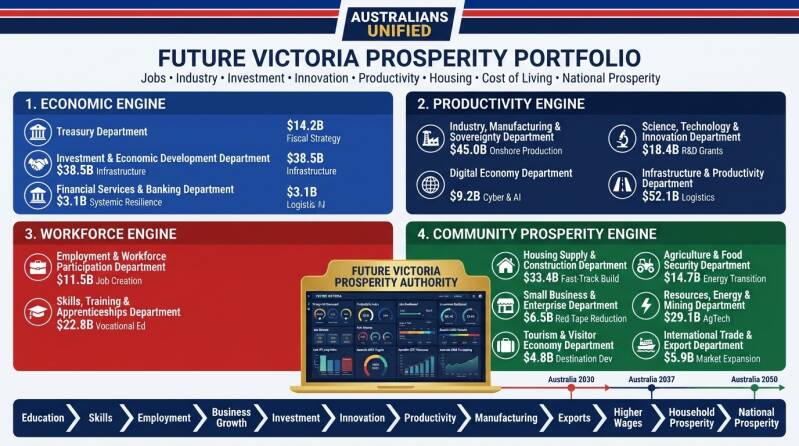
Vision: a prosperous State economy that creates jobs, delivers housing, grows industry, supports business and improves living standards for all residents. Mission: coordinate State economic development, workforce participation, industry growth, housing supply, infrastructure delivery and regional prosperity. The portfolio is the primary economic delivery framework for translating national prosperity strategy into measurable State outcomes—delivering prosperity where Australians live and work.
State portfolio structure: Treasury & Finance; Industry & Manufacturing; Small Business; Employment; Skills & Training; Housing & Construction; Infrastructure; Regional Development; Agriculture; Resources & Energy; Tourism; Innovation & Technology; and the State Prosperity Authority.
Current priorities respond to housing shortages, skills shortages, weak productivity growth, growth concentrated in major cities and increasing cost-of-living pressure. Future Australia State projects include the State Housing Delivery Framework (homes built, housing affordability and planning performance); State Workforce Participation Framework (employment rates, apprenticeships and workforce shortages); Regional Prosperity Framework (regional jobs, population growth and business development); and State Productivity Framework (economic output, infrastructure efficiency and labour productivity).
The State Prosperity Authority would track delivery through Prosperity, Housing, Jobs, Cost of Living, Infrastructure and Manufacturing dashboards, alongside Australia 2030 reporting, Australia 2037 reporting and Australia 2050 forecasting—measuring whether prosperity is actually being delivered.
Treasury, finance and business
Responsible for: State budget management, economic forecasting, tax reform and cost-of-living monitoring, alongside support for small business and investment. Outcome: strong State finances that help households and enterprises plan with confidence.

Industry and manufacturing
Responsible for: manufacturing growth, supply-chain resilience, sovereign capability and industrial precincts, connected with innovation, technology, resources, energy, agriculture, tourism and regional business development. Outcome: more local production and stronger Victorian industry.

Employment, skills and training
Responsible for: workforce participation, employment pathways, regional employment and workforce mobility; plus TAFE, apprenticeships, vocational education and workforce readiness. Outcome: more people employed in an industry-ready workforce.

Housing and infrastructure
Responsible for: housing supply, affordable housing, the construction workforce and planning reform; roads, rail, freight, utilities and productivity infrastructure. Outcome: increased housing availability and greater economic efficiency, with more homes delivered faster.
Victoria’s investment pathway to 2037
Victoria’s current State investment model supports Treasury and Finance, industry development, employment programs, TAFE and skills training, housing delivery, major infrastructure, regional development, agriculture, tourism and events, and innovation and technology. The Future Australia model retains these programs and proposes $25 billion in coordinated additional investment to address housing and skills shortages, productivity stagnation, regional inequality, cost-of-living pressures, fragmented reporting and the lack of whole-of-state prosperity measurement.
Current State investment: $87 billion
Indicative investment to 2037 spans Treasury and Finance $8.0B; Industry and Manufacturing $5.0B; Employment Programs $3.0B; Skills and Training $7.0B; Housing and Construction $12.0B; Infrastructure $35.0B; Regional Development $4.0B; Agriculture $3.0B; Resources and Energy $4.0B; Innovation and Technology $2.0B; Tourism and Visitor Economy $1.5B; and Small Business Programs $2.5B.

Future Australia addition: $25 billion
Proposed additions are Housing Delivery Acceleration $8.0B; Productivity Infrastructure $5.0B; Manufacturing and Sovereignty $4.0B; Skills and Apprenticeship Expansion $3.0B; Workforce Participation $2.0B; Technology and Innovation $2.0B; and a State Prosperity Authority $1.0B. Priorities include faster planning and modern construction, TAFE and apprenticeships, industrial precincts, workforce mobility and inclusion, freight corridors, commercialisation, AI adoption and public dashboards.

Annual budget and delivery pathway
Total annual investment is projected to rise from $9.8B in 2027–28 ($8.3B current plus $1.5B additional) to $13.1B in 2036–37 ($10.1B plus $3.0B). Estimated annual benefits increase from $0.5B to $12.0B, with the net position moving from –$1.0B in 2027–28 to +$0.5B in 2030–31, then +$9.0B by 2036–37. Intermediate annual totals are $10.3B, $10.9B, $11.3B, $11.6B, $11.8B, $12.1B, $12.4B and $12.7B.

Measured benefits and accountability
Projected benefits to 2037 are $36B–$80B: housing $8B–$15B, workforce participation $5B–$12B, skills $4B–$10B, manufacturing $6B–$15B, infrastructure productivity $10B–$20B and innovation $3B–$8B. By 2050, potential benefits are $150B–$385B, or a 5.3:1–13.7:1 benefit-to-cost ratio. Outcomes depend on population and housing demand, workforce needs, infrastructure delivery, investment attraction and training completion. Conservative, base and high-performance scenarios estimate $25B–$40B, $36B–$80B and $80B–$120B+ respectively. A State Prosperity Authority would publish Prosperity, Housing, Jobs and Cost-of-Living dashboards and Australia 2037 reporting.
Victorian state government major projects review
A comprehensive audit of Victorian public sector delivery across transport, health, housing, and clean energy. Compare current budget variances, cross-tier funding dependencies, and Australians Unified reform alternatives designed to protect taxpayers and guarantee public ownership.
| Major transport delivery | Budget, variance & status |
|---|---|
| Suburban Rail Loop (SRL East: Cheltenham to Box Hill) — SRLA | $34.5B+ (Initial est. $30B–$34.5B; PBO estimates project higher lifecycle costs) |
| SRL funding & cross-tier links | Federal ($2.2B committed of $11.5B sought) ↔ State ($11.5B) ↔ Local value-capture ($11.5B across Whitehorse, Monash, Kingston & Bayside) |
| SRL status & AU reform fix | 🔴 Budget risk: Heavy state debt pressure and unverified local value capture. AU fix: Independent State DBO audit, value-capture caps, and strict milestone gating. |
| Metro Tunnel Project (Sunbury to Cranbourne/Pakenham) — MTIA | $15.5B+ (Escalated from $10.9B initial 2016 business case; +$4.6B variance) |
| Metro Tunnel funding & status | State debt funded with local council interface (Melbourne, Stonnington, Port Phillip). In final commissioning after multi-billion contractor dispute settlements. |
| Metro Tunnel AU reform fix | 🟡 Escalation containment: Enforce fixed-price DBO milestone contracts with public dispute registers to stop contractor blowouts borne by Victorian taxpayers. |
| Clean energy & public housing renewal | Budget, variance & status |
|---|---|
| State Electricity Commission (SEC) Renewable & Storage Builds — SEC Victoria | $1B+ initial equity (utility-scale solar and battery storage including Horsham & MREH) |
| SEC funding & cross-tier links | Federal Capacity Investment Scheme (CIS) underwriting ↔ Victorian State equity alongside private joint-venture partners |
| SEC status & AU reform fix | 🟢 Active rollout: AU fix expands SEC into 100% publicly owned Renewable Super-Grid equity, eliminating private margins to pass wholesale savings to households. |
| Victoria’s Big Housing Build & Social Housing Renewal — Homes Victoria | $5.3B+ (State Big Housing Build) + $1B (Regional Housing Fund) |
| Housing funding & cross-tier links | Federal Housing Australia Future Fund (HAFF) & Social Housing Accelerator ↔ Victorian Crown land & Local Council planning fast-tracks |
| Housing status & AU reform fix | 🟡 Delivery bottlenecks & demolition delays. AU fix: Direct public construction via State DBO, retaining 100% of social housing stock in permanent public ownership. |
| Healthcare infrastructure pipeline | Budget, variance & status |
|---|---|
| Victorian Hospital & Regional Health Pipeline — VHBA | $15B+ multi-year pipeline (including Footscray Hospital, Frankston Hospital & regional builds) |
| Health funding & cross-tier links | Capital funded predominantly by Victorian State borrowing; operational service relies on 50:50 National Health Reform Agreement federal splits |
| Health status & delivery risks | 🟡 Scope deferrals & cost pressures: Suburban and regional health commitments paused or rescoped due to escalating construction inflation |
| Health pipeline AU reform fix | Ring-fenced health capital pool audited directly by State DBO to prevent bureaucratic middle-management bloat and secure hospital capacity across regional Victoria |
Victorian state-backed private and PPP projects
A detailed landscape audit of major public-private partnerships across transport, water, and renewable transmission. Contrast multi-decade private availability fees and cost escalations against Australians Unified sovereign reform alternatives.
| Major road and tunnel PPPs | CapEx, funding links and AU fix |
|---|---|
| North East Link Tunnels (Watsonia to Bulleen) — Transport & Prosperity | $26.1B CapEx (escalated from $15.8B 2018 estimate; +$10.3B cost blowout) |
| Consortium and cross-tier link | Spark Consortium (PPP) + MTIA. Federal ($5B grant) ↔ State debt ($21.1B+) and long-term availability payments. |
| Outcome vs. AU reform fix | 🔴 Blowout absorbed by taxpayers with locked-in private fees. AU fix: Ban opaque availability models, enforce pre-tender lock-ins and open-book audits. |
| West Gate Tunnel Project — Transport & Prosperity | $10.2B+ CapEx (escalated from $5.5B original estimate; +$4.7B blowout) |
| Consortium and cross-tier link | Transurban + CPB/John Holland + Victorian Govt. State ↔ Local co-funding via extended CityLink tolling concessions to 2045. |
| Outcome vs. AU reform fix | 🔴 Toxic-soil delays and privatised toll extraction. AU fix: Publicly finance essential freight corridors via National Public Bank, ending toll monopolies. |
| Water grid and critical resource PPPs | CapEx, funding links and AU fix |
|---|---|
| Victorian Desalination Plant (Wonthaggi) — Water & Sovereignty | $3.5B capital build with ~$600M–$650M/yr ongoing private availability payments |
| Consortium and cross-tier link | AquaSure Consortium (PPP) + DEECA. State ↔ Local Water Corps funded directly via regional and Melbourne household bills regardless of water ordered. |
| Outcome vs. AU reform fix | 🔴 Fixed private finance charges extracted annually. AU fix: Integrate into Sovereign Nation Water Grid, refinancing high-cost PPP debt through public capital. |
| Energy zones and transmission lines | CapEx, funding links and AU fix |
|---|---|
| VREZ and Transmission Lines (VNI West / Western Renewables Link) — Energy & Future | $7B–$11B+ estimated CapEx (subject to ongoing route, environmental and cost revisions) |
| Consortium and cross-tier link | AusNet / Transgrid (private network operators) + VicGrid. Federal Rewiring the Nation concessional loans ↔ State ↔ Moorabool, Hepburn & Grampians shires. |
| Outcome vs. AU reform fix | 🔴 Guaranteed returns for private operators amid local friction. AU fix: Community-backed underground corridors governed by VicGrid with landholder equity sharing. |
Current projects, ventures & Future Australia proposals
State Prosperity Portfolio (Victoria example)
This comparative roadmap sits between current government delivery and Future Australia initiatives to clearly show what already exists, what is underway, and what Australians Unified proposes to add across every economic department.
🏭 Industry & manufacturing
Current projects: Industry Development Grants, Advanced Manufacturing Initiatives, Defence Industry Support, Supply Chain Programs.
Current issues: ⚠ Manufacturing decline, offshore dependence, rising production costs, sovereign capability gaps.
Future Australia proposals: Victorian Sovereign Manufacturing Framework, State Industrial Precinct Authority, Critical Industry Protection Program, Australian Made Procurement Framework, Advanced Manufacturing Innovation Hubs, Supply Chain Resilience Strategy.
🚧 Infrastructure & productivity
Current projects: Major Transport Infrastructure, Roads & Rail Projects, Freight Upgrades, Regional Infrastructure Programs.
Current issues: ⚠ Cost overruns, delivery delays, productivity impacts, congestion pressures.
Future Australia proposals: Infrastructure Accountability Dashboard, National Productivity Corridor Program, Infrastructure Cost Transparency Framework, Digital Infrastructure Planning System, Freight Efficiency Program, State Productivity Authority.
💡 Science, innovation & technology
Current projects: Research Grants, Innovation Precincts, Startup Ecosystem Programs, Digital Transformation Initiatives.
Current issues: ⚠ Commercialisation gaps, loss of Australian IP overseas, low innovation adoption.
Future Australia proposals: Future Australia Innovation Fund, AI Commercialisation Framework, Australian Intellectual Property Retention Program, Innovation Investment Dashboard, Research-To-Industry Pipeline.
⛏ Resources, energy & mining
Current projects: Mining Programs, Critical Minerals Development, Energy Infrastructure Projects.
Current issues: ⚠ Processing performed offshore, global competition, energy reliability concerns.
Future Australia proposals: Critical Minerals Processing Strategy, Energy Security Framework, Resource Value-Adding Initiative, Sovereign Resource Development Zones, Future Fuels Program.
🏢 Small business & enterprise
Current projects: Small Business Support, Business Recovery Programs, Start-Up Programs.
Current issues: ⚠ Cost pressures, regulation burden, capital access challenges.
Future Australia proposals: Small Business Growth Authority, Startup Accelerator Network, AU Enterprise Investment Program, Business Regulation Review Commission, SME Productivity Framework.
📊 Future Australia additions across all departments
New authorities: State Prosperity Authority, Housing Delivery Authority, Industry Development Authority, Skills Forecasting Authority, Food Security Authority, Digital Economy Authority.
New national dashboards: Prosperity Dashboard, Cost of Living Dashboard, Housing Dashboard, Jobs Dashboard, Skills Dashboard, Manufacturing Dashboard, Investment Dashboard, Infrastructure Dashboard.
New accountability measures: Australia 2030 Targets, Australia 2037 Outcomes, Australia 2050 Forecasts, Annual Prosperity Report, Department Performance Scorecards, Public Transparency Reporting.
Summary: The State Prosperity Portfolio retains all existing state economic programs while introducing delivery authorities, accountability dashboards, productivity frameworks, housing acceleration programs, workforce development initiatives and industry growth strategies designed to measurably improve jobs, housing, skills, investment, productivity and living standards through to Australia 2037 and Australia 2050.
🏠 Housing & construction
Current projects: Big Housing Build, Housing Statement Programs, Social and Affordable Housing Programs, Planning System Reforms, Regional Housing Initiatives.
Current issues: ⚠ Housing demand exceeding supply, construction workforce shortages, high approval timeframes, rising building costs.
Future Australia proposals: Housing Delivery Acceleration Authority, Fast Track Approval System, State Construction Workforce Program, Trade Apprentice Housing Initiative, Regional Housing Growth Zones, Community Infrastructure Housing Partnerships.

🎓 Skills & training
Current projects: Free TAFE, Apprenticeship Support Programs, Victorian Skills Plan, Industry Training Partnerships.
Current issues: ⚠ Apprenticeship completion rates, training not aligned to industry demand, trade shortages.
Future Australia proposals: Trades Australia Program, School-To-Trade Pathways, Apprenticeship Completion Incentives, Industry Skills Forecasting Dashboard, Skills Shortage Early Warning System, Australia 2037 Skills Framework.

👷 Employment & workforce
Current projects: Jobs Victoria, Workforce Participation Programs, Regional Employment Programs, Disability Employment Support, Mature Age Workforce Support.
Current issues: ⚠ Skilled labour shortages, regional workforce shortages, youth employment gaps, workforce mobility issues.
Future Australia proposals: State Workforce Mobility Framework, Australia Trades Pathway Program, Jobs To Skills Dashboard, Manufacturing Workforce Pipeline, Regional Workforce Incentive Scheme, Workforce Participation Index.

🌐 Digital economy
Current projects: Digital Government Programs, Cyber Security Initiatives, Business Digital Adoption Grants.
Current issues: ⚠ Regional digital gaps, cybersecurity risks, low SME technology adoption.
Future Australia proposals: Digital Economy Authority, Regional Digital Connectivity Program, SME Technology Upgrade Program, AI Readiness Framework, Digital Skills Accelerator.

🌾 Agriculture & food security
Current projects: Food Production Programs, Biosecurity Initiatives, Drought Support Programs, Export Agriculture Programs.
Current issues: ⚠ Climate pressures, water security, rising input costs, labour shortages.
Future Australia proposals: Food Security Authority, Agricultural Innovation Network, Water Security Investment Plan, Regional Farming Workforce Program, Export Agriculture Growth Framework.

✈️ Tourism & visitor economy
Current projects: Tourism Victoria, Major Events Programs, Regional Tourism Support.
Current issues: ⚠ Seasonal demand fluctuations, regional infrastructure limitations, workforce shortages.
Future Australia proposals: National Tourism Growth Strategy, Regional Destination Development Program, Visitor Economy Dashboard, Tourism Infrastructure Fund, Australia 2037 Tourism Framework.
SUMMARY
The State Prosperity Portfolio retains all existing state economic programs while introducing delivery authorities, accountability dashboards, productivity frameworks, housing acceleration programs, workforce development initiatives and industry growth strategies designed to measurably improve jobs, housing, skills, investment, productivity and living standards through to Australia 2037 and Australia 2050.
Frequently asked questions about Victoria’s prosperity portfolio
Explore clear answers on how Australians Unified connects public investment, regional capability, sovereign industry, and measurable governance across Victoria.