Australian Business Department
🏢 TRANSFORMING DISR INTO THE ABDS
Australian Business Department Services (ABDS)
The Department of Business & Industry (DBI) is Australians Unified’s proposed business-growth framework within the Treasury Portfolio. Built around 10-year, cost-saving and development-focused modelling, it brings business owners, industry partners and investors together around common ground: stronger Australian capability, simpler regulation, sovereign investment and lasting national prosperity.
Business and industry services
DBI is designed to strengthen Australia’s long-term economic competitiveness while delivering measurable savings across government and the commercial sector. Explore the three practical areas through which the department supports modern, capable and investment-ready Australian businesses.

Industry development
Strategic business policy and industry roadmaps to modernise high-value domestic industries, strengthen onshore capability and support sustainable national growth.

SME capability uplift
Practical support for small and medium enterprises, including resources for digital adoption, stronger operations and market scaling.

Investment attraction
A pathway for domestic capital and global partnerships to contribute to priority onshore projects and Australian industry renewal.
A simpler path to national prosperity
Australians Unified supports a business environment where enterprise, investment and public value can advance together. DBI’s focus is practical reform with measurable long-term outcomes—reducing unnecessary compliance, supporting business growth and helping keep Australian industry competitive.

Modernising Australian industry
DBI develops strategic roadmaps for high-value domestic industries and connects business, industry and investment partners around onshore opportunity. The objective is a more resilient, modern Australian economy that can create long-term value without losing sight of efficient public spending.
Reducing barriers to business growth
Regulatory simplification is central to the department’s approach. By streamlining business licensing and reducing compliance burdens, DBI aims to free businesses to focus on innovation, expansion and jobs—while supporting significant, measurable cost savings across government and the commercial sector over the 10-year model.

Transforming DISR into the ABDS
Under the current model, the Department of Industry, Science and Resources (DISR) attempts to govern industry policy, resources, science, manufacturing, technology, and business services simultaneously. This fragmentation forces business owners through overlapping agencies and complex portals, diluting targeted support and leaving startups and SMEs without a clear lifecycle pathway.
The Future Australia Gold Standard framework replaces this divided landscape with the Australian Business Department Services (ABDS). By establishing one national business system, one entry point, and one growth pathway, ABDS unifies Start-Up, SME, Scale-Up, Export, and Regional programs to drive measurable sovereign capability, investment, and lasting prosperity.
From fragmented business support to one national pathway
Australia’s business-support landscape contains valuable services, but it is spread across multiple agencies, portals and overlapping programs. Australians Unified proposes Australian Business Department Services (ABDS): one connected system that makes it easier to start, invest, grow, innovate and export.

Current functions and agencies
DISR currently carries broad business functions alongside industry, science, resources, manufacturing and technology responsibilities. Businesses may also need to navigate business.gov.au, the Business Grants Hub, Investor Front Door, Austrade business support, ASBFEO and the Industry Growth Program.

Current government programs
Existing programs include the Industry Growth Program, Business Grants Hub, National AI Centre, Investor Front Door, Research and Development Tax Incentive, venture capital programs, export assistance programs and business advisory programs. Together they provide important support, but can be difficult to locate and compare.
Future Australia projects
ABDS brings current projects into clear national services: Business Grants Hub → One Business Portal; Investor Front Door → Business Investment Australia; start-up programs → Start-Up Australia; export programs → Export Business Australia; business advice → Small Business Australia; AI programs → Digital Business Australia; regional programs → Regional Business Australia.

A clearer growth pathway
Current: Business → find an agency → find a program → apply → wait. This fragmentation, program duplication and multiple portals make navigation difficult. Future: Business → ABDS → one portal → business advisor → growth pathway → investment → productivity → exports → prosperity.
ABDS SWOT analysis
Australians Unified’s proposed Australian Business Department Services (ABDS) would transform business-facing functions now spread across DISR and other services into a connected business growth and prosperity ecosystem. This analysis identifies the strengths to build on, the gaps to solve, the opportunities to capture and the risks Australia must address.

Strengths
Australia has a strong base to integrate.
- Established infrastructure: business.gov.au, Business Grants Hub, Industry Growth Program, Investor Front Door, National AI Centre, Export Market Development programs and Austrade business services.
- A diverse enterprise base of 2.5+ million businesses, including SMEs, family-owned firms, startups, export-capable and regional businesses.
- Existing capability in grants administration, investment support, business advice, innovation programs and export assistance.
- ABDS can build on these foundations through One Business Portal Australia, a unified National Business Services Network, Business Operations Centre, National Business Dashboard and Business Health Index.
Government has many of the tools, while Australia’s entrepreneurial culture provides the platform for Family Enterprise Australia, Scale-Up Australia, Export Business Australia, Regional Business Australia and a National Startup Accelerator Network.

Weaknesses
Business support remains fragmented and uneven.
- Owners may need to navigate DISR, business.gov.au, Austrade, Treasury, ASBFEO, state agencies and local government programs.
- Grants, export, tax, regulatory, state and local portals can require separate systems and repeated reporting.
- Programs often assist with creation, exporting or investment individually, rather than the full business lifecycle.
- Service availability can differ dramatically by region and postcode.
ABDS responds with one entry point, one support system, one business profile and one reporting framework: start → operate → grow → scale → export → transfer → prosperity. One Business Portal Australia, a Single Business ID, unified reporting, national service standards, Regional Business Australia, local business services and community business hubs would replace confusion with connected delivery.

Opportunities
ABDS can make business support simpler, smarter and available across Australia.
- Expand business.gov.au into One Business Portal Australia, with a single customer experience, AI-powered advice and whole-of-lifecycle support.
- Use the National AI Centre and digital adoption grants to deliver an AI Business Adviser, automated grant matching, diagnostics, growth forecasting and productivity recommendations.
- Build Export Business Australia, a National Export Accelerator, SME Export Certification and a market-diversification strategy from Austrade, export grants and trade agreements.
- Create Business Productivity Australia, a National Productivity Dashboard, SME benchmarking and AI productivity tools.
- Support succession, governance, continuity and intergenerational transfer through Family Enterprise Australia.
- Extend prosperity beyond capital cities through Regional Business Australia, investment corridors, main street renewal and tourism-enterprise support.
The opportunity is a more accessible national business ecosystem that lifts competitiveness, wages, Australian ownership and regional growth.

Threats
Australian businesses face pressure to adapt faster and compete harder.
- Global competition from lower-cost economies, technology firms, aggressive export competitors and foreign investment rivals.
- Rising energy, insurance, compliance, labour and commercial-rent costs.
- Slowing productivity growth, skills mismatches and technology-adoption gaps.
- Shortages in construction, trades, manufacturing, engineering and technology.
- Cyber threats, AI disruption, automation gaps and global platform dominance.
ABDS would respond through export readiness, productivity improvement, sovereign capability development, regulatory reform, digital adoption and business-efficiency programs. Business Productivity Australia, workforce partnerships, skills forecasting, apprenticeship and school-to-business pathways, Digital Business Australia, AI Adoption Grants, cyber-readiness support and technology transformation programs would help businesses remain viable, capable and competitive.
FUTURE AUSTRALIA POSITION STATEMENT
Australian Business Department Services (ABDS) transforms fragmented business programs currently delivered through DISR, business.gov.au, Austrade, advisory networks and multiple grant systems into a single national business ecosystem that supports Australian businesses from startup to scale-up, export, succession and long-term prosperity, creating a stronger, more productive and globally competitive business sector by Australia 2037 and Australia 2050
Business ecosystem gap analysis
A targeted assessment of current capability alignment across national enterprise functions, highlighting critical gaps in productivity metrics, dashboard intelligence, and succession planning within Australian business support.
| Gap analysis area | Alignment & status |
|---|---|
| Startups | 75% 🟡 |
| Small business support | 80% 🟢 |
| Export support | 75% 🟡 |
| Productivity measurement | 30% 🔴 |
| Succession planning | 10% ⚫ |
| Business dashboards | 5% ⚫ |
| National business ecosystem | 20% 🔴 |
Current Baseline
Current Environment
✅ 2.6M+ businesses
✅ Existing support ecosystem
✅ Existing exports framework
✅ Existing innovation system
Challenges
⚠ Business failure rates
⚠ Complicated government systems
⚠ Limited scaling support
⚠ Regional business disadvantage
Australian Business Department services
ABDS establishes a unified national architecture to support enterprise growth across every tier of the economy. From inception to global expansion, our programs deliver streamlined regulatory pathways, direct capability development, and sovereign investment backing.
Start-up and small business
Direct support through Start-Up Australia and Small Business Australia, simplifying early registrations, local compliance, and essential commercial foundations.
Family and regional enterprise
Tailored lifecycle support via Family Enterprise Australia and Regional Business Australia, protecting multi-generational assets and expanding regional economic resilience.
Scale-up, export and digital
Accelerated expansion delivered by Scale-Up Australia, Export Business Australia, and Digital Business Australia to reach foreign markets and modernise operations.
Productivity and Operations Centre
Coordinated nationwide through Business Investment Australia, Business Productivity Australia, and the integrated Business Operations Centre.
Business growth services
The Australian Business Department brings practical support into one clear business-growth pathway—from first idea and formation through to succession, expansion and international growth. Explore the four core services designed to build stronger Australian-owned businesses.

🚀 Start-up Australia
Founder programs, incubators, accelerators and early-stage grants that support business formation, founder education, startup mentoring and innovation. Outcome: more Australian businesses created.

🏢 Small Business Australia
Consolidating business.gov.au-style services with business support, regulatory guidance, grants, operations assistance and growth support for small businesses. Outcome: higher SME survival rates.

👨👩👧 Family Enterprise Australia
A Future Australia function supporting succession planning, family business transition, intergenerational transfer, family governance and business continuity. Outcome: Australian-owned businesses retained for generations.

📈 Scale-up Australia
Expansion assistance for high-growth businesses, including productivity programs, capital readiness and international growth support. Outcome: more Australian companies scale globally.
Business growth, trade and productivity services
The Australian Business Department Services (ABDS) brings key business-growth functions into four clear national services: export development, digital capability, investment access and productivity improvement. Together, they give Australian businesses practical pathways to grow, compete and create lasting national prosperity.

🌏 Export Business Australia
Consolidates export support, market development and international business assistance. Responsible for export readiness, trade access, market entry, export mentoring and global partnerships. Outcome: more exporting Australian businesses.

💻 Digital Business Australia
Consolidates National AI Centre functions, digital adoption programs and business technology initiatives. Responsible for AI adoption, automation, e-commerce, cybersecurity readiness and digital transformation. Outcome: more productive businesses.
💰 Business Investment Australia
Consolidates the Investor Front Door, venture capital programs and business investment support. Responsible for capital raising, investor matching, venture capital access, growth investment and foreign investment support. Outcome: improved access to business capital.

📊 Business Productivity Australia
Drives productivity benchmarking, industry performance analysis, efficiency improvement, workforce productivity and best-practice adoption across Australian business. Outcome: higher national productivity.
Building stronger business systems for Australia
The Australian Business Department proposal brings regional enterprise support and measurable business performance into clear national services, while retaining strategic industry, science and sovereign-capability functions in a focused successor to DISR.

🌄 Regional Business Australia
Responsible for regional enterprise, tourism business development, agricultural enterprise, main street renewal and regional investment. Outcome: stronger regional economies.

🏢 Business Operations Centre
Provides business, startup, investment, export, SME and productivity dashboards, alongside a Business Health Index, Australia 2030 targets, Australia 2037 outcomes and Australia 2050 forecasting. Outcome: business performance becomes measurable.

🔄 What stays in DISR?
ABDS does not absorb all of DISR. A retained Department of Industry, Science & Sovereign Capability would lead manufacturing policy, defence industry, critical minerals, resources, national science policy, research infrastructure, sovereign capability, supply-chain security and strategic industry development.
A connected federal, state and local business model
Australians Unified’s Australian Business Department Services (ABDS) sets clear responsibilities across every level of government—linking national strategy, state delivery and local enterprise support with signature Future Australia projects that make business growth measurable, practical and accessible.
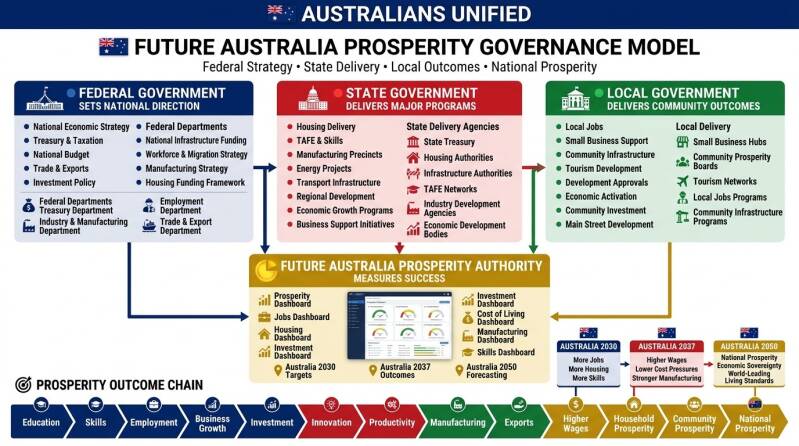

🇦🇺 Federal ABDS
Responsible for national business settings:
- National business strategy
- Regulation
- Export support
- Investment support
- Entrepreneurship
- Productivity measurement

🏛 State business services
Responsible for state-based delivery:
- Grants
- Industry precincts
- Business advisory services
- State investment attraction
- Startup ecosystems
🏘 Local business services
Responsible for place-based enterprise:
- Main street activation
- Local jobs
- Tourism enterprises
- Business networking
- Community investment
- Business hubs
📈 Signature Future Australia projects
A national platform for enterprise growth and accountability:
- One Business Portal Australia and National Business Dashboard
- Business Startup Fast Track and SME Health Index
- Family Enterprise Framework and National Export Accelerator
- Business Investment Network and AI Adoption Grants
- Business Productivity Index and Regional Enterprise Network
- Australia 2037 Business Strategy and Australia 2050 Competitiveness Framework
National business transformation roadmap
The four-phase transition from fragmented departmental oversight to the Australian Business Department Services (ABDS) establishes a unified, measurable, and world-competitive enterprise ecosystem from 2027 to 2050.
Phase 1: Foundation & consolidation (2027 – 2029)
Objective: Create a single national business entry point without disrupting existing operations. Key initiatives include launching One Business Portal Australia, integrating business.gov.au, rolling out the Business Operations Centre, and establishing the National Business Dashboard and Business Health Index while consolidating the Business Grants Hub, Industry Growth Program, and Investor Front Door.
Phase 2: Integration & growth (2030 – 2033)
Objective: Align federal, state, and local business services into one seamless network. Key milestones include standing up Start-Up Australia, Small Business Australia, Digital Business Australia, and Export Business Australia, backed by State Integration Agreements, local business hubs, national startup accelerator networks, and the AI Business Adoption Program.
Phase 3: Scale & export (2033 – 2037)
Objective: Accelerate domestic expansion and global market access for Australian enterprises. Driven by Scale-Up Australia, the National Export Accelerator Program, Regional Business Australia, Export Readiness Certification, and family enterprise succession frameworks, this phase targets a 25% cut in red tape and a 20% rise in exporting SMEs.
Phase 4: Australia 2050 business leadership (2037 – 2050)
Objective: Establish Australia among the world’s premier nations to start, build, and scale enterprises. Powered by an AI-driven advisory platform, global investment networks, next-generation incubators, and the Australia 2050 Competitiveness Framework, delivering long-term productivity, higher wages, and enduring national prosperity.
Current system vs future Australia
Current fragmented system
Today, Australian enterprise is held back by structural division across government departments and agencies:
Business
↓ Multiple agencies
↓ Multiple systems
↓ Multiple programs
↓ Different rules and compliance burdens
This fragmented landscape forces businesses to navigate overlapping departments, duplicate paperwork, and disjointed portals, restricting growth and productivity.
Future Australia model
Australians Unified replaces bureaucratic friction with the Australian Business Department Services (ABDS):
Business
↓ ABDS
↓ One portal
↓ One support system
↓ One growth pathway
↓ National prosperity
Our end goal is to transform DISR's business-facing functions into a dedicated pathway for Australians to start, operate, grow, invest in, export from, and pass forward enterprise across generations while driving productivity, jobs, and sovereign prosperity.
A single national business ecosystem
The Australian Business Department Services (ABDS) consolidates fragmented business-facing operations currently divided across DISR, business.gov.au, export programs, investment initiatives, and advisory networks into one unified national ecosystem. By establishing an integrated framework, ABDS supports Australians to start, operate, grow, invest in, export from, and pass forward enterprise across generations—forging an unbroken pathway from grassroots entrepreneurship to sovereign national prosperity.
Business growth frameworks and proposed legislative reform
Australians Unified proposes four connected frameworks within Australian Business Department Services (ABDS): Start-Up Australia, Family Enterprise Australia, Scale-Up Australia and the Business Productivity Framework. Proposed amendments to the Industry Research and Development Act would strengthen startup support, commercialisation and innovation pathways. The proposed Future Australian Business Department Services Act would establish ABDS, a National One Business Portal and a Business Operations Centre, with national reporting requirements for Australia 2030, 2037 and 2050.
Draft bill clauses: Clause 1 establishes Australian Business Department Services; Clause 2 establishes the National One Business Portal; Clause 3 creates the Business Operations Centre; and Clause 4 requires Australia 2030, 2037 and 2050 reporting.
Start-Up Australia framework
A national pathway for new Australian ventures, combining founder support, startup grants and an accelerator network. The framework is designed to help founders turn ideas into viable businesses, access early capability and progress through clear innovation and commercialisation pathways.

Family Enterprise Australia
Support for family-owned enterprises to plan confidently for the future through succession planning, family governance and business continuity. It helps protect Australian ownership, strengthen intergenerational transition and maintain resilient enterprises for generations.

Scale-Up and productivity frameworks
Scale-Up Australia provides expansion pathways, capital attraction and global growth support for high-potential businesses. The Business Productivity Framework adds productivity measurement, technology adoption and benchmarking so businesses can identify improvements, invest with confidence and compete at scale.
Safeguards & eligibility
Business support eligibility
Support through the Australian Business Department is structured to empower productive enterprises across the national economy. Priority access and funding frameworks are open to:
- ✅ Australian businesses
- ✅ Startups
- ✅ Small and medium enterprises (SMEs)
- ✅ Family businesses
- ✅ Exporters
Accountability safeguards
Every dollar invested and program administered under the department operates under strict statutory standards to guarantee integrity, efficiency, and public benefit:
- ✅ Independent audit
- ✅ Grant transparency
- ✅ Public reporting
- ✅ Annual review
Current budget vs ABDS budget
Transforming DISR business functions into a unified national business growth ecosystem. By expanding existing support by an additional $10.0 billion, the Australian Business Department Services (ABDS) establishes a $25.0 billion investment model delivering an estimated $59B–$127B in economic benefits by 2037.
| Current investment (to 2037 scope) | Estimated allocation |
|---|---|
| Business grants programs | $4.0B |
| Industry growth programs | $2.0B |
| Export support programs | $2.5B |
| Business advisory services | $1.0B |
| Digital business programs | $1.5B |
| Startup & innovation programs | $2.0B |
| Investment attraction functions | $1.0B |
| Business administration systems | $1.0B |
| Total current investment baseline | $15.0B |
| Future Australia ABDS investment | Additional funding |
|---|---|
| Start-Up Australia (accelerators, mentoring) | $1.2B |
| Small Business Australia (SME resilience, advice) | $1.0B |
| Scale-Up Australia (expansion & market prep) | $1.5B |
| Export Business Australia (trade acceleration) | $1.5B |
| Digital Business Australia (AI adoption & cyber) | $1.8B |
| Business Investment Australia (capital attraction) | $1.0B |
| Regional Business Australia (enterprise hubs) | $1.0B |
| Business Operations Centre (One Portal & reporting) | $1.0B |
| Total additional ABDS investment | $10.0B |
| Investment overview & ROI summary | Economic value |
|---|---|
| Current business programs baseline | $15.0B |
| Additional ABDS transformation investment | $10.0B |
| Total ABDS investment to 2037 (+66.7% uplift) | $25.0B |
| Total projected economic benefits by 2037 | $59B–$127B |
| Net economic benefit to Australia | $34B–$102B |
| Overall benefit-to-cost ratio | 2.4:1 to 5.1:1 |
References and source benchmarks
Current Australian government baselines:
- Department of Industry, Science and Resources (DISR) – Industry policy, National AI Centre, Industry Growth Program, and Investor Front Door
- business.gov.au – Startup support, small business advisory, and grants finder
- Austrade – Export assistance, trade facilitation, and global investment attraction
- ASBFEO – Small business advocacy, dispute resolution, and family enterprise support
- Productivity Commission – Productivity research, regulatory reform, and economic evaluation
- Australian Bureau of Statistics (ABS) – Enterprise statistics and economic indicators
- Australian Treasury – Competition, macroeconomic, and business tax policy
International benchmarks and future additions:
- Enterprise Singapore – Integrated SME capability, startups, and international expansion
- UK Department for Business & Trade – Unified trade promotion and commercial investment
- NZ Ministry of Business, Innovation & Employment – Streamlined enterprise development
- US Small Business Administration – Comprehensive capital readiness and founder support
Position statement: Australian Business Department Services (ABDS) consolidates fragmented federal programs into a single national lifecycle ecosystem. It connects Federal, State, and Local tiers while integrating productivity tracking, One Business Portal, and future forecasting dashboards to empower long-term Australian prosperity.
Frequently asked questions about the Australian Business Department
Find answers to key questions about the proposed transition from DISR to the Australian Business Department Services (ABDS), regulatory simplification, and support pathways for Australian enterprises.