DEPARTMENT OF NATIONAL BUSINESS & INDUSTRY SYSTEMS (NBIS)
A nationally integrated department advancing coordinated business and industry policy
AI-enabled • Efficient • Responsive • Integrated • Future-focused
OUR ROLE
The Department of National Business & Industry Systems (NBIS) provides strategic leadership to:
-
Coordinate business-related functions across government
-
Integrate policy and service delivery across trade, industry, skills, digital capability, regulation, and innovation
-
Provide Australian businesses with a clear and accessible central point of engagement
-
Advance national productivity, competitiveness, and sustainable economic growth
-
Promote consistent, transparent, and effective business policy and regulation
-
Improve efficiency by reducing duplication across government agencies
-
Strengthen sovereign capability and national economic resilience
NBIS serves as the central coordinating mechanism & authority for Australia’s future ecosystem.
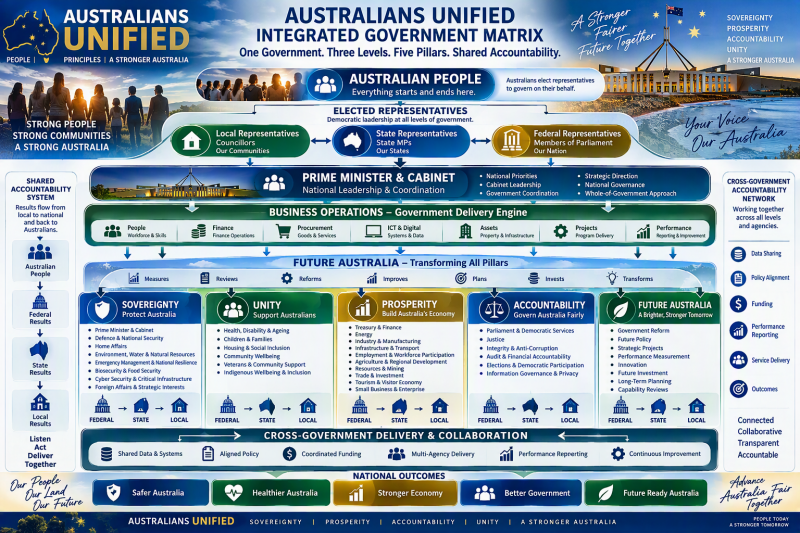
Why a business services department is essential for foreign trade
A dedicated Business Services Department provides Australia with a unified, sovereign, and future-ready trade architecture. Under the current structure, trade responsibilities are scattered across multiple disparate agencies, generating administrative duplication, compliance delays, and confusion for enterprise. By creating a single front door for exporters, the department unifies regulatory guidance, speeds up statutory approvals, and cuts overhead costs. Furthermore, modern digital platforms replace obsolete systems with integrated data, automated compliance, and real-time predictive market analytics.
Consolidating foreign trade within a single portfolio ensures that global economic decisions strictly serve Australia’s national interest. A coordinated trade strategy drives market diversification to eliminate reliance on any single foreign power, while active supply chain mapping safeguards sovereign assets and critical goods. Through robust anti-capture safeguards, transparent investment screening, and strategic workforce alignment, foreign trade shifts from a point of vulnerability into a catalyst for national strength, resilient regional industry, and fair outcomes for Australian workers.
Expected regional and economic outcomes by 2030
Through the consolidation of national business functions into the Department of National Business & Industry Systems (NBIS), Australia establishes a streamlined single front door for enterprise. By merging overlapping business operations and redirecting 38,000 personnel into high-priority infrastructure, sovereign energy, and advanced manufacturing sectors, this initiative delivers over $32B to $40B in annual net economic benefits. Local manufacturing hubs in Geelong, Newcastle, Townsville, and Whyalla gain direct access to automated compliance tools and predictive global market intelligence.
By integrating sovereign solid-state battery precincts, national electric vehicle manufacturing, and the national energy super-grid, our communities will experience tangible long-term gains. Regional centres benefit from increased employment, higher visitor spending, upgraded civic infrastructure, and robust supply chain resilience. Decentralised data architecture and transparent anti-capture safeguards guarantee that trade decisions and public investments remain dedicated strictly to the enduring interests of Australian workers and families.

OUR STRENGTHS
Economic & Business Strengths
-
Whole‑of‑economy oversight
-
Unified business policy and regulation
-
Stronger national competitiveness
-
Streamlined business support
AI‑Enhanced Strengths
-
Automated regulatory compliance
-
AI‑driven industry forecasting
-
Predictive economic modelling
-
Real‑time business intelligence dashboards
-
Integrated national business data platform

.OUR WEAKNESSES (PRE‑AI, PRE‑UNIFICATION
-
Fragmented business functions
-
Slow regulatory processes
-
High administrative overhead
-
Conflicting policy directions
-
Limited cross‑agency coordination

OUR THREATS
External Threats
-
Global economic volatility
-
International competition
-
Supply chain disruptions
-
Technological disruption
Internal Threats
-
Political appointments influencing priorities
-
Legacy systems
-
High program duplication
-
Workforce shortages in specialist roles
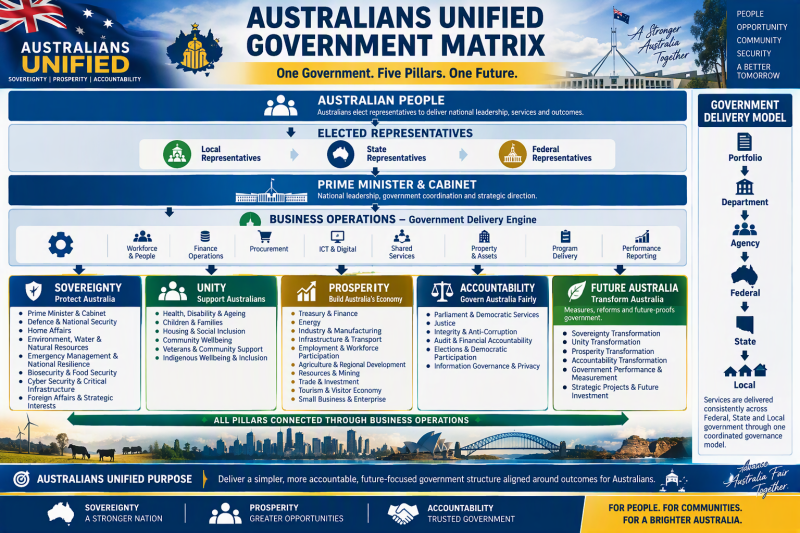
AI-enabled opportunities and sovereign anti-capture safeguards
Our opportunities (AI-enabled)
By modernising the department through artificial intelligence, we streamline national commerce and eliminate unnecessary friction for enterprise. Core initiatives include:
Automate business regulation and compliance: Speeding up statutory reviews and reducing administrative friction.
Deploy AI-enabled industry forecasting: Utilizing predictive modelling for proactive market analysis and planning.
Reduce administrative overhead: Slashing red tape and repetitive procedural delays.
Improve transparency and reporting: Providing real-time, comprehensive data access across agencies.
Strengthen independence through tamper-proof systems: Locking in institutional integrity via secure technology.
Reinvest savings: Channeling operational dividends straight into Australian innovation, skills development, and sovereign capability.
Anti-capture safeguards
To ensure no government or interest group can politicise or redirect the department, we enforce six non-negotiable institutional protections:
AI-governed policy prioritisation: Regulatory pipelines and programs determined purely by transparent algorithms rather than partisan preference.
Immutable audit trails: Automated public logging of all regulatory decisions, system modifications, and approvals.
Independent appointment panels: Non-political selection boards composed of trusted leaders across industry, academia, and civil society.
Mandatory publication of ministerial contacts: Complete, automated publication of all representations made by elected officials.
Conflict-of-interest rules: Strict bans on political party memberships, donations, or campaign involvement for senior personnel.
Decentralised data architecture: Distributed infrastructure preventing any single minister or entity from overriding core systems.
Australian Manufactoing
Australian culture and build a more profitable future, Australia should prioritise manufacturing in clean energy, defence, food processing, and creative industries. These sectors align with the “Future Made in Australia” industrial policy and cultural renewal goals. The government has committed $22.7 billion over the next decade to support sovereign capability and cultural exports
High-Impact Manufacturing Sectors for Cultural & Economic Renewal
🔋 Clean Energy & Resource Value-Adding
-
Solar panel and battery manufacturing
-
Green hydrogen infrastructure
-
Critical minerals processing (lithium, rare earths)
-
Wind turbine components
-
Energy storage systems
- hydro electric power
- supports the national super grid
Supports net-zero transition and sovereign energy capability.
🛡️ Defence & Sovereign Infrastructure
-
Military-grade electronics and communications
-
Naval shipbuilding and aerospace components
-
Secure digital infrastructure and AI systems
-
Disaster resilience and emergency equipment
- hydro electric power
- supporting the national super grid
Strengthens national security and cultural confidence.
🍽️ Food & Agriculture Processing
-
High-quality packaged foods for export
-
Sustainable meat, dairy, and grain processing
-
Indigenous bush foods and native ingredients
-
Agri-tech and smart farming tools
Promotes Australia’s clean, safe food reputation globally.

🎨 Creative Industries & Cultural Exports
-
Film, animation, and digital media production
-
Music instruments and audio tech
-
Art supplies and cultural merchandise
-
Publishing and educational content manufacturing
Amplifies Australian stories and cultural pride.
🏗️ Construction & Circular Manufacturing
-
Modular housing and prefab infrastructure
-
Recycled materials and green building systems
-
Cultural precinct construction and heritage restoration
-
🧠 Strategic Enablers
-
AI-enabled manufacturing systems
-
Workforce training in future industries
-
Public investment via Future Made in Australia Ac
-
Supports urban renewal and cultural infrastructure.

Solid‑State Batteries (Core Sovereign Industry)
-
Use Australian lithium + rare earths for domestic battery production
-
Power national EV, defence systems, robotics, and grid storage
-
Export battery packs, modules, and licensed chemistry

National Australian Car (Zero‑Emission, Robotic‑Built)
-
Build a sovereign EV platform using green steel + solid‑state batteries
-
Replace government fleets and support regional transport
-
Export EV models, modular platforms, and assembly kits
. Green Robotic Factories (Powered by Renewables)
-
Manufacture EVs, batteries, robotics, and automation components
-
Use solar, wind, and hydrogen for zero‑emission production
-
Export turnkey “factory‑in‑a‑box” systems and robotics‑as‑a‑service
Rebuilding national productivity through unified enterprise
Australia's economic framework is currently fragmented across seven uncoordinated federal entities, burdening enterprises with regulatory bottlenecks, conflicting rules, and escalating compliance costs. Australians Unified establishes a whole-of-economy National Business & Industry Framework that aligns commerce, sovereign manufacturing, taxation, and logistics into a single accountable engine. By shifting focus from exporting raw materials to onshore processing, modernising transport corridors, and streamlining business tax systems, we ensure our economy actively protects Australian jobs, supports regional industry, and fosters long-term prosperity.
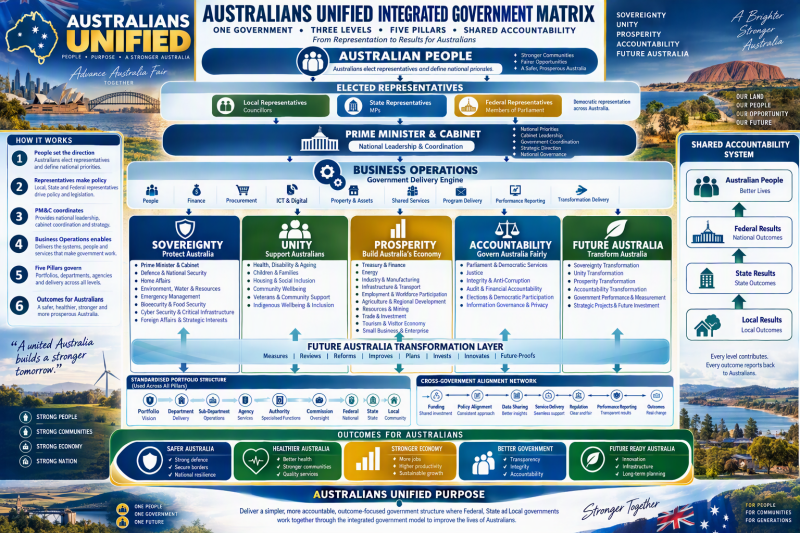
Strategic roadmap — NBIS implementation
A phased, reduced-budget, and AI-enabled transition delivering sovereign economic resilience, operational efficiency, and unified national business oversight.
Phase 1: Foundation (years 1–2) — unify and stabilise
Merge business-related functions from multiple disparate departments to reduce duplicated staffing, overlapping agencies, and redundant programs. We immediately deploy workflow automation, launch initial AI pilots for industry forecasting and compliance, construct a unified national business data architecture, and establish an independent governance board.
Key outcome: Lower operating costs, unified strategic direction, and reduced political influence across national enterprise policy.
Phase 2: Acceleration (years 2–4) — modernise and automate
Launch an enterprise-grade AI-enabled business intelligence platform alongside automated compliance and regulatory assessment mechanisms. Introduce digital self-service tools for commercial operators, automate national grants, approvals, and public reporting, while heavily upgrading digital infrastructure and cyber-resilience frameworks.
Key outcome: Higher administrative capability and faster statutory processing delivered with significantly fewer public resources.
Phase 3: Expansion (years 4–6) — grow national capability
Scale whole-of-agency adoption of automated operational tools across all portfolio functions. Establish a nationwide business intelligence network, roll out real-time industry dashboards, provide modern workforce augmentation tools, and institute immutable, real-time audit trails and transparent public reporting standards.
Key outcome: Substantially stronger sovereign economic capability, protected domestic assets, and resilient commercial supply corridors.
Phase 4: Future-ready (years 6–10) — transform and protect
Operationalise fully automated regulatory cycles, predictive macroeconomic modelling, and AI-enabled industry transformation planning. Through continuous algorithmic improvement and an integrated national business ecosystem, sovereign production lines and clean energy industries operate with maximum domestic agility.
Key outcome: A modern, resilient, tamper-proof, and future-ready business framework safeguarding Australian enterprise for decades to come.
Department investment and capability roadmap
A phased, AI-enabled transition delivering reduced baseline funding, strict statutory integrity, and transformative national economic returns across a 10-year horizon.
Baseline funding and initial foundations
Operating at a lean $0.62B per year (reduced from $0.88B to capture an immediate 30% efficiency gain), NBIS eliminates administrative overhead, cuts reliance on external consultants, and deploys workflow automation to replace repetitive tasks.
Phase 1 (years 1–2, $0.48B – $0.66B): Consolidates legacy systems, unifies national business data architecture, establishes an independent governance board, and launches targeted AI pilots for compliance and industry forecasting.
Modernisation, automation, and capability expansion
Phase 2 (years 2–4, $1.00B – $1.40B): Accelerates transformation through an AI-enabled business intelligence platform, automated statutory compliance tools, digital enterprise self-service, streamlined grant approvals, and upgraded cyber-resilience frameworks.
Phase 3 (years 4–6, $0.80B – $1.10B): Builds a nationwide business intelligence network, real-time industry dashboards, workforce augmentation systems, and immutable transparent public audit logs.
Future-ready transformation and sovereign ecosystem
Phase 4 (years 6–10, $2.20B – $2.80B): Achieves a fully integrated national business ecosystem driven by predictive economic modelling, automated regulatory cycles, and algorithmic industrial transformation planning.
This phase safeguards domestic manufacturing and critical supply corridors, ensuring sovereign enterprise operates with speed and strategic agility on the international stage.
Integrity safeguards and total investment overview
People and community: Non-negotiable anti-capture standards enforce strict conflict-of-interest prohibitions, zero political memberships or donations, mandatory public logging of ministerial contacts, digital accessibility tools for all enterprises, and a national digital business literacy uplift.
Total capital plan: 6-year total of $2.28B – $3.16B; 10-year total of $4.58B – $5.96B to deliver an independent, AI-enabled department that drives enduring economic growth.
Frequently asked questions about NBIS & business services
Explore common questions regarding the Department of National Business & Industry Systems (NBIS), export modernisations, and Australia's sovereign trade architecture.