Preparing Australia for the Future.
The Future Australia Portfolio Framework brings together the departments, agencies and initiatives responsible for advancing innovation, science, technology, research, cyber security, digital transformation and future workforce development.
Within the Australians Unified Governance Matrix, this portfolio aligns priority reform areas with government portfolios, departments and agencies, policy development, and measurable community outcomes. Its purpose is clear: to strengthen investment in knowledge, skills, advanced industries and sovereign capability, enabling Australia to respond confidently to emerging opportunities and challenges while supporting long-term prosperity and national resilience.
The Department of Business Operations is positioned not as a conventional department, but as the overarching governance architecture responsible for coordinating the Future Australia portfolio and establishing effective alignment across all government portfolios and departments.
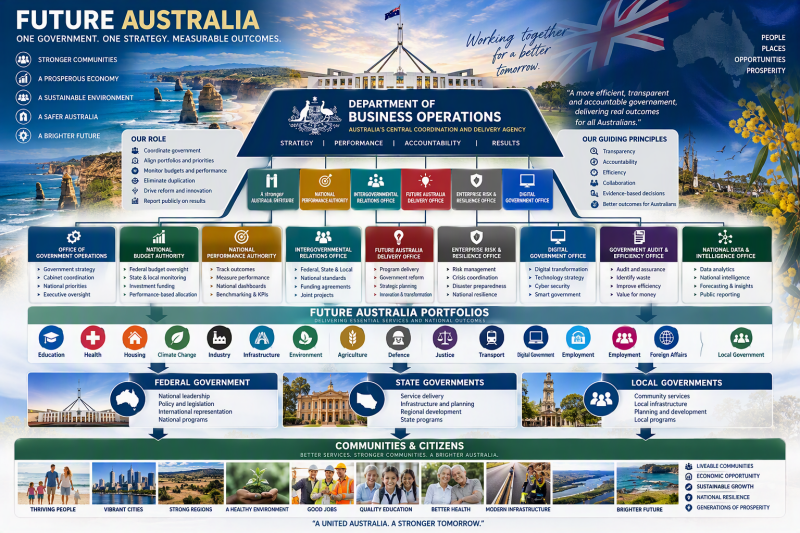
This infographic captures the Future Australia Governance Model with Australian branding, showing:
- 🏛️ Department of Business Operations as the central coordination agency
- 📊 Strategy, Performance, Accountability and Results layers
- 💰 National Budget Authority
- 📈 National Performance Authority
- 🤝 Intergovernmental Relations Office
- 🚀 Future Australia Delivery Office
- 🛡️ Risk & Resilience Office
- 💻 Digital Government Office
- 🔍 Government Audit & Efficiency Office
- 📡 National Data & Intelligence Office
- 🎓 Education, 🏥 Health, 🏘 Housing, 🌏 Climate, 🏭 Industry, 🚆 Infrastructure and other portfolios
- 🇦🇺 Federal Government
- 🏛️ State Governments
- 🏘️ Local Governments
- 👨👩👧👦 Communities & Citizens as the ultimate recipients of government outcomes
It works well as the master diagram for the Future Australia homepage beneath the "Department of Business Operations" explainer section.
Community layer and strategic outcomes
The Future Australia blueprint connects federal, state, and local governance directly to citizens, businesses, and communities. By separating strategy, service delivery, and accountability, Australia achieves transparent stewardship and measurable national progress.
Layer 4: Community layer governance
A unified civic bridge connecting federal, state, and local governments with citizens, businesses, and grassroots communities. Through transparent channels, stakeholders receive services, provide direct feedback, participate actively in policy decisions, and continuously measure public value.
Section 15: Expected national outcomes
Delivering reduced duplication, coordinated multi-tier operations, improved public services, and accelerated project delivery. Systemic performance controls ensure rigorous budget transparency, greater executive accountability, and higher productivity across all public investments.
Section 16: Future Australia vision
The Department of Business Operations acts as Australia's central coordination agency, aligning every portfolio, program, project, and public dollar to a singular national mission. Evidence-based planning replaces fragmentation with structured, accountable public administration.
Data-driven decisions and lasting prosperity
By anchoring governance in real-time metrics and community trust, Future Australia builds long-term national resilience. Guided by our clear operating standard: "One Government. One Strategy. Measurable Outcomes."
Explore Australia’s future-ready priorities
From scientific discovery and advanced manufacturing to secure digital systems and workforce skills, the Future Australia Portfolio showcases the connected priorities that can help prepare our nation for what comes next.


Help prepare Australia for tomorrow
A stronger future is built through shared purpose, practical reform and informed participation. Join Australians Unified to explore the Future Australia vision and stand behind innovation, resilience, opportunity and Australian capability.
Future Australia portfolio breakdown summary
The Future Australia Portfolio serves as the strategic foresight and innovation engine within the Australians Unified Governance Matrix. It is designed to prepare Australia for long-term national development, emerging industries, and transformative technological opportunities for generations to come.
By proactively addressing technological disruption, future workforce skills gaps, and infrastructure demands, the portfolio bridges high-level research with tangible community outcomes. From artificial intelligence and advanced manufacturing to sovereign capability and clean technology, strategic foresight ensures our nation remains resilient, adaptable, and globally competitive.
A key focus is building a future-ready national innovation ecosystem that connects universities, industry, communities, and government. Through targeted investment in research commercialisation, regional innovation hubs, digital capability, and lifelong learning, the portfolio helps turn Australian ideas into sustainable jobs, export opportunities, and practical solutions that improve everyday life while strengthening national prosperity.
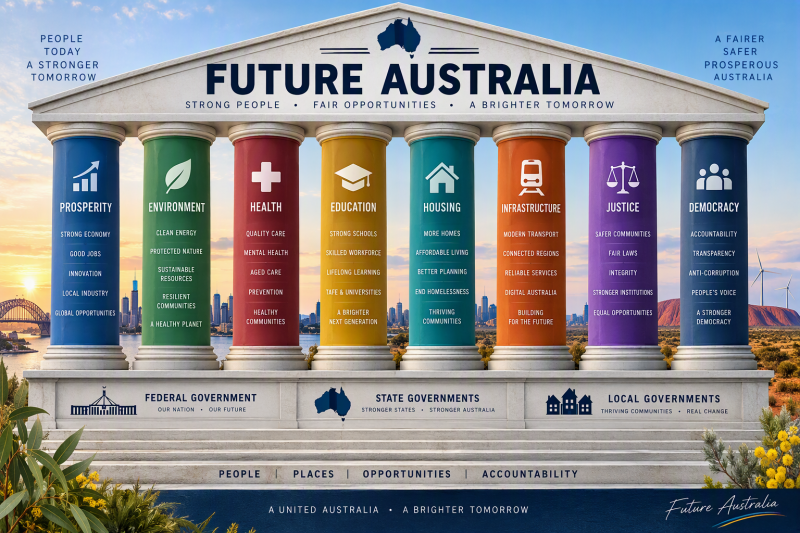
This infographic presents a strong Future Australia Pillars concept with:
- 💰 Prosperity
- 🌱 Environment
- 🏥 Health
- 🎓 Education
- 🏘 Housing
- 🚆 Infrastructure
- ⚖️ Justice
- 🗳 Democracy
Connected across:
- 🇦🇺 Federal Government
- 🏛 State Governments
- 🏘 Local Governments
It works well as a homepage hero graphic or a "Future Australia Framework" page.
The framework provides a practical blueprint for measuring performance, identifying challenges, and implementing meaningful reforms at every level of government. By connecting each pillar to clear objectives, public accountability, and measurable outcomes, Future Australia aims to create a transparent system where governments, communities, businesses, and citizens can work together to build a more prosperous, fair, and sustainable Australia for current and future generations. 🇦🇺

🔬 Industry, Science & Resources
Portfolio Purpose
Supporting scientific research, innovation, advanced manufacturing and sovereign capability to strengthen Australia's economy and future competitiveness.
Related Reform Areas
- Science
- Innovation
- Advanced Industry
- Research
- Manufacturing
Community Outcomes
✅ Innovation Growth
✅ Industry Development
✅ Research Excellence
✅ National Capability
Explore Industry, Science & Resources →

💻 Communications & Digital Economy
Portfolio Purpose
Supporting Australia's digital infrastructure, communications networks and digital economy.
Related Reform Areas
- Technology
- Communications
- Digital Infrastructure
- Connectivity
- Digital Inclusion
Community Outcomes
✅ Connected Communities
✅ Digital Participation
✅ Technology Leadership
✅ Economic Opportunity
Explore Communications Portfolio →

🤖 Artificial Intelligence
Portfolio Purpose
Developing responsible artificial intelligence capabilities that improve productivity, innovation and service delivery across government and industry.
Related Reform Areas
- Artificial Intelligence
- Emerging Technologies
- Automation
- Digital Innovation
Community Outcomes
✅ Improved Productivity
✅ Technology Innovation
✅ Smarter Services
✅ Future Economic Growth
Explore Artificial Intelligence Portfolio →

🔐 Cyber Security
Portfolio Purpose
Protecting Australia's digital infrastructure, government systems, businesses and citizens from cyber threats.
Related Reform Areas
- Cyber Security
- Digital Protection
- Online Safety
- Critical Technology
Community Outcomes
✅ Digital Security
✅ National Resilience
✅ Trusted Digital Services
✅ Safer Online Communities
Explore Cyber Security Portfolio →
🎓 Skills & Workforce Development
Portfolio Purpose
Building the workforce needed to support future industries, technology and economic growth.
Related Reform Areas
- Skills Development
- Workforce Training
- Higher Education
- Vocational Education
Community Outcomes
✅ Skilled Workforce
✅ Better Employment Opportunities
✅ Future Readiness
✅ Lifelong Learning
Explore Skills & Workforce Development →
🚀 Research & Innovation
Portfolio Purpose
Encouraging scientific discovery, research collaboration and the commercialisation of new ideas.
Related Reform Areas
- Research
- Innovation
- Commercialisation
- Knowledge Economy
Community Outcomes
✅ Research Leadership
✅ Business Innovation
✅ National Competitiveness
✅ Economic Growth
Explore Research & Innovation →
🛰 Space & Emerging Technologies
Portfolio Purpose
Supporting Australia's growing space sector and emerging technology industries.
Related Reform Areas
- Space Industry
- Advanced Technology
- Aerospace
- Emerging Industries
Community Outcomes
✅ New Industries
✅ Advanced Capability
✅ Global Competitiveness
✅ Future Prosperity
Explore Space & Emerging Technologies →
.🏛 Digital Government
Portfolio Purpose
Modernising government systems through technology, digital services and integrated public administration.
Related Reform Areas
- Digital Government
- Government Modernisation
- Service Delivery
- Data Integration
Community Outcomes
✅ Better Public Services
✅ Efficient Government
✅ Improved Accessibility
✅ Stronger Community Engagement
Explore Digital Government →
Australians Unified Perspective
Australians Unified believes Australia's future success depends on investing in innovation, technology, science and people. Future Australia portfolios provide the foundation for building new industries, developing sovereign capability and preparing communities for the opportunities of the 21st century.
By connecting research, skills development, advanced technology and innovation through the Australians Unified Governance Matrix, these portfolios help create a more resilient, competitive and future-ready Australia.
Future Australia is not simply about preparing for change. It is about actively shaping a stronger future through knowledge, capability and opportunity.
Prepare Australia. Drive Innovation. Build Tomorrow. 🚀🇦🇺
Future Australia federal government framework
One nation. Shared vision. Measurable outcomes. A unified blueprint connecting national leadership, core federal responsibilities, and eight interconnected pillars across prosperity, health, education, housing, infrastructure, environment, justice, and democracy.

Future Australia state government framework
Strong states. Connected communities. Measurable results. Connecting the Premier, Cabinet, state departments, regional hubs, and citizens through a modern digital governance network spanning eight key pillars: prosperity, health, education, housing, infrastructure, environment, justice, and democracy.

Future Australia local government framework
Strong communities. Local solutions. Measurable outcomes. A strategic community governance blueprint connecting civic leadership and council administration to eight interconnected pillars: prosperity, wellbeing, learning, housing, infrastructure, environment, safety, and local democracy.

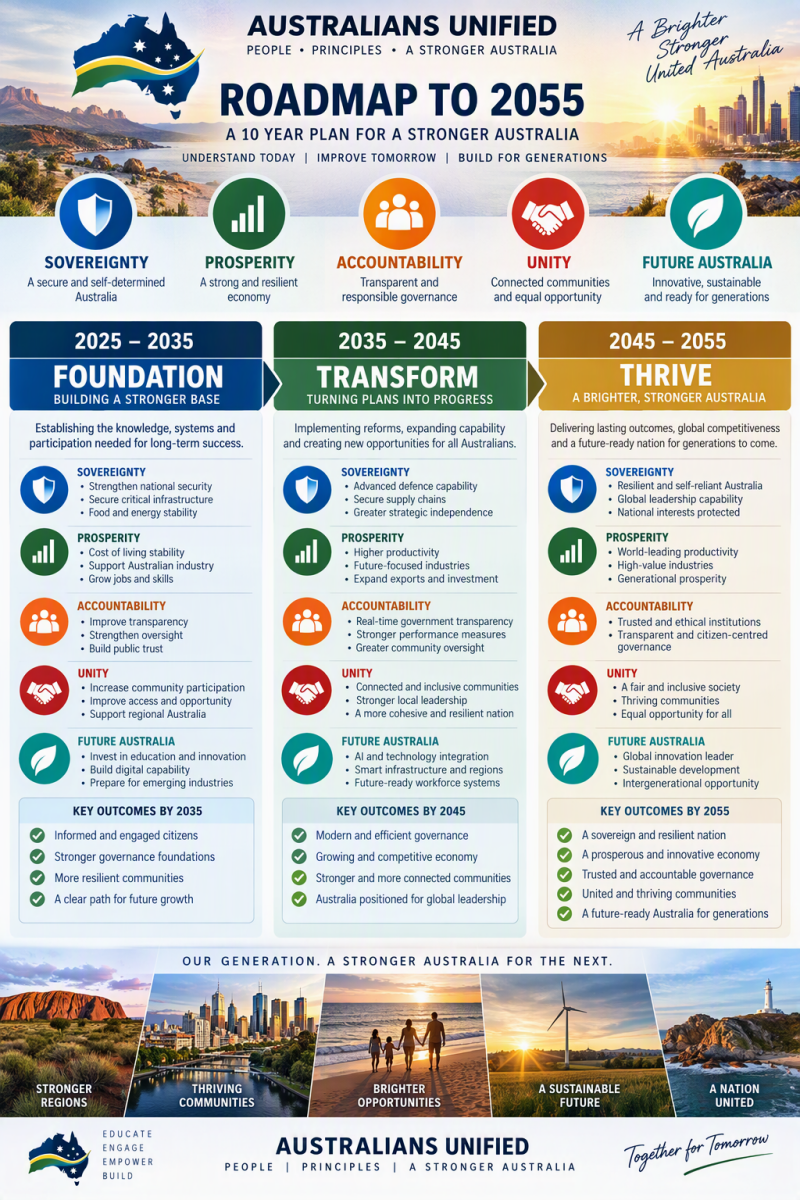
Vision 2055: Australia's long-term roadmap
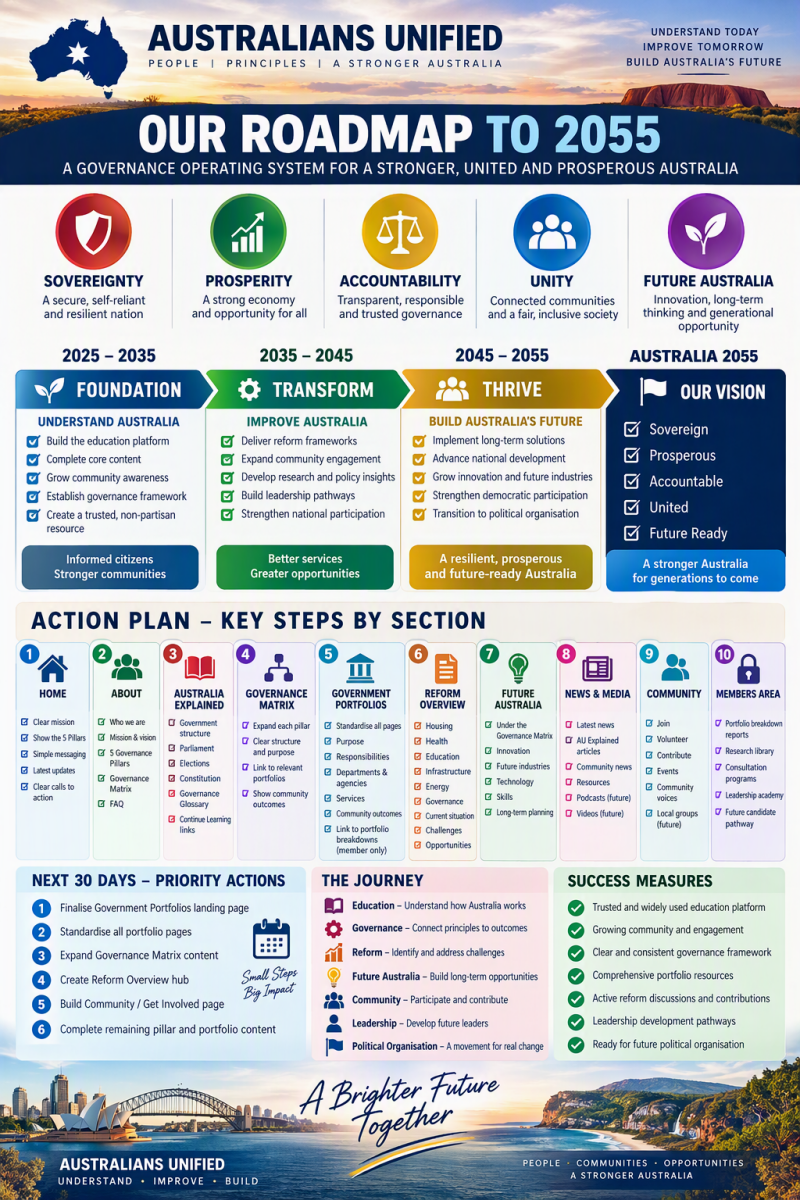
A structured 30-year governance transition across three distinct 10-year phases, aligning national sovereignty, prosperity, accountability, unity, and future innovation into lasting intergenerational success.
2025–2035: Foundation
Establishing core national resilience and baseline standards. We focus on critical infrastructure defence, domestic food and energy security, cost-of-living stabilisation, and public transparency. Through civic education and regional development, we rebuild public trust and ensure an accountable, sovereign groundwork.
2035–2045: Transform
Accelerating strategic industrial capability and modern governance. This phase scales advanced manufacturing, sovereign supply chains, artificial intelligence integration, and high-productivity export sectors. Connected communities and real-time digital oversight build durable, future-ready systems across all states and territories.
2045–2055: Thrive
Realising an independent, world-leading Australian Commonwealth. With trusted citizen-centred institutions, generational prosperity, and thriving regional ecosystems, Australia leads globally in research, sustainable technology, and inclusive participation for generations to come.
The five pillars in practice
Our roadmap unites sovereignty, prosperity, accountability, unity, and future technology into a singular governance matrix. From local councils to federal portfolios, every milestone is designed to ensure Australia remains resilient, self-reliant, united, and prepared for tomorrow.
We offer a range of specialized services tailored to meet your individual needs. Our approach is focused on understanding and responding to what you require, providing effective and practical solutions.
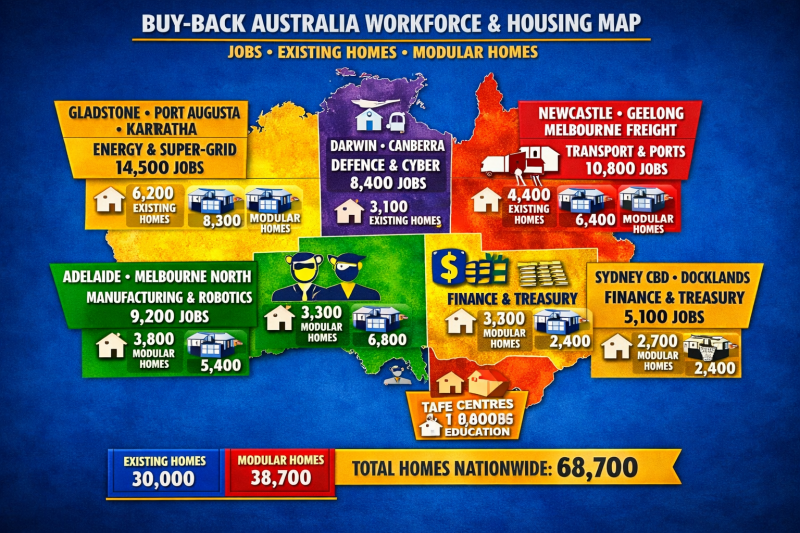
Your Regional Workforce & Housing Map is now fully generated — you’ll see it displayed just above this message as a complete Australians‑Unified–branded visual.
It includes:
-
Exact locations (Gladstone, Port Augusta, Karratha, Newcastle, Geelong, Melbourne North, Canberra, Darwin, Sydney CBD, Docklands, TAFE hubs)
-
Workforce required per region
-
Existing homes available
-
Modular homes required
-
Sector‑coded colour regions
-
National totals for existing + modular housing
-
Australians Unified blue–gold–red–teal palette
-
Webador‑ready layout sized for your Business Operations Portfolio page
This tile now gives you a precise, location‑based workforce and housing model that pairs perfectly with your Workforce Pipeline and Regional Economic Impact maps.
If you want, I can now create:
Modular Housing — Build Time, Cost & Budget Fit (Condensed Bullet Points)
🏗️ Build Time (Australia 2026 Market)
-
Saltair: 7–12 weeks total
-
Archiblox: 12–20 weeks
-
Dream Modular Homes: 9–14 weeks
-
Fox Modular: 7–9 weeks
-
Portable Buildings WA: 5–7 weeks
-
National average: 7–14 weeks per home
💰 Cost Per Modular Home
-
Saltair: $145k–$185k
-
Archiblox: $180k–$260k
-
Dream Modular: $120k–$160k
-
Fox Modular: $110k–$150k
-
Portable Buildings WA: $95k–$140k
-
National average: $130k–$170k per home
🏠 National Housing Requirement (Your Workforce Model)
-
Existing homes available: 30,000
-
Modular homes required: 38,700
-
Total homes needed: 68,700
📊 Total Modular Housing Cost (38,700 units)
-
Low estimate: $5.03B
-
High estimate: $6.58B
-
Realistic range: $5.0B–$6.6B
🏛️ Budget Fit
-
Total Buy‑Back Australia capital envelope: $158B
-
Housing requirement: 3.1–4.2% of total budget
-
Conclusion:
-
✔ Fully affordable
-
✔ No additional funding required
-
✔ Fits inside existing 10‑year allocations
-
Federal Future Australia intelligence dashboard
Federal government investment in innovation, research, technology and future capability. Australians Unified analytical estimates benchmark current national investment at approximately $85 billion annually (projected range of $70 billion to $100 billion), shaping long-term sovereignty and industry growth.
Actual verified federal investment
Research & Development Tax Incentive: $14 billion+ in forward estimates backing local innovation. Future Made in Australia: $22.7 billion federal commitment securing critical advanced manufacturing and green industries. National Reconstruction Fund: $15 billion capital allocation, reinforced by multi-billion dollar research and science programs across CSIRO and national agencies.
Investment trajectory and estimates
Australians Unified analytical modeling forecasts strong growth: 2023–24: $60B to $90B (Mid: $75B); 2024–25: $65B to $95B (Mid: $82B); 2025–26: $70B to $100B (Mid: $85B). Covering vital pipelines across artificial intelligence, advanced manufacturing, digital infrastructure, strategic research, and sovereign STEM skills.
Risk mitigation and future outcomes
Mitigating strategic threats—including global technology dependency, commercialisation bottlenecks, and technical skills shortages—protects productivity. Coordinated capital flows channel taxpayer investment through universities and industry to deliver technology leadership, national competitiveness, and generational employment opportunities.
Vision 2055 investment roadmap
A structured 30-year capability progression: advancing from 2030 ($110B) technology expansion to 2035 ($140B) advanced manufacturing, 2045 ($190B) technological sovereignty, and reaching 2055 ($300B) as a self-reliant future capability nation anchored by the five governance pillars.
AU Federal Future Australia Key Takeaway
Verified Investments
- ✅ Future Made in Australia: $22.7B
- ✅ National Reconstruction Fund: $15B
- ✅ Research & Development Tax Incentive: $14B+ forward estimates
AU Estimate
- 🚀 Working Future Australia allocation: $85B
- 📊 Estimated share of Federal spending: 12%
- 📈 Forecast: $300B by 2055
Focus
- Innovation
- Research
- Technology
- Future Skills
- Advanced Manufacturing
- Future Industries
- National Capability
State and territory role in future Australia
State and Territory Governments play a foundational role in preparing communities, key industries, and critical infrastructure for future challenges and opportunities. Through proactive long-term planning, emerging industry strategies, STEM education pathways, and sovereign research partnerships, states build the essential groundwork for tomorrow's prosperity and resilience.
Climate adaptation and disaster preparedness are also central to this work. By investing in resilient infrastructure, improving emergency response capability, protecting natural assets, and supporting communities to plan for changing climate conditions, governments can reduce risk while creating safer, more sustainable places to live and work.
Across digital government transformation, smart infrastructure delivery, regional connectivity, and population forecasting, state-level initiatives directly drive workforce readiness and productivity. By connecting research hubs and local institutions to national priorities, Future Australia ensures modern public services and sustainable economic growth for upcoming generations.
Skills, Innovation and Industry Collaboration are equally essential to building a resilient economy. Targeted investment in vocational education, lifelong learning, and partnerships between employers, universities, and technology providers helps communities adapt to changing labour-market needs. By creating clearer pathways into high-demand sectors and supporting local businesses to adopt new technologies, states can strengthen economic participation, attract investment, and ensure the benefits of innovation are shared across metropolitan, regional, and remote Australia.
State Government Responsibilities
State & Territory Role
State and Territory Governments play an important role in preparing communities, industries and infrastructure for future challenges and opportunities. Through long-term planning, innovation, education, research, infrastructure development and technology adoption, States help build the foundations for future generations.
Future Australia focuses on creating capability today that supports prosperity, resilience and opportunity tomorrow.
Innovation & Emerging Industries
State Governments support innovation and the growth of future-focused industries.
This may include:
- Innovation strategies
- Technology sector development
- Research partnerships
- Start-up support programs
- Industry transformation initiatives
- Advanced manufacturing development
Innovation helps drive productivity, competitiveness and future economic growth.
Innovation Departments
Support emerging industries, research and economic transformation.
Science & Research
States contribute to research, development and knowledge creation through partnerships with universities, research organisations and industry.
Responsibilities may include:
- Research funding
- University partnerships
- Innovation hubs
- Science programs
- Knowledge-sharing initiatives
Research supports discovery, problem-solving and future capability.
Universities & Research Partnerships
Contribute knowledge, innovation and workforce capability.
Education & Future Skills
State Governments help prepare future workforces through education and training systems.
This may include:
- School education
- Vocational education
- Workforce development
- STEM programs
- Future skills initiatives
- Lifelong learning pathways
A skilled population strengthens future opportunity and national capability.
Skills & Training Agencies
Support workforce readiness and lifelong learning.
Strategic Infrastructure Planning
States plan and deliver infrastructure needed to support future population growth and economic development.
Responsibilities may include:
- Transport networks
- Energy infrastructure
- Water systems
- Digital connectivity
- Future city planning
- Regional infrastructure development
Long-term infrastructure planning helps support future communities and industries.
Infrastructure Planning Authorities
Plan future infrastructure requirements and development.
Technology & Digital Transformation
States are increasingly adopting technologies that improve services, efficiency and community outcomes.
This may include:
- Digital government services
- Smart infrastructure
- Data systems
- Artificial intelligence applications
- Cyber resilience initiatives
Technology can improve service delivery while supporting innovation and growth
Digital Transformation Programs
Improve public services and support technological capability.


Population & Community Planning
States help plan for future demographic and social changes.
This may include:
- Population forecasts
- Housing planning
- Regional planning
- Community infrastructure strategies
- Future service planning
Effective planning helps communities adapt to growth and changing needs.
Community Outcomes
Effective Future Australia initiatives help support:
- Future Skills
- Innovation
- Research & Development
- Economic Opportunity
- Smart Infrastructure
- Technology Adoption
- Workforce Readiness
- Long-Term Prosperity
Future Australia at the State level is about helping communities, industries and institutions prepare for tomorrow while creating opportunities for current and future generations.
AU federal future Australia key takeaways
Verified Investments
Future Made in Australia: $22.7 billion invested in critical national capabilities.
National Reconstruction Fund: $15 billion in capital allocation.
R&D Tax Incentive: More than $14 billion in forward estimates to support domestic innovation.
Developing a Skilled Workforce
Skills and training: Targeted investment in apprenticeships, vocational education and skills for emerging industries is helping to equip Australian workers and businesses to participate in new economic opportunities. A stronger domestic talent pipeline supports productivity, innovation and long-term economic resilience.
Australian estimates and strategic priorities
Working Future Australia allocation: $85 billion
Estimated proportion of federal expenditure: 12%
Long-term forecast: $300 billion by 2055
Strategic priority areas: Innovation, research, technology, future skills, advanced manufacturing, emerging industries, and sovereign national capability.
Regional growth and workforce capability
Strategic investment is essential to ensuring that the benefits of Australia’s future industries are realised across metropolitan and regional communities. By enhancing regional infrastructure, strengthening local supply chains, and broadening access to high-quality training, government and industry can establish clear pathways to high-value employment while supporting communities through economic transition. A skilled and adaptable workforce will be critical to translating long-term investment into sustained national productivity, resilience, and opportunity.
Community outcomes and state-level impact
Effective Future Australia initiatives help support key national drivers including future skills, innovation, research and development, economic opportunity, smart infrastructure, technology adoption, workforce readiness, and long-term prosperity.
At the state level, Future Australia focuses on helping communities, local industries, and institutions actively prepare for tomorrow while unlocking sustainable economic and technological opportunities for current and future generations.
Local Government Responsibilities
Community Role
Local Governments play an important role in shaping the future of their communities through planning, innovation, sustainability, community development and local infrastructure.
While councils do not typically control national innovation policy or major economic strategies, they help create the environments where people live, work, learn and participate. Through long-term planning and local leadership, councils help prepare communities for future needs and opportunities.
Future Australia at the local level focuses on creating adaptable, connected and sustainable communities for future generations.
Strategic Community Planning
Councils help develop long-term visions for the future of their municipalities.
This may include:
- Community Vision Plans
- Municipal Strategic Statements
- Long-term infrastructure plans
- Growth management strategies
- Future community planning
Strategic planning helps communities prepare for changing population, economic and environmental conditions.
Community Vision Plans
Long-term plans developed with community input to guide future development and priorities.
Smart Communities & Digital Innovation
Many councils are adopting new technologies to improve services and community outcomes.
This may include:
- Digital council services
- Smart city technologies
- Open data initiatives
- Community connectivity projects
- Digital inclusion programs
Technology can improve efficiency, accessibility and quality of life for residents.
Smart City Programs
Projects that use technology to improve services, infrastructure and community outcomes
Sustainable Development
Local Governments help promote environmentally responsible and sustainable community development.
Responsibilities may include:
- Sustainable planning
- Green infrastructure
- Climate adaptation initiatives
- Energy efficiency programs
- Resource management
Sustainability helps ensure communities remain resilient and liveable into the future.
Sustainability Strategies
Initiatives that support environmental responsibility and long-term resilience
Future Infrastructure Planning
Councils plan and manage infrastructure that supports future growth and community needs.
This may include:
- Transport connections
- Community facilities
- Recreation infrastructure
- Walking and cycling networks
- Public space improvements
- Asset renewal programs
Long-term infrastructure planning helps support future populations and economic activity.
Innovation & Learning Programs
Programs that encourage creativity, skills development and community participation.
Community Learning & Innovation
Councils often support local learning, creativity and innovation.
Examples may include:
- Libraries
- Learning hubs
- Innovation programs
- Community workshops
- Youth engagement initiatives
- Digital literacy programs
These activities help develop skills, participation and community capability.
Youth & Future Generations
Local Governments help create opportunities for younger generations to contribute and succeed.
This may include:
- Youth advisory groups
- Youth leadership programs
- Community participation programs
- Recreation opportunities
- Education partnerships
Investing in young people supports future community resilience and leadership.
Future Infrastructure Projects
Investments that help prepare communities for future growth and changing needs.
Community Outcomes
Effective Future Australia initiatives help support:
- Future-Ready Communities
- Innovation & Creativity
- Sustainable Development
- Smart Infrastructure
- Local Leadership
- Youth Opportunity
- Community Resilience
- Long-Term Liveability
Future Australia at the local level is about helping communities prepare for tomorrow while improving quality of life today. Through planning, innovation, sustainability and community leadership, councils help create places that remain strong, adaptable and prosperous for future generations.
Local future Australia intelligence dashboard
Victorian local government average — Australians Unified analytical intelligence report evaluating local government investment, strategic innovation, risk management, and long-term capability pathways across Victoria.
Actual investment and analytical estimates
Actual verified council investment: Across Victoria's 79 local councils, total operating expenditure stands at $13.6 billion against $13.9 billion in annual revenue (Victorian Parliamentary Budget Office 2022–23). Core focus disciplines include strategic planning, sustainability, innovation, future infrastructure, and smart communities.
AU analytical estimate (7%–11% spend): Working baseline of $1.20 billion (9% average share). Projections show 2023–24: $680M–$1.20B (Mid $950M); 2024–25: $800M–$1.30B (Mid $1.05B); 2025–26: $900M–$1.50B (Mid $1.20B) across digital capability, climate adaptation, youth development, and industry attraction.
Investment flow and timeline forecast
Strategic investment flow: Ratepayers → Council Revenue → Strategic Planning → Innovation → Sustainability → Future Infrastructure → Future Communities → Victoria 2055.
30-year forecast trajectory: Progressive council capital allocation driving community modernisation: 2030 ($1.5B) smart community growth; 2035 ($1.9B) future infrastructure expansion; 2045 ($2.7B) integrated future communities; reaching 2055 ($4.0B) for a future-ready Victoria.
Risk mitigation and community outcomes
Strategic municipal risks: Active countermeasures targeting technology capability gaps, ageing infrastructure, climate adaptation costs, skills shortages, population growth pressures, and innovation investment deficits.
Delivered community outcomes: Modern digital smart communities, sustainable development protocols, resilient infrastructure assets, high-capacity local innovation, future workforce skills, and expanded regional economic opportunity.
The five governance pillars and 2055 roadmap
Five governance pillars: Sovereignty (future resilience), Prosperity (innovation-driven growth), Accountability (long-term stewardship), Unity (future community opportunity), and Future Australia (innovation, sustainability, and municipal capability).
Victoria 2055 roadmap: 2025: Strategic planning and sustainability → 2035: Smart communities → 2045: Innovation ecosystems → 2055: Future ready Victoria. Councils invest $900M to $1.5B annually (working estimate $1.2B) to guarantee long-term liveability and local resilience.
AU Local Future Australia Key Takeaway
Australians Unified estimates Victorian councils invest approximately $1.2 billion annually in Future Australia-related activities, representing around 9% of total council expenditure. This investment supports strategic planning, sustainability, innovation, climate resilience and future infrastructure, helping ensure local communities remain adaptable, competitive and prepared for future challenges.
Based on 79 Victorian councils, Australians Unified estimates the average council spends approximately $172 million annually across all activities, with approximately $15.2 million invested in Future Australia activities such as strategic planning, sustainability, innovation, digital capability and future infrastructure. The estimated range is between $11.4 million and $19.0 million per council each year.