🏛️ Australian Taxation Office (ATO)
A sovereign, simplified, fair taxation system that puts Australians first
The Australian Taxation Office is responsible for administering the nation’s taxation and superannuation systems. Under Australians Unified reforms — the ATO’s mandate is strengthened to ensure fair taxation, protection of national revenue, and elimination of loopholes that benefit foreign interests over Australian workers, families, and businesses.
Current position and core functions
Core functions
Tax collection: Administers Australia's taxation system and collects revenue that funds essential government services, infrastructure, and national priorities.
Revenue protection: Protects Commonwealth revenue through compliance activities, audit programs, and integrity measures.
Superannuation compliance: Supports and monitors employer obligations, Superannuation Guarantee compliance, and retirement savings integrity.
Taxpayer services: Provides digital tools, guidance, and direct support for individuals, businesses, superannuation funds, and tax practitioners.
Fraud detection: Identifies and acts against tax evasion, criminal fraud, identity misuse, and emerging revenue risks.
Business tax administration: Administers GST, PAYG, BAS reporting, company taxation, and commercial compliance duties.
Revenue forecasting: Delivers taxation intelligence and predictive data modelling to support Treasury budget planning.
Current priorities and operating model
Revenue integrity: Safeguarding the Commonwealth revenue base through rigorous compliance, enforcement, and systemic risk mitigation.
Tax system simplification: Eliminating administrative complexity and reporting burdens for workers and small businesses.
Cyber security: Protecting taxpayer records, digital identity registries, and core revenue platforms.
Operating model:
Tax collection → Revenue protection → Compliance monitoring → Taxpayer services → Digital government → Revenue integrity → Economic stability → Australia 2055.
Current objective:
Revenue integrity + tax simplification + digital services + superannuation protection + fraud prevention = strong national revenue for Australia 2055.
Current operations and sovereign tax reform
The Australian Taxation Office (ATO) serves as the frontline agency within the Treasury portfolio, administering Australia's taxation and superannuation frameworks. Operating at national scale, it oversees personal income tax, GST, PAYG, excise, and company taxes, while coordinating with bodies such as ASIC, APRA, and AUSTRAC. Its core mission is to protect revenue integrity, maintain retirement savings compliance, and assist honest taxpayers across the nation.
Under Australians Unified reforms, the ATO's mandate is modernised to eliminate foreign tax loopholes and safeguard national wealth. Moving beyond slow legacy infrastructure, our framework establishes automated compliance, heightened withholding rates on offshore profit shifting, and sovereign oversight. By putting Australian families and businesses first, we ensure national revenue directly supports our communities rather than offshore interests.
Core operations and why change is needed
The Australian Taxation Office (ATO) operates as the primary administrator of national revenue and superannuation compliance across the Treasury portfolio. Managing complex systems across PAYG, GST, corporate taxes, and retirement integrity, it serves millions of individuals, small businesses, and multinational entities while coordinating closely with ASIC, APRA, and AUSTRAC to safeguard the economic base.
Digital services and data-driven compliance are also central to the ATO’s role. Through online portals, pre-filled tax returns, Single Touch Payroll reporting, and sophisticated data-matching capabilities, the agency aims to make obligations easier to meet while identifying inconsistencies, undeclared income, and high-risk arrangements. This technology-led approach supports more timely guidance for taxpayers, reduces administrative burden for compliant businesses, and helps protect the integrity of Australia’s tax and superannuation systems.
Legacy systems, siloed agency data, and sophisticated offshore avoidance schemes place an unsustainable burden on Australian families and honest businesses. To eliminate multinational loopholes and mitigate rising financial crime, our reform model modernises the ATO into a sovereign, automated tax authority delivering real-time intelligence, simplified filing, and unyielding national protection.
Privacy, transparency, and taxpayer confidence must sit at the centre of this transformation. Secure, Australian-controlled data infrastructure and clear safeguards will ensure automation strengthens—not compromises—the rights of individuals and businesses. By providing taxpayers with understandable decisions, timely alerts, and accessible pathways to correct errors, the system can reduce compliance anxiety while maintaining rigorous oversight of high-risk activity. This creates a fairer tax system: one that is easier for honest Australians to navigate and far harder for bad actors to exploit.
Taxation reform
Stop the Erosion of Australia’s Tax Base
Higher Withholding Taxes on Offshore Profits
-
Raise withholding tax on profits transferred offshore to 20%
-
Raise withholding tax on interest income paid overseas to 30%
-
Introduce an operating profit ratio test to prevent transfer pricing abuse
-
Ensure profits generated in Australia stay in Australia
Purpose: Stop multinational tax leakage and protect national revenue.

STRENGTHS
-
Strong national mandate
-
Large, skilled workforce
-
Extensive data and digital infrastructure
-
High public trust in core systems
-
Strong compliance and enforcement capability

WEAKNESSES
-
Legacy systems and slow workflows
-
High administrative burden for businesses
-
Limited real‑time data integration
-
Complex tax legislation
-
Workforce shortages in digital and analytics roles

THREATS
-
Cybersecurity risks
-
Global tax competition and avoidance
-
Economic volatility
-
Digital platform and gig‑economy complexity
-
Financial crime and phoenix activity

OPPORTUNITIES
-
AI‑enabled compliance and forecasting
-
Unified national tax platform
-
Simplified business tax systems
-
Real‑time revenue intelligence
-
Stronger superannuation integrity
FUTURE MODEL
A. Unified National Tax & Revenue Platform
-
One integrated system for individuals, businesses and agents
-
Real‑time tax calculation and payment tracking
-
Automated pre‑filled returns for most taxpayers
-
Seamless integration with myGov and digital identity
B. AI‑Enabled Compliance & Fraud Detection
-
Predictive modelling for tax evasion and avoidance
-
Automated anomaly detection
-
Real‑time GST and PAYG monitoring
-
Faster, more accurate audits
C. Modernized Business Tax System
-
Simplified reporting for SMEs
-
Automated BAS and GST reconciliation
-
Digital invoicing and real‑time transaction data
-
Reduced administrative burden
D. Superannuation Integrity & Transparency
-
Real‑time super guarantee compliance
-
Automated employer reporting
-
Fraud and theft detection
-
Retirement savings forecasting tools
E. National Revenue Intelligence Network
-
Real‑time revenue dashboards
-
Integrated Treasury–ATO forecasting
-
Economic risk modelling
-
Transparent public reporting
F. Taxpayer Support & Education
-
Digital guidance tools
-
Multilingual and accessible services
-
Specialist support for vulnerable taxpayers
-
Community and industry partnerships

-
🏛️ SIMPLIFY BUSINESS TAX
✅ Universal Company Tax
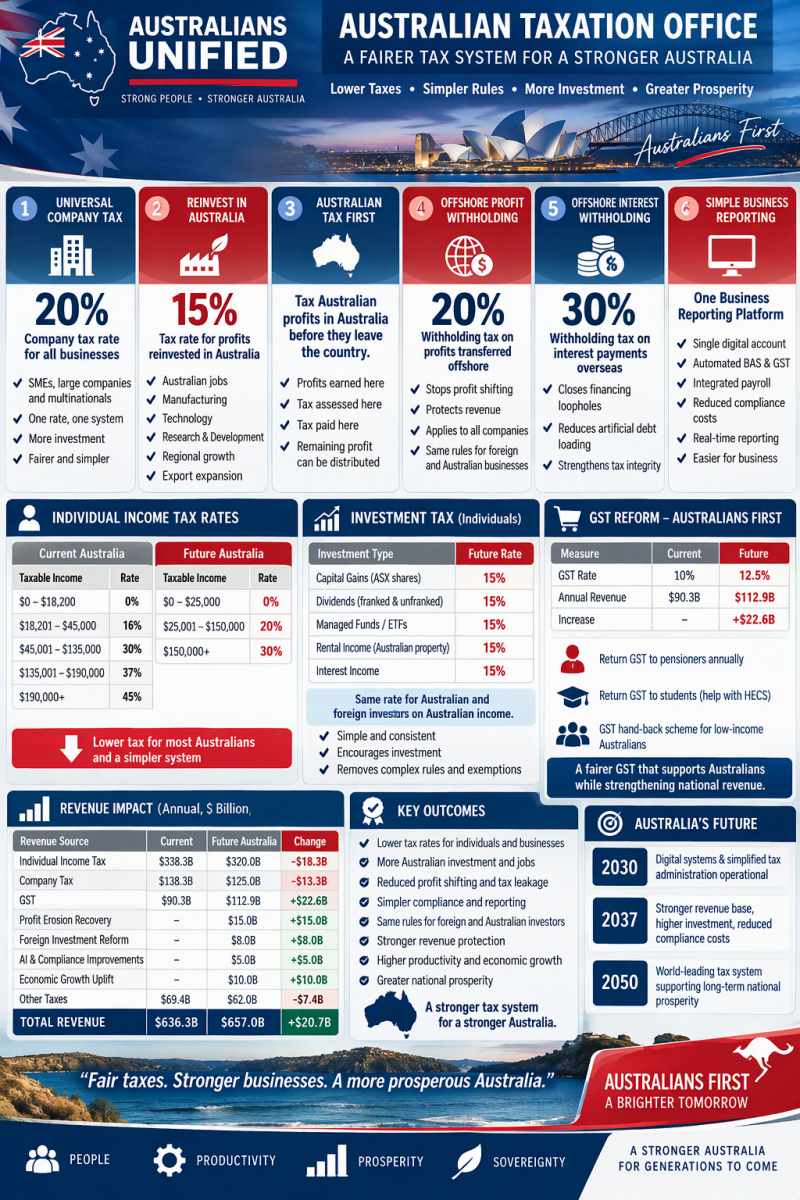
- 20% company tax for all businesses
- One rate. One system. Less complexity.
✅ Reinvest in Australia
- 15% tax rate for profits reinvested into:
- Australian jobs
- Manufacturing
- Technology
- Research & Development
- Regional growth
✅ Australian Tax First
- Profits earned in Australia should be taxed in Australia first
- Tax paid before profits move offshore
✅ Revenue Protection
- 20% withholding tax on offshore profit transfers
- 30% withholding tax on offshore interest payments
- Stronger anti-profit shifting measures
✅ Simpler Business Reporting
- One Business Reporting Platform
- Automated GST & BAS reporting
- Reduced compliance costs
🇦🇺 Outcome
Lower taxes. Simpler rules. More Australian investment. Less profit leakage. Stronger revenue. Greater prosperity.

✅ Reinvest in Australia
-
Australian Jobs – Lower tax rates reward businesses that create and sustain Australian employment opportunities.
-
Manufacturing – Encourages companies to build, expand and produce more goods within Australia.
-
Technology – Supports investment in digital infrastructure, automation and innovation to improve productivity.
-
Research & Development – Rewards businesses that develop new products, services and technologies in Australia.
-
Regional Growth – Incentivises investment in regional communities, infrastructure and local economic development.
🇦🇺 Outcome
Businesses that reinvest profits into Australia's workforce, industries, innovation and regions qualify for a reduced 15% tax rate, helping create jobs, drive productivity and strengthen long-term national prosperity.

GST Reform At A Glance
✅ Raise GST to 12.5%
Estimated Additional Revenue: +$22.6B per year
✅ Return GST To Australians
- Pensioner GST Rebate
- Student GST Rebate
- Low-Income GST Hand-Back Scheme
✅ Fund Lower Taxes
- Higher tax-free threshold ($25,000)
- Lower personal income tax rates
- 20% universal company tax
- 15% reinvestment tax rate
-
GST increase becomes the largest revenue source funding the broader tax reform package, generating approximately $22.6 billion annually while allowing lower personal taxes, lower company taxes, stronger reinvestment incentives and targeted rebates for pensioners, students and low-income Australians.

Strengthen ATO Enforcement & National Revenue Protection
Aligned sovereignty and anti‑avoidance stance:
-
Crack down on multinational avoidance
-
Expand real‑time fraud detection
-
Increase penalties for phoenix activity
-
Strengthen FIRB‑linked tax enforcement
-
Protect superannuation from foreign exploitation
Future model: ATO under Australians Unified reform
Our reform agenda transforms the Australian Taxation Office into a sovereign, automated, and fair revenue system. Built to eliminate offshore tax avoidance, empower honest taxpayers, and simplify compliance for businesses nationwide.
Unified national tax and revenue platform
A single integrated platform for all taxpayers delivers automated pre-filled returns, real-time tax calculation, and instant payment tracking to simplify annual filing and eliminate bureaucratic backlogs.
AI-enabled compliance and fraud detection
Advanced predictive modelling detects tax evasion schemes and multinational avoidance in real time. Continuous GST and PAYG monitoring ensures faster, more precise audits while protecting domestic revenue.
Modernised business tax and superannuation integrity
We streamline reporting for small and medium enterprises with automated BAS and GST reconciliation, while safeguarding retirement balances through real-time superannuation guarantee compliance and anti-theft tracking.
National intelligence and taxpayer guidance
Seamless Treasury–ATO integrated forecasting delivers transparent public dashboards, alongside accessible digital education, multilingual assistance, and dedicated support for vulnerable taxpayers.

Preventing the Erosion of Profits Offshore
Protect Australia’s tax base
Australians Unified proposes stronger safeguards against offshore profit shifting, alongside a simpler corporate tax system that rewards Australian enterprise and protects national revenue.
Withholding tax on profits transferred to treaty countries would increase to 20%, while interest income paid to all countries would be taxed at 30%. An operating profit ratio test would reinforce transfer-pricing rules and help ensure profits generated in Australia contribute to Australia.
The corporate tax rate would be reduced to 25%, replacing franking credits with a 15% non-refundable rebate for all taxpayers and a refundable rebate of up to $10,000 for low-income earners. The proposal is intended to be revenue neutral by reducing the administrative cost and tax-base erosion associated with refundable imputation credits.
Foreign investors holding portfolio interests in non-real assets would also lose the capital gains tax exemption under section 855 of the Income Tax Assessment Act 1997, so Australian investment gains are taxed fairly. With more than $3 trillion in superannuation assets, Australia can place greater value on capital built from Australian earnings—wealth for toil.

AUSTRALIANS UNIFIED — ATO REFORM SUMMARY
Our tax system must:
-
Protect Australian revenue
-
Prioritise Australian workers and families
-
Stop foreign exploitation
-
Simplify compliance
-
Strengthen national sovereignty
-
Modernise digital systems
-
Reduce burden on small business
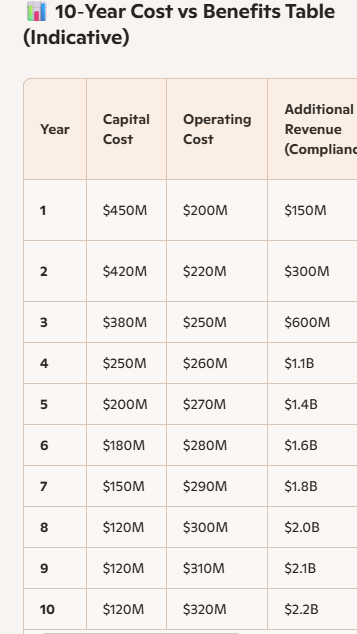
Over 10 years, the ATO reform package delivers:
-
$5.09B in total costs (within existing budget envelopes)
-
$15.50B in total benefits
-
$10.41B net positive return
-
Break‑even in Year 3
-
Strong positive returns from Year 4 onward
This aligns with the ATO’s current direction and the reform logic on your Australians Unified page .
Oliver Hartman
How the supergrid transforms
Debt, Tax, GDP & Wage Dynamics (2026–2036)
How Sovereign Ownership and Smarter Tax Policy Strengthen Australia’s Economy
1️⃣ Debt Position
-
Starting national debt (2026): ≈ $950 B
-
Projected debt (2036): ≈ $1.05 T – $1.15 T → Debt grows modestly but remains stable as sovereign enterprises generate offsetting revenue.
-
Debt‑to‑GDP ratio: falls from 38 % → 28 % as GDP expands faster than borrowing.
-
Debt servicing: reduced by 20–25 % through lower bond yields from the Government Bank and sovereign investment returns.
2️⃣ Tax Reform Impact
-
Lower corporate tax encourages reinvestment and expansion.
-
Simplified GST and payroll tax bands reduce compliance costs.
-
Sovereign dividends and bond yields replace lost tax revenue, keeping the budget balanced.
-
Net fiscal neutrality: government revenue stays steady while private‑sector productivity rises.
3️⃣ GDP Growth — 10-Year Projection (2026–2036)
-
Sovereign Enterprises Contribution: +$490 B–$710 B from government-owned energy, water, manufacturing, finance, and defense corporations.
-
Private-Sector Expansion: +$1.0 T–$1.95 T from lower tax, cheaper energy, green-steel manufacturing, EV production, and export growth.
-
National Efficiency Savings: +$600 B–$870 B from reduced insurance risk, logistics optimization, regulatory automation, and water-grid stability.
-
Total GDP Uplift: +$2.1 T–$3.5 T added to the economy over the decade.
-
Annual Growth Rate: Sustained 3.2%–3.8% growth—outpacing debt and enhancing productivity.
-
Economic Engine: Sovereign ownership + lower tax + national grids = a self-reinforcing growth loop.
4️⃣ Wage Growth
-
Higher productivity from automation and sovereign investment lifts real wages by 22–28 % over the decade.
-
Reduced business tax burden allows employers to increase pay and hire more staff.
-
Public‑sector wage stability maintained through efficiency savings and reinvestment.
-
Median wage (2036): projected $110 K–$125 K, up from ~$85 K in 2026.
5️⃣ Overall Fiscal Outcome
-
Debt remains serviceable and proportionally smaller.
-
Tax pressure eases without cutting essential services.
-
GDP and wages rise through sovereign ownership and reinvestment.
-
Australia’s fiscal multiplier: 1.8× — every $1 invested returns $1.80 in national value.
Frequently asked questions about ATO reform
Learn how the Australians Unified tax reform model strengthens sovereign revenue, closes multinational avoidance loopholes, and delivers direct relief to Australian workers, pensioners, and small businesses.