Department of Business & Industry (DBI): Purpose and core functions
Operating within the Treasury Portfolio under 10‑year cost‑saving and development‑focused modelling, the Department of Business & Industry is designed to power long‑term national prosperity.
Core purpose: To drive national business growth, reduce regulatory burden, attract sovereign investment, modernise Australian industry, and deliver lasting economic competitiveness while achieving significant, measurable cost savings across government and the commercial sector.
Key operational functions:
Business policy and industry development: Crafting strategic roadmaps to modernise high-value domestic industries.
SME capability uplift: Supporting small and medium enterprises with practical resources, digital adoption, and market scaling.
Investment attraction: Channelling domestic capital and global partnerships into key onshore projects.
Regulatory simplification: Streamlining business licensing and slashing the compliance burden by up to 40%.
Innovation and digital transformation: Equipping local businesses with advanced technologies, robotics, and cyber capabilities.
Workforce and skills forecasting: Predicting market requirements to build resilient, industry-aligned career pathways.
National business intelligence: Delivering unified real-time analytics to safeguard supply chains and identify economic opportunities.
Core functions and operational pillars
Australians Unified outlines the strategic responsibilities driving the Department of Business & Industry. Through nationwide integration and targeted capability programs, these pillars foster sustainable productivity, job creation, and economic resilience across all sectors.
Business policy and industry development
Develops national business policies that stimulate sustainable economic growth, bolster industry capabilities, and secure enduring prosperity. This function ensures high-value domestic sectors remain resilient and competitive globally.
SME capability and growth
Delivers targeted capability building, productivity improvements, and practical development programs for small and medium enterprises. We empower everyday businesses to modernize systems and scale operations effectively.
Investment attraction and transformation
Promotes strategic domestic and international capital flows to modernize sovereign industries, drive advanced manufacturing, accelerate digital adoption, and construct critical future infrastructure onshore.
Workforce forecasting and regulatory reform
Aligns evolving market demands with future skills pipelines while stripping away unnecessary regulatory burdens, cutting compliance overhead, and preserving public accountability and commercial confidence.
Current priorities and strategic operating model
Operating within the Treasury Portfolio and aligning with the AU Gold Standard format established across agencies such as the ATO, ACCC, ASIC, and the Future Fund, the Department of Business & Industry coordinates targeted economic reforms for enduring sovereign prosperity.
Current priorities
Productivity growth: Unlocking efficiency through streamlined processes and capital investment.
Small business growth: Building resilience and scalable capability for local enterprises.
Investment attraction: Directing domestic and sovereign capital into vital economic sectors.
Advanced manufacturing: Modernising sovereign production pipelines and high-value industry.
Export expansion: Broadening international trade corridors and market reach.
Workforce capability: Equipping workers with advanced, industry-aligned skill sets.
Digital transformation: Integrating automated platforms, data intelligence, and cyber protection.
Business simplification: Slashing regulatory red tape and compliance overhead across jurisdictions.
Business & industry operating model
Business data → Industry intelligence → Investment planning → Business growth → Workforce development → Productivity growth → Economic prosperity → Australia 2055
Business & industry strategic outcome
Business growth + Investment attraction + Industry development + Workforce capability + Innovation + Export growth = Economic prosperity → Australia 2055
AU business vision
Competitive businesses → Skilled workforce → Investment growth → Industry innovation → Productivity → Jobs → Prosperity → Australia 2055

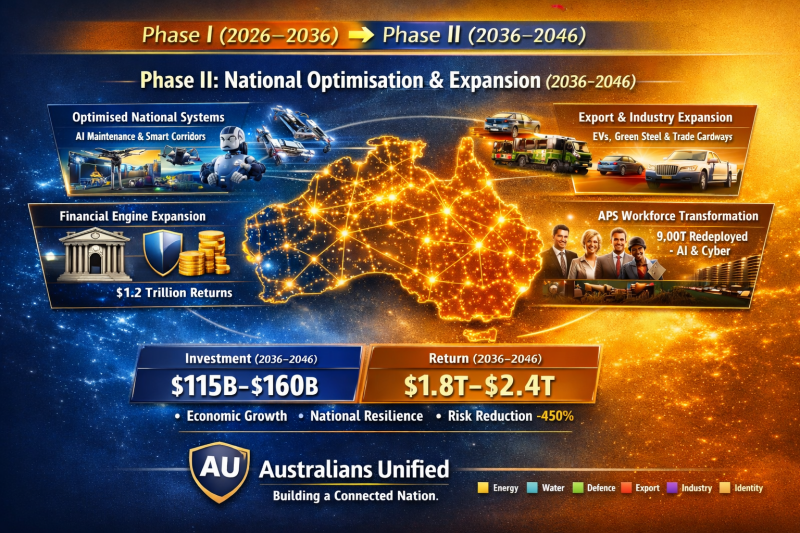
Australians Unified: 2036–2046 national optimisation plan
Whole-of-nation integration and financial architecture
Australia's sovereign systems operate in unified orbit across energy, water, defence, export, industry, and national identity. Backed by a tri-pillar whole-of-government financial engine—comprising the Government Bank for strategic lending, the Insurance Corporation for systemic risk underwriting, and the Superannuation Company for high-yield onshore investment—this ten-year plan shifts the nation from foundational consolidation into rapid optimisation.
Workforce transformation and economic return
Workforce redeployment: Over 7,350 APS positions protected and 9,000 roles repositioned into cyber resilience, data governance, and strategic AI oversight.
Sovereign infrastructure: Smart corridors, autonomous convoys, and automated predictive grids cutting operating overheads by 25% with 40% higher uptime.
Export dominance: Advanced manufacturing hubs across Geelong, Bayswater, Whyalla, and the Darwin Gateway generating $2.4T in export revenues and 300,000 skilled jobs.
National economic metrics: Total investment of $115B–$160B unlocking returns between $1.8T and $2.4T, delivering an average annual GDP uplift of 3.5% alongside a 45% reduction in national exposure.


COST SAVINGS & EXPENDITURE STRATEGY
A. Government Cost Savings (10‑Year Target: 30–40%)
-
Consolidation of fragmented business programs across portfolios
-
Automation of grants, licensing and compliance
-
Reduction in duplicated regulatory functions
-
Shared data systems with Treasury, ATO, ACCC, ASIC, APRA
-
AI‑enabled modelling replacing manual analysis
-
Streamlined procurement and digital service delivery
B. Business Cost Savings (10‑Year Target: 25–35%)
-
Simplified reporting and compliance
-
Automated BAS, GST and licensing workflows
-
Reduced regulatory burden for SMEs
-
Faster approvals for investment and development
-
Digital tools for workforce, finance and export readiness
C. Expenditure Priorities
-
Digital infrastructure for business services
-
Industry transformation programs
-
SME capability uplift
-
National investment attraction
-
Workforce and skills development
-
Innovation and commercialisation

AREAS OF DEVELOPMENT (10‑YEAR HORIZON)
1. Digital & Advanced Industries
-
AI, automation and robotics
-
Cybersecurity and digital infrastructure
-
Advanced manufacturing
-
Clean energy and green tech
-
Quantum and emerging technologies
2. SME Growth & Modernisation
-
Digital adoption
-
Export capability
-
Supply chain resilience
-
Regional and remote business support
3. Workforce & Skills
-
National skills forecasting
-
Industry‑aligned training pathways
-
Digital literacy and future‑skills programs
4. Investment & Global Competitiveness
-
National investment pipeline
-
Incentives for high‑value industries
-
International partnerships
-
Trade diversification
5. Regulatory Reform
-
Unified business compliance portal
-
Automated reporting
-
Simplified licensing
-
Sector‑specific regulatory modernisation

FUTURE MODEL (AI‑ENABLED, COST‑EFFICIENT, COMPETITIVE)
A. National Business Intelligence Platform
-
Real‑time business performance dashboards
-
AI‑enabled forecasting for industry trends
-
Integrated data across Treasury, ATO, ACCC, ABS, PC
-
Early‑warning indicators for business stress
B. Unified Business Services Portal
-
One platform for grants, licensing, compliance and reporting
-
Automated workflows and pre‑filled forms
-
24/7 digital support
-
Multilingual and accessible
C. SME Capability & Modernisation System
-
Digital adoption grants
-
Workforce and skills uplift
-
Export readiness and market access
-
Regional business hubs
D. Investment Attraction & Industry Transformation
-
National investment pipeline
-
Industry roadmaps (manufacturing, clean tech, digital)
-
Global investor partnerships
-
Incentives for high‑value industries
E. Regulatory Simplification & Red‑Tape Reduction
-
40% reduction in compliance burden
-
Automated regulatory impact assessments
-
Modernised sector‑specific frameworks
-
Transparent regulatory dashboards
DEPARTMENT (DBI) FITS INTO THE BUSINESS OPERATIONS MODEL
Prime Minister & Cabinet Portfolio → Business Operations Model → Treasury Portfolio → DBI
1. POSITION IN THE NATIONAL SYSTEM
Prime Minister & Cabinet Portfolio
Holds the Business Operations Model, which coordinates:
-
Whole‑of‑government efficiency
-
Cross‑portfolio integration
-
National data and intelligence
-
Workforce, digital and regulatory alignment
-
Long‑term planning and capability
Treasury Portfolio
Holds the economic engine of government:
-
Treasury
-
ATO
-
ACCC
-
ASIC
-
APRA
-
RBA
-
Productivity Commission
-
Business & Industry Department (DBI) ← your new addition
DBI’s role inside this system
DBI becomes the national business development arm of the Treasury Portfolio, but it is operationally supported and coordinated through the PM&C Business Operations Model.
A. National Data & Intelligence (PM&C) → Business Intelligence (DBI)
PM&C Business Ops provides:
-
Whole‑of‑government data architecture
-
AI‑enabled modelling
-
National dashboards
-
Cross‑portfolio data sharing
DBI uses this to:
-
Build the National Business Intelligence Platform
-
Forecast industry trends
-
Identify SME stress early
-
Map investment opportunities
-
Model workforce and skills needs
Result: A single national economic + business intelligence ecosystem.
B. Regulatory Simplification (PM&C) → Business Compliance Reform (DBI)
PM&C Business Ops provides:
-
Unified regulatory frameworks
-
Cross‑agency compliance alignment
-
Digital identity and secure access
DBI uses this to:
-
Build the Unified Business Services Portal
-
Automate licensing, reporting and approvals
-
Reduce SME compliance burden by 40%
-
Integrate ATO, ASIC, ACCC, APRA requirements
Result: A nationally consistent, low‑burden regulatory environment.
HOW DBI CONNECTS TO THE BUSINESS OPERATIONS MODEL
The Business Operations Model has several core pillars. Here’s how DBI plugs into each one.
C. Workforce & Capability (PM&C) → Industry Skills & Transformation (DBI)
PM&C Business Ops provides:
-
APS capability uplift
-
National workforce forecasting
-
Digital and AI training frameworks
DBI uses this to:
-
Build industry‑aligned skills pathways
-
Support SME workforce development
-
Model future skills needs
-
Drive digital adoption across sectors
Result: A future‑ready national workforce aligned with industry needs.
D. Digital Transformation (PM&C) → SME & Industry Modernisation (DBI)
PM&C Business Ops provides:
-
Whole‑of‑government digital platforms
-
Automation frameworks
-
Cybersecurity standards
DBI uses this to:
-
Modernise SMEs
-
Support digital adoption
-
Build innovation precincts
-
Strengthen cyber resilience
Result: A digitally competitive national business ecosystem.

10‑YEAR DEVELOPMENT & COST‑SAVING ALIGNMENT
DBI’s 10‑year plan aligns perfectly with the PM&C Business Operations Model.
PM&C Business Ops 10‑Year Themes
-
Efficiency
-
Automation
-
Data integration
-
Workforce capability
-
National digital systems
-
Long‑term planning
DBI 10‑Year Themes
-
SME modernisation
-
Industry transformation
-
Investment attraction
-
Regulatory simplification
-
Digital adoption
-
Workforce and skills uplift
Shared 10‑Year Outcomes
-
30–40% reduction in government admin costs
-
25–35% reduction in business compliance burden
-
National business intelligence ecosystem
-
Fully integrated digital services
-
Stronger global competitiveness
-
Higher productivity and innovation
-
Resilient supply chains
-
Future‑ready workforce
Investment & Economic Strategy (Treasury) → Industry Development (DBI)
Treasury provides:
-
Fiscal strategy
-
Economic modelling
-
Investment policy
-
Tax and revenue settings
DBI uses this to:
-
Build the National Investment Pipeline
-
Develop industry transformation roadmaps
-
Attract global investors
-
Support advanced manufacturing, clean tech, digital industries
Result: A coordinated national economic and industry strategy.
DAY‑TO‑DAY WITH PM&C BUSINESS OPERATIONS
PM&C Business Ops provides:
-
Governance
-
Data infrastructure
-
Digital platforms
-
Workforce capability
-
Regulatory alignment
-
Performance reporting
DBI delivers:
-
Business programs
-
Industry development
-
SME support
-
Investment attraction
-
Innovation and transformation
-
Business intelligence
Together they create:
A national business ecosystem that is:
-
Efficient
-
Modern
-
Data‑driven
-
Globally competitive
-
Low‑burden
-
High‑growth
-
Future‑ready
Strategic roadmap and portfolio highlights
A structured 10-year transformation transitioning Australian business and industry from foundational data systems to an integrated, future-ready economic ecosystem.
Phase 1 — Foundation (years 1–2)
Establishing core infrastructure by building a unified business data architecture, initiating targeted SME and regulatory reform pilots, and locking in a coherent national investment attraction strategy.
Phase 2 — Acceleration (years 2–4)
Scaling capabilities via the National Business Intelligence Platform, comprehensive SME capability uplifts, and sector-wide industry transformation programs driving technological adoption.
Phase 3 — Expansion (years 4–6)
Deploying advanced predictive modelling tools, delivering real-time economic performance dashboards, and managing an active sovereign investment pipeline across high-value markets.
Phase 4 — Future-ready (years 6–10)
Realising a fully integrated business ecosystem powered by automated compliance, ongoing continuous improvement, AI-enabled forecasting, and lower operational overheads nationwide.

Costing model and phased delivery
Designed for sustainable expenditure and high-return investment, the Department of Business & Industry establishes a $1.10B baseline per year with 30% built-in efficiency gains across all 10-year phases.
Phase 1 — Years 1–2: Foundation
Budget: $0.75B – $1.10B
Focuses on establishing the unified business data architecture, initiating SME and regulatory pilots, locking in the national investment attraction strategy, and standing up the digital services foundation.
Projected cost savings: 10–15% reduction in duplicated government programs and 5–10% reduction in business compliance costs.
Phase 2 — Years 2–4: Acceleration
Budget: $2.40B – $3.20B
Scales national execution through the National Business Intelligence Platform, comprehensive SME capability uplift programs, sector-wide industry transformation roadmaps, and full regulatory simplification rollouts.
Projected cost savings: 20–25% reduction in regulatory burden and a 15% reduction in government administration costs.
Phase 3 — Years 4–6: Expansion
Budget: $1.60B – $2.40B
Expands intelligence through predictive economic modelling, live cross-portfolio performance dashboards, and direct management of Australia's national sovereign investment pipeline.
Projected cost savings: 30% reduction in duplicated public services alongside a 20% reduction in SME compliance costs.
Phase 4 — Years 6–10: Future-ready
Budget: $4.20B – $5.60B
Consolidates a fully integrated, automated business ecosystem featuring continuous process improvement, instant regulatory reporting, and robust sovereign industry resilience.
Projected cost savings: 40% reduction in commercial regulatory burden and 30–35% reduction in whole-of-government administrative expenditure.
Business system implementation
TREASURY PORTFOLIO — ROLE, COST vs OUTCOME & SAVINGS
Australia’s economic engine: stability, sovereignty, and long‑term capability.
🔵 1. Treasury’s Core Role (BLUE — Primary)
Treasury is responsible for the economic foundations that keep Australia stable, competitive, and sovereign.
Core Functions:
-
National budgets & fiscal strategy
-
Economic modelling & forecasting
-
Market regulation & consumer protection
-
Taxation & revenue systems
-
Whole‑of‑government financial governance
Outcome: A stable, resilient economy that supports national priorities.
🟡 2. Cost of the Current Fragmented System (YELLOW — Cost)
Without unified Treasury‑aligned financial governance, government faces:
-
Duplicated economic programs across portfolios
-
Multiple financial reporting systems
-
Inefficient budget oversight
-
High consultant & contractor reliance
-
Slow economic decision cycles
Estimated 10‑Year Cost Burden: $6.8B in duplicated financial systems, modelling teams, and fragmented economic programs.
🟦 3. Treasury‑Led Reform Savings (TEAL — Savings)
A unified Treasury‑aligned economic governance model delivers:
-
$3.2B saved from consolidated financial systems
-
$1.8B reduced consultant/contractor spend
-
$900M saved through unified economic modelling
-
$600M saved through streamlined reporting & compliance
Total Estimated Savings (10 years):
$6.0B
🔴 4. Outcomes for Australia (RED — Impact)
Treasury‑driven reform strengthens national capability by delivering:
-
Faster, clearer economic decision‑making
-
Stronger sovereign financial settings
-
Better protection for consumers & markets
-
More efficient government spending
-
Improved national resilience during global shocks
-
A unified economic strategy across all portfolios
Net Impact: A more secure, sovereign, future‑ready economy.
⚪ 5. Why Treasury Matters (WHITE — Clarity)
Treasury ensures Australia has:
-
A strong, stable economy
-
Fair and competitive markets
-
Responsible government spending
-
Protection for households & businesses
-
The financial capability to deliver national priorities
Treasury is the economic backbone of a sovereign, resilient Australia.

Government‑Owned Business Portfolio (Phase I → Phase II)
Sovereign Enterprises Driving National Growth
1️⃣ Financial & Insurance Sector
-
National Government Bank — issues sovereign bonds, funds infrastructure, and provides low‑interest lending for strategic industries.
-
National Insurance Corporation — underwrites Defence, energy, and climate assets; provides citizen and workforce protection.
-
Sovereign Superannuation Company — invests in Australian innovation, renewables, and export manufacturing.
2️⃣ Infrastructure & Utilities
-
Energy Super‑Grid Authority — manages national renewable generation, transmission, and export of clean power.
-
Water Grid Corporation — oversees water security, recycling, and agricultural supply chains.
-
National Transport & Logistics Agency — integrates ports, rail, and Defence routes for domestic and export efficiency.
3️⃣ Manufacturing & Export
-
Australian Manufacturing Rebuild Corporation — operates EV, battery, and green‑steel facilities.
-
Indo‑Pacific Trade Gateway Authority — manages Darwin and northern export corridors, ensuring sovereign control of trade routes.
4️⃣ Digital & Data Systems
-
National AI & Cyber Agency — develops secure AI systems for government and industry.
-
Unified Identity & Data Services — manages digital identity, compliance, and secure citizen access.
5️⃣ Defence & Strategic Assets
-
Defence Engineering & Logistics Corporation — builds hybrid fleets, robotics, and sovereign supply chains.
-
Veteran Transition & Innovation Agency — redeploys Defence talent into engineering and renewable sectors.
💰 Fiscal Outcome
These enterprises generate direct government revenue through dividends, bond yields, and export profits — while simultaneously reducing private‑sector costs and creating high‑skill jobs. Together, they form a sovereign economic engine that replaces fragmented outsourcing with unified national ownership.
🇦🇺 Capital Investment Opportunities for Companies (Including Superannuation Funds) into the supergrid system
1️⃣ Sovereign Infrastructure Bonds
-
Issued by the Government Bank to fund ports, grids, rail, and defence precincts.
-
Companies and super funds can invest directly for stable 4–6 % returns.
-
Bonds are backed by national assets — low risk, long‑term yield.
2️⃣ Public–Private Sovereign Partnerships
-
Co‑investment in energy super‑grid, battery precincts, and hydrogen export hubs.
-
Firms gain equity stakes while government retains ownership.
-
Superannuation funds channel capital into productive, onshore assets instead of offshore speculation.
3️⃣ Sovereign Insurance & Risk‑Reduction Pools
-
National Insurance Corporation underwrites climate, logistics, and infrastructure risk.
-
Private insurers and funds can co‑underwrite or reinsure sovereign projects.
-
Creates predictable returns and stabilises national investment cycles.
4️⃣ Technology & Defence Manufacturing Credits
-
Sovereign investment system offers tax credits and procurement guarantees for domestic manufacturers.
-
Super funds can invest in sovereign supply‑chain ventures with guaranteed government contracts.
5️⃣ Export Corridor Equity
-
Companies can buy into Indo‑Pacific renewable export corridors (energy, shipping, data).
-
Returns linked to sovereign trade revenue and long‑term export growth.
6️⃣ Superannuation Integration
-
Super funds invest in sovereign enterprises via Sovereign Retirement Bonds.
-
Members’ savings grow while funding national infrastructure.
-
Aligns retirement income with Australian productivity and wage growth.
7️⃣ Fiscal Outcome
-
Corporate and superannuation investment drives GDP growth (3.2–3.8 % p.a.).
-
Government earns dividends, companies earn returns, and citizens gain cheaper services.
-
Creates a closed‑loop sovereign economy — investment, profit, reinvestment.