Australians Unified Reform policies
Portfolio Overview — Core Mandate
-
Protect Australia’s natural resources.
-
Support primary producers.
-
Ensure long‑term sustainability of agriculture, fisheries, and forestry.
-
Strengthen national food security.
-
Support regional and rural communities.
-
Maintain Australia’s global reputation for clean, safe, high‑quality food and fibre.
- Continue manufacturing & exporting our natural resources in clean green factories
- Focusing on Shaping Australians future first

Economic Sovereignty & National Capability
-
Rebuild sovereign manufacturing, agriculture, and energy capability.
-
Reduce reliance on foreign supply chains for essential goods.
-
Reform free‑trade settings that has disadvantage Australian workers and industries.
-
Strategic procurement favoring Australian industry and national resilience.
- Building Future industries through Education & opportunity

Streamlining Bureaucracy & Reducing Waste
-
Reduce duplication caused by overlapping federal–state responsibilities.
-
Streamline governance and service delivery across health, disability, aged care, and social services.
-
Consolidate digital systems into single‑entry pathways.
- Creating an Australin government model and business system with AI capabilities
- Streaming systems through AI to free up staffing for future industries

Tax Reform to Support Working Families
-
Address tax settings that penalize single‑income and low‑middle income families.
-
Reform childcare subsidies to empower parents directly.
-
Increase tax‑free thresholds and family‑based tax settings.
- Creating tax reforms benefit the growth of industries and Australians
- creating tax breaks for students, disadvantaged, elderly and business that creates opportunity
Rebuilding Public Institutions
-
Strengthen accountability and transparency in government.
-
Rebuild public institutions with citizen‑first service design.
-
Establish independent oversight bodies with real enforcement powers & industries so there independently analyzed
- building end to end pipelines of business that ensure economic freedom for our future
National Cultural Policy (Arts, Media, Creative Industries)
-
Renew arts, entertainment, music, and cultural sectors through a 5‑year plan.
-
Funding for national broadcasters (ABC, SBS) and community broadcasting.
-
Screen production offsets and support for Australian stories.
-
Strengthen multicultural arts, festivals, and anti‑racism initiatives.
-
Protect tangible and intangible cultural heritage.
-
Support creative industries and career pathways for artists.
-
Promote Australian culture internationally through cultural diplomacy.
Multiculturalism & Social Cohesion
-
Ensure government services are accessible across cultural and linguistic backgrounds.
-
Strengthen the national anti‑racism strategy.
-
Support multicultural arts, festivals, and community broadcasting.

Heritage Protection
-
Protect cultural heritage through laws and funding for galleries, libraries, museums.
-
Support preservation of both tangible and intangible heritage.
- building heritage through education
Financial System Sovereignty
-
Reduce reliance on private banks and foreign capital.
-
Establish a public bank and public insurance office.
-
Provide low‑cost, secure financial services for households and small businesses that give them opportunity to flourish
- ensuring our nation resources have end to end capabilities
- creating a sovereign wealth fund
Social Support System Reform
-
Fix long wait times and inconsistent assessments across NDIS, aged care, welfare.
-
Replace agency‑centered systems with person‑centered models.
-
Introduce national standards for planning, assessment, and service quality.
- ensuring we produce the energy to support our nation
National Planning & Infrastructure Coordination
-
Address fragmented planning across states.
-
Create a unified national strategy for housing, transport, health, and energy.
-
Implement long‑term sovereign capability planning across essential sectors.
- building the pipelines of a super grid structure that supports our way of life
First Nations Cultural Development
-
Support First Nations arts, culture, and heritage through national cultural policy.
-
Promote First Nations stories domestically and internationally.
- Protecting cultural sites and land of historic importance to local mobs
- Developing a regional voting systems for elected leaders to manage indigenous affairs in Australia
- cutting the red to refocus treaties and land acts both state and federally
Religious Discrimination & Human Rights Reform
-
Prohibit discrimination based on religious belief or activity.
-
Establish the Religious Discrimination Commissioner.
-
Create offences for discriminatory advertisements and victimization.
-
Provide exceptions and protections under anti‑discrimination law.
- Building Future pathways between First Nations & Multiculturism
- Restoration of Australian family Values and beliefs that help unify the integrity of future generations
Service Delivery Reform (Basic → Enterprise Services)
-
Provide tiered service models tailored to individual needs.
-
Deliver practical, effective, citizen‑focused solutions.
- rebuild the NDIS to streamline corporate involvement to benefit the disabled
- create family first policies that initiate future generations of Australians and culture
- creating education programs that support our future industries

Australians Unified — 10‑Year National Reform Roadmap
Foundation → Build → Integrate → Future‑Ready
PHASE 1 — FOUNDATION (Years 1–2)
Stabilise, simplify, and set national direction
Government & Systems
-
Remove duplication across federal–state systems (health, disability, aged care, social services)
-
Begin consolidation of digital systems into single‑entry pathways
-
Establish citizen‑first service design standards
-
Launch national integrity & transparency uplift
Economy & Sovereignty
-
Begin rebuilding sovereign manufacturing, agriculture & energy capability
-
Reform free‑trade settings disadvantaging Australian workers
-
Prioritise Australian industry in procurement
Culture & Identity
-
Begin 5‑year renewal of arts, entertainment & cultural sectors
-
Fund ABC, SBS & community broadcasting
-
Strengthen multicultural festivals & anti‑racism initiatives
First Nations
-
Protect cultural sites & heritage
-
Begin development of regional voting systems for Indigenous leadership
PHASE 2 — BUILD (Years 3–5)
Construct national capability, modernise services, and expand cultural confidence
Government & Systems
-
Deploy AI‑enabled government models to streamline assessments & service delivery
-
Implement national standards for planning, assessment & service quality
-
Reduce wait times across NDIS, aged care & welfare systems
Economy & Sovereignty
-
Expand sovereign manufacturing hubs
-
Strengthen national food security & regional community support
-
Launch public bank & public insurance office for low‑cost financial services
Culture & Identity
-
Scale Australian screen production & storytelling
-
Expand creative industry career pathways
-
Strengthen multicultural arts & community broadcasting
-
Begin national cultural diplomacy program
First Nations
-
Promote First Nations stories domestically & internationally
-
Strengthen language, arts & cultural programs
PHASE 3 — INTEGRATE (Years 6–8)
Unify systems, embed national values, and align long‑term planning
Government & Systems
-
Fully integrate digital government into a single national platform
-
Align housing, transport, health & energy planning under unified national strategy
-
Mature AI‑driven service models across all portfolios
Economy & Sovereignty
-
Achieve measurable reduction in foreign supply‑chain dependence
-
Expand clean, green manufacturing & export capability
-
Strengthen agricultural, fisheries & forestry sustainability systems
Culture & Identity
-
Integrate cultural policy across education, tourism, diplomacy & community programs
-
National heritage protection fully modernised (galleries, libraries, museums)
-
Launch national cultural literacy curriculum
First Nations
-
Embed First Nations cultural leadership in national planning
-
Strengthen treaty, land act and heritage reforms (state + federal)
PHASE 4 — FUTURE‑READY (Years 9–10)
A unified, sovereign, culturally confident Australia
Government & Systems
-
Fully automated, citizen‑first, AI‑supported service ecosystem
-
National planning system operating as a single coordinated framework
-
Independent oversight bodies with full enforcement capability
Economy & Sovereignty
-
Australia positioned as a global leader in clean manufacturing & sustainable exports
-
Strong sovereign capability across energy, agriculture, finance & critical goods
-
Future industries pipeline embedded in education & workforce systems
Culture & Identity
-
Australia recognised globally for cultural leadership & creative exports
-
Strong national identity built on fairness, respect, responsibility & community
-
Cultural heritage protected and celebrated nationwide
First Nations
-
Mature, empowered First Nations governance structures
-
Cultural leadership embedded in national identity
-
Strong pathways between First Nations and multicultural communities
Restoring Pride in Australian Culture
A Strategic Framework for Cultural Development Australia (CDA)
Re‑anchor Australia in its Core Values
Your open page already emphasises fairness, respect, responsibility, community, and stewardship. To restore pride, CDA can:
-
Codify a National Values Charter taught in schools, workplaces, and citizenship programs.
-
Promote “The Australian Way” as a shared moral compass — egalitarianism, mateship, integrity, and respect for women and children.
-
Embed values in public institutions, service design, and leadership standards.
This becomes the cultural spine of the nation.
🎨 2. Rebuild Cultural Confidence Through Creative Industries
The policy reforms page already outlines a strong cultural policy direction: funding arts, screen production, festivals, and Australian stories.
CDA can elevate this by:
-
Launching a National Storytelling Initiative to amplify Australian narratives across film, music, literature, and digital media.
-
Incentivising Australian-made content that reflects real communities — rural, urban, multicultural, First Nations.
-
Establishing a Cultural Export Office to promote Australian culture internationally.
Pride grows when people see themselves reflected with dignity and strength.
🖤 3. Strengthen First Nations Cultural Leadership
Your page already commits to First Nations arts, heritage protection, and cultural sites.
CDA can build on this by:
-
Creating a First Nations Cultural Authority to guide national cultural decisions.
-
Expanding language revival programs and embedding them in schools.
-
Supporting First Nations-led festivals, museums, and digital archives.
This positions First Nations culture as a central pillar of national identity — not a side program.
🤝 4. Build Social Cohesion Through Shared Experiences
The policy reforms page highlights multicultural arts, anti-racism strategy, and community broadcasting.
CDA can unify these by:
-
Establishing National Community Festivals celebrating local heritage, food, music, and stories.
-
Creating a Neighbourhood Culture Fund for grassroots cultural projects.
-
Supporting interfaith and intercultural dialogue programs.
Shared experiences build shared pride.
🏛️ 5. Protect and Elevate Heritage
The page already includes heritage protection for galleries, libraries, museums, and cultural sites.
CDA can:
-
Modernise museums with interactive, digital-first storytelling.
-
Restore historic sites and turn them into community learning hubs.
-
Launch a National Heritage Trail linking iconic cultural, environmental, and historical locations.
This reconnects Australians with their roots.
📚 6. Embed Culture in Education
To rebuild pride, culture must be lived — not just observed.
CDA can introduce:
-
A Cultural Literacy Curriculum from primary to tertiary.
-
Programs teaching civic responsibility, democratic participation, and Australian history.
-
A Culture-to-Careers Pipeline linking arts, heritage, tourism, and creative industries to employment.
This builds cultural capability across generations.
🛡️ 7. Rebuild Trust in Institutions
Your open page emphasises transparency, accountability, and citizen-first service design.
CDA can:
-
Lead a National Integrity in Culture Program promoting ethical leadership.
-
Create public campaigns celebrating everyday Australians who embody national values.
-
Partner with Defence, Education, and Community portfolios to reinforce unity and shared purpose.
Pride grows when institutions reflect the people they serve.
🌟 8. A National Cultural Renewal Campaign
Finally, CDA can launch a flagship initiative:
“Proudly Australian” — A 10-Year Cultural Renewal Strategy
Featuring:
-
National storytelling campaigns
-
Cultural ambassadors
-
School and community programs
-
Public art and national symbols revitalisation
-
Annual cultural awards
-
A national month of cultural celebration
This becomes the public-facing engine of cultural pride.
Australia's Unified Super grid
Solving Tomorrow's problems today
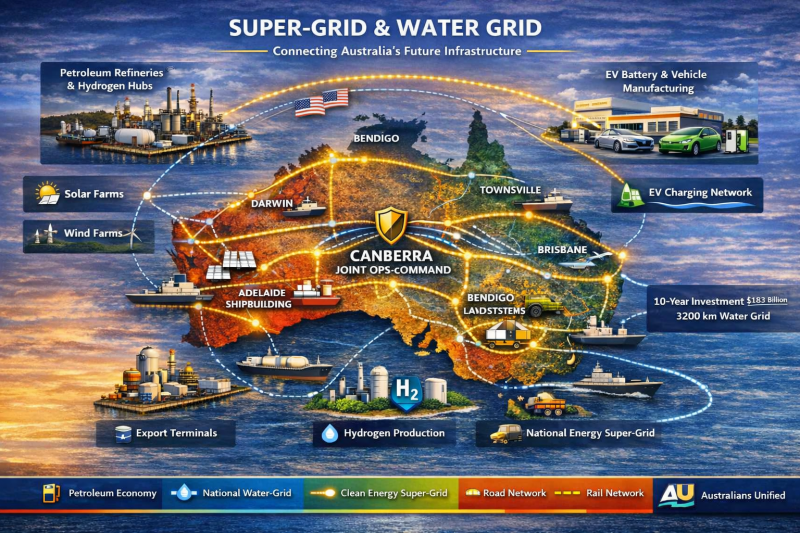
🗺️ SUPER-GRID & WATER GRID — Connecting Australia’s Future Infrastructure
This version overlays:
-
Clean Energy Super-Grid (yellow lines)
-
National Water Grid (light blue dashed lines)
-
Petroleum Economy (dark blue)
-
Road Network (black)
-
Rail Network (orange)
-
Strategic Hubs: Canberra Joint Ops-Command, Bendigo Land Systems, Adelaide Shipbuilding, EV Manufacturing, Hydrogen Production, Export Terminals
Super Grid Services
🗺️ SUPER-GRID & WATER GRID — Connecting Australia’s Future Infrastructure
The integration of Australia’s Clean Energy Super-Grid and the National Water Grid forms a critical foundation for the nation’s infrastructure future. This advanced framework overlays essential systems: the Clean Energy Super-Grid, marked by vibrant yellow lines, aims to harness renewable energy sources across the country, ensuring a sustainable power supply. Complementing this, the light blue dashed lines represent the National Water Grid, designed to efficiently distribute water resources to areas in need, mitigating the impacts of drought and enhancing agricultural productivity. Furthermore, the dark blue network illustrates Australia's petroleum economy, highlighting the importance of these resources in supporting economic growth. The robust black lines indicate the extensive road network, facilitating transport and connectivity, while the rail network, depicted in green, provides an efficient means for freight and passenger movement. Together, these elements create a cohesive infrastructure landscape, strategically connecting communities and driving Australia towards a more resilient and sustainable future.
Road and Rail Network on the Supergrid
The integration of a robust road and rail network within the supergrid is essential for enhancing transportation efficiency and connectivity across Australia. This supergrid is not just about electricity; it also signifies a harmonious blend of various transport systems designed to facilitate seamless movement of goods and people. The road infrastructure provides flexibility for short-distance travel and access to remote areas, while the rail system offers a reliable, efficient means of transporting larger quantities over longer distances. By aligning the development of these transport networks with the supergrid framework, we can ensure reduced congestion, lower emissions, and better overall access to services and markets. This integrated approach supports economic growth, improves regional development, and promotes sustainability across the nation.
Understanding Australia's Connection Points and Their Role in National Systems
Australia is a vast continent with diverse landscapes, cultures, and systems that connect its regions and people. At the heart of these connections are key infrastructure points that facilitate movement, communication, and commerce. Major cities including Sydney, Melbourne, Brisbane, and Perth serve as vital hubs that link various regions. These urban centres are supported by a network of roads, railways, and airports, making transportation integral to connecting communities across different states.
In addition to physical infrastructure, Australia is equipped with advanced digital connectivity. The National Broadband Network (NBN) plays a critical role, providing internet access to urban and remote areas alike. This digital framework not only enhances communication among citizens but also supports businesses, education, and health services, ensuring that even the most isolated communities have access to essential resources.
On a broader scale, these connection points are interlinked with national systems including the economy, governance, and environmental management. The economic activities concentrated in major cities drive growth in regional areas, while policies set by the national government help to balance development between urban and rural communities. Furthermore, sustainable practices are encouraged through systems that connect environmental conservation efforts with economic incentives, promoting a holistic approach to Australia’s development.
Lastly, social systems also thrive on these connections. Community organisations and support networks leverage physical and digital pathways to reach individuals in need, fostering resilience and inclusivity. By understanding and enhancing these connections, Australia can work towards a cohesive approach that nurtures each of its regions while maintaining its unique identity.
In summary, the connection points around Australia are not merely physical locations; they are critical to the functionality of the nation’s systems. By effectively integrating transportation, digital access, economic policies, and social networks, Australia reinforces its commitment to a united and thriving society.
Understanding Water Management: Water Grids and Beyond
Australia's water management system is an intricate network that relies on various components, including water grids, catchments, hydroelectric power, and water distribution. A water grid is a comprehensive infrastructure that connects different water sources, treatment facilities, and supply networks, ensuring a reliable flow of water to urban and rural areas. This grid is vital for balancing water supply and demand, especially during drought conditions, which are common in many parts of Australia.
Catchments are critical to this system, as they are areas where rainfall collects and flows into rivers, lakes, or reservoirs. Healthy catchments are essential for maintaining water quality and quantity, supporting biodiversity, and regulating the water cycle. Protecting these areas from pollution and degradation is paramount to ensure sustainable water resources for future generations.
Furthermore, hydroelectric power plays a significant role in water management by harnessing the energy from flowing water. This renewable energy source not only provides electricity but also aids in the efficient operation of water distribution systems. By integrating hydroelectric generation into water infrastructure, we can support both energy and water needs simultaneously.
Finally, water distribution involves the systems and technology used to deliver water from treatment plants to consumers. Effective distribution systems ensure that communities have access to clean, safe water for drinking, irrigation, and industrial use. Continuous improvements in technology and infrastructure are necessary to enhance efficiency, reduce waste, and adapt to the challenges posed by climate change.
In summary, understanding the interconnectedness of water grids, catchments, hydroelectric power, and water distribution is crucial for developing sustainable water management practices in Australia. Together, these elements contribute to a resilient system that can meet the needs of people and the environment alike.
Clean Energy Supergrid and National Connection
The concept of a clean energy supergrid is becoming increasingly essential as the world seeks to transition towards sustainable energy solutions. This supergrid refers to a vast network that interlinks renewable energy sources, such as solar, wind, and hydropower, allowing for a seamless distribution of clean energy across regions and even countries. In Australia, the vision of a national connection through this supergrid aims to maximise the use of abundant renewable resources while reducing reliance on fossil fuels. By connecting different states and territories, energy can be shared more efficiently, ensuring that regions can benefit from excess energy produced elsewhere, especially during peak generation times.
This interconnected system not only enhances energy security but also stabilises the grid, reducing the chances of blackouts and ensuring a more reliable energy supply for all Australians. Moreover, a clean energy supergrid could significantly lower electricity costs over time by increasing competition among energy providers and enabling the use of the cheapest available renewable sources. The national connection facilitates better management of energy resources, helping to balance supply and demand effectively.
Implementing a clean energy super grid is a tremendous opportunity for Australia to lead in renewable energy innovation. It can also play a crucial role in reducing carbon emissions, helping the nation meet its climate targets and commitment to a sustainable future. Furthermore, such a project could create thousands of jobs in construction, maintenance, and operation, providing a vital economic boost.
In conclusion, the clean energy super grid represents a transformative approach to energy distribution that benefits both the environment and the economy. By investing in a national connection, Australia can harness its renewable energy potential, improve energy resilience, and pave the way for a greener future that supports generations to come.
The Petroleum Industry: Distribution Points and the Importance of Self-Reliance
The petroleum industry plays a crucial role in powering economies and supporting modern lifestyles across Australia and beyond. From extraction to refinement, the journey of petroleum involves numerous distribution points that are vital for ensuring that energy reaches both urban and rural areas efficiently. Understanding these distribution points is essential for grasping how oil and gas products are delivered to the market. Typically, petroleum is extracted from oilfields and transported to refineries through pipelines, tankers, or trucks. Once refined, products like petrol, diesel, and heating oil are distributed through a network of terminals and retail outlets, including service stations. This intricate system highlights not only the importance of the industry but also the need for self-reliance in energy supply.
Self-reliance in the petroleum sector means that a nation or region can meet its own energy needs without excessive dependency on foreign sources. This is vital for several reasons. Firstly, it enhances national security by reducing vulnerability to fluctuating global oil prices and geopolitical tensions. When a country can produce and distribute its own petroleum products, it is less affected by international conflicts or trade disputes. Secondly, self-reliance contributes to economic stability. By investing in local oil extraction and refining facilities, countries can create jobs, foster innovation, and stimulate economic growth. This localized approach not only supports the economy but can also lead to more affordable prices for consumers. Finally, having a self-reliant petroleum industry aids in the transition to alternative energy sources. As nations strive to meet climate goals, a solid foundation in local petroleum resources can help facilitate the shift towards renewable energy solutions while ensuring a steady energy supply during the transition period.
In conclusion, the petroleum industry and its distribution points are not just critical components of our daily lives; they also underscore the importance of self-reliance in ensuring energy security, economic stability, and a sustainable future. By investing in local capabilities, Australia can secure its energy future while continuing to support the global energy market.
EV Manufacturing of Cars and Trucks with Hybrid Motors
The electric vehicle (EV) industry is rapidly evolving, particularly in Australia, where the demand for eco-friendly transportation is on the rise. In cities like Adelaide, Geelong, and Melbourne, manufacturers are increasingly focusing on the production of both cars and trucks equipped with hybrid motors. These hybrid models combine traditional internal combustion engines with electric power, offering a more sustainable option for consumers concerned about fuel efficiency and environmental impact.
Distribution Points for EVs in Adelaide, Geelong, and Melbourne
To support the growing market for hybrid EVs, various distribution points have been established across these regions. Adelaide boasts several dealerships that specialise in electric and hybrid vehicles, making it easier for residents to access the latest models. In Geelong, local businesses are also stepping up to meet the local demand, offering a range of electric cars and trucks to choose from. Meanwhile, Melbourne's extensive network of auto retailers includes numerous centres dedicated to promoting and selling eco-friendly vehicles, ensuring that consumers have plenty of options at their fingertips.
The Future of EV Manufacturing
As technology continues to advance, we can expect further improvements in EV manufacturing processes and hybrid motor technology. This growth will likely lead to better range and performance for electric vehicles, alongside increased charging infrastructure across the cities. The shift towards hybrid motors not only caters to environmental concerns but also ensures that consumers benefit from the versatility and reliability of conventional engines. With ongoing investments in research and development, the future of EV manufacturing in Australia looks promising, paving the way for an integrated approach to sustainable transportation.
Conclusion
In conclusion, the landscape of EV manufacturing, particularly for cars and trucks with hybrid motors, is evolving in Australia. Cities like Adelaide, Geelong, and Melbourne are leading the charge with their focus on sustainability and distribution infrastructure. As awareness grows and technology advances, we can anticipate a brighter future for eco-friendly vehicles.
Ship
building
Shipbuilding is a critical industry that involves the design, construction, and maintenance of various types of vessels. On our website, we provide extensive information about the shipbuilding process, the latest technologies used, and the different types of ships that can be constructed. You can explore sections dedicated to the history of shipbuilding, innovations that have transformed the industry, and a detailed overview of the shipbuilding lifecycle—from conception and design to launch and delivery. Additionally, we offer resources for those interested in pursuing a career in shipbuilding, outlining the skills required and training pathways available. Whether you are a seasoned professional or new to the field, our website aims to be a comprehensive resource for all things shipbuilding.
Hydrogen Production: An In-Depth Overview
Hydrogen is a versatile energy carrier that can play a crucial role in the transition to a more sustainable energy system. It is produced from various sources and methods, each with its unique advantages and challenges. In this comprehensive guide, we delve into the primary methods of hydrogen production, their environmental impacts, and their applications.
Key Methods of Hydrogen Production
1. Steam Methane Reforming (SMR)
Currently, the dominant method for hydrogen production is Steam Methane Reforming. This process involves reacting methane, usually sourced from natural gas, with steam to produce hydrogen and carbon dioxide. While SMR is efficient and cost-effective, it emits significant amounts of greenhouse gases, making it less favourable as we aim for cleaner energy solutions.
2. Electrolysis
Electrolysis is another prominent method, wherein water is split into hydrogen and oxygen using electricity. If the electricity comes from renewable sources (like wind or solar), the resulting hydrogen can be considered "green hydrogen." This method is gaining traction as advancements in technology drive down costs and improve efficiency, making it a promising avenue for sustainable hydrogen production.
3. Biomass Gasification
This method involves converting organic materials, such as agricultural and forestry residues, into hydrogen through high-temperature chemical reactions. Biomass gasification presents a renewable alternative to fossil fuel-based hydrogen production, with the added benefit of reducing waste.
4. Photoelectrochemical Water Splitting
This innovative technique harnesses sunlight to drive the water-splitting reaction, directly producing hydrogen. Although still largely in the research phase, photoelectrochemical systems hold great potential for future hydrogen production, combining the benefits of solar energy with hydrogen technology.
Environmental Considerations
The environmental impact of hydrogen production largely depends on the method used. While SMR has a substantial carbon footprint, processes like electrolysis (when powered by renewables) and biomass gasification are much cleaner. Transitioning towards these greener methods is essential to align hydrogen production with global climate goals.
Applications of Hydrogen
Hydrogen has a variety of applications across industries. In the energy sector, it can be used in fuel cells to generate electricity with only water as a by-product. Moreover, hydrogen is also employed in refining processes and can serve as a feedstock in the production of ammonia for fertilizers. As the hydrogen economy expands, its uses in transportation, heating, and as a storage medium for renewable energy will likely increase.
Conclusion
Understanding the various methods of hydrogen production and their implications is critical as we navigate the future of energy. While traditional methods like steam methane reforming currently dominate, there is an evident shift towards more sustainable practices. Continued research and investment in technologies such as electrolysis and biomass gasification will be vital in harnessing hydrogen's full potential while minimising environmental impact.
Understanding Canberra Joint Ops-Command and Its Role in the Suprgrid
The Canberra Joint Ops-Command, alongside Bendigo Land Systems and Export Terminals, plays a vital role in shaping Australia's strategic operations and defence capabilities within the broader framework of the suprgrid. This integrated network enhances the country's ability to manage and respond to various operational challenges. The Joint Ops-Command focuses on coordinating efforts across military and civil sectors, ensuring that resources are effectively utilised to address both domestic and international needs. Meanwhile, Bendigo Land Systems contributes to the development and manufacturing of advanced land defence technologies, ensuring that Australian forces are equipped with the latest innovations. Export Terminals work in tandem with these entities by facilitating the efficient movement of goods and materials, thus supporting Australia’s defence logistics and supply chains. Together, these components strengthen national security and enhance operational readiness, ultimately contributing to the effectiveness of the suprgrid—a comprehensive system designed to unify multiple operational domains for improved governance and security.