FOREIGN AFFAIRS & TRADE PORTFOLIO — POLICIES, REFORM & LEGISLATION
A sovereign, transparent, community‑centred foreign affairs system that protects Australia’s interests at home and abroad.
Australia’s foreign affairs, trade, and global engagement systems are being rebuilt to ensure:
-
Sovereignty first — decisions made in Australia’s interest
-
Transparency — clear reporting on treaties, aid, partnerships, and foreign influence
-
Capability — a modern, skilled diplomatic workforce
-
Security — cyber‑secure, integrated global systems
-
Community benefit — trade and diplomacy that support Australian workers and regions
This portfolio integrates the reform logic from your DFAT Reform & Modernisation page and aligns with People First and One Nation principles.
1. PORTFOLIO PURPOSE
The Foreign Affairs & Trade Portfolio exists to:
-
Protect Australia’s sovereignty and national interest
-
Strengthen Indo‑Pacific partnerships and regional stability
-
Support fair, transparent trade that benefits Australian workers
-
Deliver accountable, community‑centred development programs
-
Provide fast, reliable consular services
-
Modernise global systems and diplomatic capability
-
Ensure transparency in treaties, aid, and foreign influence
2. NATIONAL CHALLENGES
Australia faces:
-
Strategic competition in the Indo‑Pacific
-
Foreign influence risks
-
Outdated diplomatic systems and capability gaps
-
Limited transparency in treaties and aid
-
Slow, manual global operations
-
Low public trust in foreign policy
-
Economic vulnerabilities in trade and investment
These challenges are reflected directly in your DFAT Reform page
PORTFOLIO REFORM PRIORITIES
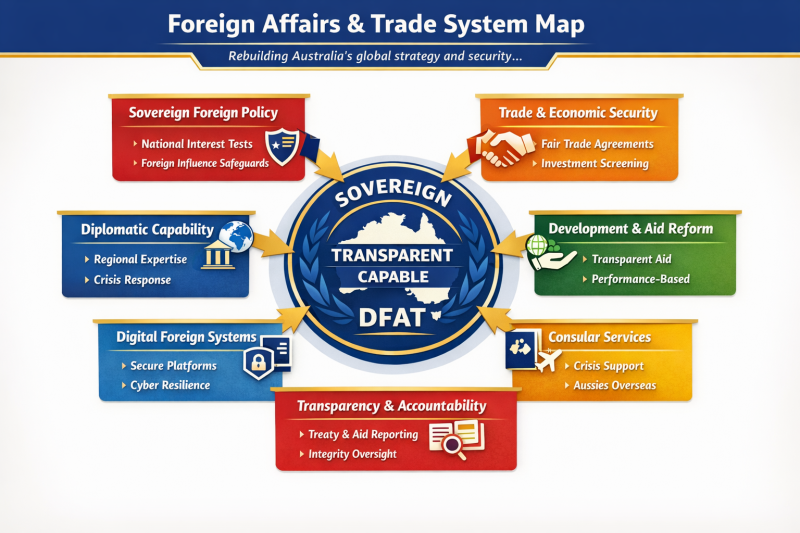
The portfolio is structured around seven national reform pillars, matching your DFAT reform structure.
1. Sovereign Foreign Policy
-
National interest tests for all agreements
-
Transparent treaties and partnerships
-
Stronger foreign influence safeguards
2. Modern Diplomacy & Capability
-
Rebuild regional expertise and language capability
-
Faster diplomatic decision‑making
-
Stronger Indo‑Pacific presence
3. Fair, Transparent Trade & Investment
-
Trade that benefits Australian industries and workers
-
Transparent reporting on agreements
-
Stronger investment screening
4. International Development & Aid Reform
-
Transparent, measurable, community‑centred aid
-
Reduced duplication and waste
-
Performance‑based funding
5. Digital Foreign Affairs Systems
-
Secure, modern global platforms
-
Integrated data and communications
-
Cyber‑resilient operations
6. Consular & Citizen Services
-
Faster crisis response
-
Real‑time communication
-
Community‑first service standards
7. Transparency & Accountability
-
Treaty & Aid Transparency Portal
-
Standardised reporting
-
Strong integrity frameworks
These pillars come directly from your DFAT Reform & Modernisation page
FOREIGN AFFAIRS & TRADE — LEGISLATIVE CHANGE PACKAGE
Legislative reforms for each sub‑department
This package provides clear, implementable legislative amendments for all DFAT sub‑divisions, ensuring the portfolio operates with sovereignty, transparency, accountability, and modern capability.

Sovereign Foreign Policy Division
Protecting Australia’s sovereignty, independence, and national interest.
Purpose Ensure all foreign policy decisions serve Australian communities and national interests.
Key Responsibilities
-
National interest tests
-
Treaty transparency
-
Foreign influence reporting
-
Strategic alignment with Defence & Home Affairs
Problems Identified
-
Foreign influence risks
-
Limited visibility into treaties
-
Fragmented national strategy
Reform Actions
-
Transparent treaty reporting
-
Stronger foreign influence safeguards
-
Unified Indo‑Pacific strategy
Outcomes
-
Stronger sovereignty
-
Clear, accountable foreign policy
-
Higher public trust
(Directly aligned with your DFAT page’s “Sovereign Foreign Policy” section)
SOVEREIGN FOREIGN POLICY DIVISION — LEGISLATIVE CHANGES
A. Foreign Influence & Sovereignty Protection Act (New Act)
-
Establish a National Interest Test for all treaties, MOUs, and strategic partnerships.
-
Mandate public disclosure of foreign influence activities.
-
Require parliamentary approval for high‑risk foreign agreements.
-
Create penalties for undisclosed foreign influence in policy formation.
B. Treaties & International Agreements Amendment Bill
-
Require all treaties to be published in a Treaty Transparency Register.
-
Mandate impact assessments before ratification.
-
Introduce automatic sunset clauses for outdated agreements.
C. Indo‑Pacific Strategic Alignment Act
-
Legislate a unified Indo‑Pacific strategy across Defence, Home Affairs, and DFAT.
-
Require annual reporting to Parliament on regional engagement outcomes.

Diplomacy & Global Capability Division
Rebuilding Australia’s diplomatic strength and frontline capability.
Purpose Modernise Australia’s diplomatic workforce and global presence.
Key Responsibilities
-
Diplomatic missions
-
Regional expertise
-
Language capability
-
Crisis response
Problems Identified
-
Capability shortages
-
Slow diplomatic processes
-
Outdated systems
Reform Actions
-
National Diplomatic Capability Centre
-
Modern training programs
-
Faster decision‑making systems
Outcomes
-
A capable, respected diplomatic service
-
Stronger Indo‑Pacific influence
(Aligned with “Diplomacy & Global Capability”)
. Diplomatic Capability & Workforce Modernisation Act
-
Establish a National Diplomatic Capability Centre.
-
Mandate minimum training standards in languages, regional expertise, and crisis response.
-
Create a Diplomatic Workforce Mobility Framework to deploy staff rapidly.
B. Foreign Service Modernisation Amendment Bill
-
Update the Public Service Act to recognise diplomatic specialist roles.
-
Enable fast‑track recruitment for critical skills.
-
Introduce performance‑based progression for overseas postings.
C. Crisis Response & Global Operations Act
-
Legislate a unified crisis response framework across DFAT, Defence, and Home Affairs.
-
Mandate real‑time communication systems for Australians overseas.

Trade, Investment & Economic Security Division
Fair, transparent trade that benefits Australian workers and industries.
Purpose Ensure trade and investment support national sovereignty and local industries.
Key Responsibilities
-
Trade agreements
-
Export support
-
Investment screening
-
Economic diplomacy
Problems Identified
-
Unfair trade impacts
-
Limited transparency
-
Foreign investment risks
Reform Actions
-
Fair Trade Framework
-
Transparent agreement reporting
-
Stronger investment screening
Outcomes
-
Fairer trade
-
Stronger local industries
-
Economic sovereignty
TRADE, INVESTMENT & ECONOMIC SECURITY DIVISION — LEGISLATIVE CHANGES
A. Fair Trade & National Interest Act
-
Require all trade agreements to undergo a National Interest & Sovereign Capability Test.
-
Mandate transparency on tariff impacts, labour impacts, and regional effects.
-
Require parliamentary review for major trade agreements.
B. Foreign Investment Screening Amendment Bill
-
Strengthen screening for critical infrastructure, land, and technology assets.
-
Require public reporting of foreign ownership trends.
-
Introduce penalties for non‑compliance with investment conditions.
C. Export & Industry Support Act
-
Legislate support for Australian exporters in sovereign capability sectors.
-
Require DFAT to prioritise trade that benefits Australian workers and regions.
International Development & Aid Reform Division
Transparent, effective, community‑centred development programs.
Purpose Deliver aid that is transparent, measurable, and aligned with national interest.
Key Responsibilities
-
Aid delivery
-
Program governance
-
Humanitarian response
Problems Identified
-
Inefficient aid programs
-
Limited transparency
-
Weak performance measurement
Reform Actions
-
Transparent Aid Portal
-
Performance‑based funding
-
Community‑centred delivery models
Outcomes
-
Effective, transparent aid
-
Stronger regional partnerships
A. Aid Transparency & Accountability Act
-
Establish a public Aid Transparency Portal.
-
Require all aid programs to publish outcomes, costs, and performance metrics.
-
Mandate independent audits of major aid programs.
B. Development Effectiveness Amendment Bill
-
Introduce performance‑based funding for NGOs and delivery partners.
-
Require alignment with national interest and Indo‑Pacific stability goals.
-
Ban duplication of programs across agencies.
C. Humanitarian Response & Climate Resilience Act
-
Legislate a unified humanitarian response framework.
-
Require climate adaptation programs to be co‑designed with Pacific partners.
Digital Foreign Affairs Systems Division
Modern, secure, integrated digital systems for global operations.
Purpose Replace legacy systems with secure, modern global platforms.
Key Responsibilities
-
Digital platforms
-
Secure communications
-
Cyber resilience
Problems Identified
-
Outdated ICT
-
Cyber vulnerabilities
-
Poor interoperability
Reform Actions
-
Secure Digital Foreign Affairs Platform
-
Cloud‑first systems
-
Integrated global data
Outcomes
-
Faster, safer global operations
-
Stronger national resilience
(Aligned with “Digital Foreign Affairs Systems”
Digital Foreign Affairs Modernisation Act
-
Mandate replacement of legacy DFAT ICT systems.
-
Require secure, cloud‑first global platforms.
-
Legislate interoperability with Defence, Home Affairs, and PM&C.
B. Cyber & Digital Diplomacy Act
-
Establish a national framework for cyber diplomacy.
-
Require DFAT to lead global engagement on AI, quantum, and digital standards.
-
Mandate cyber‑resilience standards for all overseas missions.
C. Secure Communications Amendment Bill
-
Require encrypted, real‑time communication systems for global operations.
-
Mandate secure data storage for consular and diplomatic information.
Consular & Citizen Services Division
Fast, reliable support for Australians overseas.
Purpose Deliver community‑first consular services and crisis response.
Key Responsibilities
-
Emergency assistance
-
Travel advice
-
Repatriation
Problems Identified
-
Slow response times
-
Outdated systems
Reform Actions
-
Modern consular platform
-
Real‑time crisis communication
-
Faster case management
Outcomes
-
Safer Australians overseas
-
Higher public trust
(Aligned with “Consular & Citizen Services”)
Consular Services Modernisation Act
-
Legislate service standards for crisis response.
-
Require real‑time communication tools for Australians overseas.
-
Mandate 24/7 global case management capability.
B. Passport & Travel Security Amendment Bill
-
Strengthen identity verification for passport issuance.
-
Introduce digital passport capabilities.
-
Mandate interoperability with Home Affairs border systems.
C. Overseas Crisis Response Act
-
Legislate DFAT’s role in evacuations, repatriations, and emergency support.
-
Require coordination with Defence and Home Affairs.

Transparency & Accountability Division
Clear reporting, open data, and public trust in foreign policy.
Purpose Ensure transparency in treaties, aid, partnerships, and foreign influence.
Key Responsibilities
-
Treaty transparency
-
Aid reporting
-
Integrity oversight
Problems Identified
-
Limited visibility
-
Weak integrity safeguards
Reform Actions
-
Treaty & Aid Transparency Portal
-
Standardised reporting
-
Stronger integrity frameworks
Outcomes
-
Higher trust
-
Clearer foreign policy
-
Stronger accountability
(Aligned with “Transparency & Accountability”)
Treaty & Aid Transparency Act
-
Create a public, searchable register of treaties, aid programs, and foreign partnerships.
-
Mandate quarterly reporting to Parliament.
-
Require disclosure of all foreign funding to Australian entities.
B. Foreign Influence & Integrity Amendment Bill
-
Strengthen reporting requirements for foreign‑funded organisations.
-
Mandate integrity checks for all DFAT‑linked partnerships.
-
Introduce penalties for non‑disclosure.
C. DFAT Integrity & Oversight Act
-
Establish an independent oversight body for DFAT operations.
-
Mandate annual audits of foreign policy, trade, and aid programs.
CROSS‑PORTFOLIO ALIGNMENT
Foreign Affairs & Trade integrates with:
-
Defence — unified Indo‑Pacific strategy, security posture
-
Home Affairs — border, intelligence, crisis response
-
Treasury — economic diplomacy, sovereign investment
-
PM&C — whole‑of‑government coordination
-
Industry & Resources — critical minerals, technology partnerships
-
Climate & Energy — regional climate cooperation
These align with the cross‑portfolio tiles on your DFAT page .

Professional services
We offer a range of specialized services tailored to meet your individual needs. Our approach is focused on understanding and responding to what you require, providing effective and practical solutions.
What we do
We offer a range of specialized services tailored to meet your individual needs. Our approach is focused on understanding and responding to what you require, providing effective and practical solutions.
