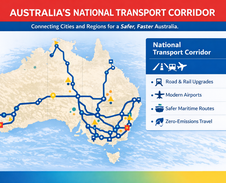
📘 Purpose of Reform
Australia’s infrastructure, transport and regional development systems are fragmented, slow, and over‑costed. Multi‑layered approvals, inconsistent state standards, ageing assets, and weak regional connectivity limit national capability.
This reform program delivers:
-
A unified national infrastructure strategy
-
Faster, transparent project delivery
-
Modern transport systems supporting defence, trade and communities
-
Resilient, climate‑ready infrastructure
-
A national workforce pipeline for construction, engineering and logistics
📉 System Problems
Structural Failures
-
Multi‑agency approvals causing decade‑long delays
-
State‑by‑state duplication
-
Ageing transport assets and poor maintenance cycles
Economic Failures
-
Cost blowouts
-
Inefficient procurement
-
Weak integration between infrastructure, housing, energy and regional planning
Regional Failures
-
Unequal access to transport and digital connectivity
-
Limited freight capacity and supply chain resilience
Capability Failures
-
Workforce shortages
-
Outdated digital systems and asset management tools
🏛️ Reform Pillars
1. National Infrastructure Strategy
A single, unified national plan linking transport, energy, housing, defence and regional development.
2. Modern Transport Systems
Reform of road, rail, aviation, maritime and freight networks.
3. Regional Development & Connectivity
Equitable access to services, digital connectivity and transport.
4. Infrastructure Delivery & Procurement Reform
Faster approvals, transparent procurement, modern project management.
5. Resilience, Climate & Future‑Proofing
Climate‑ready infrastructure and long‑term asset planning.
6. Workforce & Capability Pipeline
Construction, engineering, logistics and transport workforce uplift.

Infrastructure Division
Problem
Fragmented planning, slow approvals, inconsistent standards.
Reform
A unified national infrastructure strategy and a single approvals pathway.
Impact
Faster delivery, reduced duplication, national consistency.
Legislative Amendments
-
Amend Infrastructure Australia Act 2008 to give IA binding authority over national standards.
-
Amend EPBC Act 1999 to create a single‑window major project approval pathway.
-
Amend Public Works Committee Act 1969 to modernise cost thresholds and digital submissions.

ransport Systems Division
Problem
Ageing transport networks, inconsistent safety standards, outdated systems.
Reform
Modernize road, rail, aviation and maritime systems with unified national standards.
Impact
Safer, faster, more reliable transport.
Legislative Amendments
-
Amend National Land Transport Act 2014 to unify road + rail funding and standards.
-
Amend Civil Aviation Act 1988 to mandate digital compliance + real‑time monitoring.
-
Amend Navigation Act 2012 for modern maritime safety and port integration.

Freight & Supply Chain Division
Problem
Congested freight corridors, weak supply chain resilience.
Reform
National freight corridors, port modernization, integrated supply chain planning.
Impact
Lower costs, stronger trade, resilient logistics.
Legislative Amendments
-
Amend Heavy Vehicle National Law for national freight standards.
-
Amend Customs Act 1901 to mandate digital freight clearance.
-
Amend Shipping Registration Act 1981 for modern port logistics.

Basic
Regional Development Division
Problem
Unequal access to services, digital connectivity and transport.
Reform
Regional infrastructure guarantee, digital connectivity, local workforce programs.
Impact
Stronger regional economies and equitable access.
Legislative Amendments
-
Amend Telecommunications Act 1997 to mandate minimum digital service levels.
-
Amend Regional Development Australia Act for needs‑based funding.
-
Amend National Broadband Network Companies Act 2011 for regional priority rollout.

Smart & Digital Infrastructure Division
Problem
Legacy systems, poor data integration, no national digital twin.
Reform
National digital infrastructure platform and real‑time asset monitoring.
Impact
Lower maintenance costs, better planning, transparency.
Legislative Amendments
-
Amend PGPA Act 2013 to require digital asset reporting.
-
Amend Building Code of Australia to mandate digital compliance.
-
Amend Archives Act 1983 to allow digital‑only infrastructure records.

Climate & Resilience Division
Problem
Infrastructure not designed for climate risk or disaster resilience.
Reform
Climate‑ready design standards and long‑term asset planning.
Impact
Lower disaster costs, safer communities, resilient national assets.
Legislative Amendments
-
Amend National Construction Code for climate‑resilient design.
-
Amend Disaster Recovery Funding Arrangements to include proactive mitigation.
-
Amend Emergency Management Act 2013 for integrated infrastructure planning.
🌏 Future State — What This Reform Delivers
Australia will have:
-
A unified national infrastructure system
-
Faster, cheaper, transparent project delivery
-
Modern transport networks supporting defence, trade and communities
-
Strong regional economies with equitable access
-
A climate‑ready, digitally managed national asset base
-
A skilled workforce powering national capability