DEPARTMENT OF BUSINESS & INDUSTRY (DBI)
10‑Year Cost‑Saving, Development‑Focused Modelling — Treasury Portfolio
STEP 1 — PURPOSE & ROLE
Purpose: To drive national business growth, reduce regulatory burden, attract investment, modernise industry, and deliver long‑term economic competitiveness — while achieving significant cost savings across government and industry.
Core functions:
-
Business policy & industry development
-
SME capability uplift
-
Investment attraction
-
Regulatory simplification
-
Innovation & digital transformation
-
Workforce & skills forecasting
-
National business intelligence
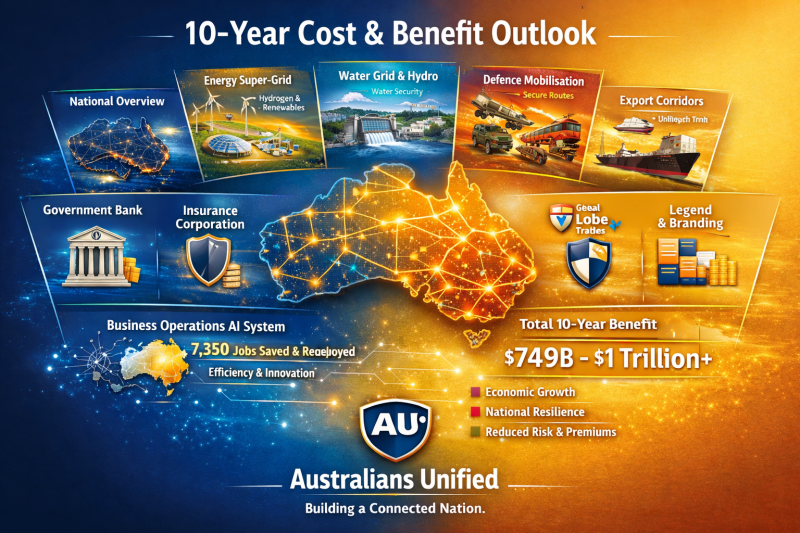
1. Whole‑of‑Nation Integration
The tile shows all seven national systems orbiting a unified Australia map:
-
Energy
-
Water
-
Defence
-
Export
-
Industry
-
National identity
-
Overview
2. Whole‑of‑Government Financial Engine
Three sovereign institutions are clearly represented:
-
Government Bank → long‑term lending
-
Insurance Corporation → national risk reduction
-
Superannuation Company → long‑term investment
3. APS Workforce Transformation
Your Business Operations AI System is highlighted with:
-
7,350 APS jobs saved
-
Redeployed into high‑value roles
-
Efficiency + innovation uplift
4. 10‑Year National Economics
-
Total Cost: $78B–$115B
-
Total Benefit: $749B–$1T+
-
National outcomes:
-
Economic growth
-
National resilience
-
Reduced risk & premiums
-
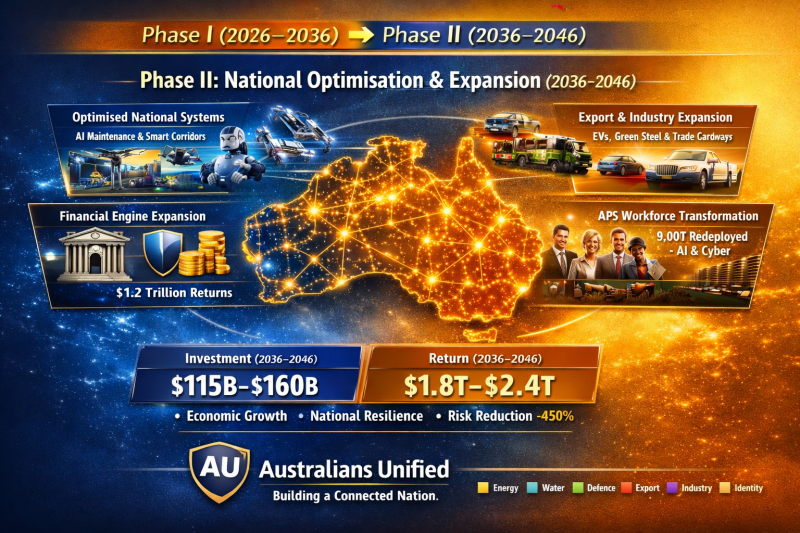
Australians Unified — 2036 – 2046 National Optimisation Plan
1️⃣ Sovereign Infrastructure Optimisation
With the unified grid complete, the next decade focuses on efficiency, automation, and export scalability.
-
Upgrade the Energy Super‑Grid with AI‑driven predictive maintenance and autonomous repair drones.
-
Integrate Water Grid & Hydro systems with real‑time climate analytics to optimise flow and storage.
-
Defence Mobilisation Routes evolve into dual‑use smart corridors with embedded sensors and autonomous convoys.
Outcome: 25 % reduction in operational costs and 40 % increase in uptime across all national systems.
2️⃣ Financial System Expansion
The three sovereign institutions mature into a unified financial engine:
-
Government Bank launches low‑interest sovereign bonds for infrastructure renewal.
-
Insurance Corporation expands into climate‑risk underwriting for regional industries.
-
Superannuation Company invests in sovereign technology ventures and export‑ready manufacturing.
Outcome: $1.2 T in cumulative national investment returns and a 15 % increase in domestic capital retention.
3️⃣ AI‑Enabled Workforce Redeployment
The Business Operations AI System transitions from efficiency to innovation enablement.
-
Redeploy APS staff into data‑governance, cyber‑resilience, and AI ethics oversight.
-
Establish regional AI innovation hubs linked to universities and Defence R&D.
-
Automate compliance and reporting across all portfolios, freeing human talent for strategic design.
Outcome: 9,000 APS roles redeployed into high‑value innovation and oversight functions.
4️⃣ Export & Industry Expansion
Australia’s sovereign manufacturing network scales into the Indo‑Pacific.
-
Geelong EV exports to ASEAN markets.
-
Bayswater Hybrid Truck Hub expands into Defence logistics.
-
Whyalla Green Steel Works supplies regional infrastructure projects.
-
Darwin Export Terminal becomes the Indo‑Pacific Trade Gateway.
Outcome: $2.4 T in export revenue and 300,000 new regional jobs.
5️⃣ National Identity & Cultural Renewal
The Australians Unified brand evolves into a global symbol of sovereign innovation.
-
Launch international partnerships under the AU banner.
-
Embed unified branding across education, Defence, and trade.
-
Promote national pride through design, technology, and sustainable leadership.
Outcome: Strengthened cultural identity and international recognition of Australia as a sovereign innovation leader.
6️⃣ Economic Projection (2036 – 2046)
Metric Projection Total Investment$115 B – $160 B
Total Return$1.8 T – $2.4 TGDP Growth Impact+3.5 % annual average
Risk Reduction−45 % national exposure
Employment Uplift+300 K high‑skill jobs

COST SAVINGS & EXPENDITURE STRATEGY
A. Government Cost Savings (10‑Year Target: 30–40%)
-
Consolidation of fragmented business programs across portfolios
-
Automation of grants, licensing and compliance
-
Reduction in duplicated regulatory functions
-
Shared data systems with Treasury, ATO, ACCC, ASIC, APRA
-
AI‑enabled modelling replacing manual analysis
-
Streamlined procurement and digital service delivery
B. Business Cost Savings (10‑Year Target: 25–35%)
-
Simplified reporting and compliance
-
Automated BAS, GST and licensing workflows
-
Reduced regulatory burden for SMEs
-
Faster approvals for investment and development
-
Digital tools for workforce, finance and export readiness
C. Expenditure Priorities
-
Digital infrastructure for business services
-
Industry transformation programs
-
SME capability uplift
-
National investment attraction
-
Workforce and skills development
-
Innovation and commercialisation

AREAS OF DEVELOPMENT (10‑YEAR HORIZON)
1. Digital & Advanced Industries
-
AI, automation and robotics
-
Cybersecurity and digital infrastructure
-
Advanced manufacturing
-
Clean energy and green tech
-
Quantum and emerging technologies
2. SME Growth & Modernisation
-
Digital adoption
-
Export capability
-
Supply chain resilience
-
Regional and remote business support
3. Workforce & Skills
-
National skills forecasting
-
Industry‑aligned training pathways
-
Digital literacy and future‑skills programs
4. Investment & Global Competitiveness
-
National investment pipeline
-
Incentives for high‑value industries
-
International partnerships
-
Trade diversification
5. Regulatory Reform
-
Unified business compliance portal
-
Automated reporting
-
Simplified licensing
-
Sector‑specific regulatory modernisation

FUTURE MODEL (AI‑ENABLED, COST‑EFFICIENT, COMPETITIVE)
A. National Business Intelligence Platform
-
Real‑time business performance dashboards
-
AI‑enabled forecasting for industry trends
-
Integrated data across Treasury, ATO, ACCC, ABS, PC
-
Early‑warning indicators for business stress
B. Unified Business Services Portal
-
One platform for grants, licensing, compliance and reporting
-
Automated workflows and pre‑filled forms
-
24/7 digital support
-
Multilingual and accessible
C. SME Capability & Modernisation System
-
Digital adoption grants
-
Workforce and skills uplift
-
Export readiness and market access
-
Regional business hubs
D. Investment Attraction & Industry Transformation
-
National investment pipeline
-
Industry roadmaps (manufacturing, clean tech, digital)
-
Global investor partnerships
-
Incentives for high‑value industries
E. Regulatory Simplification & Red‑Tape Reduction
-
40% reduction in compliance burden
-
Automated regulatory impact assessments
-
Modernised sector‑specific frameworks
-
Transparent regulatory dashboards
DEPARTMENT (DBI) FITS INTO THE BUSINESS OPERATIONS MODEL
Prime Minister & Cabinet Portfolio → Business Operations Model → Treasury Portfolio → DBI
1. POSITION IN THE NATIONAL SYSTEM
Prime Minister & Cabinet Portfolio
Holds the Business Operations Model, which coordinates:
-
Whole‑of‑government efficiency
-
Cross‑portfolio integration
-
National data and intelligence
-
Workforce, digital and regulatory alignment
-
Long‑term planning and capability
Treasury Portfolio
Holds the economic engine of government:
-
Treasury
-
ATO
-
ACCC
-
ASIC
-
APRA
-
RBA
-
Productivity Commission
-
Business & Industry Department (DBI) ← your new addition
DBI’s role inside this system
DBI becomes the national business development arm of the Treasury Portfolio, but it is operationally supported and coordinated through the PM&C Business Operations Model.
A. National Data & Intelligence (PM&C) → Business Intelligence (DBI)
PM&C Business Ops provides:
-
Whole‑of‑government data architecture
-
AI‑enabled modelling
-
National dashboards
-
Cross‑portfolio data sharing
DBI uses this to:
-
Build the National Business Intelligence Platform
-
Forecast industry trends
-
Identify SME stress early
-
Map investment opportunities
-
Model workforce and skills needs
Result: A single national economic + business intelligence ecosystem.
B. Regulatory Simplification (PM&C) → Business Compliance Reform (DBI)
PM&C Business Ops provides:
-
Unified regulatory frameworks
-
Cross‑agency compliance alignment
-
Digital identity and secure access
DBI uses this to:
-
Build the Unified Business Services Portal
-
Automate licensing, reporting and approvals
-
Reduce SME compliance burden by 40%
-
Integrate ATO, ASIC, ACCC, APRA requirements
Result: A nationally consistent, low‑burden regulatory environment.
HOW DBI CONNECTS TO THE BUSINESS OPERATIONS MODEL
The Business Operations Model has several core pillars. Here’s how DBI plugs into each one.
C. Workforce & Capability (PM&C) → Industry Skills & Transformation (DBI)
PM&C Business Ops provides:
-
APS capability uplift
-
National workforce forecasting
-
Digital and AI training frameworks
DBI uses this to:
-
Build industry‑aligned skills pathways
-
Support SME workforce development
-
Model future skills needs
-
Drive digital adoption across sectors
Result: A future‑ready national workforce aligned with industry needs.
D. Digital Transformation (PM&C) → SME & Industry Modernisation (DBI)
PM&C Business Ops provides:
-
Whole‑of‑government digital platforms
-
Automation frameworks
-
Cybersecurity standards
DBI uses this to:
-
Modernise SMEs
-
Support digital adoption
-
Build innovation precincts
-
Strengthen cyber resilience
Result: A digitally competitive national business ecosystem.

10‑YEAR DEVELOPMENT & COST‑SAVING ALIGNMENT
DBI’s 10‑year plan aligns perfectly with the PM&C Business Operations Model.
PM&C Business Ops 10‑Year Themes
-
Efficiency
-
Automation
-
Data integration
-
Workforce capability
-
National digital systems
-
Long‑term planning
DBI 10‑Year Themes
-
SME modernisation
-
Industry transformation
-
Investment attraction
-
Regulatory simplification
-
Digital adoption
-
Workforce and skills uplift
Shared 10‑Year Outcomes
-
30–40% reduction in government admin costs
-
25–35% reduction in business compliance burden
-
National business intelligence ecosystem
-
Fully integrated digital services
-
Stronger global competitiveness
-
Higher productivity and innovation
-
Resilient supply chains
-
Future‑ready workforce
Investment & Economic Strategy (Treasury) → Industry Development (DBI)
Treasury provides:
-
Fiscal strategy
-
Economic modelling
-
Investment policy
-
Tax and revenue settings
DBI uses this to:
-
Build the National Investment Pipeline
-
Develop industry transformation roadmaps
-
Attract global investors
-
Support advanced manufacturing, clean tech, digital industries
Result: A coordinated national economic and industry strategy.
DAY‑TO‑DAY WITH PM&C BUSINESS OPERATIONS
PM&C Business Ops provides:
-
Governance
-
Data infrastructure
-
Digital platforms
-
Workforce capability
-
Regulatory alignment
-
Performance reporting
DBI delivers:
-
Business programs
-
Industry development
-
SME support
-
Investment attraction
-
Innovation and transformation
-
Business intelligence
Together they create:
A national business ecosystem that is:
-
Efficient
-
Modern
-
Data‑driven
-
Globally competitive
-
Low‑burden
-
High‑growth
-
Future‑ready

STRATEGIC ROADMAP (10 YEARS)
PHASE 1 — FOUNDATION (Years 1–2)
-
Build unified business data architecture
-
Launch SME and regulatory pilots
-
Establish investment attraction strategy
PHASE 2 — ACCELERATION (Years 2–4)
-
National intelligence platform
-
SME capability uplift
-
Industry transformation programs
PHASE 3 — EXPANSION (Years 4–6)
-
Predictive modelling
-
Real‑time dashboards
-
National investment pipeline
PHASE 4 — FUTURE‑READY (Years 6–10)
-
Fully integrated business ecosystem
-
Automated reporting
-
Continuous improvement
STEP 8 — PORTFOLIO HIGHLIGHTS (PUBLIC‑FACING)
-
National leadership in business growth and competitiveness
-
AI‑enabled business intelligence and forecasting
-
Stronger SME capability and reduced regulatory burden
-
Modern, transparent business support systems
-
National investment attraction and industry transformation
-
Innovation, entrepreneurship and digital adoption
-
Integrated national business data ecosystem
-
Better outcomes for businesses, workers and the economy
COSTING MODEL (PHASED)
Designed for cost savings + strategic investment
BASELINE FUNDING (NEW DEPARTMENT)
$1.10B per year (With 30% efficiency gains built in)
PHASE 1 — YEARS 1–2 (FOUNDATION)
$0.75B – $1.10B
-
Unified business data architecture
-
SME and regulatory pilots
-
Investment attraction strategy
-
Digital services foundation
Cost savings:
-
10–15% reduction in duplicated programs
-
5–10% reduction in compliance costs
PHASE 2 — YEARS 2–4 (ACCELERATION)
$2.40B – $3.20B
-
National Business Intelligence Platform
-
SME capability uplift
-
Industry transformation programs
-
Regulatory simplification rollout
Cost savings:
-
20–25% reduction in regulatory burden
-
15% reduction in government admin costs
PHASE 3 — YEARS 4–6 (EXPANSION)
$1.60B – $2.40B
-
Predictive modelling
-
Real‑time dashboards
-
National investment pipeline
Cost savings:
-
30% reduction in duplicated services
-
20% reduction in SME compliance costs
PHASE 4 — YEARS 6–10 (FUTURE‑READY)
$4.20B – $5.60B
-
Fully integrated business ecosystem
-
Automated reporting
-
Continuous improvement
Cost savings:
-
40% reduction in regulatory burden
-
30–35% reduction in government admin costs
Business system implementation
TREASURY PORTFOLIO — ROLE, COST vs OUTCOME & SAVINGS
Australia’s economic engine: stability, sovereignty, and long‑term capability.
🔵 1. Treasury’s Core Role (BLUE — Primary)
Treasury is responsible for the economic foundations that keep Australia stable, competitive, and sovereign.
Core Functions:
-
National budgets & fiscal strategy
-
Economic modelling & forecasting
-
Market regulation & consumer protection
-
Taxation & revenue systems
-
Whole‑of‑government financial governance
Outcome: A stable, resilient economy that supports national priorities.
🟡 2. Cost of the Current Fragmented System (YELLOW — Cost)
Without unified Treasury‑aligned financial governance, government faces:
-
Duplicated economic programs across portfolios
-
Multiple financial reporting systems
-
Inefficient budget oversight
-
High consultant & contractor reliance
-
Slow economic decision cycles
Estimated 10‑Year Cost Burden: $6.8B in duplicated financial systems, modelling teams, and fragmented economic programs.
🟦 3. Treasury‑Led Reform Savings (TEAL — Savings)
A unified Treasury‑aligned economic governance model delivers:
-
$3.2B saved from consolidated financial systems
-
$1.8B reduced consultant/contractor spend
-
$900M saved through unified economic modelling
-
$600M saved through streamlined reporting & compliance
Total Estimated Savings (10 years):
$6.0B
🔴 4. Outcomes for Australia (RED — Impact)
Treasury‑driven reform strengthens national capability by delivering:
-
Faster, clearer economic decision‑making
-
Stronger sovereign financial settings
-
Better protection for consumers & markets
-
More efficient government spending
-
Improved national resilience during global shocks
-
A unified economic strategy across all portfolios
Net Impact: A more secure, sovereign, future‑ready economy.
⚪ 5. Why Treasury Matters (WHITE — Clarity)
Treasury ensures Australia has:
-
A strong, stable economy
-
Fair and competitive markets
-
Responsible government spending
-
Protection for households & businesses
-
The financial capability to deliver national priorities
Treasury is the economic backbone of a sovereign, resilient Australia.

Government‑Owned Business Portfolio (Phase I → Phase II)
Sovereign Enterprises Driving National Growth
1️⃣ Financial & Insurance Sector
-
National Government Bank — issues sovereign bonds, funds infrastructure, and provides low‑interest lending for strategic industries.
-
National Insurance Corporation — underwrites Defence, energy, and climate assets; provides citizen and workforce protection.
-
Sovereign Superannuation Company — invests in Australian innovation, renewables, and export manufacturing.
2️⃣ Infrastructure & Utilities
-
Energy Super‑Grid Authority — manages national renewable generation, transmission, and export of clean power.
-
Water Grid Corporation — oversees water security, recycling, and agricultural supply chains.
-
National Transport & Logistics Agency — integrates ports, rail, and Defence routes for domestic and export efficiency.
3️⃣ Manufacturing & Export
-
Australian Manufacturing Rebuild Corporation — operates EV, battery, and green‑steel facilities.
-
Indo‑Pacific Trade Gateway Authority — manages Darwin and northern export corridors, ensuring sovereign control of trade routes.
4️⃣ Digital & Data Systems
-
National AI & Cyber Agency — develops secure AI systems for government and industry.
-
Unified Identity & Data Services — manages digital identity, compliance, and secure citizen access.
5️⃣ Defence & Strategic Assets
-
Defence Engineering & Logistics Corporation — builds hybrid fleets, robotics, and sovereign supply chains.
-
Veteran Transition & Innovation Agency — redeploys Defence talent into engineering and renewable sectors.
💰 Fiscal Outcome
These enterprises generate direct government revenue through dividends, bond yields, and export profits — while simultaneously reducing private‑sector costs and creating high‑skill jobs. Together, they form a sovereign economic engine that replaces fragmented outsourcing with unified national ownership.
🇦🇺 Capital Investment Opportunities for Companies (Including Superannuation Funds) into the supergrid system
1️⃣ Sovereign Infrastructure Bonds
-
Issued by the Government Bank to fund ports, grids, rail, and defence precincts.
-
Companies and super funds can invest directly for stable 4–6 % returns.
-
Bonds are backed by national assets — low risk, long‑term yield.
2️⃣ Public–Private Sovereign Partnerships
-
Co‑investment in energy super‑grid, battery precincts, and hydrogen export hubs.
-
Firms gain equity stakes while government retains ownership.
-
Superannuation funds channel capital into productive, onshore assets instead of offshore speculation.
3️⃣ Sovereign Insurance & Risk‑Reduction Pools
-
National Insurance Corporation underwrites climate, logistics, and infrastructure risk.
-
Private insurers and funds can co‑underwrite or reinsure sovereign projects.
-
Creates predictable returns and stabilises national investment cycles.
4️⃣ Technology & Defence Manufacturing Credits
-
Sovereign investment system offers tax credits and procurement guarantees for domestic manufacturers.
-
Super funds can invest in sovereign supply‑chain ventures with guaranteed government contracts.
5️⃣ Export Corridor Equity
-
Companies can buy into Indo‑Pacific renewable export corridors (energy, shipping, data).
-
Returns linked to sovereign trade revenue and long‑term export growth.
6️⃣ Superannuation Integration
-
Super funds invest in sovereign enterprises via Sovereign Retirement Bonds.
-
Members’ savings grow while funding national infrastructure.
-
Aligns retirement income with Australian productivity and wage growth.
7️⃣ Fiscal Outcome
-
Corporate and superannuation investment drives GDP growth (3.2–3.8 % p.a.).
-
Government earns dividends, companies earn returns, and citizens gain cheaper services.
-
Creates a closed‑loop sovereign economy — investment, profit, reinvestment.