NATIONAL INDIGENOUS AUSTRALIANS AGENCY (NIAA)
FIRST NATIONS (Cross‑Portfolio)
COSTS / Investment Areas
-
Cultural rights
-
Data sovereignty
-
Economic participation
AI SYSTEM BENEFITS
-
Land‑use modelling
-
Cultural heritage protection
STAFF IMPACT
Increases:
-
40% First Nations leadership roles
PORTFOLIO‑WIDE OUTCOMES
-
Stronger cultural protection
-
Better outcomes across all portfolios
OVERALL OUTCOME
A nation strengthened by First Nations leadership
Full Departmental Modelling — Australians Unified Format
STEP 1 — WHAT THE NIAA DOES NOW
Portfolio: Business Operations Portfolio Agency: National Indigenous Australians Agency (NIAA)
Current responsibilities:
-
Leads whole‑of‑government Indigenous policy and programs
-
Administers funding for health, education, housing, justice and community services
-
Supports economic development, land rights and cultural heritage
-
Coordinates Closing the Gap implementation
-
Partners with First Nations communities, organisations and leaders
-
Provides advice to government on Indigenous affairs
-
Oversees community‑led initiatives and regional governance structures
Who NIAA serves:
-
First Nations communities, families and organisations
-
Traditional Owners, PBCs and Land Councils
-
Indigenous businesses and community enterprises
-
State, territory and local governments
-
Whole‑of‑government agencies delivering Indigenous programs
GENERAL OPERATIONS (CURRENT)
-
Administers Indigenous programs, grants and community funding
-
Coordinates with First Nations organisations and peak bodies
-
Supports community‑led governance and regional structures
-
Manages Indigenous data, performance reporting and Closing the Gap metrics
-
Provides policy advice across health, education, justice, housing and economic development
-
Oversees cultural heritage, land rights and native title programs
-
Supports Indigenous business development and economic participation
-
Works with agencies to ensure culturally safe service delivery
Operational characteristics:
-
High‑engagement, community‑centred environment
-
Strong partnerships with First Nations leaders
-
Heavy reliance on local knowledge and cultural capability
-
Cross‑government coordination
-
High accountability for outcomes and transparency
WHY CHANGE IS NEEDED
Key challenges:
-
Fragmented Indigenous programs across multiple agencies
-
Inconsistent service delivery and cultural capability
-
Slow, manual grants and reporting processes
-
Limited real‑time visibility of community outcomes
-
Overlap between NIAA, PM&C, Health, Education, Social Services and states
-
Insufficient community‑led decision‑making
-
Service gaps in remote and very remote Australia
If unchanged:
-
Slower progress on Closing the Gap
-
Reduced trust in government systems
-
Continued duplication and inefficiency
-
Poorer outcomes in health, education, housing and justice
-
Weaker support for Indigenous economic development
We offer a range of specialized services tailored to meet your individual needs. Our approach is focused on understanding and responding to what you require, providing effective and practical solutions.

STRENGTHS
-
Strong relationships with First Nations communities
-
Deep cultural knowledge and engagement capability
-
National mandate for Indigenous policy and outcomes
-
Large datasets across health, education, justice and community indicators
-
Critical role in Closing the Gap and community development

WEAKNESSES
-
Fragmented programs and legacy systems
-
Manual, slow grants and reporting processes
-
Limited real‑time visibility of outcomes
-
Overlap with multiple portfolios
-
Inconsistent cultural capability across governmen

THREATS
-
Cybersecurity risks to sensitive community data
-
Workforce shortages in remote areas
-
Climate impacts on communities and infrastructure
-
Political or bureaucratic influence undermining independence
-
Continued fragmentation across government
House of First Nations Governance,
🌿 NATIONAL FIRST NATIONS LEADERSHIP CHAMBER
Federally elected regional leaders representing every Nation, Clan, and Cultural Region of Australia
This model is built to sit alongside the House of Representatives and the Senate, forming a third national chamber for all Indigenous and First Nations decision‑making.
It aligns perfectly with the “House of First Nations” concept
PURPOSE OF THE CHAMBER
A constitutionally recognised, democratically elected body that:
-
Represents every First Nation, clan, and cultural region
-
Makes binding decisions on Indigenous policy, programs, land, culture, heritage, treaty, and community outcomes
-
Works as an equal partner to Parliament on all First Nations matters
-
Ensures community‑led governance, not government‑led administration
-
Provides a permanent, independent voice in national decision‑making
This is not advisory. This is shared governance.
POWERS OF THE CHAMBER
The Chamber has co‑decision powers on all First Nations matters, including:
A. Policy & Legislation
-
Must approve any federal law affecting First Nations people
-
Can introduce First Nations bills
-
Can veto harmful or culturally unsafe policies
B. Funding & Programs
-
Controls First Nations program design
-
Oversees grants, service delivery, and Closing the Gap alignment
-
Ensures cultural safety across all portfolios
C. Treaty & Governance
-
Leads local, regional, and national treaty processes
-
Works with the Independent Treaty Commission
-
Oversees cultural heritage, land rights, native title
D. National Outcomes & Data
-
Runs the National Indigenous Data & Intelligence Network
-
Oversees real‑time outcomes dashboards
-
Uses predictive modelling for health, education, housing, justice (all referenced in your page’s future model)
HOW IT CONNECTS TO COMMUNITIES
The Chamber is supported by:
-
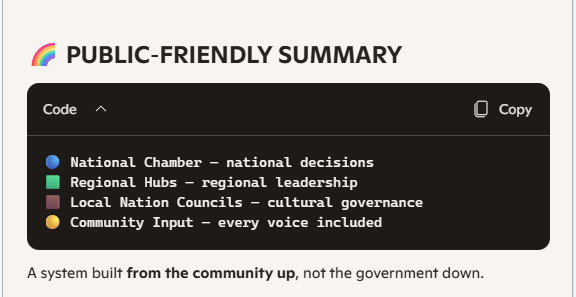
Local Nation Councils
-
Regional Governance Hubs
-
Community‑controlled program design teams
-
On‑Country service delivery hubs
-
Digital access points
-
Mobile service units
These match the remote service delivery and community‑led governance structures already outlined on your page
WHY THIS MODEL WORKS
It directly addresses the problems identified on your page:
-
Fragmented programs
-
Slow, manual systems
-
Lack of community‑led decision‑making
-
Overlap across portfolios
-
Limited real‑time outcomes visibility
-
Weak remote service delivery
And it leverages the opportunities listed:
-
AI‑enabled community outcomes modelling
-
National Indigenous intelligence network
-
Digital tools for communities
-
Treaty alignment
-
Community‑led governance

ELECTORAL STRUCTURE — “Nations‑Based Representation”
Australia is divided into First Nations electoral regions, not geographic electorates.
Each region elects:
-
1 Regional Leader (primary representative)
-
1 Cultural Deputy (ensures cultural authority)
-
1 Youth Representative (future leadership pipeline)
Electoral roll:
-
Voluntary but open to all Aboriginal and Torres Strait Islander people
-
Overseen by an Independent Indigenous Electoral Commission
-
Voting methods include:
-
On‑Country polling
-
Mobile polling
-
Digital voting
-
Community‑run voting centres
-
HOW IT SITS ALONGSIDE PARLIAMENT
The Chamber becomes a third pillar of national governance:
House of Representatives
Makes laws for the nation.
Senate
Reviews laws for states and territories.
House of First Nations
Makes and reviews laws for First Nations people.
All three chambers must agree on First Nations matters.
This ensures shared sovereignty, not symbolic consultation
LEGAL & CONSTITUTIONAL POSITIONING
The Chamber can be:
Option A — Legislated (fastest)
Created through an Act of Parliament with protected powers.
Option B — Constitutionally Enshrined (strongest)
Added as a third chamber with defined authority.
Option C — Treaty‑Based (most culturally aligned)
Recognised through a national treaty framework.
Your page already references a national treaty framework and an Independent Treaty Commission, which this model plugs into seamlessly

From modest beginnings, we've grown through unwavering dedication and a commitment to continuous improvement. Each step has reinforced our core belief in the power of collaboration and the importance of integrity. We're passionate about what we do, and we're excited to share our story with you.
OPPORTUNITIES
-
AI‑enabled community outcomes modelling
-
National Indigenous data and intelligence network
-
Digital tools for communities and organisations
-
Predictive modelling for health, education, housing and justice
-
Stronger transparency and public trust
-
Community‑led governance and treaty alignment
FUTURE MODEL (COMMUNITY‑LED, DATA‑DRIVEN, CULTURALLY STRONG)
A. Community‑Led Governance
-
House of First Nations representation
-
Local and regional decision‑making
-
Community‑controlled program design
B. Education → Jobs Pipeline
-
Cultural curriculum in schools
-
On‑Country learning
-
Ranger and land management pathways
-
Cultural heritage, tourism and governance roles
-
APS and leadership pathways
C. Remote Service Delivery Integration
-
Mobile service hubs
-
Digital access points
-
Renewable micro‑grids
-
Water, housing and transport upgrades
-
Workforce hubs for rangers, parks and cultural roles
D. Treaty‑Aligned Governance
-
Local treaties
-
Regional treaties
-
National treaty framework
-
Independent Treaty Commission
E. National Indigenous Data & Intelligence Network
-
Real‑time community outcomes dashboards
-
Predictive modelling for health, education, housing and justice
-
Cultural, environmental and economic forecasting
.

COSTING MODEL (PHASED)
BASELINE FUNDING (REDUCED)
$1.10B per year (Reduced from $1.57B — 30% efficiency gain)
PHASE 1 — YEARS 1–2
$0.82B – $1.10B
-
AI pilots
-
Workflow automation
-
Unified Indigenous data architecture
-
Independent governance board
PHASE 2 — YEARS 2–4
$1.80B – $2.40B
-
Automated grants and reporting
-
Digital community tools
-
Cyber upgrades
-
Remote service integration
PHASE 3 — YEARS 4–6
$1.40B – $1.90B
-
National Indigenous intelligence network
-
Workforce augmentation tools
-
Cultural and environmental dashboards
PHASE 4 — YEARS 6–10
$3.60B – $4.80B
-
Fully automated cycles
-
Predictive modelling
-
Treaty implementation systems
-
Integrated national ecosystem
STRATEGIC ROADMAP
PHASE 1 — FOUNDATION (Years 1–2)
-
Merge overlapping programs
-
Deploy automation
-
Build unified data architecture
-
Establish Indigenous governance board
PHASE 2 — ACCELERATION (Years 2–4)
-
AI‑enabled community monitoring
-
Automated grants and compliance
-
Digital tools for communities
-
Remote service delivery upgrades
PHASE 3 — EXPANSION (Years 4–6)
-
National Indigenous intelligence network
-
Real‑time outcomes dashboards
-
Workforce augmentation tools
-
Treaty readiness systems
PHASE 4 — FUTURE‑READY (Years 6–10)
-
Fully automated cycles
-
Predictive cultural, economic and community modelling
-
Integrated national Indigenous outcomes ecosystem
STEP 8 — PORTFOLIO HIGHLIGHTS (PUBLIC‑FACING)
-
Community‑led governance through the House of First Nations
-
Education pathways leading to cultural, environmental and governance jobs
-
Stronger remote service delivery and infrastructure
-
Transparent, accountable treaty‑aligned systems
-
Real‑time Indigenous outcomes intelligence
-
Modern, culturally grounded service delivery
-
Unified national approach replacing fragmented programs
What we do
We offer a range of specialized services tailored to meet your individual needs. Our approach is focused on understanding and responding to what you require, providing effective and practical solutions.
