NATIONAL INDIGENOUS AUSTRALIANS AGENCY (NIAA)
FIRST NATIONS
Federal Government | First Nations Partnership, Self-Determination & Community Outcomes
Status: Current Federal Agency + Australians Unified Reform Framework
The current Australians Unified page correctly identifies the National Indigenous Australians Agency (NIAA) as the lead whole-of-government agency coordinating Indigenous policy, Closing the Gap priorities, community programs, cultural heritage, economic participation and First Nations engagement across Australia. [australian...ied.com.au], [australian...ied.com.au]
🧭 Governance Matrix Position
Primary Pillar
✅ 🤝 Unity
Supporting Pillars
✅ 🛡 Sovereignty
✅ ⚖ Accountability
✅ 💰 Prosperity
✅ 🚀 Future Australia
📋 Agency Snapshot
Agency
✅ National Indigenous Australians Agency (NIAA) [australian...ied.com.au], [australian...ied.com.au]
Portfolio
✅ Prime Minister & Cabinet Portfolio [australian...ied.com.au], [australian...ied.com.au]
Core Functions
✅ Indigenous Policy Coordination
✅ Closing the Gap Coordination
✅ Community Development Programs
✅ Cultural Heritage Protection
✅ Economic Participation
✅ Indigenous Business Development
✅ Land Rights & Native Title Support
✅ Regional Community Partnerships
-
🎯 National Mission
Australia should:
✅ Empower First Nations communities
✅ Enable practical self-determination
✅ Safeguard culture and heritage
✅ Deliver better social outcomes
✅ Increase economic participation and opportunity
✅ Strengthen Indigenous leadership
✅ Improve accountability across government programs
WHY CHANGE IS NEEDED
Key challenges:
-
Indigenous programs are fragmented across multiple agencies.
-
Service delivery and cultural capability are inconsistent.
-
Grants and reporting processes are slow and manual.
-
There is limited real-time visibility of community outcomes.
-
Responsibilities overlap across NIAA, PM&C, Health, Education, Social Services and state governments.
-
Community-led decision-making remains insufficient.
-
Service gaps persist in remote and very remote Australia.
Without change:
-
Progress towards Closing the Gap will remain slow.
-
Trust in government systems will decline.
-
Duplication and inefficiency will continue.
-
Outcomes in health, education, housing and justice will worsen.
-
-
Weaker support for Indigenous economic development
We offer a range of specialized services tailored to meet your individual needs. Our approach is focused on understanding and responding to what you require, providing effective and practical solutions.

STRENGTHS
-
Strong relationships with First Nations communities
-
Deep cultural knowledge and engagement capability
-
National mandate for Indigenous policy and outcomes
-
Large datasets across health, education, justice and community indicators
-
Critical role in Closing the Gap and community development

WEAKNESSES
-
Fragmented programs and legacy systems
-
Manual, slow grant and reporting processes
-
Limited real‑time visibility of outcomes
-
Overlap with multiple portfolios
-
Inconsistent cultural capability across government

THREATS
-
Cybersecurity risks to sensitive community data
-
Workforce shortages in remote areas
-
Climate impacts on communities and infrastructure
-
Political or bureaucratic influence undermining independence
-
Continued fragmentation across government
Framework alignment and core functions
A structured overview comparing current policy frameworks and baseline responsibilities with the comprehensive Australians Unified reform model for First Nations communities.
Current legislative & policy framework
Current responsibilities:
• Closing the Gap implementation
• Indigenous program administration
• Community grants
• Indigenous economic development
• Cultural heritage programs
• Government coordination
• Regional service delivery
Core agency responsibilities
Community development: Housing, health, education, employment, community infrastructure, early childhood.
Culture & heritage: Preservation, traditional knowledge, language, heritage management, Traditional Owner engagement.
Economic participation & governance: Indigenous businesses, procurement, regional enterprises, whole-of-government coordination, reporting.
Australians Unified reform framework
Proposed reforms (not current law):
• National First Nations Outcomes Authority: Framework measuring wellbeing, housing, and justice.
• Indigenous data sovereignty framework: Community-owned data and dashboards.
• First Nations Leadership Network: Local, regional, and national decision pathways.
• Economic prosperity framework: Procurement targets and sovereign wealth.
House of First Nations: proposed representative structure
Australians Unified proposes a community-to-national First Nations representative pathway, grounded in Aboriginal and Torres Strait Islander leadership, cultural authority and local priorities. The proposed model connects local communities, Traditional Owner groups, regional representatives and state councils to a National House of First Nations, with advice, oversight and measurable community outcomes reported through an Australians Unified KPI dashboard.
Proposal only: this is an Australians Unified reform concept, not a current government body or law.

Community foundations
Local communities ↓ Traditional Owner groups
Representation begins on Country. Local communities identify priorities for wellbeing, housing, education, employment, culture and community safety. Traditional Owner groups provide cultural authority, protect knowledge and heritage, and ensure proposed decisions are respectful, place-based and community-led.

Regional and state leadership
Regional First Nations representatives ↓ State First Nations councils
Regional representatives bring local priorities together across Nations, clans and cultural regions. State First Nations councils coordinate shared issues, strengthen leadership pathways and connect communities with relevant state services, investment and policy processes.

National House of First Nations
National House of First Nations ↓ Advice, oversight and community priorities
The proposed national body receives community-led priorities through the representative pathway. It is designed to provide advice and oversight on First Nations matters, support accountability, and engage with Parliament and government departments on policies, programs and outcomes.

Australians Unified KPI dashboard
Baseline 100 | 2032 | 2037 targets
- Indigenous employment index: 100 | 130 | 190
- Indigenous business growth index: 100 | 140 | 210
- Community wellbeing index: 100 | 130 | 190
- Housing outcomes index: 100 | 135 | 200
- Education participation index: 100 | 140 | 210
- Cultural protection index: 100 | 150 | 230
- First Nations leadership index: 100 | 145 | 220
These proposed indicators make progress visible while respecting community data governance and local context.
House of First Nations governance
Australians Unified proposal: a National First Nations Leadership Chamber of federally elected regional leaders representing every Nation, Clan and Cultural Region across Australia. Designed to sit alongside the House of Representatives and the Senate, this proposed third national chamber would establish shared governance—not symbolic consultation—on First Nations matters.
Purpose and authority
A constitutionally recognised, democratically elected and independent body representing every First Nation, clan and cultural region. The Chamber would provide a permanent national voice, make binding decisions on Indigenous policy, programs, land, culture, heritage, treaty and community outcomes, and operate as an equal partner with Parliament through community-led governance.
Co-decision powers
The proposed Chamber would approve federal laws affecting First Nations people, introduce First Nations bills and reject harmful or culturally unsafe policy. It would guide program design, grants, service delivery and Closing the Gap alignment; lead treaty processes with an Independent Treaty Commission; and oversee cultural heritage, land rights and native title.

Community connection and outcomes
Local Nation Councils, Regional Governance Hubs, community-controlled program teams, On-Country service hubs, digital access points and mobile service units would connect decisions to communities. A National Indigenous Data & Intelligence Network would support community data governance, real-time dashboards and culturally safe predictive modelling for health, education, housing and justice.

Nations-based representation
First Nations electoral regions—not geographic electorates—would each elect a Regional Leader, Cultural Deputy and Youth Representative. A voluntary roll open to Aboriginal and Torres Strait Islander people, overseen by an Independent Indigenous Electoral Commission, would enable On-Country, mobile, digital and community-run voting. Pathways include legislated, constitutional or treaty-based recognition.
Future model: community-led, data-driven, culturally strong
Australians Unified outlines a practical transformation agenda for First Nations governance, integrating self-determination, modern service infrastructure, community-led treaty frameworks, and sovereign data intelligence.
Community-led governance
A national House of First Nations representation structure ensures regional leaders hold direct legislative co-decision powers. Communities guide their own program designs and funding allocations, returning decision-making authority directly to Country.
Education to jobs pipeline
Culturally grounded curriculum and On-Country learning create clear pathways to lifelong employment. Programs connect young people directly to ranger and land management careers, cultural heritage and tourism operations, as well as executive leadership roles across the APS.
Remote service delivery integration
Essential remote infrastructure is modernized through mobile service hubs, high-speed digital access points, and independent renewable micro-grids. Clean water, enhanced transport, and regional workforce centers provide resilient operational foundations on Country.
Treaty-aligned governance & intelligence
A unified national treaty architecture supported by an Independent Treaty Commission aligns local and regional agreements. Backed by the National Indigenous Data & Intelligence Network, real-time dashboards and predictive modeling ensure transparency and community sovereignty.
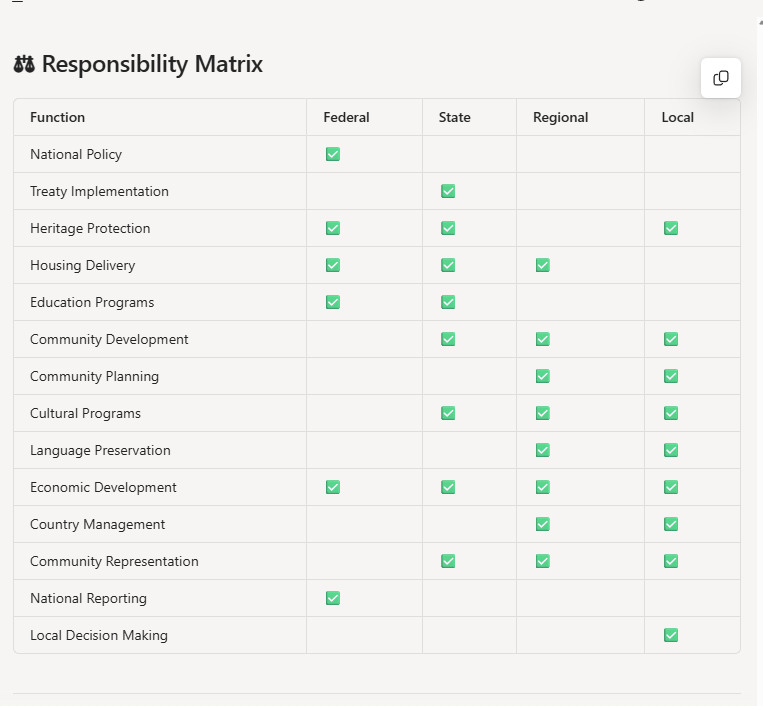
Australians Unified First Nations governance responsibility map
Built on existing Australian frameworks, this proposed State–Federal responsibility map connects Commonwealth, state, regional and local First Nations governance. It is designed to align responsibilities and strengthen the path from community priorities to national outcomes—without replacing existing legal structures, Traditional Owner authority or current government responsibilities.
Federal responsibilities
National Indigenous Australians Agency current functions: Closing the Gap coordination, national Indigenous policy, Indigenous programs and grants, economic development, native title coordination, whole-of-government coordination and national outcome reporting.
Australians Unified federal role: national policy, standards, funding programs, data and outcomes, a National Indigenous Prosperity Framework, and National House of First Nations coordination.

State responsibilities
State First Nations Council alignment: Aboriginal Victoria, treaty authorities, state Indigenous affairs, heritage protection agencies, and state housing, education and health programs.
Australians Unified state role: state Indigenous strategy, funding oversight, treaty implementation, heritage and cultural protection, community outcome monitoring, economic development coordination, regional First Nations representation and state performance reporting.

Regional responsibilities
Regional First Nations Councils are a new Australians Unified layer operating between state and local levels. They bring neighbouring communities together around shared priorities while maintaining local voices and cultural authority.
Responsibilities include regional priorities and planning, community funding coordination, regional employment and community development programs, infrastructure planning, and regional cultural programs.

Local responsibilities
Tribal Councils align with existing local structures: Traditional Owner groups, Prescribed Bodies Corporate, Aboriginal corporations, community-controlled organisations, land councils and Elders councils.
Australians Unified local role: community priorities, cultural preservation, Country management, youth development, community wellbeing, local economic development, language protection and community planning.
Strategic implementation roadmap
A structured, intergenerational pathway designed to modernize program delivery, enforce Indigenous data sovereignty, and anchor community-led governance across Australia.
Phase 1: Foundation (Years 1–2)
Focuses on merging overlapping programs, deploying workflow automation, building a unified national data architecture, and establishing an independent Indigenous governance board alongside regional leadership forums.
Phase 2: Acceleration (Years 2–4)
Introduces AI-enabled community monitoring, automated grants compliance, digital tools for local councils, remote infrastructure upgrades, and comprehensive cultural heritage modernization.
Phase 3: Expansion (Years 4–6)
Rolls out the National Indigenous Intelligence Network, operationalizes the House of First Nations, deploys real-time outcome dashboards, and establishes robust treaty readiness systems across cultural regions.
Phase 4: Future-ready (Years 6–10)
Delivers fully automated grant cycles, predictive cultural and community modelling, long-term intergenerational planning, and an integrated national prosperity framework owned by First Nations communities.
Costing model (phased)
Baseline funding reduced to $1.10B per year (reduced from $1.57B — 30% efficiency gain) supporting a multi-stage modernization framework for First Nations outcomes.
Phase 1 — Years 1–2 ($0.82B – $1.10B)
Establishing foundational infrastructure across the portfolio:
- AI pilots and process exploration
- Workflow automation to reduce administrative friction
- Unified Indigenous data architecture
- Independent governance board oversight
Phase 2 — Years 2–4 ($1.80B – $2.40B)
Scaling capability and modernizing essential services:
- Automated grants management and real-time reporting
- Digital community tools for local access
- Critical cyber security upgrades
- Integrated remote service delivery systems
Phase 3 — Years 4–6 ($1.40B – $1.90B)
Expanding strategic intelligence and workforce capability:
- National Indigenous intelligence network rollout
- Workforce augmentation tools for frontline staff
- Cultural and environmental monitoring dashboards
- Readiness systems for community-led outcomes
Phase 4 — Years 6–10 ($3.60B – $4.80B)
Delivering a future-ready, self-determined ecosystem:
- Fully automated program and grant cycles
- Culturally safe predictive modelling
- Treaty implementation digital systems
- Fully integrated national outcomes ecosystem
Frequently asked questions
Key details on the National Indigenous Australians Agency (NIAA), current operations, and proposed Australians Unified structural reforms.